
OurAIwords:
Language shapes how we understand unfamiliar ideas and whether we feel confident enough to join the conversation. This is particularly important in artificial intelligence (AI), where familiar words such as learning, memory, intelligence and hallucination are used in ways that can be ambiguous, anthropomorphic or misleading.
The Better Words for AI project began with a simple but important question: how might students and staff work together to develop clearer, more accessible and critically informed ways of talking about AI?
Funded through the Praxis Centre for Scholarship and Innovation, the project brought students and staff together as partners to examine AI terminology and co-create a dynamic lexicon.
The project was led by
- Professor Mirjam Hauck, Academic Lead for AI in Learning, Teaching and Assessment, and
- Eleanor Moore, Senior Learning Designer, with
- Dr Nancy Pontika, KMi Project Manager for Innovation in AI, as a project team member.
Why does AI terminology matter?
The language surrounding AI is not neutral. Words influence what people believe technologies can do, how responsibility is understood and which questions users feel able to ask (Darvin, 2017).
For example, saying that an AI system “hallucinates” may give the impression that it perceives or experiences the world in a human sense. Similarly, words such as “intelligence” and “learning” can encourage people to attribute human-like understanding to systems based on statistical processes. As a technology AI has capacity to structure our social relations, our access to and knowledge of the world and our reflexive relationship with ourselves (Mühlhoff 2025). These terms we associate with AI may be widely established, but they still need to be questioned and explained.
Our review of existing AI glossaries found that many provide useful technical definitions, but often offer limited opportunities to question terminology, explore common misconceptions or consider different social, educational and disciplinary contexts. This highlighted the need for a resource combining clarity with critical reflection, accessibility and participation.
Co-creating meaning with students and staff
Student partnership was central to the project rather than an additional activity at the end. Informed by a students-as-partners approach and Participatory Ethnographic Evaluation and Research, the project positioned students and staff as co-researchers who could contribute their experiences, questions and perspectives.
Students and staff participated in focus groups and collaborative workshops, discussing how they encountered AI terminology and identifying words they found confusing or potentially misleading. Participants also helped shape the format and features of the lexicon.
These conversations demonstrated that people interpret AI language through different disciplinary, linguistic and personal contexts. Participants called for plain-language explanations, real-world examples and explicit discussion of common misunderstandings. They also wanted information to be layered, allowing newcomers to begin with an accessible explanation while giving more experienced users opportunities to explore a concept further.
The co-creation process also showed that partnership does not require everyone to begin with the same level of technical knowledge. Uncertainty became a valuable starting point for discussion. Students did not simply respond to definitions produced for them; they helped identify problems, proposed alternatives and influenced how the resulting resource should communicate with its users.
From Better Words for AI to OurAIwords
The result is OurAIwords, a collaborative and openly available lexicon designed to help students, staff and the wider public make sense of AI terminology.
OurAIwords provides clear, accessible explanations, highlights misconceptions and encourages users to reflect on how language shapes their understanding of AI. It is intended to support critical AI literacy by helping people move beyond accepting apparently settled definitions and instead ask what particular words imply, whose perspectives they represent and whether they accurately describe the technology.
Importantly, OurAIwords is designed to evolve. AI technologies and the language surrounding them continue to change, so the lexicon cannot be treated as a finished or fixed reference source. Community members will be able to propose new terms and contribute perspectives as new technologies, practices and understandings emerge.
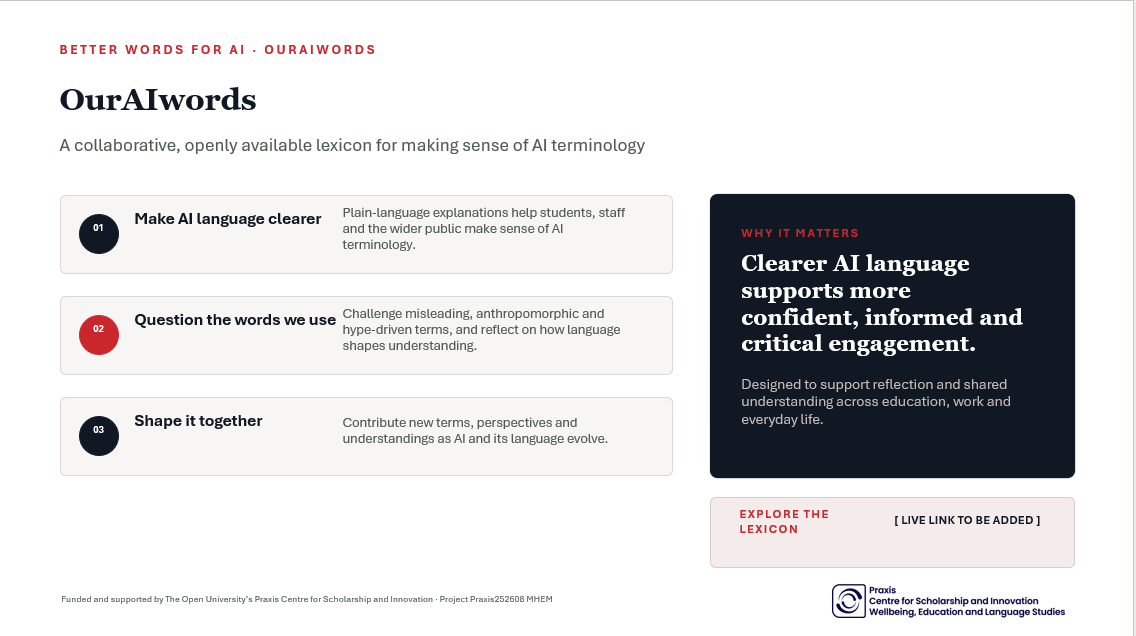
The image above summarises the three invitations at the heart of the lexicon:
- make AI language clearer,
- question the words we use and
- shape the resource together.
What did we learn about partnership?
The project reinforced the value of treating students as partners in meaning-making. Students brought situated insights that might be absent from definitions created solely by specialists. Their contributions drew attention to accessibility, multilingual use, neurodivergence, disciplinary differences and the practical contexts in which people encounter AI terminology.
Co-creation did not mean eliminating disagreement or producing a single uncontested interpretation. Instead, it created space to recognise uncertainty, compare perspectives and make decisions transparently. This is particularly valuable for critical AI literacy, which requires people not only to understand AI systems but also to question the language, assumptions and power structures surrounding them.
Explore and shape OurAIwords
OurAIwords is both an outcome of the partnership and an invitation to continue it. We hope it will support teaching, learning and communication while encouraging wider discussion about how AI is represented.
Explore the lexicon, share it with your networks and help us shape it together: https://www.open.edu/openlearncreate/course/view.php?id=20609
We welcome your feedback on this lexicon and the approach taken. Are there other AI words you’d like to see explained and dismantled? We welcome your comments on this blog post.
You won’t be surprised that AI has generated a great deal of discussion within the OU PGR and Early Careers blog space. There are several other blog posts related to AI that might interest you?
Back to the future? How AI may be taking education backwards Blog by Dr Lesley Fearn
AI for academic writing – to plagiarise or not to plagiarise?
AI – What’s all the fuss about?
Blog post written by
Dr Nancy Pontika, KMi Project Manager for Innovation in AI