OU News
News from The Open University
- Home
- OU academics use novel technique to begin unravelling mysteries of Mars’ climate
OU academics use novel technique to begin unravelling mysteries of Mars’ climate
Posted on • Science, maths, computing and technology
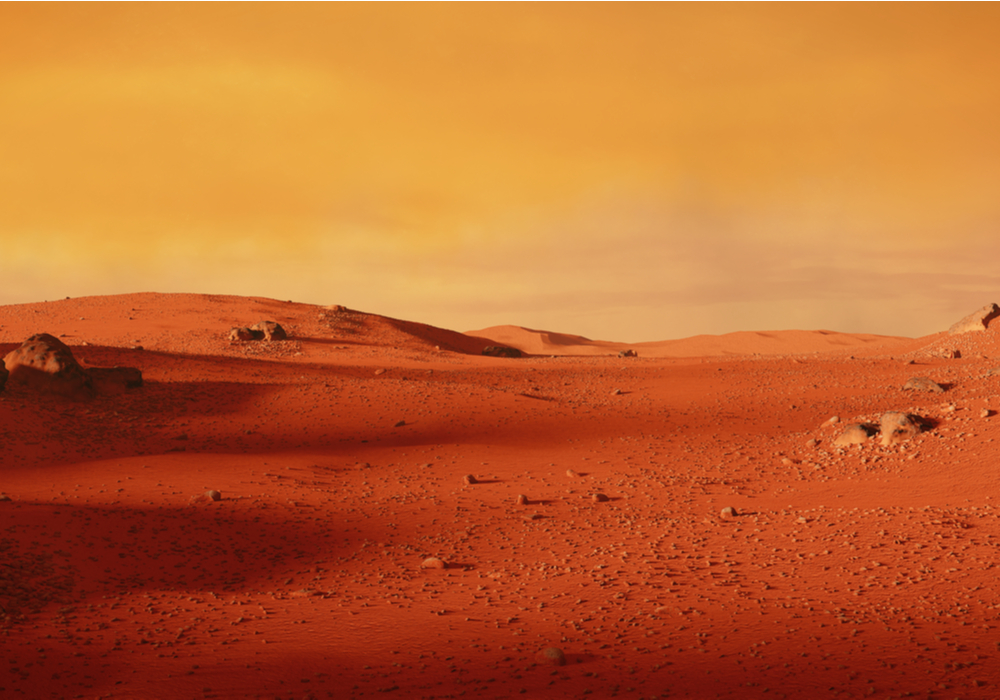
Academics from The Open University (OU) have used a new method to study the surface of Mars, identifying millions of features called “TARs” (Transverse Aeolian Ridges) in detailed satellite images of the Martian surface. These are large wind blown ripples which can tell us a lot about the atmosphere and climate of the red planet.
The research, published in Icarus, is the largest catalogue of TARs yet produced from images of this quality. It provides us with an important global database of their shape and orientation which are now being used to learn more about the Martian climate.
The team used novel ‘Deep Learning’ techniques to study the surface of Mars, identifying ~14 million features of TARs in ~7000 of the most detailed satellite images of Mars’ surface.
Alexander Barret, author of the research and Post Doctoral Research Associate, on Mars Machine Learning at the OU used Deep Learning, a kind of scientific AI, to produce these results. This style of research allowed the team to examine thousands more images than has ever been possible before.
Alexander said:
“We essentially trained an AI computer model to recognise and draw around the ripples in any “HiRISE” (High Resolution Imaging Science Experiment) image of Mars. Before these AI tools were developed, finding and annotating these features would have to be done by hand, and would have taken years, if not decades. A sample of this scale was never feasible before.”
“As geomorphologists we often have to spend hundreds of hours painstakingly annotating images by drawing around features of interest. In this study we were able to use new Deep Learning techniques to train a computer model to do the tedious part, allowing us to focus on using the resulting information for science.”
TARs are a kind of wind blown ripple, or bedform, much like those you see when the wind blows across a sandy beach. TARs are different because they are much larger, tens of metres long and often several metres wide, but very shallow. They are also covered with coarse granular material, which protects them from being moved except by the strongest winds. Most of them have not moved much in the two decades during which scientists have been observing them.
These features are found across the surface of the planet Mars and can be seen in the most high-resolution satellite images. Their equivalents are much less common on Earth.
They are very important because they provide us with a record of what the Martian atmosphere and climate were doing in the time when they formed. We can compare the orientations of the TARs to the modern winds and see how the wind regime might have changed in the time since the TARs formed.
Alexander added:
“Transverse Aeolian Ridges are a fascinating landform, which tell us a lot about the winds that form them. We don’t see much movement in repeat satellite images, so we think that the strong gusts which can make them move don’t happen often or haven’t happened recently over most of Mars.
“This means that the ripples we’ve measured may give us a window into a past wind regime which we otherwise wouldn’t be able to study.”


Explore

Undergraduate
Postgraduate
Policy
-
Follow us on Social media
-