OU News
News from The Open University
- Home
- New research boosts prospects for finding life in the icy plumes of Saturn’s moon Enceladus
New research boosts prospects for finding life in the icy plumes of Saturn’s moon Enceladus
Posted on • Science, maths, computing and technology, Space
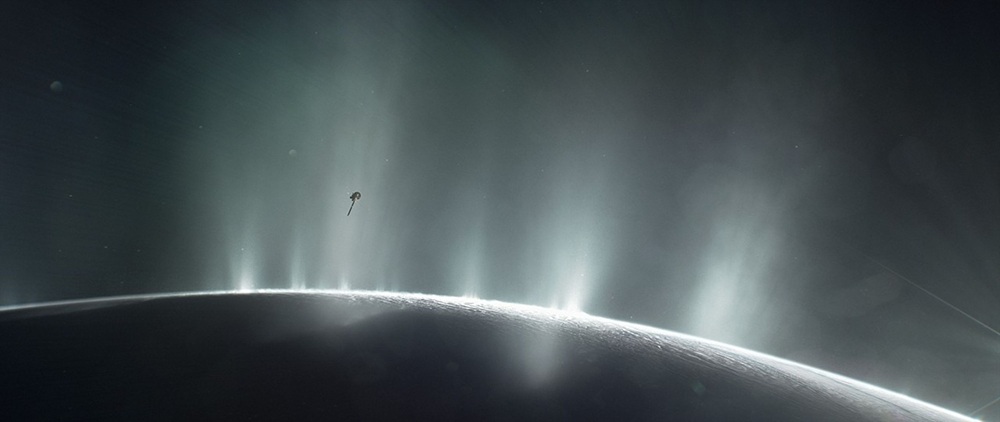
How likely are we to find extra terrestrial life in our Solar System? A study published in Science Advances involving OU academics shows that potential traces of life in the hidden ocean of Saturn’s moon Enceladus may be easier to detect than previously thought. The research demonstrates that components of the ocean water become separated from one another and highly concentrated within individual ice particles as they travel into space. Future spacecraft may be able to take advantage of this process when searching for biosignatures.
Why Enceladus is so interesting in the search for life
Enceladus is considered one of the most promising places in our Solar System in the search for extraterrestrial life. Beneath its thick icy crust lies a global ocean of liquid water, underlain by a rocky core. Through fractures in the ice shell near the south pole, enormous plumes of water vapour and tiny ice particles, fed by the subsurface ocean, are ejected hundreds of kilometres into space.
NASA’s Cassini spacecraft flew through these plumes several times and analysed their composition. As a result, the ocean of Enceladus remains the only extraterrestrial body of water from which material has been directly sampled and studied. Among the substances detected were salts and organic compounds. Previous Cassini analyses also provided evidence for hydrothermal activity on the seafloor and other key ingredients necessary for habitable conditions.
Enceladus’ Ice Volcanoes separate and “sort” the components of its ocean
The new study, which involved new analysis of Cassini data by an international team, now provides surprising insights into what happens to ocean water on its journey into space. Comparing Cassini’s findings with detailed laboratory experiments, the researchers were able to reconstruct how ocean compounds become concentrated and separated into individual ice grains.
Small droplets are produced when gas bubbles burst at the ocean surface. These droplets are carried by water vapour through cracks in the ice shell toward space. Contrary to previous assumptions, they do not freeze instantaneously. Instead, they freeze slowly, which allows salts and organic compounds to accumulate in different regions of the freezing droplet. Different types of salts, such as sodium chloride (table salt) and sodium carbonates, also become separated.
As the frozen droplets move upward, they accelerate to speeds of up to 1,000 km/h. When they collide with the walls of the ice fractures, they shatter into fragments only a few micrometres in size before being expelled into space. As a result, many of these ice particles contain predominantly a single substance, but at a greatly enhanced concentration.
OU study co-author Dr Mark Fox-Powell said:
“These findings show that the Enceladus plume is much more complex than we originally thought.
“They also highlight how important laboratory experiments are- they help us make sense of what the spacecraft sees.”
Potential traces of life may be easier to detect
This mechanism is not only helpful for studying the chemistry of the ocean but is also particularly significant for the search for ‘biosignatures’, or measurable indicators of life. If microbial material were present in an ocean droplet, it could become separated from other components during freezing. After fragmentation, the material might end up in only a few ice particles, but there it would be relatively pure and highly concentrated.
In that case, biosignatures could be detected particularly effectively using measurement technologies that are already available.
This finding could be highly important for future space missions to Enceladus, such as the currently planned ESA “L4” mission, which aims specifically to search for signs of life there.
Dr Mark Fox-Powell said:
“It’s a really exciting finding because it means Enceladus is already doing some of our hard work for us.
“Separating out these ocean components, which could include possible signs of life, makes them much easier to detect and analyse with spacecraft.”
Link to paper: Frank Postberg et al., Cassini CDA observes compositional segregation of Enceladus’ ice grains from slow freezing and fragmentation of oceanic spray. Science Advances 12, eaee7256(2026). DOI:10.1126/sciadv.aee7256
Main image: Shows an artist’s impression of the Cassini spacecraft flying through plumes of water vapour and icy particles erupting from the south pole of Saturn’s Moon Enceladus. Cassini was active in the Saturn system between 2004 and 2017. Copyright: NASA/JPL-Caltech/Space Science Institute


Explore

Undergraduate
Postgraduate
Policy
-
Follow us on Social media
-