OU News
News from The Open University
- Home
- OpenLearn celebrates two decades of trailblazing free learning
OpenLearn celebrates two decades of trailblazing free learning
Posted on • University news

Twenty years ago this October, The Open University launched an experimental platform called OpenLearn, an ambitious experiment to draw on the future possibilities of the new and fast-changing online technology of the time.
Back in 2006 some of the world’s most popular, and enduring, online platforms were also emerging – Facebook, Twitter, YouTube, MySpace. The Open University (OU) – an established leader in supported online learning – jumped aboard and 20 years later a two-year test turned into OpenLearn, the multi-serving, award-winning platform seen today.
Harnessing new technology had a deeper purpose for the OU; honouring the institution’s 1969 Royal Charter, mandating that it makes Higher Education accessible, breaking the barriers of location and cost. OpenLearn was simply the next step in doing that; presenting a novel way to release a percentage of all OU degree-level course materials into the public domain.
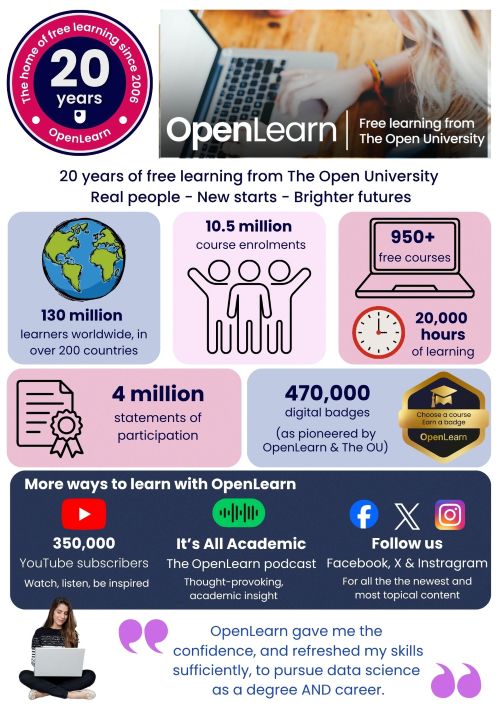
Highlights and stats across the last 20 years of OpenLearn.
But today’s OpenLearn, as its millions of users will attest, is so much more than that; a business-as-usual activity that supports informal learners and OU students alike. Hundreds upon thousands of people, young and old, have enjoyed the free courses – from finance to the Classics; mental health awareness to the secrets of the solar system – with many gaining the confidence to advance to formal OU study.
The site launched with 900 hours of free learning and today the platform provides an estimated 20,000 hours. In 20 years, OpenLearn has reached more than 130 million people, in more than 200 countries across the world – proof that the idea of delivering free learning on a global scale was achieved, and then some.
Having notably served the lockdown communities in the Covid years with a lifeline of at-home factual learning for millions, OpenLearn’s star has continued to rise and it is now proud to announce that shortly before its landmark 20th anniversary, it reached 10 million course enrolments and regularly adds thousands of extra visitors every year.
Andrew Law, Director of Business Innovation in the Business Development Unit, joined the OU in 2009, and was impressed by OpenLearn’s potential at a time when MOOCs (massive open online courses) were starting to shake up Higher Education.
He said:
“The MOOC engines were serving the over-served, OpenLearn was, and still is, serving the underserved.”
OpenLearn’s response to the MOOC phenomena was to tune in to its audience, where learners also wanted recognition for their achievements.
Those digital badges – a form of “micro-credential” – were introduced in 2015 and rewarded learners with something tangible, a proof of learning and, importantly, something they could share, post and include on their CVs. More than 4 million statements of participation and 500,000 digital badges have been issued since.
Head of the platform at the time, Patrina Law remembers the impact and popularity of the badges:
“They appealed to people who did not have qualifications, or had been excluded from education in some form. Some 40% of people on one early badged course classed themselves as having a disability.
“It gave those learners a real ‘eureka moment’ of realising they had recognition from The Open University, that they could manage that content, and those learners were then more inclined to take the next step.”
She said this in turn allowed OpenLearn to “really hone our skills as learning designers, and to see we had a special place in the world”.
“We began to see that free online learning, unmoderated, without tutor support, was a really important endeavour.”
Andrew Law says he is also particularly proud of the functional skills courses in Mathematics and English. Developed with further education college tutors, these resources addressed a need beyond the OU’s traditional focus on higher-level study. They demonstrated OpenLearn’s commitment to reaching people who might otherwise miss out.
Looking ahead to the next challenge
Andrew believes AI presents OpenLearn’s next major challenge. Just as online learning transformed the project in its early years, AI could change how people discover and access educational content.
OpenLearn continues to fulfil its Royal Charter mandate to serve the wider public’s educational wellbeing, with taster courses allowing learners to ‘try the OU’ before they enrol.
Students such as Freya, enjoying her graduation in London recently with a 2:1 in English Language, agree. She used Openlearn frequently in the early years of her degree study “getting used to distance learning”.
Graduate Katy recognises that the wealth of content on OpenLearn is also a magnet for those who simply love to learn, whatever the topic. She says:
“You can go on there and dabble … it doesn’t have to be to do with your degree.”
The family health practitioner is such a fan she recommends it to the teenagers she meets through her work and says it can really help to “find direction, but without the same pressure” as school or college.
Meanwhile Diane, a self-confessed OpenLearn fan, who recently graduated in Criminology and Psychology, sums it up nicely:
“I’m really impressed with OpenLearn. It doesn’t take long, you can stop and then just go back to where you left off.
“You’ve got nothing to lose, it’s just improvement. You can never stop learning.”
The OU’s Vice-Chancellor Dave Phoenix, is confident that OpenLearn’s next chapter will again be trailblazing:
“Our mission has always been to be open to people, places, methods and ideas and OpenLearn allows us to extend these values into the 21st century. We want to lead the learning revolution.”
Celebrating its official birthday on October 25, the OU is proud that its communities of learners on OpenLearn are stronger than ever, cementing the much-loved platform at the heart of its social mission.
Follow the link by clicking here to the official 20th birthday landing page to find out more
Main Image: Photo of a laptop screen with the words “Never stop learning” displayed. Photo credit: Geralt on Pixabay.


Explore

Undergraduate
Postgraduate
Policy
-
Follow us on Social media
-