OU News
News from The Open University
- Home
- Euclid lays the foundation for its best-ever 3D map of the Universe, with help from OU scientists
Euclid lays the foundation for its best-ever 3D map of the Universe, with help from OU scientists
Posted on • Science, maths, computing and technology
The European Space Agency’s Euclid mission has released its first major batch of data. With this release, which captures the light of more than a billion objects and covers an area of sky as big as 9500 full Moons, ESA’s dark Universe detective lays the foundation for its largest-ever 3D map of the cosmos.
The new data release, named DR1-Foundation, comprises around 13 months of observations, and marks the first major release of mission data since the space telescope’s launch in mid-2023. For the first time, it gives scientists the puzzle pieces they need to begin constructing a detailed 3D map of the cosmos – crucial for solving the many mysteries of the dark Universe (including dark energy, dark matter, and the cosmic web.
The data are accompanied by spectra and images, including large sky mosaics.
The OU has been central to capturing these images through Euclid’s VIS instrument (also known as the Visible Instrument, a high-resolution optical camera) and understanding how it responds to cosmic ray impacts in the very harsh radiation environment of space.
Dr Jesper Skottfelt of the OU’s Centre for Electronic Imaging (CEI) said:
“The success of this mission depends on the quality of the images, and that’s where the work of Teledyne-e2v and the CEI is so important. Teledyne-e2v developed the cutting-edge CCD (charge-coupled device) detectors that are at the heart of Euclid’s camera, and the CEI is working to correct for the effects of radiation damage on these detectors, ensuring that we get the most out of these precious images.”
Brand new science and discovery
Today’s release is the first to demonstrate Euclid’s abilities as a sky surveyor. Its breadth, panoramic mosaics, and wide sky coverage in visible and near-infrared light support a wide range of new science. DR1-Foundation reveals unprecedented numbers of cosmic objects, including:
- Over 900 million galaxies
- Around 15 000 strong gravitational lensing candidates
- Over 60 million quasar candidates, the brilliant cores of distant galaxies
- The spectra from more than 160 million sources
- Euclid Wide Survey results from 1900 deg² of sky – a total of 1.7 million GB of data
A machine for discovering rare objects
In space, above Earth’s image-blurring and light-dimming atmosphere, Euclid can complete deep and wide surveys of the sky in a way that ground-based telescopes cannot. As a result, this data release delivers vastly more cosmic objects than any preceding survey, pushing the boundaries of detection for rare and distant objects. These include strong gravitational lenses and galaxy clusters.
The strong gravitational lenses sought by Euclid are extremely rare, and form when the light travelling to us from distant galaxies is significantly distorted by a foreground galaxy. This release contains the largest strong lens catalogue ever – bigger than all previous catalogues combined.
A team of experts at the OU has been developing artificial intelligence (AI) and machine-learning models to find the rare strong gravitational lenses in Euclid’s data and has contributed to the avalanche of 15,000 strong lenses discovered by Euclid through machine learning and careful human checks.
Prof. Stephen Serjeant said:
“This avalanche of discovery is completely unprecedented. We’ve increased the number of known strong lenses spectacularly by about a factor of ten. Most of the matter in the Universe is dark matter, so this will help us unpick the behaviour of this dominant but still deeply mysterious form of matter.”
Euclid’s discovery avalanche is not just limited to its images. Euclid also splits up light like a rainbow, in a technique known as spectroscopy, to measure the redshifts of galaxies (how far away they are) and to understand the gas in galaxies most of the way back to the Big Bang. Thanks to Horizon Europe and Innovate UK funding of the “ELSA” project, Euclid team members have created the essential tools for unlocking this extra legacy.
At the OU, the team leads the ELSA work package on crowdsourced data mining and has just launched a citizen science project to explore this legacy, using human input to correct AI identification of artefacts.
Dr Hugh Dickinson, who created a sophisticated custom front end to the Zooniverse platform specifically for this project, said:
“I’m excited by the many ways that human beings and computers can work together to help solve some of the trickiest and most intriguing problems in modern science.”
Just the beginning
With this release, Euclid begins to reveal the dark cosmos. Scientists can mine the dataset to determine the distances to individual galaxies and place them into the 3D structure of the Universe, connecting them to the vast, invisible mesh of the cosmic web.
While enormous, the dataset only covers about 14% of the total sky area Euclid will survey. The full Data Release 1, to come in mid-2027, will build on today’s release and add more crucial parts to the cosmic puzzle, including observations of weak lensing to complement the strong ones and calculations of how galaxies and galaxy clusters fit into the cosmic web.
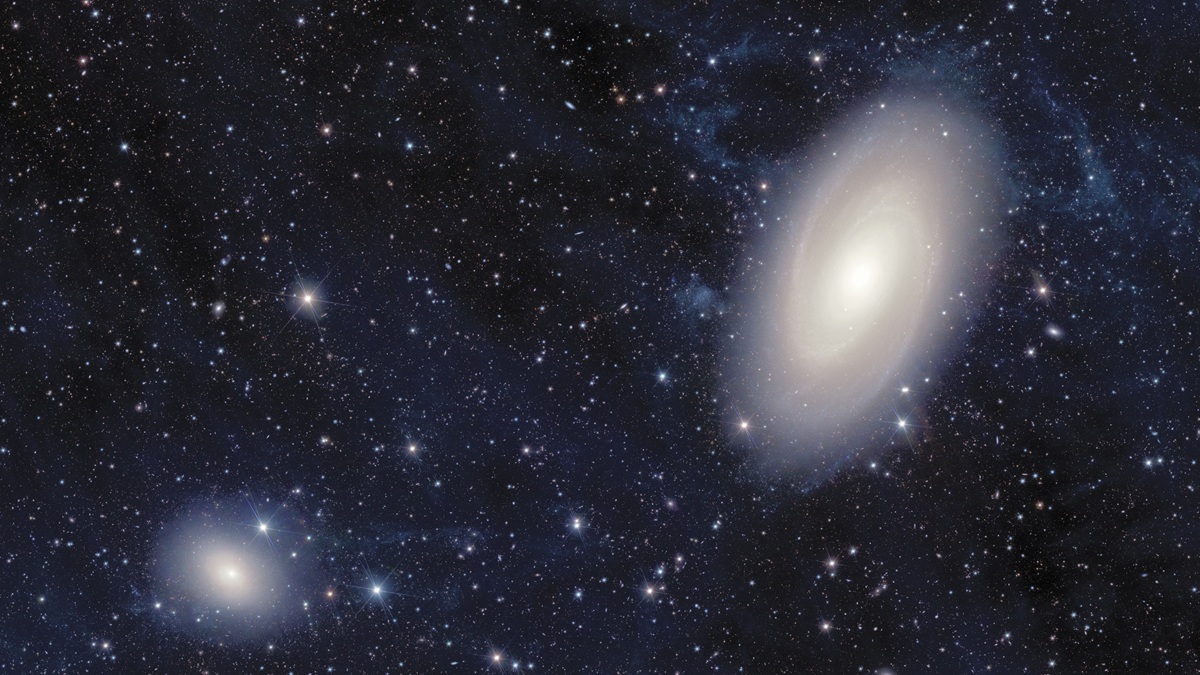
Header image: Euclid views the core of the Messier 81 galaxy group. Credit: ESA/Euclid/Euclid Consortium/NASA, image processing by J.-C. Cuillandre and E. Bertin CC BY-SA 3.0 IGO


Explore

Undergraduate
Postgraduate
Policy
-
Follow us on Social media
-