OU News
News from The Open University
- Home
- Open University partners in major Milton Keynes Robotics Adoption Hub
Open University partners in major Milton Keynes Robotics Adoption Hub
Posted on • University news
Open University research will form a significant part of a 43-month project to set up a self-sustaining Robotics Adoption Hub that will foster the take-up and solutions for robotics in open public spaces in Milton Keynes.
The RoboPass Plus hub – created thanks to £38m funding from the Robotics Adoption programme delivered by Innovate UK, and part of UKRI IS8 Advanced Manufacturing Programme– is one of only eight hubs in a national initiative aimed at accelerating robotics.
The hub will be located around Milton Keynes at the heart of the Oxford-Cambridge Growth Corridor, with a mandate to drive adoption, not just locally and regionally, but nationally and internationally, through deployment of scalable, replicable solutions with cross-sector applicability.
Based in the Smart City Experience Centre in the Centre:MK, the Milton Keynes Robotics Adoption Hub will act as a valuable resource for businesses and public sector organisations looking to understand and adopt robotics and automation technologies such as autonomous vehicles, drones, industrial robots and other automated systems used across a range of sectors.
OU expertise will develop a framework for informed adoption of urban robots
Research by the OU team will be led by Dr Miguel Valdez and Professor Matthew Cook from the School of Engineering and Innovation, drawing upon the school’s collective expertise in AI and robotic design, transport, architecture, urban planning and geography.
Dr Valdez and Professor Cook will apply their expertise regarding innovation in future urban environments to develop a framework for informed adoption of urban robots and policy guidance notes to support decision-makers.
Specifically, they will work to the following objectives:
1-To identify knowledge gaps that urban governance actors need to address to make informed decisions about the adoption of robots in urban environments.
2-To identify public benefits that accelerated adoption of urban robots could attend to, including for instance environment, economic development, accessibility and community support, and improved urban resiliency.
3-To identify physical, digital and institutional infrastructures needed to support effective use of urban robots.
The project is part of the initiative supporting local hubs across the UK to build on the strengths and capabilities of their local innovation ecosystems, with all the hubs working with a central convening body to share lessons learned and develop national adoption resources.
The eight UK hubs will provide organisations with impartial advice on the benefits, costs and practical requirements of adopting robotics, as well as connecting them with technology suppliers, integrators and finance providers.
Dr Valdez said:
“Advancements in robotics and autonomous systems are likely to reshape urban futures and we have the opportunity and even the duty to learn how to govern, manage and plan these technologies.”
“This project has potential to initiate a second wave of urban robotics of national and even global significance as robots will be deployed at scale and will support user cases including not only the pavement robots that we already have, but also robots in green spaces, in healthcare settings, social robots and many other applications that will allow us to see how robots learn to live with us, with each other, and with complex, unpredictable urban environments.”
Milton Keynes is recognised for its pioneering deployments of urban robots. The MK hub will support the rollout of service robots, drones and driverless vehicles, bringing new technologies into transport, logistics and delivery services that people rely on every day.
The project will be led by Smart City MK CIC, an independent, not-for-profit organisation, working with Milton Keynes City Council, The Open University, Smart City Consultancy, Ohmio, Cranfield University and Beverly Clarke Consulting.
This prestigious award is further acknowledgement of Milton Keynes and its tech ecosystem as one of the UK’s leading centres for technology innovation.
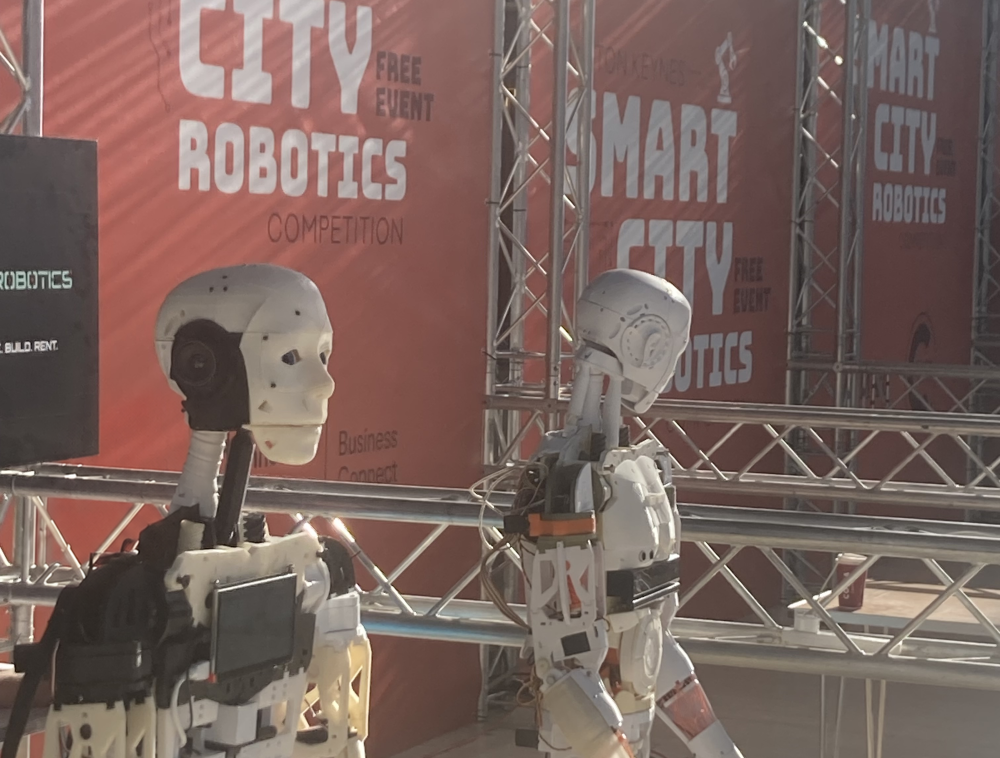
Main image: Robots at a Smart City event in Milton Keynes. Copyright The Open University


Explore

Undergraduate
Postgraduate
Policy
-
Follow us on Social media
-