OU News
News from The Open University
- Home
- OU technology brings Dunster Castle’s rare gilt leather collection to life
OU technology brings Dunster Castle’s rare gilt leather collection to life
Posted on • Arts
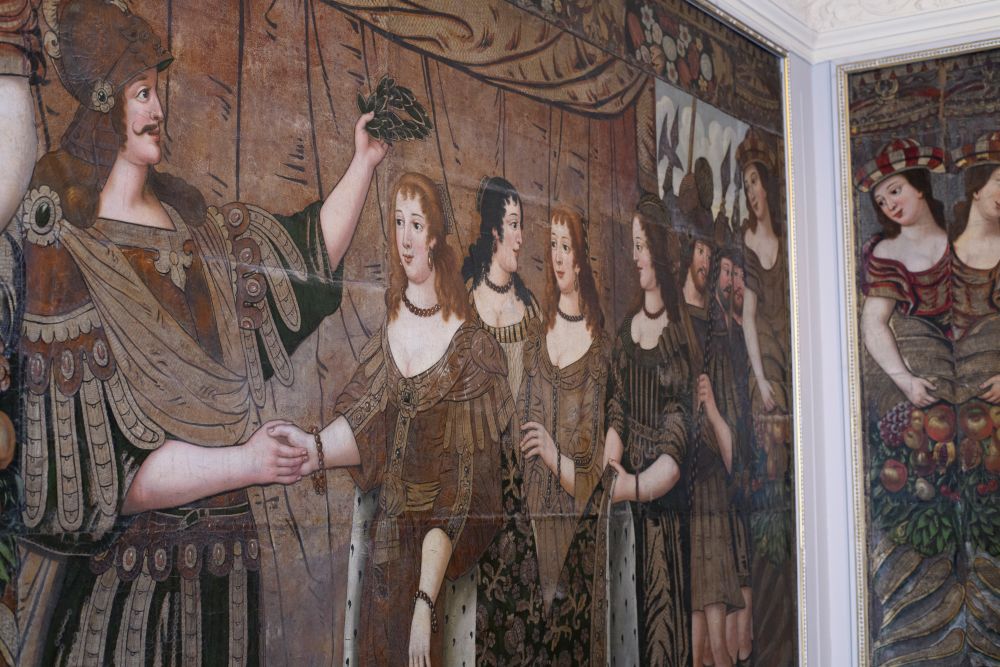
Visitors to the National Trust’s Dunster Castle can now explore its rare 17th-century gilt leather collection in a new immersive film created by The Open University (OU). Shown in a dedicated room before visitors enter the Leather Gallery, the film reveals the stories, craftsmanship and hidden details behind one of the castle’s most remarkable collections.
The project is led by Professor Clare Taylor, Professor of Art History and Material Cultures at the OU. It turns her original academic research into an engaging experience for the public. Produced through the OU’s innovative XR Studios, the film explores seven large painted leather panels from the 17th century that tell the story of Antony and Cleopatra.
Gilt leather is not widely known and is often mistaken for tapestry. The hangings are not woven; they are made from animal skins joined together. Silver leaf was added to the surface and painted yellow to look like gold. Stamped patterns created the shimmering metallic effects that catch and reflect the light.
Using extended reality and game-engine technology, the film takes visitors through a virtual version of the gallery. It zooms in on details that can be hard to see in the room, helping visitors explore the hangings’ colours, textures, images and construction in new ways.
Professor Clare Taylor, The Open University, said:
“It’s been a fantastic opportunity to work with the National Trust
and show how academic research can be made accessible,
engaging and relevant to visitors. Our research has uncovered new
insights into these remarkable gilt leathers and their international
significance.“Working with our XR Studios has enabled us to
bring those findings to life in an exciting new way, responding
directly to visitors’ questions and helping people see what’s on the
walls at Dunster from a completely fresh perspective.”
Professor Taylor’s research has uncovered a continuous history of the Luttrell family’s interest in leather at Dunster, from the 1690s to the 1880s. As well as the celebrated hangings, the castle contains gilt-leather screens and seats, and wallpaper made to look like embossed leather. Records show that more hangings and unusual leather carpets were also once used in the property. This material has not been examined in a recent English-language book since the 1970s.
The research also shows how Dunster’s collection fits into a wider international story. Detailed comparisons with decorated leather at Château Écouen, home to France’s National Museum of the Renaissance, and with lost panels from Walsingham Abbey in Norfolk reveal similar figures and settings. These links connect Dunster to a broader fashion among royal and wealthy households for luxury objects that could be moved from place to place.
Claire Reed, Cultural Heritage Curator, National Trust said:
“This project has shone a new light on some of Dunster Castle’s most remarkable collections. By putting visitors’ and volunteers’ curiosity at the heart of the research, we’ve explored the questions and subjects that matter most to them.
“Using the OU’s innovative XR Studios has enabled us to bring these previously untold stories to life, giving visitors an exciting new way to encounter the collections.”
The film was developed with the Trust’s Cultural Heritage Curator, Claire Reed, and shaped by questions from Dunster’s volunteers and visitors. It shows how sharing knowledge can work in practice: bringing together OU research, National Trust expertise and innovative immersive production to help more people understand this exceptional historic collection.
Main image: Close up photo of the rare 17th-century gilt leather screen at Dunster Castle. Copyright: National Trust


Explore

Undergraduate
Postgraduate
Policy
-
Follow us on Social media
-