OU News
News from The Open University
- Home
- New research could aid human-to-parrot communication
New research could aid human-to-parrot communication
Posted on • Science, maths, computing and technology
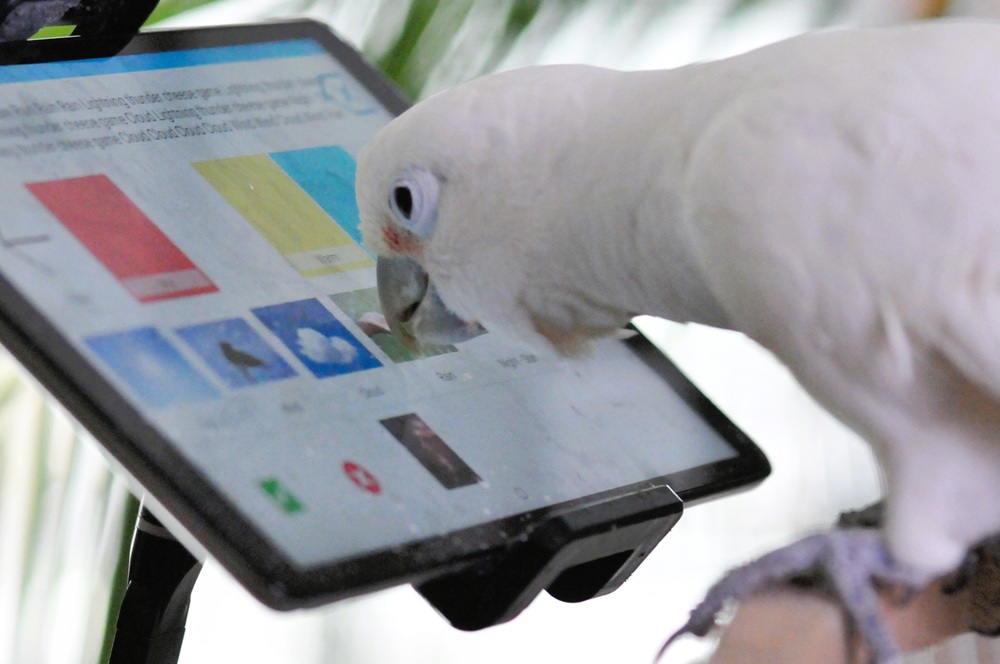
A new study, from Professor Clara Mancini of The Open University (OU) and colleagues, has deepened understanding of human to parrot communication through a tablet-based speech board.
Previous research showed that parrots can use speech boards to communicate with humans. However, how the design of these boards affects how easy they are for birds to use, or how well they support communication between parrots and people, had yet to be explored.
This study followed a Goffin’s cockatoo (Ellie) over four years as she used three different speech board designs in her everyday environment. For the first time, researchers looked at how design features usually considered for human users – such as the type of symbols, how detailed they are, how many options are available, and how they are arranged – affected the bird’s choices in different situations and across different versions of the board.
Professor Clara Mancini, Head of the OU’s Animal-Computer Interaction Laboratory, commented:
“While previous research has demonstrated that parrots can be trained to use a speech board for functional communication by selecting visual representations of concepts, this is the first study to have examined how different aspects of the interface design may influence their use of the device.”
Co-author of the study, Dr Corinne Renguette, Associate Professor at Purdue University, explained how the research worked:
“This four-year study involving three speech board iterations, which grew from 55 to 462 representations, tracks how the interface design and the parrot’s use of the tool evolved over time, with its increasing complexity. We analysed some 8500 interactions of the parrot with her speech board, which enabled us to detect notable use trends and patterns that can inform future interface design for improved avian usability.”
The study suggests that using photos of real objects from the parrots’ environment, along with simple drawings of familiar items that stand for broader ideas, may help parrots understand the symbols without needing training.
Professor Mancini added:
“One of our key findings suggest that photos which portray objects in the parrots’ environment and figurative drawings of familiar objects which represent more general concepts relevant to the parrots’ experience may help them to recognise the meaning of those visual representations without training.
“This may facilitate learning for the birds and give them greater autonomy in the use of the device for self-expression and for active participation in their own welfare management.”
Looking to the future of human-parrot communication, co-author Jennifer Taylor-O’Connor, Co-Founder of Parrot Kindergarten and Adjunct Assistant Professor at Texas A&M University, said:
“We know from research that parrots’ intelligence is on par with six- and even eight-year-old children. For example, they can solve puzzle tasks and pass reward procrastination tests. Our work shows that Ellie initiates communicative interactions via her speech board frequently and intentionally. The data even suggests that she may be able to interpret and use speech board representations autonomously, if the images support her recognition of them.”
Header image: Ellie the cockatoo using the speech board. Credit: The Open University
Read the full study online.


Explore

Undergraduate
Postgraduate
Policy
-
Follow us on Social media
-