OU News
News from The Open University
- Home
- OU expert shows that NASA’s Bennu mission still holds surprises
OU expert shows that NASA’s Bennu mission still holds surprises
Posted on • Science, maths, computing and technology
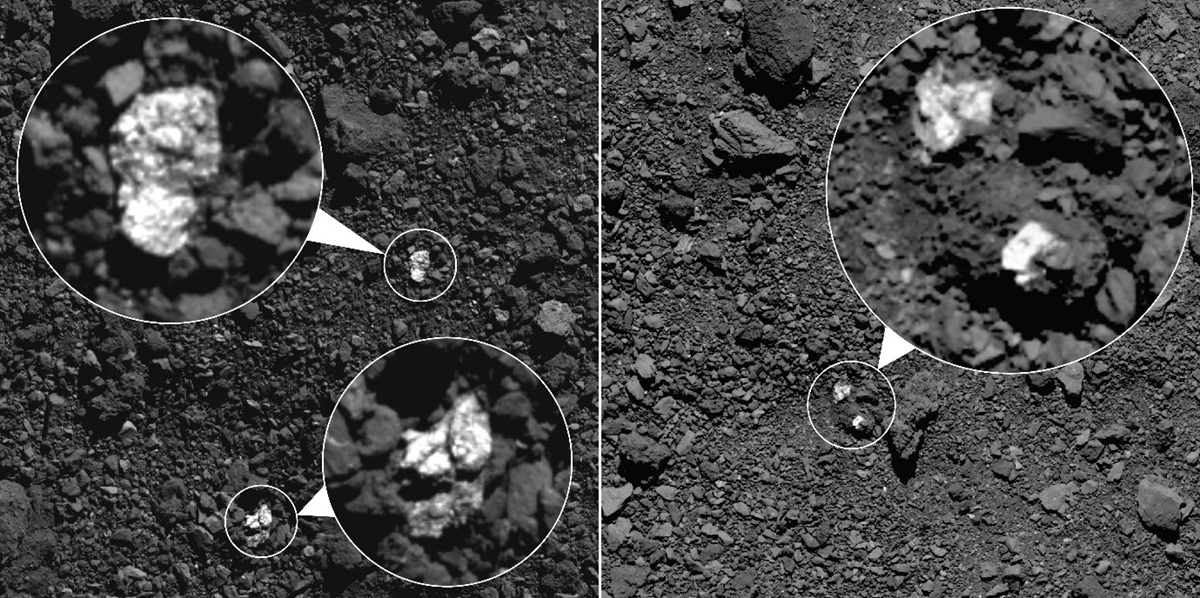
During NASA’s OSIRIS-REx mission to the asteroid (101955) Bennu, several unusually bright boulders were observed scattered across the asteroid’s otherwise dark surface. These rocks were unexpected, as Bennu’s predicted mineralogy is primitive and volatile-rich, indicating formation without extensive melting processes.
One leading hypothesis proposed that these bright boulders originated from (4) Vesta, one of the largest bodies in the asteroid belt. Observations revealed similarities between the boulders and the howardite-eucrite-diogenite (HED) meteorites, a group widely believed to originate from Vesta following large impact events that ejected crustal material into space.
However, a new study by Ben Rider-Stokes of the OU, published in Monthly Notices of the Royal Astronomical Society, entitled Provenance of the Bright Boulders on (101955) Bennu, presents an alternative possibility. The research shows that basaltic rocks dominated by pyroxene, which formed in the outer Solar System, could provide equally plausible matches to the spectral properties of Bennu’s bright boulders.
This raises the possibility that at least some of these rocks may not originate from the inner Solar System, as previously suggested.
Interestingly, one of these meteorites was historically classified as a HED meteorite due to their comparable mineralogy and chemistry. This highlights the importance of caution when interpreting planetary surface materials using mineralogical signatures alone.
Ben commented:
“This study encourages us to reconsider the origins of Bennu’s bright boulders and highlights the need for caution when linking meteorites such as the howardite–eucrite–diogenite (HED) group to asteroid surfaces based solely on mineralogy. Similar compositions can form in different regions of the Solar System, meaning mineralogy alone may not uniquely identify where a rock formed.”
Fragments of pyroxene-bearing material have also recently been identified within samples returned by OSIRIS-REx and presented at the Lunar and Planetary Science Conference by Wilbur et al.
Although these fragments are currently too small for definitive isotopic measurements to determine their origin, they further illustrate the complexity of interpreting Bennu’s geological history.
Together, these findings suggest that linking asteroid surface materials to specific parent bodies based solely on spectroscopy may oversimplify a more complex reality. Bennu’s bright boulders may therefore record a broader story of material transport across the Solar System than previously recognised.
Looking to the future, Ben added:
“Regardless of their origin, the bright boulders on Bennu are particularly exciting because they were only revealed once OSIRIS-REx observed the surface at high spatial resolution. This raises the possibility that similar materials may exist on other primitive asteroids but remain undetected.
“Future missions, such as NASA’s Lucy mission to the Jupiter Trojans beginning in 2027, may reveal whether evolved, potentially magmatic lithologies are more widespread than previously expected, with important implications for how protoplanets formed and evolved across the Solar System.”
Header image: NASA’s OSIRIS-REx spacecraft captured these images in 2019, which show fragments of bright materials present on asteroid Bennu’s surface. The bright boulders (circled in the images) are probably pyroxene-rich material. NASA/Goddard/University of Arizona.


Explore

Undergraduate
Postgraduate
Policy
-
Follow us on Social media
-