OU News
News from The Open University
- Home
- OU launches wireless button allowing dogs to control household appliances
OU launches wireless button allowing dogs to control household appliances
Posted on • Science, maths, computing and technology
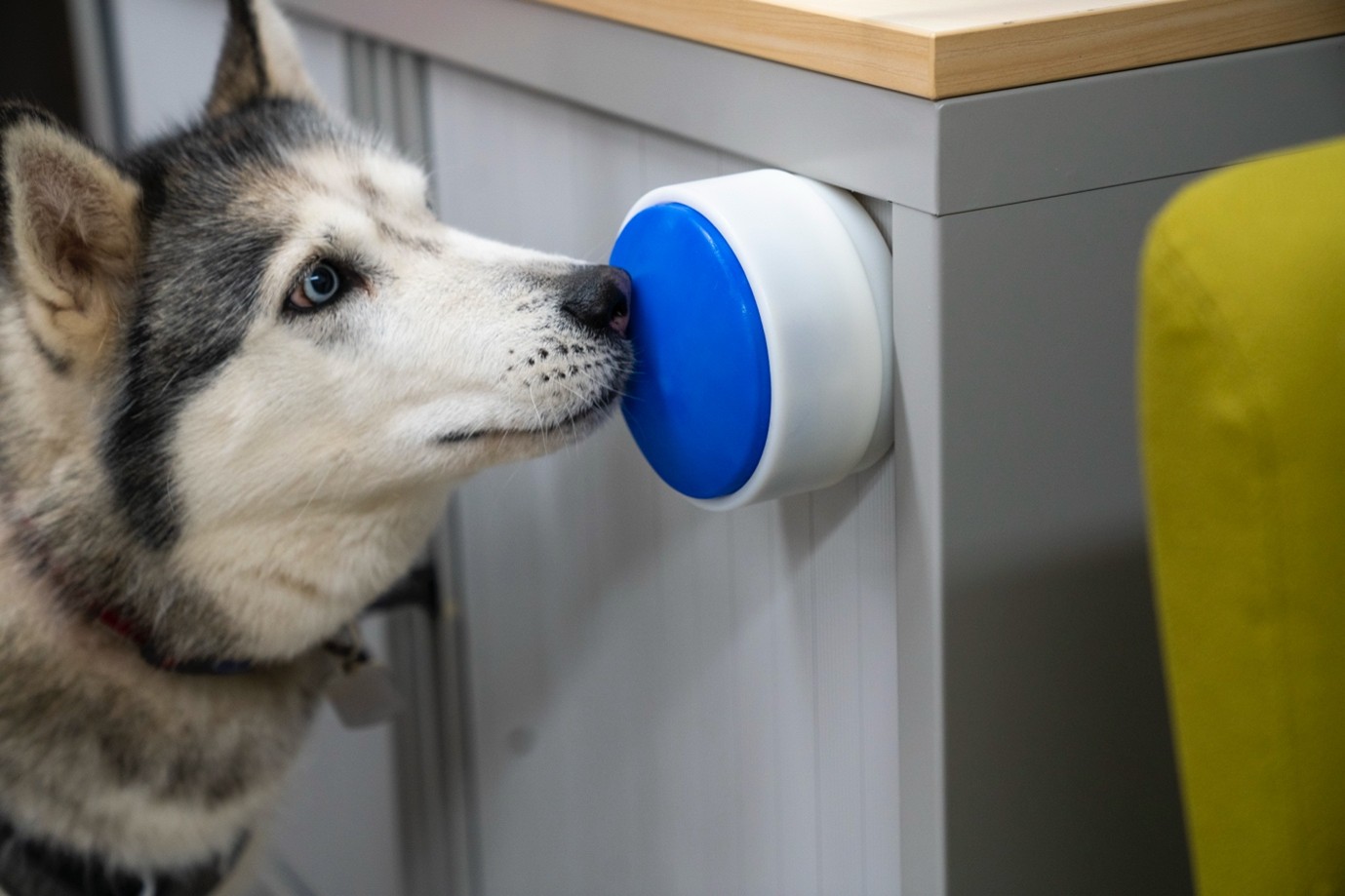
A new wireless button designed for dogs to control appliances has launched thanks to research led by Professor Clara Mancini at The Open University’s Animal-Computer Interaction (ACI) Laboratory.
The Dogosophy Button allows dogs to switch home appliances on and off using a device tailored to their physical and sensory characteristics. Initially developed to support assistance dogs in tasks like turning on lights, fans or kettles, the button is now being made available to the public for all dogs.
The product is the result of extensive research by the ACI Lab’s team into dog-centred design. Drawing on insights from years of collaboration with UK charities Dogs for Good and Petplan Charitable Trust, the team at the ACI Lab created a button that dogs can use easily, comfortably and independently.
The device features a blue push-pad suited to canine vision, a textured convex surface for grip, and a gentle light that confirms successful activation. It responds to nose nudges and paw presses and can be positioned anywhere within a 40-metre range of the appliance it is used to control.
Each Dogosophy Button package includes a battery-powered wireless button, a receiver to connect to a household appliance, and fixings to attach the button securely to surfaces.
Prof. Clara Mancini said:
“I am delighted to see the Dogosophy Button concept finally become available as a product to benefit assistance and companion dogs alike, by making it easier for them to control aspects of the environment in which they live.”
“Dogs live in a world that is not designed with them in mind, which challenges and constrains their daily interactions with it. With the Dogosophy Button we want to begin to change that, by making our shared environments more accessible for dogs and more inclusive for all. The device’s simplicity and portability make it very versatile, which is one of its strengths.”
Available from November 2025, the Dogosophy Button brings a new level of accessibility to dogs and dog-assisted living, canine experience and human-animal interaction.
Prof Mancini added:
“From first ideation to production, the Dogosophy Button emerges from years of research and numerous design iterations thanks to the contributions of a dedicated team.
“I would like to acknowledge Dr Luisa Ruge, Dr Rachael Luck, Dr Patrizia Paci, Elizabeth Cox, Sha Li, Jose Valencia and Brendan Aengenheister, who worked on the project at the OU, as well as UK Charity Dogs for Good and Petplan Charitable Trust for their ongoing support.”


Explore

Undergraduate
Postgraduate
Policy
-
Follow us on Social media
-