OU News
News from The Open University
- Home
- OU Researchers Begin New Collaboration with the MIT Kavli Institute
OU Researchers Begin New Collaboration with the MIT Kavli Institute
Posted on • Science, maths, computing and technology
The Open University (OU) scientists from the Centre for Electronic Imaging (CEI) have started a new research project with the Massachusetts Institute of Technology (MIT) Kavli Institute (MKI) for Astrophysics and Space Research to support them in the evaluation of a new detector technology developed at the OU.
During the project, members of the CEI will work closely with MKI researchers to allow the new detectors to be characterised at much lower temperatures and over a wider energy range of X-rays.
Under previous funding from the European Space Agency (ESA) and working closely with their industrial collaborators at Teledyne e2v, the Centre for Electronic Imaging (CEI) developed a new CMOS image sensor optimised for soft-X-ray imaging, called CIS221-X.
The development is aiming to provide sensors for the Soft X-ray Imager (SXI) instrument aboard the proposed THESEUS space telescope by ESA. The new CIS221-X has demonstrated world-leading performance and has attracted the attention of several overseas organisations. One stand-out result is the achieved energy resolution, which approaches the theoretical limit and is one of the best ever reported for a silicon image sensor of any kind. MKI intend to evaluate CIS221-X at lower X-ray energies and at cryogenic temperatures for possible use in future NASA space missions.
A new UK technology, invented at the OU
The underlying technology of CIS221-X was developed at the CEI and patented in 2019. In essence, it allows CMOS image sensors to be built on much thicker silicon substrates than typical devices, so that their sensitivity at near-infrared wavelengths and for soft X-rays is greatly increased.
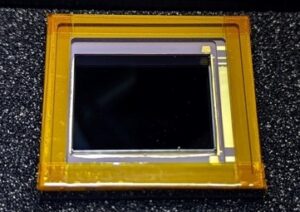
A close-up of our X-ray sensor CIS221-X
The technology was adopted by the CEI’s industrial partner Teledyne e2v, a leading manufacturer of image sensors for science and space. Optical sensors based on this technology have already been baselined by two space missions led by ESA. This success is underpinned by the close collaboration between the CEI and Teledyne e2v, spanning more than 20 years. As part of the collaboration, the CEI is tasked with delivering new intellectual property and patents for future scientific image sensors manufactured by Teledyne e2v.
Transient High-Energy Sky and Early Universe Surveyor (THESEUS)
Outside of the work with MIT, through funding from ESA, the CEI have been leading a new technology development programme to make a soft X-ray optimised CMOS image sensor based on the patent, featuring a larger pixel size with excellent energy resolution and noise. Beginning in 2020, the device has been designed and then manufactured by Teledyne e2v, then extensively characterised using a dedicated setup in the CEI laboratories at the Open University in Milton Keynes.
CMOS technology offers several advantages over legacy sensors, including faster readout rates, lower power dissipation and greater radiation hardness. These features are of keen interest to astronomers, improving the detection of short-duration transient events while maintaining excellent performance throughout a space telescope’s lifetime.
With continued support from ESA and working with Teledyne e2v, the CEI team have now started a continuation project to combine our pixel design with Teledyne e2v’s CIS300 architecture and characterise a large area sensor for the THESEUS SXI focal plane.
Dr. Konstantin Stefanov, from the Centre for Electronic Imaging, who leads this collaboration project with MKI, said:
‘This project is a great example of UK-developed technology attracting the interest of key players in the field of soft X-ray astronomy and space-based observations. Using our strong collaboration with Teledyne e2v, and under funding by ESA, the CEI at the OU has been able to produce an exciting new image sensor technology with world-leading performance. In addition to the THESEUS space telescope, future applications could be in new missions by the major space agencies. ’
Dr. David Hall, Director of the CEI, added:
‘This project is a testament to the talent, expertise and dedication of the researchers at the CEI, who play a key role in leading sensor development for space imaging. Together with our long-term industrial collaborator Teledyne e2v, we are at the forefront of providing UK-developed imaging technology for the world’s field of space-based astronomy.’


Explore

Undergraduate
Postgraduate
Policy
-
Follow us on Social media
-