The Ins and Outs of Archival Research

Part-time postgraduate researcher, Antonia Saunders, kicks off our series on the PhD journey and beyond with her reflections on a recent trip to Oxford’s Bodleian Libraries. As Antonia reveals, her visit not only furthered her research into how 19th-century historians and novelists constructed an idea of Jewishness, it also offered broader and more unexpected rewards.
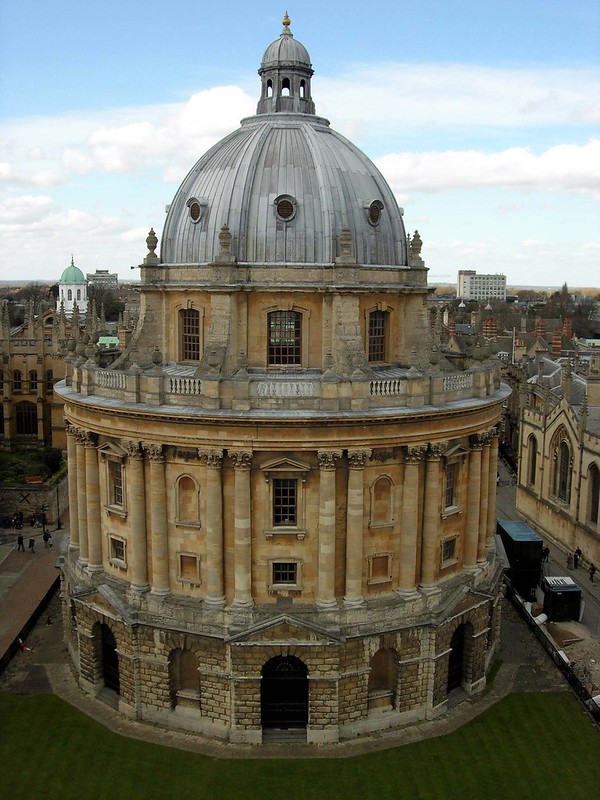
The Bodleian Library” by malias is licensed under CC BY 2.0.

As a part-time PhD student with a full-time job in corporate banking, I sometimes feel as if I am snatching snippets of time to follow my aspirations of becoming a full-time academic.

So, when my supervisors suggested that I use some of my Support Grant to facilitate a three-day research trip to the Bodleian Libraries, I got onto it straight away. The prospect was overwhelmingly appealing: access to materials relating to my research on Maria Edgeworth, Benjamin Disraeli, and George Eliot; accommodation in college rooms; an uninterrupted period to focus on my research.

I needed to apply for a Bodleian Reader card ahead of my visit, and my supervisor very kindly supplied me with a letter of introduction. I could order materials for my visit up to five days before. My list of archival materials has over forty items, and you can only order up to ten items at a time. So, I selected what I thought might be the most relevant ones to look at on my first visit.

These included handwritten manuscripts and typed proofs of Disraeli’s novels, and one of George Eliot’s notebooks from 1861, and two for 1868 when she first conceived the idea of her long poem The Spanish Gypsy. I also wanted to consult Gordon S. Haight’s seven volumes of George Eliot’s letters in the Old Bodleian Library as these have not, as yet, been digitized.
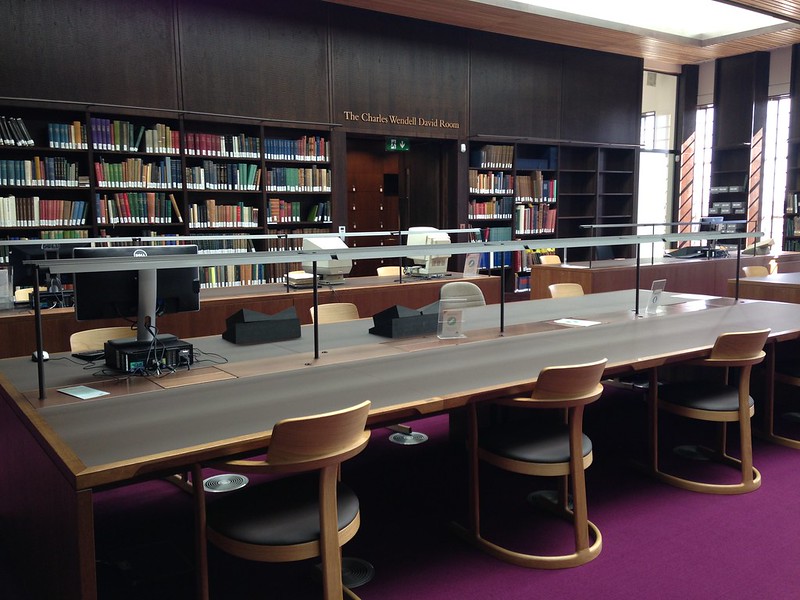
The Weston Library, Oxford University. Opening Weekend tour (March, 2015)” by alisonjpope is licensed under CC BY 2.0.

I spent most of my visit in the Weston Library with the resources I had ordered. The ability to search through Disraeli’s papers and George Eliot’s notebook was thrilling. At first, I found Disraeli’s handwriting illegible – horizontal lines in brown ink with occasional bumps and tails. I had a sinking feeling that I wouldn’t be able to make out anything. But I tried comparing his handwriting to his novels on Project Gutenberg, and – slowly, very slowly – I began to be able to decipher his handwriting, and to note some changes between the manuscript and the finished novels.

George Eliot’s handwriting in her notebooks was meticulously neat, but she had written some pages in Latin, German, and Italian, so I copied down some passages with names and words I recognised to translate later on. I also spent some time in the Old Bodleian Library reading through Haight’s volumes of George Eliot’s letters.

I didn’t get through all of the material I ordered for my visit. Now that I know what is held there, I am planning my next trips with a more focused approach to specific materials – perhaps visiting for one day at a time,

I do, however, highly recommend staying overnight in college rooms. I booked into St. Stephen’s House, a theological college, about a twenty-minute walk from the centre of Oxford. The students were welcoming, and I had some very interesting conversations over breakfast. One of the students had a diamond pin on his lapel with the figures 1897. I asked him of the significance of the year, and he told me it was from the diamond jubilee of Queen Victoria and that he collects Victorian merchandise from the golden and diamond jubilees. I also spoke to a visitor who is an Egyptologist translating a ceremonial text held at the Ashmolean Museum.

I completed both my BA and my MA at the Open University, and I am passionate about the egalitarian principles the university is founded on, especially because of the opportunities it has afforded me. However, the chance to sit down and meet other students in a relaxed atmosphere, and to talk about interests beyond my own research, gave me a feel of what it might have been like had I attended university in my youth.

The benefits reaped during my visit went beyond the academic. I also experienced a boost to my mental health. I found it invaluable to clear space in my schedule to focus on my research, to be able to think a thought through without being interrupted by pressures of work or home life, and to be surrounded by such a wealth of learning and knowledge.
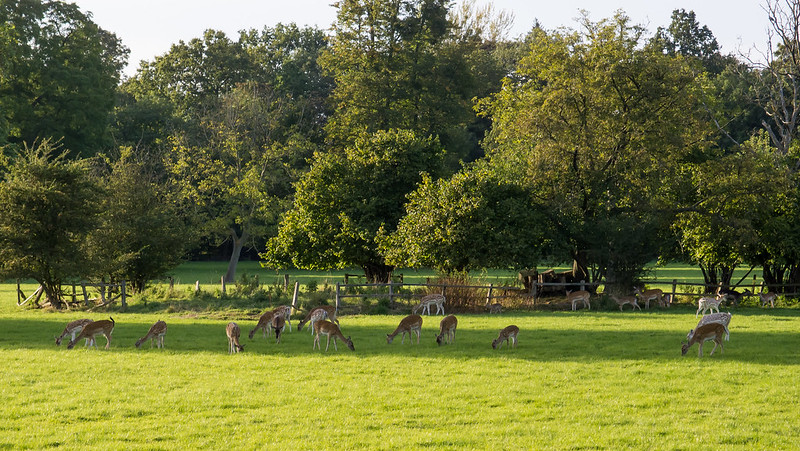
Magdalen College, Oxford” by interbeat is licensed under CC BY 2.0.

One of my supervisors, who lives in Oxford, met me for a walk on two of the days. She gave me a tour of Magdalen College, including a walk around the deer park and through a field of snake’s head fritillaries. She also took me to her own alma mater, New College, where we heard the choristers practising.

I started my research in 2020 during lockdown, and I think I have inadvertently adopted sedentary habits – always a potential risk for bibliophiles. But it felt so good to be out and about, walking in the fresh air. It made me reflect on my use of time and to commit to getting outside each day, rain or shine, to clear my mind.

Antonia Saunders

Antonia Saunders studied for both her BA and MA at The Open University. Her primary interest is in the novel in all its forms with a particular concentration on the nineteenth and early twentieth century. She began her part-time PhD at the OU in October 2020. Her thesis, The construction of a Jewish Identity in histories and novels of the nineteenth century, considers the literary and historiographical contexts of representations of Jewish people and Jewish Identity.
Cursed art, ekphrastic poetry and Prague

Staff Tutor and Associate Lecturer, Jennie Owen, travelled to Prague to present at a conference on the theme of Global Horror. The conference was run by Progressive Connexions, an organisation that supports sustainable global interdisciplinary research, and promotes collegiate exchange of ideas, experiences, and points of view.

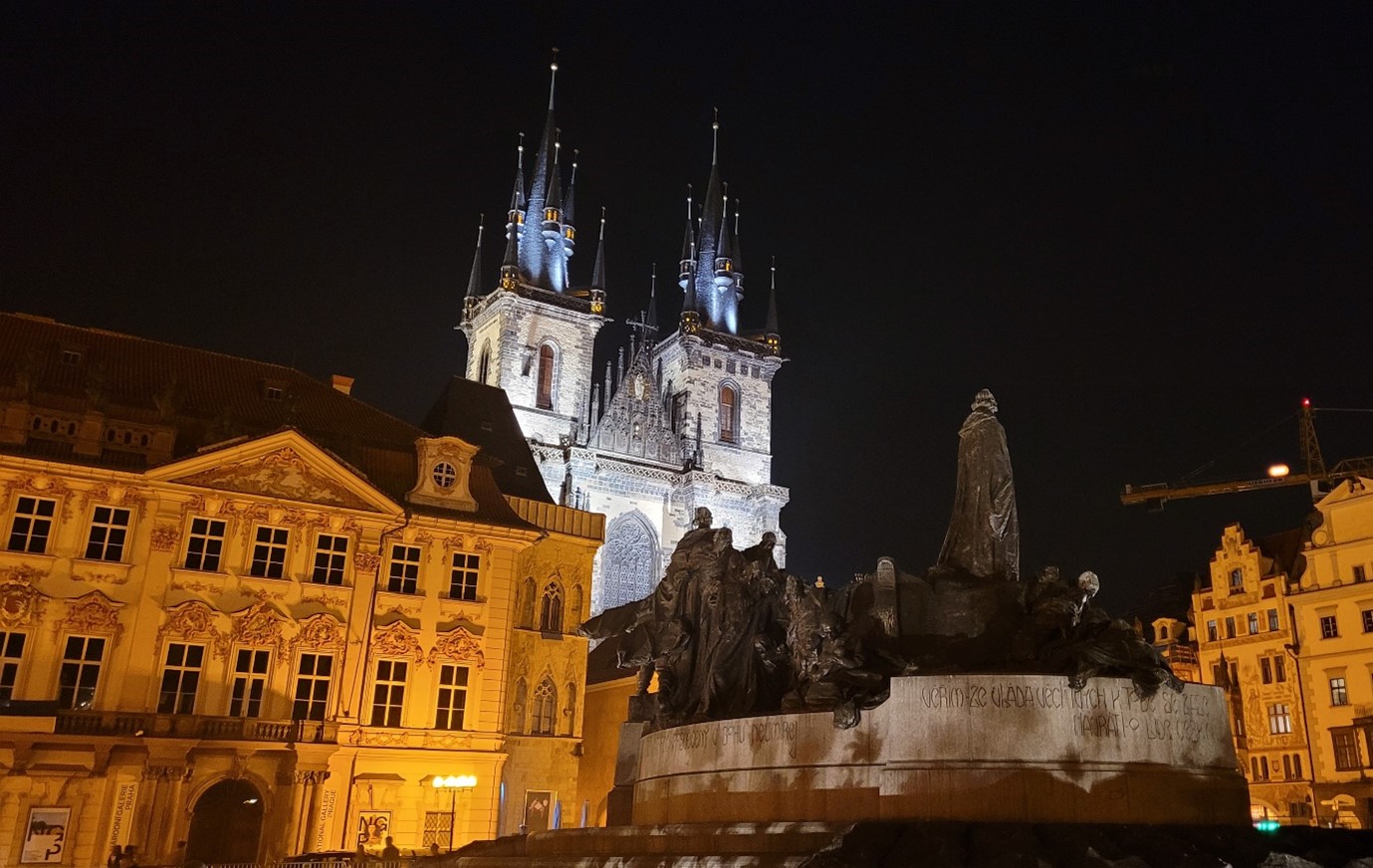
Prague

This emphasis on curiosity, open-mindedness, and collaboration is also at the heart of our Contemporary Cultures of Writing conference on 20th April, which Jennie is organising. You can book here for tickets to this London-based one-day conference: Writing place: what haunts the landscape of modern Britain?

Today, Jennie offers us a glimpse into the kinds of urban legends that inspired her paper, ‘Cursed Poetry: An Exploration of Ekphrastic Poetry Inspired by Cursed Art’.

At the Darkness at the Edges conference, delegates spoke on varied topics, from the gothic and dystopic in Indigenous fictions to fairy tale motives in German post-war literature.

I’ve long had an interest in horror, as well as the gothic and dystopian. My particular fascination with cursed paintings began as a distraction from the more challenging sociological aspects of my PhD research into traumascapes in the northwest of England.

The notion of the modern-day curse is often propagated through social media, and I was fascinated by how these urban legends become fragmented as they are retold online on websites and community forums.

But the idea of the curse is not a new one. We can trace its path through ancient history: it’s discussed in the Bible, linked inextricably to our perceptions of ancient Egypt, and a common inciting incident in the fairy-tale narrative. In common folklore, a portrait that falls to the ground may foretell the death of a loved one; whilst anyone who was a fan of the cartoon Scooby Doo will be aware of the risk of the eyes in a portrait following you around the room.

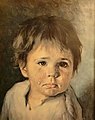
The Crying Boy by Giovanni Bragolin. This image is in the public domain.

One of the most famous cursed paintings in the UK is The Crying Boy by Giovanni Bragolin (1911-1981) – an image of a smudge-faced toddler looking sadly out at the viewer, tears running down his face.

In 1985, the Sun issued a warning that around 50 houses in Yorkshire had burned to the ground, leaving only this painting intact. This created a mild panic, reflected in a series of subsequent articles with headlines such as ‘Crying Flame’ and ‘Crying boy curse strikes again’. Such was the panic that on Halloween the Sun burned dozens of these paintings, which had been sent to their offices, and quoted a fire officer who stated: ‘I think there will be many people who can breathe a little easier now’.

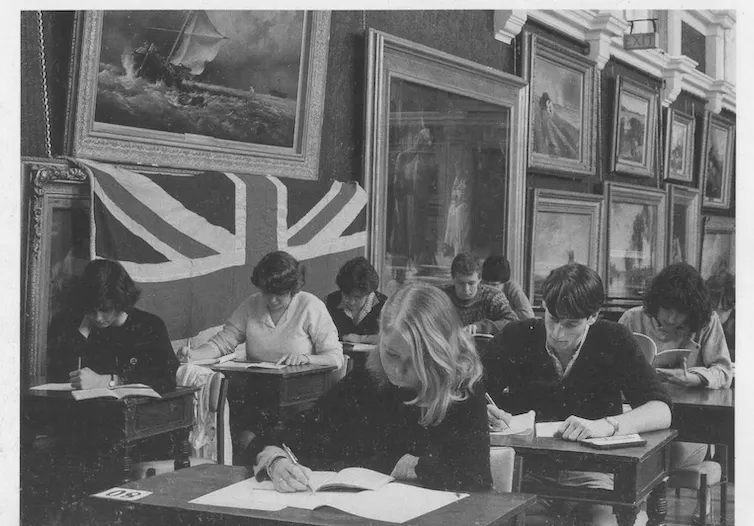
The covered painting during an exam in 1984. ©Royal Holloway, University of London

There is a rich vein of allegedly cursed artworks. Man Proposes, God Disposes by Sir Edwin Landseer (1802-1873), which hangs in Royal Holloway University, has to be covered with a Union Jack during exam season to allay students’ fears that they might fail or lose their minds if they spend too long staring at the painting. Indeed, its subject matter is rather gruesome: two polar bears fighting over the remains of the 1845 Franklin expedition. This infamous expedition was designed to locate the northwest passage in the Artic, and resulted in the loss of two ships and all men aboard (and rumours of cannibalism).

There are dozens of mysterious contemporary pieces too: having once seen it, for instance, who can forget the Momo Whatsapp curse, which featured a distorted wide-eyed sculpture by Japanese artist Keisuke Aiso?

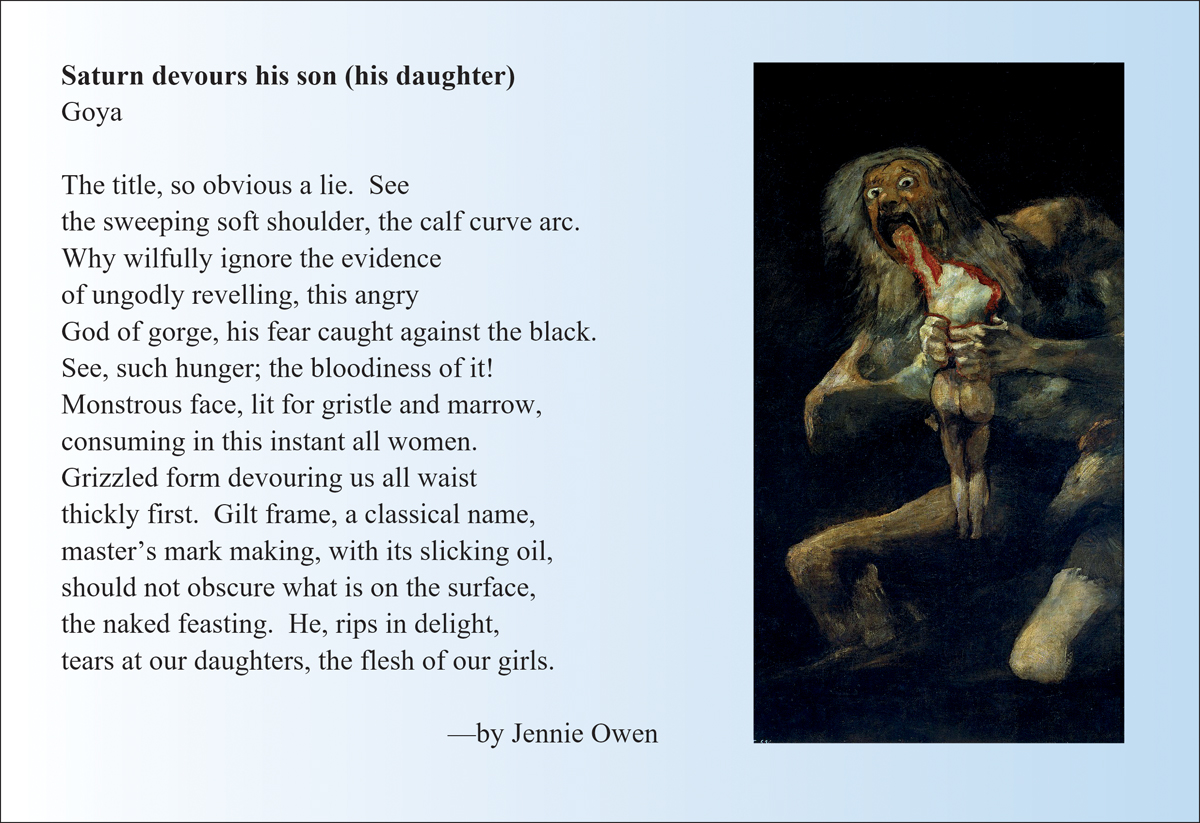
Using close examination of supposedly cursed art in the public domain, I used an ekphrastic methodology to create a series of poems.

The Poetry Foundation defines an ekphrastic poem as ‘a vivid description of a scene or, more commonly, a work of art. Through the imaginative act of narrating and reflecting on the “action” of a painting or sculpture, the poet may amplify and expand its meaning.’ It is hardly a new form of poetry – just think of Percy Bysshe Shelley’s ‘On the Medusa of Leonardo Da Vinci in the Florentine Gallery’ or ‘Ode on a Grecian Urn’, by John Keats. But ekphrastic poetry does appear currently to be celebrating a kind of renaissance in popularity.

With international colleagues from a wide variety of disciplines, I shared my practice-based research by discussing my own creative process of using art as a means of inspiration for poetry. I explored how this approach has had an impact on both the form and content of my writing, as well as how the writing of these pieces both celebrates and challenges the concept of cursed art.

My presentation was received, I hope, without any undue residue of curses.


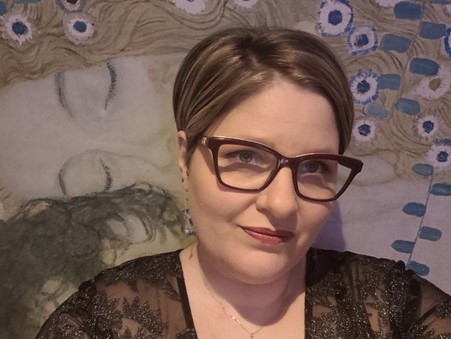
Jennie Owen

Jennie E. Owen’s cursed poems will be featuring in an anthology pamphlet published by Nine Pens Press later in 2023. Jennie has worked as an Associate Lecturer here at the OU for nearly 20 years. She is now also a Staff Tutor in Creative Writing, and lead Cluster Manager for A363, our level three undergraduate creative writing module. Jennie is working towards her PhD with Manchester Metropolitan University. She is a Forward– and Pushcart-prize nominated poet and writer of short stories, whose work has been widely published in anthologies, journals and magazines.