
George Eliot’s Piano

Dr Delia da Sousa Correa, Senior Lecturer in English

22nd November 2019 marks the 200th anniversary of the birth of novelist George Eliot, born Mary Ann Evans. Appropriately 22nd November is St Cecilia’s day, in honour of the patron saint of music. Music played a particularly vital role throughout Eliot’s life and this is reflected in the musical characters and pervasive references to music in her fiction. She was a keen piano pupil who continued to play in adulthood, and she loved attending concerts. Handel’s Oratorios featured large as they did for many of her contemporaries, and so did composers such as Beethoven, Schubert and Schumann, whose work she could also play at the piano. Eliot was one of the first champions of Wagner in Britain, although she was less enthused by his music than by his ideas on dramatic unity. The Romantic repertoire was where she was most at home. With her partner, the philosopher and scientist George Henry Lewes, Eliot enjoyed opportunities to hear music in London and abroad, meeting Liszt on their first visit to Weimar together in 1854. In London, they attended both public concerts, in fashionable venues such as St James’s Hall, and private concerts where leading musicians such as the violinist Joseph Joachim and singer (later conductor) George Henschel, performed for guests. Music making was also a significant part of their own social entertainments and domestic life.

A material trace of Eliot’s passion for music remains in the form of a fine Broadwood piano, now housed at the Herbert Art Gallery & Museum, Coventry which was purchased by Lewes for Eliot’s 50th birthday. It thus became a presence in her life precisely 150 years ago on this 22nd November. Her anniversary provides a fitting opportunity for us to reflect on what this piano meant to her and what it adds to our understanding of her life and work. For us it’s also a question of what significance we invest in material relics of the past; what does Eliot’s piano, standing there in the museum, mean to us 150 years on?
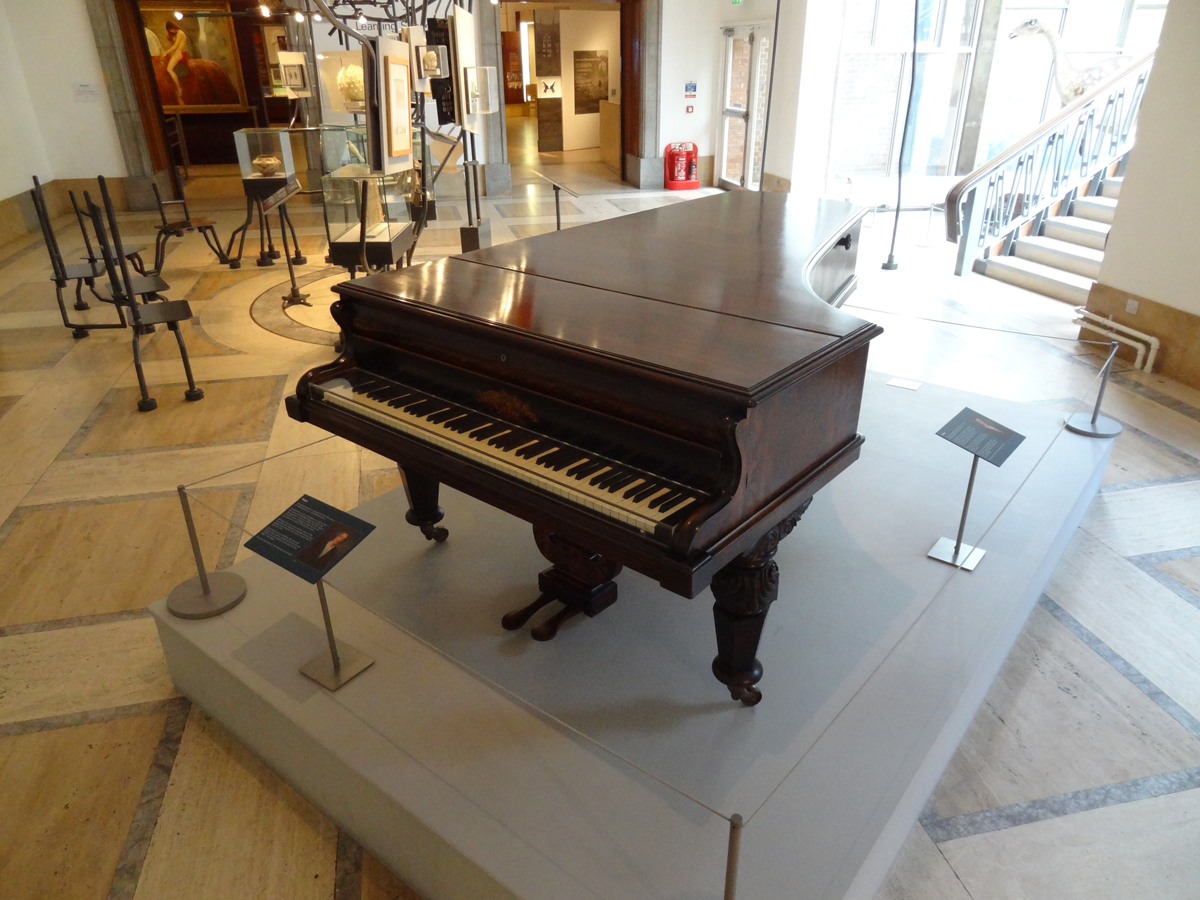
On 22 November 1869, this piano was delivered to a grieving household. Lewes’s middle son, Thornfield, had returned from farming in Africa with a painful illness and had died, aged 25, just a month previously. Neither Eliot, who was writing Middlemarch, nor Lewes, were able to work. That the piano was purchased now, marks its significance. Not surprisingly, no flurry of references to the new piano fills Eliot’s correspondence at this date. Fittingly however, the piano is an implied source of solace a decade later when, on the first anniversary of Lewes’s own death, Eliot’s diary for 8 Sept 1879 reads simply: ‘Darwin. Schubert’ (Journals, 180). ‘Darwin’ may denote a visitor, or his books; Schubert she must have been playing at the piano. Eliot’s journal further records that she had ‘Touched the piano for the first time’ after Lewes’ death on 27th May (Journals, 175). However the piano, which survives in the Herbert Art Gallery and Museum, represents not just the personal importance of music for George Eliot but its significance for numerous areas of Victorian culture.
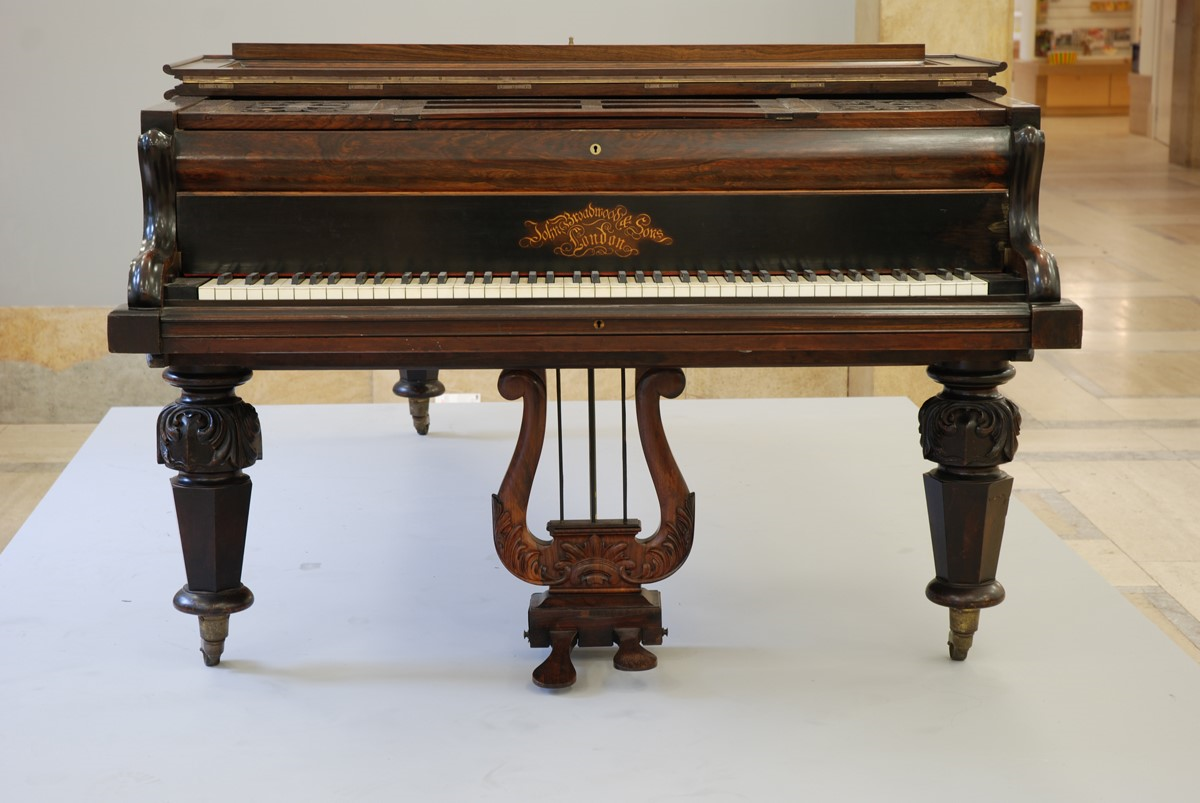
The purchase of this fine piano was possible because of Eliot’s success as a novelist, although the fact that it was acquired before the publication of Middlemarch, which made her wealthy, is a further indication of its priority. Nor was it the first Broadwood that Eliot had owned. The first, purchased in 1861, marked an early milestone in her successful career. The enthusiasm conveyed in Eliot’s letters communicates the central place a piano occupied in the Lewes’s domestic and social lives. ‘Today our new grand piano came – a great addition to our pleasures’ Eliot records in her journal for 1st October 1861 (Journals, 102). Later that month, she writes that a state of good health and spirits might be attributable to her ‘new grand piano, which tempts me to play more than I have done for years before’ (Letters, III:460). The next year she mentions being unhappy with the piano’s touch – no doubt among the reasons for subsequently replacing it (Letters, IV:30). Despite this reservation, Eliot makes repeated references over the following years to the benefits she derives from ardent and energetic practice (Letters, IV:120, 127). In 1862, the Lewes’s rearranged their entire drawing room to improve the piano’s position and sound (Letters IV:30). It became a centrepiece of social gatherings including the increasingly important Sunday salon held at The Priory, their house at 21 North Bank, Regents Park, purchased in 1863; from 1869 this will have been the place occupied by the new piano, when the Sunday salon resumed shortly after the death of Thornton Lewes for whom Eliot had frequently played during his illness. Their musical evenings were attended by an array of literary and scientific figures, including the poet Robert Browning and Herbert Spencer, founder of sociology, who would join in the singing.
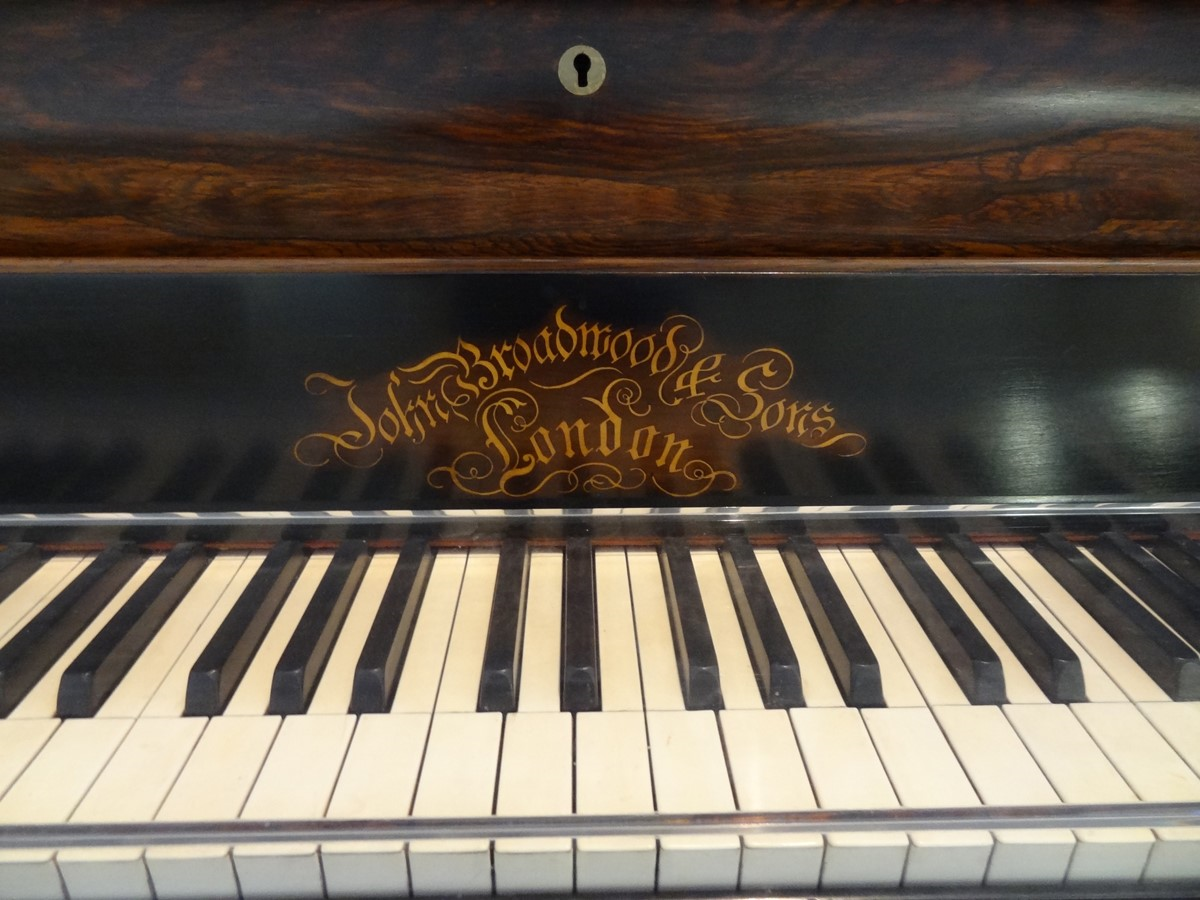
The arrival of Eliot’s first Broadwood had been celebrated, on 5th October 1861, with a ‘Beethoven night’ the first of many musical evenings in which music of the Romantic period predominated (Letters, III:456). Eliot owned numerous Beethoven scores and when she acquired her first Broadwood, had been playing Beethoven duets ‘with increasing appetite every evening’ with her eldest step-son, Charles Lee Lewes (Letters, III:346). The liberal politician Frederick Lehmann (1826-1891), who visited The Priory to play Mozart and Beethoven sonatas for piano and violin with Eliot during 1866, described her as ‘a very fair pianist, not gifted, but enthusiastic, and extremely painstaking’; their audience was Lewes who would ‘groan with delight whenever we were rather successful in playing some beautiful passage’ (Letters, VIII: 385 n.7). In October 1868, Eliot wrote to Charles requesting him to buy ‘some music from your city man’; she asked Charles to choose ‘things by Schumann and Schubert, of the genre, for example, of Schumann’s Arabesque.’ (Letters, IV:478). Also I should like to have an arrangement of Verdi’s best operas for the Piano. Pater likes hearing those things’ (Letters, IV:478). Verdi was certainly not the only opera composer to be played, in piano reduction, on this new piano. In the late 1870s, when Lewes was already seriously ill, John Cross discovered him giving enthusiastic renderings of Rossini, singing ‘the great portion of the tenor part in the Barber of Seville – George Eliot playing his accompaniment, and both of them thoroughly enjoying the fun’ (Cross, III:334). The composers that Eliot played on this piano are frequently alluded to in her novels and Romantic composers in particular were a standard against which literary contemporaries were measured. In an 1856 review she wrote that ‘Turning from the ordinary literature of the day to such a writer as Browning, is like turning […] to the distinct individuality of Chopin’s Studies or Schubert’s Songs’ (Selected Essays, 350). While most details of their existence are lost to us, the wood and metal structures of this piano, that once sounded in response to Eliot’s touch, embody the meetings in music and conversation shared by the writer and her contemporaries.

Works Cited

George Eliot, The George Eliot Letters, ed. Gordon Haight, 9 vols., (Yale University Press, 1954-78). Cited as Letters.

The Journals of George Eliot., eds. Margaret Harris and Judith Johnston, (Cambridge University Press, 1998). Cited as Journals.

George Eliot’s Life: As Related in her Letters and Journals, ed. J.W. Cross, 3 vols., (Blackwood, 1885). Cited as Cross.

Selected Essays, Poems and Other Writings, ed. by A. S. Byatt and Nicholas Warren, (Penguin, 1990). Cited as Selected Essays.

Further Reading

Delia da Sousa Correa, George Eliot, Music and Victorian Culture, (Palgrave-Macmillan, 2003).

‘George Eliot, Schubert and the Cosmopolitan Music of Daniel Deronda’, The Edinburgh Companion to Literature and Music, ed. Delia da Sousa Correa, (Edinburgh University Press, 2020).

Photographs of George Eliot’s piano by kind permission of the Herbert Art Gallery & Museum, Coventry
 

‘The Antipodes’ by Annie Baker at the National Theatre

Alistair Daniel, PhD student and Associate Lecturer, Creative Writing

In his monumental study, The Seven Basic Plots, Christopher Booker identified the seven types of story that, he argued, recur time and again, in everything from fairy tales to Hollywood blockbusters. Booker’s is one of several well-known storytelling theories that make fleeting, uncredited appearances in The Antipodes, the new play by the Pulitzer Prize-winning American playwright Annie Baker, currently making its UK debut at the National Theatre in a production co-directed by Baker herself. An enigmatic, elusive exploration of storytelling, The Antipodes is set in an anonymous boardroom where six writers are attempting to develop some kind of epic new show about monsters. The writers have been hired by a legendary showrunner called Sandy (played, in a piece of inspired casting, by Conleth Hill from Game of Thrones) and their job, Sandy explains, is to tell each other stories – any stories – until something leaps out.

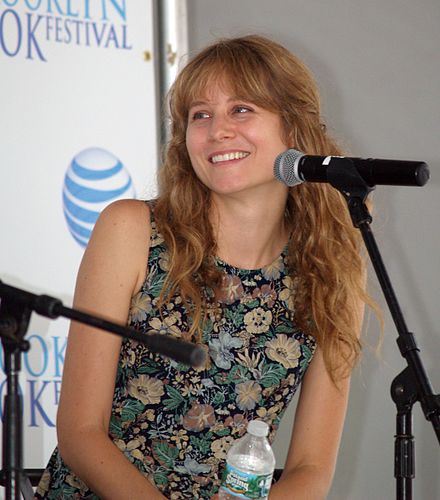
Annie Baker

The writers take to their task with relish, telling stories about everything from childhood traumas to their greatest failures, tossing out monster ideas and crackpot theories of time. In Booker’s mythic terms, they are on a quest, albeit a very modern sort of quest in which no leaves the room, where boxes of Evian are stockpiled as if anticipating the kind of apocalyptic weather event that does, in fact, arrive.

It is never clear what the writers think they are doing, or how Sandy expects this process to result in a new work of art. As a method of creation it’s a bit like running a writing workshop in which everyone types out their favourite story until inspiration strikes. Which is not quite as mad as it sounds. The novelist Joseph O’Connor learned to write by obsessively copying John McGahern’s ‘Sierra Leone’ in longhand, gradually altering, reshaping and rewriting until he’d made it his own. In a storytelling landscape heavily populated by screenwriting ‘gurus’ who, as John Yorke puts it in Into the Woods, insist that ‘there must be an inciting incident on page 12’ (Yorke, p. xii) but can’t explain why, Sandy’s method may be as good as any other.

Besides, some things bode well. Some of the writers have been through Sandy’s ‘process’ before, with apparent success. One of them is part Icelandic, which seems promising to a room full of writers in search of the epic, and then there’s Adam, who is at least named after a character in one of the most famous stories of all. And yet, suffice it to say, things do not go to plan. As the writers reel off anecdotes – funny, strange and banal – eat, doze, and bicker over how many stories types there are (Booker’s seven, or George Polti’s 36?), the chances of Sandy’s monster show going into pre-production begin to look increasingly remote.

Any play about storytelling will inevitably be judged by its own ability to tell a story, and in this respect, The Antipodes doesn’t quite deliver in its season finale. Baker’s frame of reference is dizzyingly broad. As a story about a group of strangers trapped in a room, telling stories, The Antipodes nods to everything from The Decameron to Samuel Beckett’s Waiting for Godot – where Godot is both the studio boss (Max) who will either green light Sandy’s project or pull the plug, and inspiration itself. Perhaps it’s a version of Sartre’s No Exit, in which hell is listening to your colleague crack boiled eggs on the table and eat them (an allusion, perhaps, to the Chinese creation myth printed in the programme notes). But The Antipodes is also more than that. It’s a satire about writers who never do any writing (some readers may wince), about screenwriting psychobabble and the money pits behind television’s much-vaunted ‘golden age’. And it’s a play about gender politics in the #MeToo era, in which Eleanor, the only female writer in the room, is subjected to insidious forms of aggression from her (faintly monstrous) male peers. It’s about all these things, but above all it’s a play about the business of creation – what fuels it, where it comes from, and how it works.

Baker is far too interesting a writer to answer the questions she raises, or conform to screenwriting diktats about story shape, but as the play progresses the rich stew of ideas comes to feel a little undercooked. Tensions within the group never quite come to the boil, plot threads are picked up and discarded, as if Baker is dramatising her own struggles with creation, and while, in the end, we do get crisis, climax and resolution (John Yorke would approve), what any of it might mean remains frustratingly out of reach. But perhaps it’s fitting that a play (at least in part) about creative failure might itself stop just short of success.

The Antipodes runs at the National Theatre until 23 November

Booker, C. (2004), The Seven Basic Plots: Why We Tell Stories London: Continuum

Yorke, J. (2013), Into the Woods: How Stories Work and Why We Tell Them London: Penguin


Creative Writing Workshops on Word/Image Relationships

Patrick Wright, PhD Creative Writing Student

Over the last year or so, I have been facilitating a series of creative writing workshops on the theme of responding to images or objects. I was interested in exploring some outreach opportunities, especially the application of my current PhD research: on the ekphrasis of abstract or monochromatic artworks, supervised by Siobhan Campbell and Jane Yeh. In part, I was looking to test some of my poetic strategies and methods with the general public: those who already thought of themselves as practitioners or had a casual interest in creative writing.

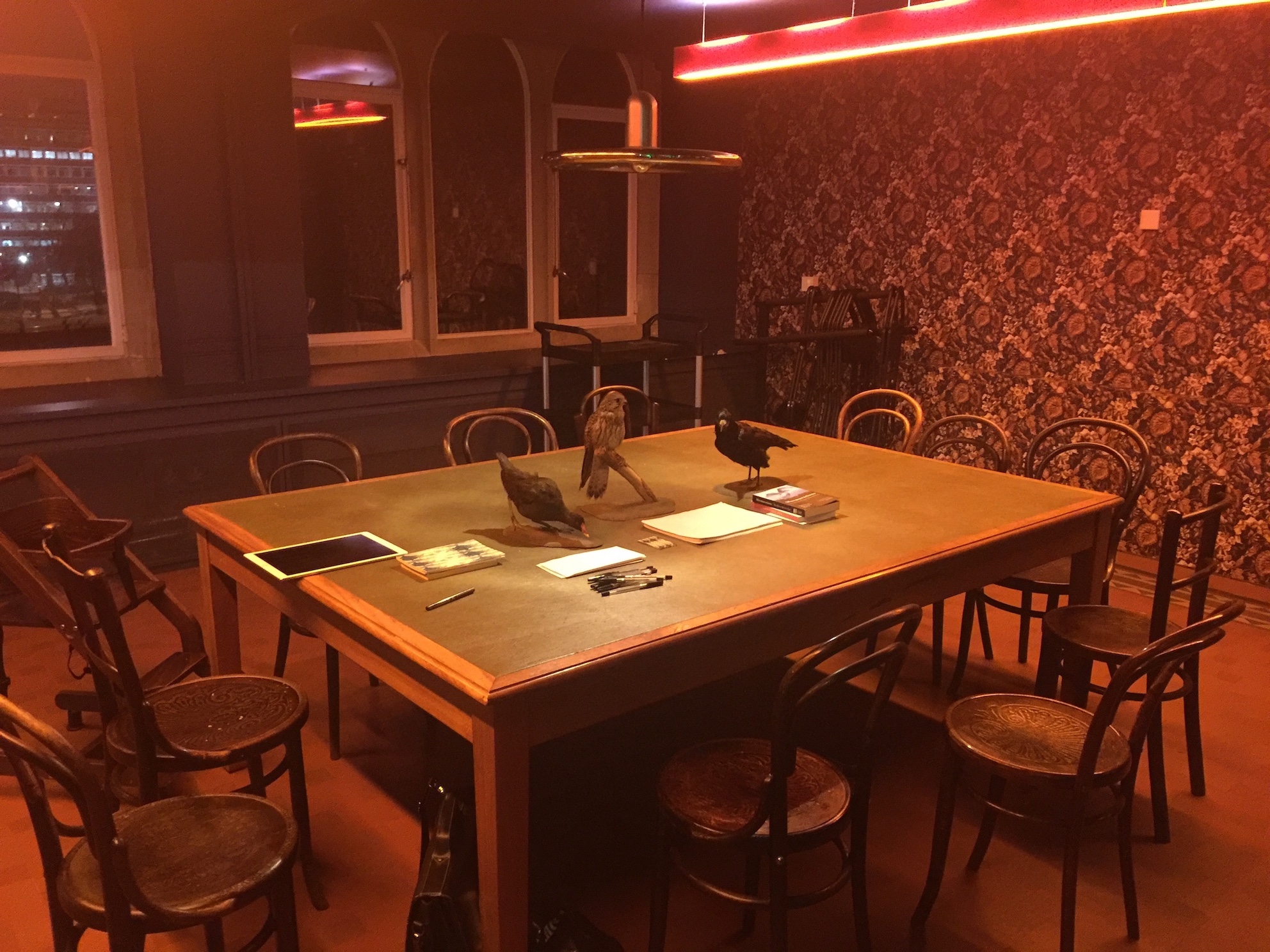
I began with a short series of workshops at the Whitworth Art Gallery and Manchester Museum (autumn 2018 – spring 2019). Here I asked participants to respond to a visual prompt. At the Whitworth, this was an artwork that could be freely chosen after having wandered around the gallery; and at the museum, I selected some artefacts from the holdings on the theme of ‘flight’, and these were presented in the middle of a table, as shown below.

The groups were asked to explore some free writing in response to their prompt over the duration of 25 minutes. We then discussed the experience and approach, and we had an opportunity to read out what we’d written.

Given that the series was funded by the Arts for Health Programme at the University of Manchester, and the workshops were aimed at carers, I also felt it was appropriate to discuss the therapeutic effects, if any. I was interested in the possibility of writing as catharsis, especially while using images or objects as a form of mediation. I was grateful to the participants that we were able to have these conversations towards the end of each session.

More recently, I ran a joint workshop (again on creative writing in response to images and objects) with Fran Hughes, as part of the AHRC conference on Trust and Truth at the University of Cambridge (September 2019). In this case the participants were, for the most part, postgraduates. Here we asked them to work in groups, using a similar method to that used in the parlour game ‘consequences’, to produce creative writing and images. Not only did the exercise result in some highly imaginative first drafts, it also worked fantastically well as an icebreaker and encouraged participants to get to know one another.

At present, I am now working again with Manchester Museum on the Creative Writing for Carers scheme. I have been asked to run a series of sessions through the autumn (2019), which will also function as a short course. With the additional time and scope, I want to explore a wider array of possibilities, especially in terms of how participants might approach their interaction with a chosen artefact. In addition to grounding what can often be highly specialised ideas (such as ekphrasis) in the playfulness of creative writing sessions, I also hope to glean new ideas for my own practice and add a social dimension to my research activity.