‘Things we cannot know’: Julian Barnes’ The Man in the Red Coat

Alistair Daniel, Associate Lecturer, Creative Writing

In June 1885, three Frenchmen – the prince Edmond de Polignac, Count Robert de Montesquiou-Fezensac, and the ‘celebrity gynaecologist’ Dr Samuel Jean Pozzi – arrived in London. They went shopping, had dinner with Henry James, and went home. It’s a thin premise for a story, fictional or real, yet from it Julian Barnes has woven a typically rich and absorbing tapestry in The Man in the Red Coat (2019).

From A History of the World in 10 ½ Chapters (1989) to Levels of Life (2013), Barnes has spent a long and garlanded career eluding categorisation and The Man in the Red Coat is no exception. Is it a group biography, a biography, or something else? As a portrait of its three protagonists it’s more than lopsided, since Barnes largely ignores Polignac in favour of Montesquiou and Pozzi, both of whom make fascinating subjects in their own right. Montesquiou was a snob with a taste for cruelty, picking up talented boyfriends and destroying them when he grew bored. The dark allure of his character was not lost on artists of the time, and the count appears in several novels, including Huysmans’ À rebours (1884) and Proust’s À la recherche du temps perdu (1913-27). He was also the model for Whistler’s Arrangement in Gold and Black (1891-2). It’s perhaps this artistic over-representation that encourages Barnes to focus on Pozzi, himself the subject of Sargent’s Dr Pozzi at Home (1881), a portrait that provides the cover, the title and the inspiration for this book.
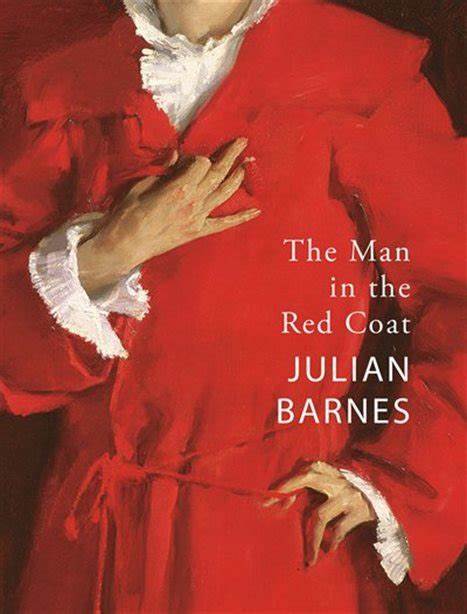
Image of book cover for ‘The Man in the Red Coat’ by Julian Barnes.

If Barnes recounts Montesquiou’s bad behaviour with relish, his sympathies lie firmly with Pozzi, a pioneering surgeon whose innovations in hygiene and surgical technique radically improved survival rates, particularly for bullet wounds to the gut. He treated both public and private patients and was tireless in his promotion of high medical standards all over the world. He was also something of an international playboy, hobnobbing with celebrities and taking mistresses to Bayreuth. Nor did his professionalism prevent him from seducing his patients, and Barnes is careful to trace the impact of his behaviour on his long-suffering family through the journals of his outraged daughter Catherine.

Pozzi himself kept no journal, and it’s perhaps for this reason that The Man in the Red Coat sidesteps conventional biography. In fact, for long stretches the book neglects Pozzi in favour of a stroll through fin de siècle Paris, with Barnes as flâneur and guide. It’s a world populated by artists, including Oscar Wilde, Sarah Bernhardt, the Goncourt brothers, Huysmans, Proust and a host of less illustrious figures, like the Symbolist poet and novelist Jean Lorrain, who wasted his talent in endless feuds (he once fought a duel with Proust).

Writing in the fragmentary, episodic style familiar from his recent fiction (The Sense of an Ending, The Noise of Time), Barnes grants himself licence to stray into any area that takes his fancy – the Dreyfus affair, duelling culture, Oscar Wilde’s tour of the US – and in many ways The Man in the Red Coat reads as a compendium of familiar Barnesian enthusiasms, including Flaubert, literary style, the nature of biography and 19th-century France. As a result the book, while never less than entertaining, is more extended essay than biography, a companion piece to Something to Declare (2002), his essay collection on French culture, liberally sprinkled with colour plates and photo cards of fin de siècle celebrities. It meanders, with frequent detours, through Pozzi’s life in loose chronology, before eventually arriving at his demise.

One of Barnes’ preoccupations – here as elsewhere – is with the challenges of historical memory. ‘“We cannot know”’, he writes, ‘is one of the strongest phrases in the biographer’s language,’ and in a late section entitled ‘Things we cannot know’, Barnes lists some of the unanswerable questions that surround Pozzi’s life. Many novelists would view the gaps in the historical record as an opportunity, as Barnes is well aware: ‘All these matters could,’ he notes, ‘be solved in a novel.’ Which begs the question: why didn’t he weave a novel out of such rich – and tantalisingly incomplete – material? After all, he has done it before: both Flaubert’s Parrot (1984) and Arthur and George (2005) made fiction from nineteenth-century lives. It’s a question that only intensifies at the book’s denouement, when a disgruntled patient shoots Pozzi in the gut and the most celebrated surgeon of the age suddenly finds himself under the knife. Here Pozzi’s life assumes the pattern of art. For some novelists the symmetry would be irresistible (Ian McEwan made a similarly ironic plot twist the climax of Saturday). But Barnes is unmoved. As a novelist he is allergic to neat plotting and glib denouements and, as Sebastian Groes and Peter Childs have pointed out, ‘the unanswered and unresolved meanings of life and death suffuse all Barnes’s work’ (2011, p. 9). In Barnes’ view, it is not the job of fiction to stitch life into pleasing patterns and shapes. It’s only in non-fiction that ‘we have to allow things to happen – because they did – which are glib and implausible and moralistic’ (Barnes, 2019, p. 258). It’s this commitment to life’s complexity, and the limits of knowledge, that accounts for the book’s episodic structure, a structure that, through its gaps and silences, its detours and shifts in focus and tone, embraces mystery, leaves loose ends untied and offers more questions than answers. In Flaubert’s Parrot, Geoffrey Braithwaite likens biography to a fishing net, ‘a collection of holes tied together’ (Barnes, 1984, p. 38). Nearly 40 years on from that award-winning novel Barnes is still fishing in these philosophical waters, hauling lost treasures from the deep, inspecting the flotsam, and contemplating all the things lost at sea.

The Man in the Red Coat is available in hardback.

Barnes, J. (1984), Flaubert’s Parrot, London: Picador

Groes, S. & Childs, P. eds (2011), Julian Barnes: Contemporary Critical Perspectives, London: Continuum
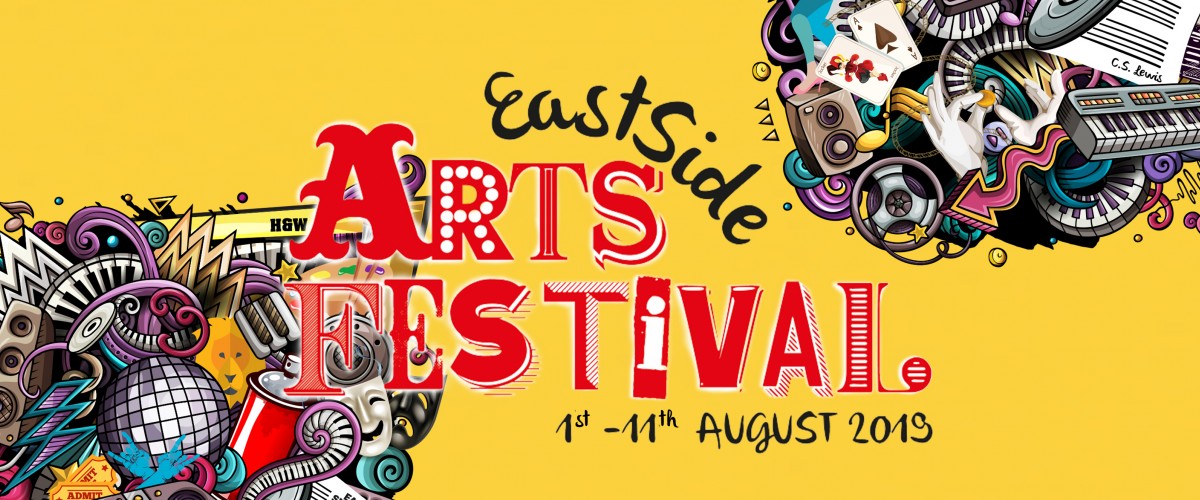
 

‘Let Me Tell You A Story’: Reflections on the EastSide Arts Festival, Belfast

Patricia Ferguson, PhD student, English Literature

‘Let me tell you a story’ was the principal theme of this year’s EastSide Arts festival. These are my reflections on four events which seem to me to resonate profoundly with the present state of affairs in Northern Ireland. The Irish genius for the ancient art of storytelling has never dimmed; it has become if anything brighter than ever in recent years. Libraries NI has its own Storyteller in Residence, whom I was privileged to meet. (Tales & Tunes With Liz Weir). Her first job had been as Children’s Librarian for the City of Belfast in 1976, when the Troubles were at their height and where they remained for the next twenty years. Undeterred by all this, she started a storytelling group at the Linen Hall Library in 1985, calling it ‘The Yarnspinners’: ‘I had a dream that one day there would be story telling groups all over Ireland. That dream has sort of come true; there are now the Tullycarnet Yarn Spinners, the Dublin Yarn Spinners, the Cork Yarn Spinners, there’s a group in Castlerock now as well.’[1]

Our event took place at Tullycarnet where yarns have been spun at least once a month for twenty-seven years. There were more than a hundred of us in that small library, brought to tears of grief and laughter by tales tragic, poignant, and hilarious, and beguiled by Maeshine’s exquisite melodies. If the musica universalis became audible to the human ear it would surely sound like this.

Word and song came together in a different way at St Martin’s Church on the Newtonards Road. (An Evening With EastSide Choir & Women Aloud NI) After each song, two members of the award winning writing group responded with stories or poems written specially for the occasion. The effect was startling; quite ordinary, well-known songs discovered the power to evoke the most personal memories and to inspire some intriguing yarnspinning. (I want to hear the murder mystery tale again!) All the same, I was constantly distracted by remembering where we were: St Martin’s Church of Ireland is just across the road from St Matthew’s Roman Catholic Church – a stone’s throw, in common parlance. As everyone in Belfast knows, plenty of those, and much worse, were thrown throughout the night of 27-28 June 1970 in what became known as ‘The Battle of St Matthew’s’. We are on the edge of Short Strand, a small Catholic enclave in the heart of Protestant East Belfast, where ‘Catholics believed that they were about to become “victims of a Protestant pogrom” and Protestants believed they were on the “eve of an IRA insurrection”’.[2] The rights and wrongs of these perceptions are still argued over and each can sound as plausible as the other: compare and contrast, for example, the accounts of the battle given by An Phoblacht and Long Kesh Inside Out.[3] [4]

In such an impasse is a just judgment even possible? This question is as old as it is intractable; it was asked by Sophocles in the Antigone more than two millennia ago and, still unresolved, was discussed here at the Festival by Northern Ireland’s Attorney General himself, John Larkin QC. (Antigone: A Choice Between Law and Justice?) The Irish have long seen parallels between the Greek classics (especially Antigone) and their own situation. In 1984, while the Troubles raged around them, Irish playwrights presented it in four different versions. One of these, Tom Paulin’s play, The Riot Act, is set in Northern Ireland, where: ‘Creon becomes a Unionist politician devoted to law and order, and Antigone becomes a republican who wishes to bury her dead brother. Here the alien laws of Creon’s Unionist state are opposed by Antigone’s devotion to the native ethos of family, kin, tribe. As Antigone says: “Down in the dark earth/ there’s no law says,/ Break with your own kin, go lick the State”. ‘[5]

Seamus Heaney took up this theme in his own translation of the play, The Burial at Thebes (London: Faber, 2004). Comparing the burial of the hunger striker, Francis Hughes, in 1981 to Antigone’s burial of her brother he asked: ‘By what right did the steel ring of the defence forces close round the remains of one who was son, brother, comrade, neighbour, companion?’ and found no satisfactory answer. I heartily recommend the lecture, which is in the public domain and can be found here: 

Immediately after the lawyer came the journalists. (Reporting the Troubles: A Discussion). This was a book launch for the second edition of Reporting the Troubles: Journalists Tell Their Stories of the Northern Ireland Conflict, compiled by Deric Henderson and Ivan Little (Newtonards: Blackstaff Press, 2019). They and their colleague Eamonn Maillie chaired the discussion. They looked at us with haunted eyes. They had been there throughout those thirty years, never knowing whether they would find themselves reporting atrocities happening in their own families. The book is indeed, as it says on the cover, ‘a landmark book, raw, thought provoking and profoundly moving, a remarkable act of remembrance’. But always the question arises: how much should be remembered? Surely the best thing to do is let the past go? Gail Walker, editor of the Belfast Telegraph, thinks not. ‘That’, she says in her contribution to the book, ‘is a recipe for mass neurosis, delusion, and moral hypocrisy – that, to keep the “peace” we must inflict another kind of violence on survivors, censoring their stories, blue-pencilling the raw heart and hurt mind’. (pp. 222-23)

On the contrary, we must hear as many stories as possible.

[1]    ‘Meet the Teller: Liz Weir’, Liz Weir: Storyteller, Writer, (2019) <https://www.lizweir.org/liz-goes-digital/> [accessed 21 August 2019]

[2]    ‘Battle of St Matthew’s 27-28 June 1970’, Belfast Child: Remembering the Victims, <https://belfastchildis.com/2016/06/26/battle-of-st-matthews-27th-28th-june-1970/> [accessed 21 August 2019]

[3]    ‘Remembering the Risen People: The Battle of St Matthew’s and the Falls Curfew’, An Phoblacht/Republican News <https://www.anphoblacht.com/contents/25115> [accessed 21 August 2019]

[4]    ‘De-bunking the Myth of the “Battle” of St Matthew’s’, Long Kesh Inside Out <https://www.longkeshinsideout.co.uk/?p=3720> [accessed 21 August 2019]

[5]    Amid Our Troubles: Irish Versions of Greek Tragedy, ed. by Marianne McDonald and J. Michael Walton (London: Methuen, 2002), pp. 52; 208.

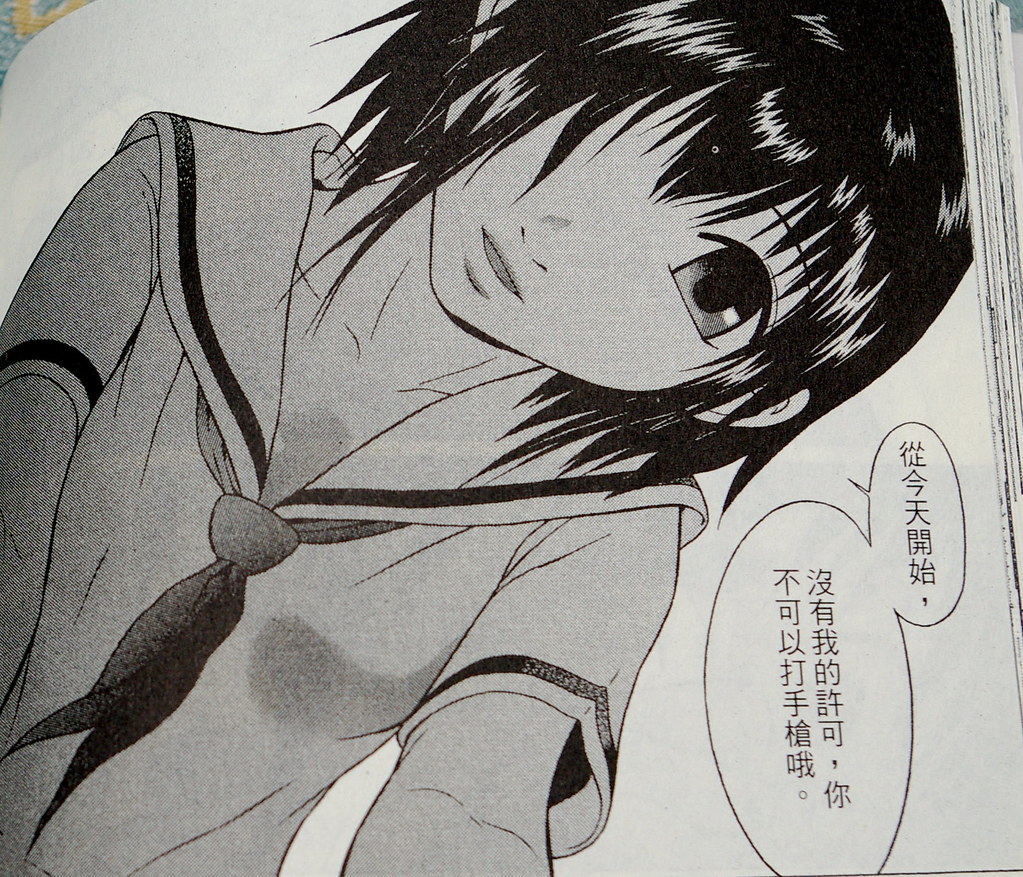
Manga, The British Museum

“思春期誘惑” by 南宮博士 is licensed under CC BY-SA 2.0

Francesca Benatti, Research Fellow in Digital Humanities

I recently visited the Manga exhibition at the British Museum (23 May-26 August 2019), the largest of its kind ever to take place outside of Japan. Manga is the name commonly applied to Japanese comics. Behind this simple term hides a galaxy of artistic, historical and cultural practices, which the British Museum exhibition elucidates for a Western audience.

Manga are composed of frames (koma) and contain a combination of black-and-white line drawings, speech balloons, onomatopoeia and symbols (manpu). Together, these form a language of visual storytelling that is central to Japanese identity and is increasingly popular in the rest of the world.

The exhibition begins by explaining the historical roots of manga, from the 12th-century Handscrolls of Frolicking Animals, to Hokusai’s 19th-century drawing manuals, to the satirical magazines inspired by Punch that emerged in the late 19th century. Kawanabe Kyōsai’s 17-metre Shintomiza Theatre Curtain (1880) is the spectacular apex of this part of the exhibition.

The ample section on Tezuka Osamu (1928-89) acknowledges his centrality in the development of modern manga through new publishing and artistic practices. Original artwork is on display from Tezuka’s seminal series, such as New Treasure Island (1947), Astro Boy (1952-68) and Princess Knight (1953-67), the first manga to address a female readership.

For a book historian like me, it was rewarding to see the attention paid to the dynamics of manga production. Interviews with manga artists (including numerous female mangaka such as Kōno Fumiyo and Hagio Moto) and with the commissioning editors of the major manga publishers illustrate the complexity of the creative and production processes of an industry worth £3bn a year in Japan alone. The weekly and monthly magazines serialising multiple titles, as well as the tankōbon collected editions can achieve sales of millions of copies across the various formats. By way of comparison, US comics titles struggle nowadays to sell more than 100,000 copies.

The diversity of contemporary manga is then illustrated through its multiple genres, including dramatic manga, comedy manga, shojo manga for female readers, shônen-ai or boys’ love manga (also aimed at women), shônen or boys’ manga and sports manga. Each genre is illustrated through noteworthy examples, such as the football manga Captain Tsubasa (a childhood favourite of mine in its anime television version), and Inoue Takehiko’s immensely successful basketball series SLAM DUNK and REAL, the latter notable for its portrayal of disability.

Where the exhibition truly shines is in its depiction of the sociological and cultural impact of manga. When studying literature, we are often taught to adopt a critical distance from our object of study. The opposite is true with manga, where audience participation is central to its impact, as shown here through exhibits and interviews from the twice-yearly Comics Market (Comiket).

The event, which attracts an audience of half a million otaku (persons with obsessive interests or fans), shows the extent to which manga readers enter into a dialogue with the medium. This takes the form of creative engagement through self-produced dōjinshi comics, which are sold at Comiket, and through the practice of cosplay (costume play), where fans dress up as their favourite characters, seeking physical immersion in their favourite manga storyworld.

The future of manga is the subject of the final section. Here the focus is on the growing transmediality of the form. Increasingly, print manga are part of a complex ecosystem that interweaves digital comics, television and games, highlighting the permeability of the form to new technologies and publics. The growing presence of manga outside of Japan is also brought to the fore, through collaborative works and through the adoption of the visual language of manga by European and American creators The appeal of manga to a wide audience both in Japan and in the rest of the world, its ability to adopt multiple registers, from escapism to social engagement, its embracing of new technologies and formats, all suggest that this art form will continue to transform and to engage readers for the foreseeable future.

Accompanying the exhibition is also an excellent catalogue edited by curators Nicole Coolidge Rousmaniere (British Museum) and Matsuba Ryoko (Sainsbury Institute for the Study of Japanese Arts and Cultures, University of East Anglia).

‘Of These and Other Worlds’: Reflections on the C. S. Lewis Festival, Belfast

Patricia Ferguson, PhD student, English Literature

Saturday November 3 is described in the brochure as ‘The Day of Magical Thinking’, but it seems to me that we were privileged to enjoy a whole week of magical thinking. The title of this year’s C. S. Lewis festival ‘Of this and Other Words’ (November 3 – 7) is adapted from Of Other Worlds, a collection of Lewis’s essays and stories in which this theme is explored. He gives warning that it is a serious matter: a sojourn in fairy land, ‘far from dulling or emptying the actual world, gives it a new dimension of depth [ … ]. It is an askesis, a spiritual exercise’.[1]  #

When, in the spring of 1916, he first read George Macdonald‘s Phantastes: A Faerie Romance for Men and Women, he found that a light from the other world came shining into this one, adding cheer to mundane things like ‘the bread upon the table’.[2]  This is Belfast, a city unrivalled for its hospitality, and that is how the festival begins, with bread upon the table (‘Festival Launch Breakfast’ at the Park Avenue Hotel), and yes, it is enchanted, both by its quality and by an inspirational speech made by Damian Smyth, Head of Literature at the Arts Council, and also a poet known for his ‘search for the uncanny, and how the local becomes the universal’.[3]

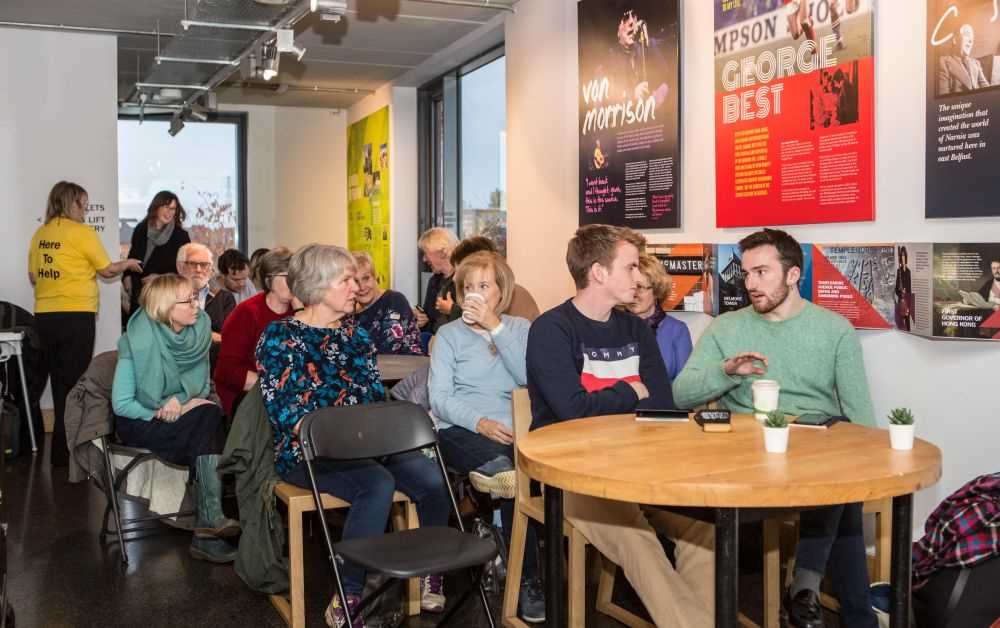
Audience members in conversation. Credit: Nurse Ratched Photography.

There are workshops in crafts and creative writing, activities for children, concerts, lectures, and book discussions, some seventy events in all. I choose from the list of lectures and book discussions, and soon I begin to notice something unexpected: a reversal of the usual meaning of ‘safe space’ as a venue, or an event, in which controversy is forbidden. It’s unexpected because, in this deeply divided society, a dangerous courtesy has developed which treats the whole city as a safe space of the usual kind. It obliges people to avoid saying anything that would identify their position as Catholic or Protestant. I’ve fallen into it myself. Because I’m Scottish, everyone assumes that I’m Protestant; I seldom correct the mistake. It’s dangerous because, although the violence has subsided, the reasons for it have not, and the words spoken are not the words that are meant, which are these: ‘I can’t ask, but I need to know, and all the time we talk I am looking for the clue that will tell me whether you are one of us or one of them’.

This being so, what is likely to happen when the Socratic Debate is given the motion: This House Believes that Churches are Holding Our Society Back, attracts a capacity audience, and has together on the same stage, the editor of the Irish Freethinker, the pastor of an ‘alternative’ church denounced as heretical by most of the others, an uncompromising Catholic, and the director of the Evangelical Alliance, all of whom speak, with passion and eloquence, the words that are meant?

There was no debacle, but plenty of fierce argument, focusing on Conor Cruise O’Brien‘s indictment of ‘the harsh re-emergence in recent years [ … ] of “sacral nationalism”’.[4]  It was pointed out that sacral politics had bedevilled Northern Ireland for four hundred years, but that evening people hammered out their views on abortion and same-sex marriage without compromise, but with good humour. Someone remarked on the relief of having a ‘safe space’ in which to do so. The motion was carried by a small majority; such an outcome would have been unthinkable just a few years ago.

This atmosphere prevailed throughout the festival. In ‘Faith and Fiction Readings’, Jan Carson, who was brought up in an exceptionally strict Presbyterian setting, spoke of her love for the Catholic writer Flannery O’Connor; academic Andrew Cunning chose novelist and essayist Marilynne Robinson, a Congregationalist with a liking for Calvin; Pádraig Ó Tuama, Irish speaker, poet and leader of the Corrymeela Community read to us from the poems of Emily Dickinson.

Corrymeela works tirelessly for reconciliation. I warm to its description of sectarianism as ‘belonging gone bad’.[5]  Then there was ‘Exploring the Protestant Imagination’, addressing tough words to both sides: to the Republicans that their works are not works of art, they are merely defensive, because art must imagine beyond itself; to the Unionists that that name is a misnomer, because they are not Unionists at all if they refuse the citizens of Northern Ireland the same rights as are enjoyed everywhere else in the United Kingdom.

I postpone writing about the ‘Till We Have Faces Book Discussion’ because that needs a whole piece to itself, which leaves me just enough space for one final reflection. Emma Must read to us from some of her engaging and delicate poems, including Belfast Pastoral which describes a city transformed from that of the Troubles. The last line goes round and round in my head: ‘And this is no longer the city you’ve read about’.[6]  Alas, it is, but hidden under the courteous veneer I spoke about earlier.

As the new Glider bus passes the small Catholic enclave of Short Strand, I look at the network of ‘Peace Walls’, and remember that Emma Little-Pengelly, DUP Member of Parliament for South Belfast, was so concerned about its name being given to the bus stop that she set up a petition to try and change it.[7]  But despite her best efforts, there is hope. Sometimes the peace walls open, as happened two months ago on Townsend Street when the heavy metal barrier that separates the Shankill from the Falls was opened for a street party.[8]  This year’s was the sixth C. S. Lewis Festival. It will take many more, and many other festivals and family fun days, but the determination is there to fulfil Emma Must’s vision at its deepest level, and it will prevail.


References

[1]     Clive Staples Lewis, Of This and Other Worlds: Essays and Stories, ed. by Walter Hooper (London: Bles, 1966), pp. 29-30.

[2]     C. S. Lewis, Surprised by Joy: The Shape of my Early Life (London: Fontana, 1959), p. 145.

[3]     ‘Nessa O’Mahony in conversation with Damian Smyth’ (2018) <http://theatticsessions.tv/the-attic-sessions-25-in-conversation-with-damian-smyth/> [accessed 19 November 2018]

[4]     Ideas Matter: Essays in Honour of Conor Cruise O’Brien, ed. by Richard English and Joseph Morrison Skelley (Lanham, MD: University Press of America, 2000), p. 17.

[5]     <https://www.corrymeela.org/programmes/sectarianism> [accessed 19 November 2018]

[6]     The Future Always Makes Me So Thirsty: New Poets from the North of Ireland, ed. by Sinéad Morrissey and Stephen Connolly (Belfast: Blackstaff Press, 2016), p. 214.

[7]     Gareth Cross, Belfast Telegraph Digital, 27 July 2018 <https://www.belfasttelegraph.co.uk/news/northern-ireland/dup-mps-short-strand-belfast-bus-stop-serious-concerns-but-its-traditional-says-translink-37160029.html> [accessed 19 November 2018]

[8]     Maurice Fitzmaurice, Belfast Live, 22 September 2018 <https://www.belfastlive.co.uk/news/belfast-news/shankill-falls-coming-together-interface-15185175> [accessed 19 November 2018]

The Book as Cure: Bibliotherapy and Literary Caregiving from the First World War to the Present

Jenny Cattier
PhD student, Anglia Ruskin University

When I saw the conference programme for The Book as Cure: Bibliotherapy and Literary Caregiving from the First World War to the Present, I genuinely could not believe my luck.  As a creative writing PhD student researching bibliotherapy, there were so many compelling paper titles it was difficult to decide which panels to attend.  In fact, it was the ‘Reading and Self-improvement’ event, part of the AHRC funded ‘Reading Communities: Connecting the Past and the Present’ project (also run by The Open University) in March 2016 that inspired me to pursue both my own creative writing and this field of academic research. Since then I have been immersed in existing scholarship on bibliotherapy and have started to design my own empirical research in the area. However, as every PhD student knows too well, independent research can be isolating and lonely. There really is no substitute for a conference and the opportunity to listen to and question experts in your field.  Fortunately for me The Book as Cure appeared on my radar just as I was beginning to feel the need for peer input very keenly.

Under the aegis of the Open University’s History of Books and Reading (HOBAR) research collaboration and organised by four English and Creative Writing academics at The Open University – Shafquat Towheed, Siobhan Campbell, Sara Haslam, and Edmund King – supported by plenary speakers Dr Jane Potter (Oxford Brookes University) and Dr Peter Leese (University of Copenhagen), the event marked the centenary of the war’s end and guided attendees on a bibliotherapeutic journey from wartime to the present.

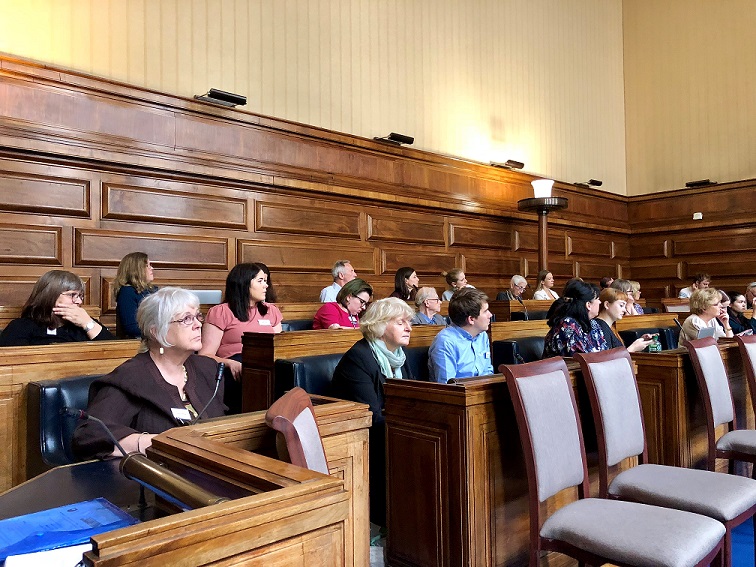
Photo: Shafquat Towheed

Dr Potter opened the sessions by describing some of the perceptions surrounding bibliotherapy during the First World War; not only in terms of its importance to traumatised and injured soldiers, but also for those left waiting at home for loved ones. Her keynote lecture: ‘The Solace of Literature: Reading and Writing in the Great War’ noted that psychiatrists, nurses and surgeons became increasingly convinced of the therapeutic benefits of reading and quoted one wartime caregiver who observed that until this point “We protected his [the soldier’s] stomach but forgot his brains.” She also highlighted the importance placed on the hospital librarian who “understood both books and men”, a highly esteemed and respected role, that was remarked upon across several of the day’s presentations.

As was acknowledged on Twitter, a number of key themes emerged early on: we repeatedly heard the terms ‘administering’, ‘prescribing’, and ‘dispensing’ used in relation to the provision of books for their curative properties. Mary Mahoney’s research suggests that the adoption of a very scientific or medical approach to bibliotherapy was particularly prevalent in America in the 1920s and 1930s. These analogies were echoed throughout the day, with references to reading acting as medicine for the troubled mind. An excellent example of this came from the journal of the writer and scientist (and MS sufferer) W.N.P. Barbellion (1889-1919), who wrote in his journal the phrase: ‘what I do is drug my mind with print’. We heard doctors of the day cautioning on reading the ‘wrong’ kind of novels, and how the consumption of these could cause ‘overdose’ and lead to ‘hysteria’.

This leads us to the books used in bibliotherapy: there have been many differing opinions over the last two centuries about what is considered suitable reading material. Should specific books be prescribed, or avoided, based on a particular illness or condition? One wartime writer noted that ‘Jane Austen has taken her fragrant way into a surprising number of dug-outs’ which stood in contrast to the advice of some medical professionals of the time, who recommended literature that promoted ‘detachment, elevation, and mental economy’.  Kipling’s ‘The Janeites’ also refers to Austen’s, perhaps unexpected, popularity with those in the trenches. On this subject, Laura Blair’s presentation: ‘Reading, Asylum Libraries, and the Asylum War Hospital Scheme’, we heard how asylums and their libraries were turned over to war hospitals and how strong concern was voiced regarding ‘appropriate’ reading material and particularly the fear of encouraging ‘addiction to novels’.  Yet, from soldiers’ diaries and hospital librarians’ records we can see that reading tastes were eclectic, with detective stories, poetry and romance very much in demand.

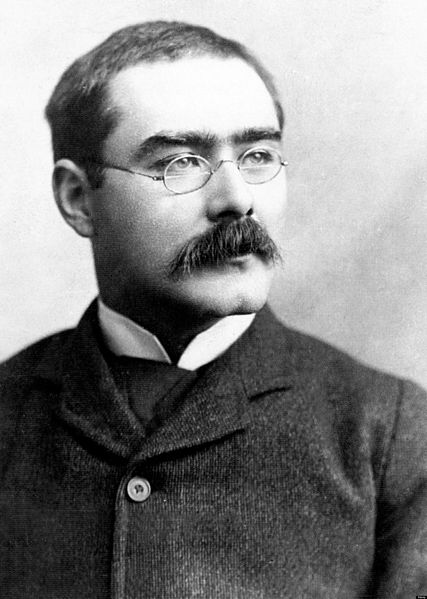
Portrait of Rudyard Kipling from Rudyard Kipling by John Palmer.  Used under Wikipedia:Text of Creative Commons Attribution-ShareAlike 3.0 Unported License

The subject of the detective tale used in bibliotherapy was broached several times; first in George Simmer’s paper “Kipling’s ‘Fairy-Kist’: Bibliotherapy Gone Haywire?”. Simmer reviewed what may have been Kipling’s own experience of bibliotherapy, making the case that Kipling’s childhood reading of Julia Ewing influenced the writing of his only detective story, Fairy-Kist (1928), about an ex-serviceman who hears voices, and ends up the prime suspect in a murder case. Simmer suggests that Ewing was the Jacqueline Wilson of the nineteenth century, taking difficult subjects and making them accessible, this being why she would have appealed to the troubled young Kipling.

An especially emotive case study demonstrating the efficacy of bibliotherapy for children suffering from post-traumatic stress disorder came in the final session of the day from Wendy French who read a poem from an adolescent boy. His writing expressed the depths of his self-loathing by listing all the ways ‘shit’ served more purpose in life than he did.  This particular boy related to Michael Morpurgo’s illustrated book Not Bad for a Bad Lad in his counselling sessions and this enabled an on-going and positive dialogue with French.

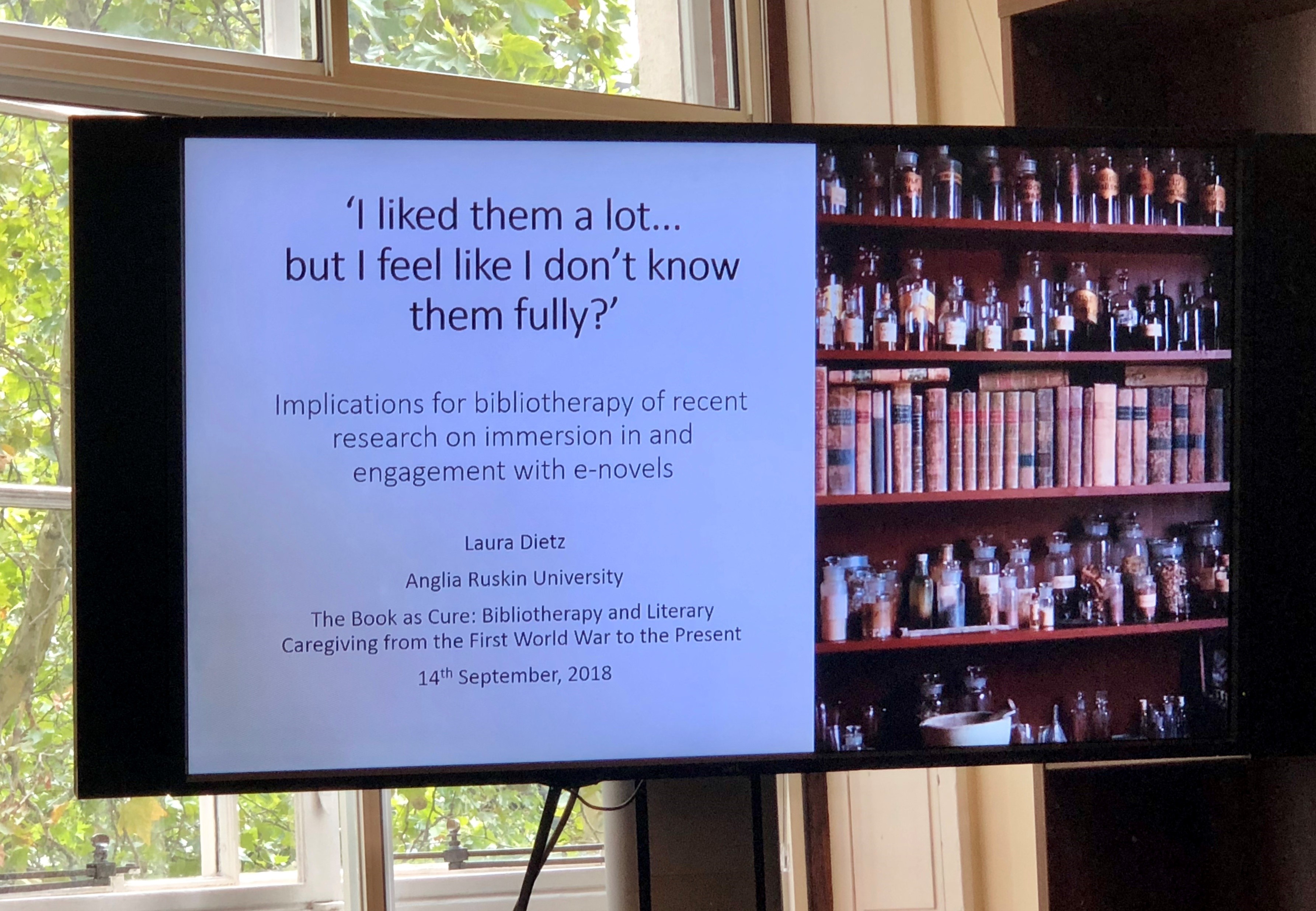
A particular highlight for me was the chance to hear in detail the important research being undertaken by Laura Dietz, my second supervisor at Anglia Ruskin University.  Her work into immersion and engagement with e-novels, suggests that screen reading, on devices such as Kindles and iPads, may see the reader equally immersed in the narrative as with a printed book. For many reasons, most notably their accessibility, digital books are critical to bibliotherapeutic practice. Dietz’s research used a wider range of e-book formats compared to earlier studies, which is perhaps one of the reasons her findings reveal narrative immersion to be a more nuanced or complex phenomenon than was initially believed.

On a personal level, one of the standout aspects of conference was the friendliness and generosity of the organisers, experts and panellists. All of the presentations I attended were insightful and persuasively communicated. I am delighted to have already exchanged emails, received papers and references for further reading that will enrich my research, which explores the place of short and fantasy fiction in bibliotherapy for women with depression.

Photo: Shafquat Towheed

In the summary session we mused over the key questions that had arisen over the course of the day: Is reading inherently good? Does the genre of the literature make a difference? Is the term ‘bibliotherapy’ itself a valid or helpful one? What does the future hold for the field and who should be advocating and delivering bibliotherapy? Is the future digital? Is the efficacy of bibliotherapy limited to specific audiences? For each of these questions the conference provided empirical indicators, anecdotal evidence and qualitative findings, all of which deserve further, deeper, and broader exploration. I, for one, hope that there is a follow up conference for The Book as Cure and I expect this sentiment is shared by the majority of attendees.

I’ll end my account with a quote from my own paper where Alan Bennett, in William Seighert’s The Poetry Pharmacy, encapsulates the essence of a good book but also that of successful bibliotherapeutic intervention:

“The best moments in reading are when you come across something – a thought, a feeling, a way of looking at things – which you had thought special and particular to you. Now here it is, set down by someone else, a person you have never met, someone even who is long dead. And it is as if a hand has come out and taken yours.”

Jenny Cattier is a PhD researcher at Anglia Ruskin University examining the therapeutic potential of short fantasy fiction for female depression. Her thesis will be fifty percent research and critical commentary, and fifty percent of her own creative writing which will take the form of a collection of short stories. 

Reflections on EastSide Arts Festival, Belfast, 2-12 August 2018

Patricia Ferguson, PhD Student, Department of English

The Director of the EastSide ArtsFestival writes, in the brochure’s welcome page: ‘…if this part of the city is your home, the festival is our annual invitation to you to celebrate and enjoy the creative energy that surrounds you. If you’re a visitor, let us be your hosts; you will receive the warmest of welcomes’. I am a visitor, and the welcome could not have been warmer. A Big Top has gone up in C. S. Lewis Square for circus events, family fun, and evenings filled with music. There are venues for authors to give readings of their poetry and prose, guided walks and bus tours, one hundred and twenty six events in all! Choosing between so many is not easy, but I decide in favour of readings and walking tours because, as the welcome page points out, the inspiration comes from ‘the landscape, history, culture and above all, people of east Belfast‘.

These four go together because, as I see for myself on the two walking tours, in every part of east Belfast, from the working class terraces of Newtonards Road (‘Communities Shaped by Conflict’) to the detached houses and gardens of Belmont and Sydenham, (‘C. S. Lewis Walking Tour’) the landscape is dominated by history and culture in two forms, and these likewise belong together. Look around you anywhere in east Belfast, and on the skyline you will see Samson and Goliath, Harland & Wolff’s enormous, bright yellow gantry cranes, and lining every street you will see Loyalist flags. Harland & Wolff grew from small beginnings in 1861 to an enterprise which, by 1919, owned 220 acres, employed 22,000 people, but was plagued by sectarianism.[1]  ‘The shipyard workers identified with a Protestant state for a Protestant people’. Catholic workers were expelled, violence followed so deadly that in 1969 ‘Catholics whose homes had been attacked when they were children found themselves being attacked again in what seemed like a re-run of the 1920s pogroms’.[2]

As on the one side, so on the other. On the ‘Conflict’ walk we visited the Andy Tyrie Interpretive Centre, an Ulster Defence Association museum named in honour of one of its earliest commanders. The Tyrie family was one of many Protestant households forced out of their homes by Catholics. As time went on Andy came to realise that the way forward must be political, but many others did not. He himself narrowly escaped death in a car bomb attack set by UDA hardliners in 1988.[3]  As we leave the museum, still reflecting on these things, a different guide – as it must be, even in 2018 – takes us a mere yard or two into a different world. This is Bryson Street in the Short Strand, a Catholic enclave of around 3,000 people surrounded by the 60,000 Protestants of Inner East Belfast.[4]  This is where in August 1971, as a consequence of the internment debacle, the residents had to flee while the wall went up, destroying houses to partition the streets. A headline in the Irish News for 12 August 1971 reads: ‘Bryson Street Dies in “Scorched Earth” exit’. Although I am Catholic myself, I am glad not to be alone here; forty years have gone by, but the fear and suspicion remain.

This is an Arts Festival. Can the mere act of painting, or writing plays and poetry, have any healing properties? Shelley Tracey, who read to us from her new collection of exquisite lyrical poems (‘Prose, Poetry, and Pastries’) told me about an oral history project of her own which demonstrates this very clearly.[5]  The Prison Arts Foundation provides Northern Ireland’s prisons with mentors, writers, and artists-in-residence ‘to release the creative potential of those previously excluded or from marginalised communities, as well as those serving custodial and community sentences’. (p. 10) This fits perfectly with the concept of the Restorative City discussed at the Imagine! Festival earlier in the year. I am especially moved by ‘SG’, a young man whose experiences in helping to create a Holocaust Museum at Magilligan transformed his prejudices into ‘a desire to communicate the importance of tolerance and acceptance’. (p. 7) He came to understand that ‘dehumanization can start even by calling people names’. (p. 41)

It is ‘ZM’, however, who has me in tears. She is out of prison now and thriving, except that she uses an alias because of ‘the people who wouldn’t want me to be doing OK’. I become aware that this malignant mindset, all too common and constantly aggravated by social comment, is a stain in my own heart too. One of Hickey’s respondents described this barrier in the mind as ‘the point of no return’. (p. 43) Belfast’s festivals provide an antidote: they show that, against all the odds, barriers can be dismantled, a point of return can be found.

[1]     ‘Harland and Wolff’, in Grace’s Guide to British Industrial History <https://www.gracesguide.co.uk/Harland_and_Wolff> [accessed 25 August 2018]

[2]     Kevin Johnson, Irish Times, 29 November 2008 <https://www.irishtimes.com/news/sectarianism-and-the-shipyard-1.916936> [accessed 25 August 2018]

[3]     Belfast Telegraph, 15 September 2002 <https://www.belfasttelegraph.co.uk/imported/struggle-for-power-within-uda-28130828.html> [accessed 25 August 2018]

[4]     Rosalind Hickey, Reflected Lives: Intergenerational Oral Histories of Belfast’s Peace Wall Communities (Belfast: Belfast Interface Project, 2018), p. 15

[5]     Shelley Tracey, Building Foundations for Change through the Arts: An Inquiry into the Impact of Participation in Prison Arts Foundation’s Programmes (Belfast: Prison Arts Foundation, 2017)

Somewhere in Between – Review

Somewhere in Between: Four Collaborations, Wellcome Collection, Euston Road, London, 8 March-27 August 2018

Sally O’Reilly, Lecturer, Creative Writing

‘Under’: Martina Amati and Kevin Fong. Courtesy of The Wellcome Collection. Used under Creative Commons Attribution 4.0 International Licence

I walk into a black box, disorientated for a moment as the space resolves itself. Giant blue screens show human shapes dancing on tightropes, strange sub-aqua acrobats. Sliding down against one dark wall, I take out my notebook and write in the darkness, wondering if by doing this I am rendering the experience of being here inauthentic. Over-thinking, under-feeling, creating responses that sound coherent when in reality I’m confused. There is a sound track which has a rhythm of breathing, suddenly interrupted by a tannoy announcement from Reception – the ‘Teeth’ tour commences shortly. I am here, but should I be?

The ‘Somewhere in Between’ exhibition at London’s Wellcome Collection is described by the Londonist as ‘wonderfully immersive’ and yet for me its reach and diversity make it a curiously distracting experience. Four collaborations between artists and scientists have created work which explores ideas relating to HIV, food production, sensory perception and the potential of the human body. There is a 54-page booklet providing copious background information, and yet somehow I feel lost.

Given that there are fine distinctions between definitions of ‘multidisciplinarity’,‘ interdisciplinarity’ and even ‘transdisciplinarity’, the title ‘Somewhere in Between’ is usefully vague. Outside in Euston Road, the temperature is close to 30 degrees. Inside the building, there are expensive books, delicious cakes, metropolitan cool.

The figures now flit against the turquoise blue. In the installation ‘Under’ artist Martina Arnati and anaesthetist Kevin Fong present an undersea vista in which free divers – diving without breathing apparatus – seem to inhabit a different world. I remember an Oscar Wilde story about a pearl diver who dies after bringing a pearl to the surface. The three screens are all different – I twist and turn to look at them. More visitors filter in, black silhouettes against the blue.

Next door, ‘Alien Sex Club’, John Walter’s collaboration with scientist Alison Rodger, is set up in a maze that feels like a 1980s party. The harsh subject matter – attitudes to HIV – is offset by the bright and garish colours, the vaguely party atmosphere. It’s another world again. There is a set of Tarot cards – I’d like to look more closely – but a herd of tourists are standing in the way. Should a reviewer be a curious mind on a stick, channelling responses? I’m feeling dizzy, and retreat.

‘Sire’ is the work of artist Maria McKinney and scientists Michael Doherty and David MacHugh. Eight bulls have been photographed, each magnificent and solitary, like portraits by George Stubbs.  They stare massively at the camera, monsters of testosterone, small eyes glinting with malign intelligence. They are astonishing creatures, emanating violent rage. McKinney has made sculptures from woven semen straws, which are used for artificial insemination, and each bull carries one of these on its back. I’m wondering what this is telling me. The flimsy, coloured structures might be a metaphor for extrinsic art, the add-on ‘nice to have’. Each bull has a nose ring, its minder holding it at a distance with  a metal rod.

And finally, two films by artist Daria Martin and scientist Michael Banissy: ‘Sensory Tests at the Threshold’. I watch these before reading about them, baffled, intrigued. A woman is told to say which cheek is being patted, left or right, and the sound track melds her robotic responses with various peculiar sounds – no tannoy interruption this time. A hi-fi speaker is placed before her, then a lamp, finally a red-lipped young man. She is distracted by him, loses the thread. The second film is longer, there seems to be a story, there are slatted blinds casting a strange light on the face of a Hispanic woman, some sort of tension. I remember when they used to show two Tarkovsky films in a row at the Ritzy in Brixton, you would emerge into the light of late afternoon barely knowing your own name.

Afterwards, I go to the café. Someone has spilled black coffee all over the service area. Eventually, I am given my pot of Earl Grey and a tiny chocolate brownie on a blue patterned plate. I sit among the cool people. Art and science, collaboration and conversation. It’s the eyes of the bulls that linger in my mind, that savage dignity.

Tolkien Exhibition: Review

Francesca Benatti, Research Fellow in Digital Humanities

I recently visited this exhibition, which is the first Tolkien exhibition in 26 years and showcases artefacts from the Bodleian, Marquette University Library and the Tolkien family private collections, some never exhibited before.

As an avid Tolkien reader since my teenage years, I approached the exhibition mostly from the point of view of someone interested in all things Middle-earth. The collections definitely satisfied my readerly expectations; indeed, they exceeded them by appealing also to my scholarly interest in the history of the book and of reading. Let us explore them in greater detail.

Firstly, I was pleased to see that the exhibition avoided a purely biographical focus. The life of the author is illustrated through photographs, letters and personal documents, such as an endearing “account book” where the undergraduate Tolkien recorded his study hours, to be exchanged for kisses from his future wife Edith. But these are supporting materials for the main story of the exhibition: the processes through which Tolkien created Middle-earth and took it from handwritten sketchbooks to the printed versions of The Hobbit and The Lord of the Rings.

The exhibition revealed to me Tolkien’s skills as an illustrator and calligrapher, which were somewhat obscured by the cheap editions of my student days or by the more recent reinterpretations of his works in numerous media. In fantasy literature, illustrations are central to the creation of a shared fictional world. Tolkien is revealed as profoundly involved with the material format of his books as well as their textual side. He shows himself a more than capable illustrator, for example through his original watercolours for The Hobbit and especially through his striking wraparound cover for the first edition of the novel, which is still in use today.

Compared to the visual feast of The Hobbit, the section dedicated to The Lord of the Rings focuses instead on the transformation of ‘the new hobbit’ into an altogether more ambitious tale. A manuscript title page captures a key moment in this process, when Tolkien crossed out the early working title ‘The Magic Ring’ and substituted it with the definitive The Lord of the Rings.

The centrepiece of the exhibition for me are the numerous draft maps of Middle-earth. Tolkien used his maps to provide a geographical framework for his readers and to aid himself in the composition of the plot. The maps in the exhibition also highlight the complex and collaborative nature of his writing process. The early maps are a mosaic of additions and deletions, held together by glue and parcel tape. Later versions show Tolkien engaged in a dialogue with other co-creators, from his son Christopher to illustrator Pauline Baynes (whom he recommended as the illustrator of his friend C.S. Lewis’ Chronicles of Narnia).

Finally, the biggest positive surprise for me was the exhibition’s explicit acknowledgement of the most important of Tolkien’s co-creators: his readers. The section entitled ‘Reading Tolkien’ displays hundreds of editions of his works in numerous languages, together with moving letters from readers famous and less so.

These artefacts testify to the breadth and diversity of reader perspectives (the counterculture pins reciting “Frodo lives” or “Gandalf for President” are especially poignant). Even more so, they demonstrate the fundamental role of the reading public in the unlikely transformation of a weighty one-thousand-page tome into the most successful book of the twentieth century. While J.R.R. Tolkien is indeed, at a textual and visual level, “the maker of Middle-earth”, readers like me and the visitors of the exhibition can certainly claim a level of co-authorship through their continued support and reinterpretation of his imaginary world.

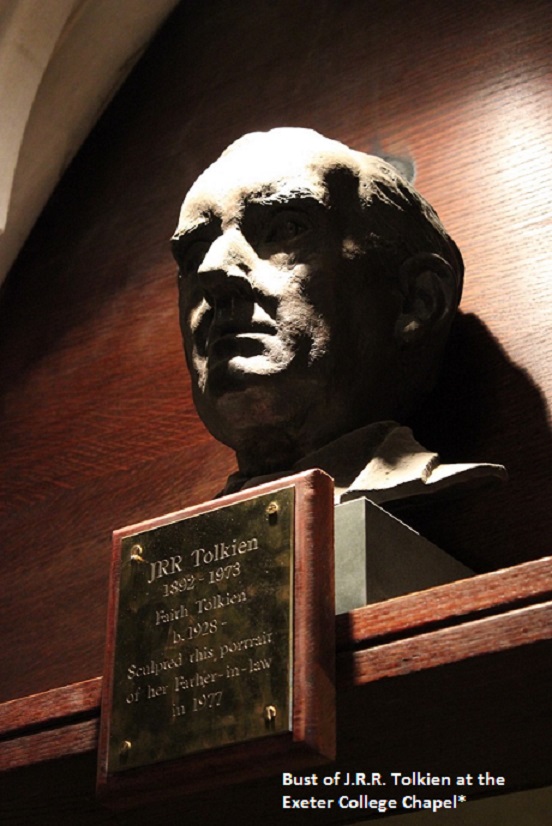
*Image credits: Bust of J.R.R. Tolkien in the chapel of Exeter College, Oxford. By Julian Nitzsche [CC BY-SA 3.0], from Wikimedia Commons