English and Creative Writing Staff Tutor Natalie Lewis has been working with colleagues Lania Knight, Dónall Mac Cathmhaoill and Emma Claire Sweeney to explore staff and student attitudes towards the recording of online Creative Writing tutorials. They wanted to determine whether recordings can increase access to tuition without harming the safe spaces students need to develop their creativity.
We caught up with them to discover what they’ve learnt.
Tell us a bit more about your project.
Prior to the 2022/23 academic year, undergraduate Creative Writing modules had opted out of the university’s recording of online tutorials policy. We’d made this decision because we wanted to protect students from potential feelings of vulnerability and inhibition in tutorials that involve sharing personal work.
However, the OU student body includes 70% of students working full or part-time and over 37,000 students with a declared disability. Attending live-streamed tutorials can for many, therefore, be a challenge in itself. We began to ask whether there might be benefits to providing recordings of tutorials, which could be accessed both by those students who’d attended the live-stream and those who’d not been able to make it.
What was your motivation for doing this project?
Creative Writing Lecturers and Staff Tutors had the OU’s strong commitment to accessibility in mind when designing the project. There are many ways in which tutorial recordings can enhance accessibility for those with disabilities, such as providing opportunities to stop and start recordings, to watch at a faster or slower speed, and to remove the need for notetaking in a live setting. Similarly, for those studying alongside work, family, and caring commitments, recordings can mean the difference between accessing tuition and missing out altogether. As Jilly MacKay says in her 2020 article You should record your teaching, the practice of ‘mainstreaming accessibility’ can benefit everyone.
On the other hand, there is a concern that student anxiety could be heightened by being in a recorded environment. This could lead to reduced participation or, worse, non-attendance.
In a practice-based discipline such as Creative Writing, students can benefit from a low-stakes environment where they can experiment with voice, style, structure, and character development. And there’s strong evidence to suggest that anxiety (including social and creativity anxiety) affects a significant proportion of the population. The Mental Health Foundation report on anxiety in the UK in 2023, for example, found that one in five people (20%) are anxious most or all of the time. So, making evidence-based decisions about tutorial recordings is crucial to the student experience.
What were the key things you learnt from it?
When offered a choice, students did not avoid recorded tutorials in favour of an unrecorded equivalent.
Tutorial attendance was not negatively affected by the availability of tutorial recordings. Most students who attended a recorded tutorial (87%) interacted the same amount they usually would in an unrecorded tutorial, suggesting they felt safe in those online spaces.
Students were overwhelmingly positive about the provision of tutorial recordings, which were accessed by an equivalent of nearly 80% of the cohort, showing their popularity in the first year of being available to students.
The steady pattern of students viewing recordings throughout the academic year suggests recordings have a legacy value for those who have fallen behind the study calendar and those who have postponed submission of their final assignment due to extenuating circumstances.
Recordings were particularly valuable for students with work or family commitments and for those with disabilities. The availability of recordings had increased their ability to access tuition.
“[Recordings are] useful for me because I work a lot and have a toddler so attending a tutorial isn’t always an option … and they’re such a good resource.”
“I often find live sessions quite stressful due to interaction, anxiety, and trouble focusing because of ADHD. A recording gives me an opportunity to take breaks and rewind if I didn’t understand something.”
Did anything come as a surprise?
Rather than being a barrier for students with anxiety, recorded tutorials enabled some students to access tuition in their own time and potentially benefit from vicarious learning while listening to their peers participate in academic and creative discussions.
Inevitably, recordings weren’t popular with everyone. For a minority of students who were not in favour of recorded tutorials, concerns were focussed on recordings not providing a full and interactive experience, and recordings acting as a deterrent from attending or interacting in live tutorials. These students are catered for by providing unrecorded tutorial options and maintaining alternative ‘safe space’ environments, such as asynchronous forums, for developing new writing and sharing peer feedback.
A comparison of different Arts and Humanities modules revealed some surprising differences in the numbers of students accessing tutorial recordings. Students of Level 3 English Literature viewed recordings above the average level, as did Music, Art History, and some History students. Whereas Creative Writing, Classical Studies, and interdisciplinary students viewed recordings at below-average levels for Arts and Humanities students.
Tell us about next steps.
The project findings were presented at a recent tuition-planning conference in Milton Keynes to support OU Arts and Humanities colleagues to find the right balance for students in their discipline areas.
Natalie Lewis
Natalie Lewis and Lania Knight are Staff Tutors in English and Creative Writing. Natalie is the Lead Cluster Manager on A215 Creative Writing and is a module team member. Natalie has contributed to recent scholarship projects supporting Creative Writing Associate Lecturers and full-time intensity students. Lania is Lead Cluster Manager for A803 Creative Writing MA (Part 2) and is a module team member. She is also Cluster Manager for A363.
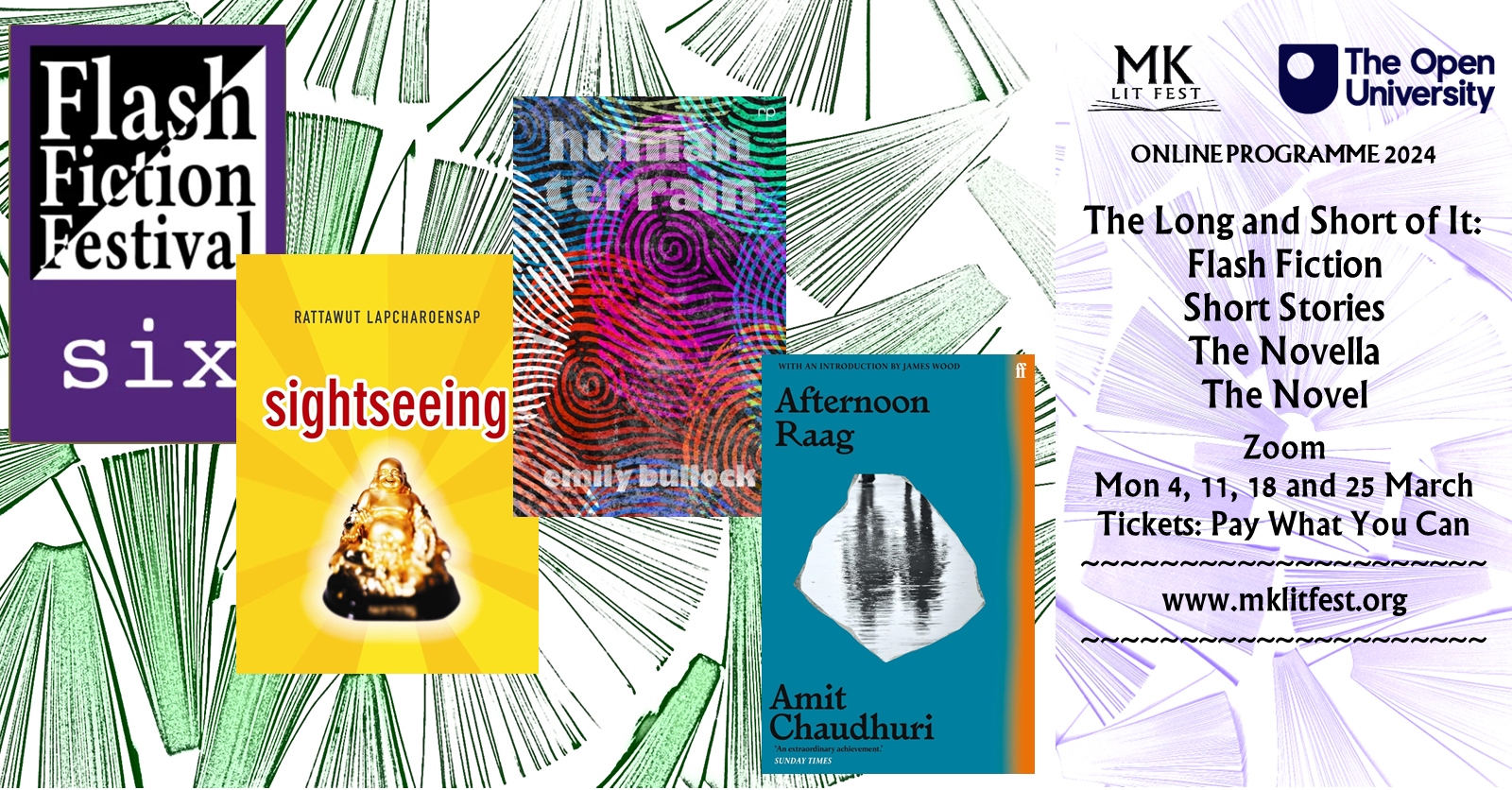
On Monday 12 March 2024, we had the privilege to hear the writer RattawutLapcharoensap in conversation with OU Associate Lecturer Dr. Alistair Daniel. In this second instalment of the MK Lit Fest series The Long and Short of It, they explored the unique challenges and pleasures, and possibly also pains, of short story writing.
PhD student, Anne Wetherilt, offers here a summary of the event for those of you who couldn’t make it.
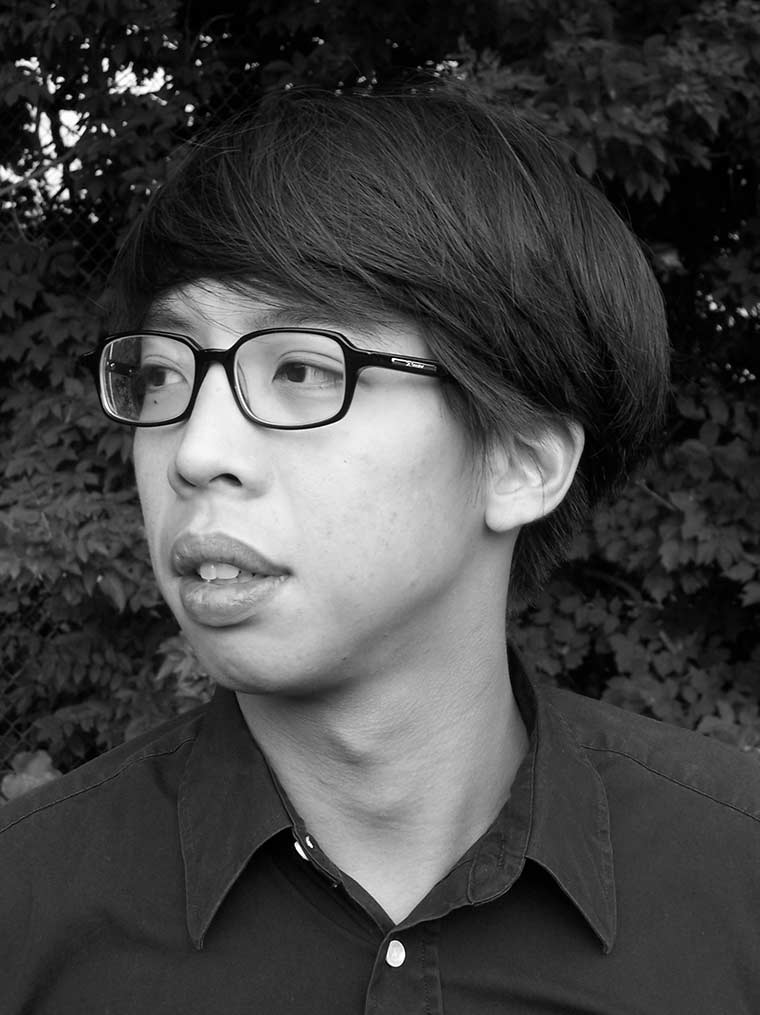
Alistair DanielRattawut Lapcharoensap
Rattawut Lapcharoensap, Alastair Daniel wrote earlier this month burst onto the literary scene in 2005 with his debut story collection, Sightseeing. It won the Asian American Literary Award and was a finalist for the Guardian First Book Award.
Short stories, Edgar Allan Poe famously wrote, need to be read in one setting. But this, Lapcharoensap argues, short-sells the short story. An avid reader of the form – he quotes James Joyce, Frank O’Connor, Sherwood Anderson, Flannery O’Connor, Alice Munro, Katherine Anne Porter and Junot Diaz amongst others – Lapcharoensap is drawn to the short story because of its ability to capture the individual and the collective experience, and its intense awareness of human loneliness.
His short stories have a strong sense of place. ‘I want to write the truth about the communities I felt part of’, he tells us. Indeed, in Sightseeing, he gives us a richly detailed picture of Bangkok in the 1980s and 1990s. The stories are rooted in experiences he witnessed as a young person and carried with him as an adult. And whilst they touch on topical political issues, his main aim is always to tell the truth about his characters’ lives.
When Sightseeing came out, William Sutcliffe, writing in The Guardian praised its ‘novelistic richness’. Lapcharoensap aims to achieve this richness through his characters. Even though a short story gives the reader only a glimpse of the character’s life, you can present the whole person: where they came from; what they have done earlier in their life; how they have lived their life. You can write beautifully and with great emotional clarity, he asserts, a short story need not be short in terms of descriptive power.
In Sightseeing, these stories typically narrate the experiences of young boys or adolescent men. But they are brought to us by older first-person narrators, who calmly observe and report their own earlier encounters with life. This older first-person narrator, Lapcharoensap reflects, brings an interesting perspective to the story. They may have greater articulacy, but often continue to be bewildered.
Given the centrality of place and character in his stories, it is perhaps no surprise to learn that Lapcharoensap usually starts the writing process with a scene or a character. Asking ‘who is speaking’, he expands on a notion, a feeling, a telling detail or bird’s eye view. The story line may emerge later – although sometimes it doesn’t. This early composition is like playing in the dark, he explains, and proceeds without a plan. But planning comes in when he starts revising and here we get a glimpse of the personal discipline Lapcharoensap applies to his writing. Revision is about looking for opportunities to exercise the imagination, he believes. The creative act is not just the initial inspiration – the artist struck by the imagination in his study. Rather, such moments occur in the sequence of drafts, when ‘something beautiful emerges from the lumps of despair’.
For all their promise, short stories can be prone to clichés and pitfalls. Lapcharoensap is particularly wary of the emphasis on epiphany. The Joycean epiphany can be beautiful, he argues, but as a narrative habit it can also be limiting. Not every character needs to act, stumble and learn from their mistakes. Weak epiphanies or false epiphanies abound in short stories, and as a genre requirement, it can limit a young writer in their development and imagination. Another pitfall, he admits, is to create characters like yourself, which you don’t allow to fail or behave foolishly. Invariably, this reduces the richness of the story, and the fictional narration becomes wishful fulfilment.
Part of the joy of being a short story writer, Lapcharoensap notes, is in seeing them published as part of a collection. Each story is written on its own and should stand on its own feet. But they are enriched by their neighbours, as the writer organises them in a particular way to achieve formal and thematic dignity.
Sightseeing closes with ‘Cockfighter’, which at 90 pages is closer to a novella.This particular one did not end, Lapcharoensap explains. ‘It just wouldn’t stop and I continued to be interested in it’. As a reader, he loves the novella – it has the expansiveness of the novel yet requires the rigour and economy of the short story. To this reader of Sightseeing, Lapcharoensap moves effortlessly across the two forms, offering us ‘novelistic richness’, as well as sheer reading pleasure.
The series will delve into the novella form on Monday 18 March and conclude with the novel on Monday 25 March.
Anne Wetherilt
Anne Wetherilt is a part-time PhD student in the Department of English, funded by the Open Oxford Cambridge (OOC) Doctoral Training Partnership. Her thesis – ‘Decolonisation and the Female Middlebrow: Politics, Economics and the Novel’ – studies the work of women writers, who witnessed the end of the British empire. Her supervisors are Prof. Alex Tickell and Prof. David Johnson.
Rebekah Lattin-Rawstrone has just embarked on a PhD in creative writing funded by the Open-Oxford-Cambridge Arts and Humanities Research Council Doctoral Training Partnership. We put her in touch with Sarah Butler, who was recently awarded her own PhD in creative writing, which was also funded by the AHRC – in her case via the Consortium for the Humanities and the Arts South-east England. Here, Rebekah and Sarah let us eavesdrop on their conversation about their writing and research.
Sarah ButlerRebekah Lattin-Rawstrone
Rebekah: It’s a privilege to be given this chance to focus for three whole years on something that really fascinates me – narrative imperialism in the contemporary British novel. But that privilege brings responsibility with it.
Sarah: I’d love to hear more about the concept of narrative imperialism.
Rebekah: This gets right to heart of what I’m hoping to explore in both my critical writing and in the novel. I intend to unravel this concept from several angles: firstly, looking at the development of the novel during a time of imperialism and asking if that affected the narrative structures widely adopted in the form, particularly the three act teleological structure based around conflict and resolution; secondly, building on feminist criticism of narrative structures, thinking specifically of Ursula K. Le Guin’s wonderful essay ‘The Carrier Bag Theory of Fiction’ in which she outlines the possibility of new story forms that don’t follow the spear, or the arrow model – the hero’s journey model – but the gathering, containing, holding model, arguing that the bag rather than the stick was the first human tool; thirdly, looking at the wide adoption in the creative writing industry, both academic and commercial, of the three act structure and the hero’s journey, especially under the influence of film theory, and asking whether, as the industry attempts to publish different stories it could also look for writing that tells these stories differently (put in another way, are we only interested in different stories when they fit into a certain story telling structure? Are we continuing to enforce a kind of narrative imperialism?).
Sarah: This is so interesting! I teach creative writing at Manchester Metropolitan University and have been reading critiques of the workshop model by writers coming from different literary/cultural traditions. I’ve been thinking about the assumptions I make about structure and form, and about how I support writers and writing from backgrounds different to my own.
I set off on my PhD thinking I was going to write about narrative and ageing and particularly about endings and death, but very early on in the process my supervisors asked me to ‘just write something’ reflective about my work. I ended up writing an essay about home across all of my published work, and realised that it is a huge and pressing theme for me.
So, I changed the direction of my research, exploring the relationship between the novel form and home. I thought about the impact of the loss of home (particularly through urban gentrification) and nostalgia, and how nostalgia can be a driver of narrative. I thought about the verbs to leave, to stay, to return and to settle in relation to home in my own work and in two novels by Anne Tyler, who is a big influence on my writing.
Rebekah: I read your response with real delight because the concept of home has been a driver for my work too. I was born overseas and my father then became a diplomat so I spent a lot of time abroad as a child and it has had a huge impact on how I think about where and what I call home and how that might relate to a sense of belonging. You can see how all of these things then fed into an interest in world literature and a wider storytelling practice.
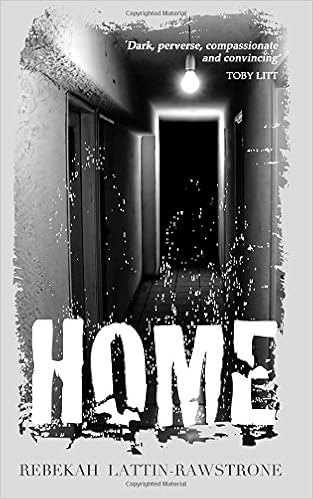
My first novel is actually called Home. It is about a corrupt care home, and I was trying to explore the fractures in the English extended family unit. Age, death and home – more common themes with you. My second novel is about a white English woman trying to forge a relationship with her Malawian half-sister. The desire to create a sense of family and home across national boundaries is central to this book.
I’ve begun by investigating possible alternative narrative structures and am having a lot fun looking at Islamic architecture and the mathematics of tessellation as a possible model for my novel’s structure. As the novel is partly set in Iraq, there is a real wealth of early literature to draw on. It makes for an interesting contrast with my protagonist, real-life adventurer Gertrude Bell who, as someone very keen to contribute to world events, did her best to fulfil the hero’s journey – albeit the heroine’s journey. I’m interested in her life outside of the public eye and how what often really fulfils us in life isn’t always our achievements. In that way, both the subject of the story and the telling should cohere as they attempt to express something different to the traditional three act structure. There will be other threads to the novel too, adding to that sense of pattern and structure through tessellation.
Sarah: I am a bit obsessed about applying structures from different disciplines/places onto writing, so I love the idea of taking ideas from architecture and maths and using those to find a structure for your novel. The way the form and the content are working together also sounds fascinating (and very satisfying!). It’s also really interesting to me because I have an idea for a new novel that I’m struggling to impose a traditional structure onto – I feel as though this conversation has given me permission to think that might not be such a bad thing!
When I started out on my PhD, I worried that ‘over’ analysing my own work would somehow damage my creative process. In fact, it’s been just the opposite. Spending time really thinking about my themes and process has given me a certain clarity of purpose. It’s allowed me to be clearer about what I’m interested in and what I want to explore in my writing.
I’ve been doing some research work for some academics at the OU about the climate crisis and creativity and that’s got me thinking about how I might combine my interest in home with my concern about the climate crisis. I guess I think of myself as both a writer and a researcher now, and that feels exciting and full of possibility.
I wish you all the very best with your PhD. It sounds fabulous, and important, and I am sure it will be an adventure worth having!
Rebekah Lattin-Rawstrone is the author of short story collection Glitches (Acorn Publishing, 2014) and novel Home (Red Button, 2015, now Kindle Direct Publishing). The working title of her PhD is Longing to Belong: an investigation into the potential for alternative storytelling techniques, in particular from the Middle East, to challenge narrative imperialism in the contemporary British novel.
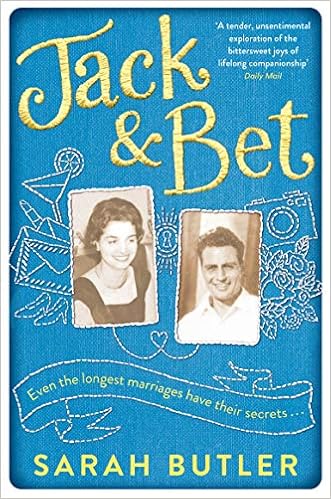
Sarah Butler is the author of novels Ten Things I’ve Learnt About Love (Picador, 2013), Before The Fire (Picador, 2015) and Jack and Bet (Picador, 2020). The title of her PhD is Writing Home: an exploration of the writing of Jack and Bet (a novel) and a consideration of what the novel – as a space and a practice – offers to our understanding of the concept of home, and what a consideration of home offers to our understanding of the novel.
OU Creative Writing MA student Ellora Sutton, winner of the 2020 Mslexia Poetry competition, talks to Sally O’Reilly, Senior Lecturer, Creative Writing.
Ellora Sutton
Can you tell me about yourself and your writing? When did you first start? Do you focus on writing poetry, or do you write in other genres?
I live in the small village of Kingsley, in Hampshire, with my grandparents and aunt. I graduated with a First Class BA (Hons) in Journalism and Creative Writing from the University for the Creative Arts back in 2018, and I work in the heritage sector although I like to call myself a poet. My debut chapbook, All the Shades of Grief, was published last September by Nightingale & Sparrow, I’ve been published by Poetry News, Poetry Birmingham Literary Journal, and fourteen poems, amongst others. I’ve won the Mslexia Poetry Competition, the Poetry Society and Artlyst’s Art to Poetry Award, and I’m the first person to have won the Pre-Raphaelite Society Poetry Competition two years in a row. My main themes include art, feminism, mental health, and mythology.
I’ve always written. Some of my earliest memories are of dictating little stories to my mother for her to write down for me, before I knew how to properly hold a pen. I really got into poetry when I studied Carol Ann Duffy’s The World’s Wife at A-level, it was an absolute awakening for me. It was the first time I really experienced poetry rather than just reading it. My mother died when I was fifteen, and poetry was a vital outlet for me in terms of processing that grief – it still is. I focus my writing on poetry, I don’t have the patience for anything else! I love poetry because it really is an ‘anything goes’ kind of genre. There is total freedom in terms of form, subject, theme. I love the possibilities, the chances for surrealism. Poetry is the oldest kind of writing, but it in many ways feels (to me at least) like the most modern.
What stage are you at with the Creative Writing MA? Assuming poetry is your first genre, what is your secondary genre? Do the two genres inform each other, and in what way?
I am in my second year, and I’ve just started planning my big end-of-module project, I’m hoping to do something with trauma and Medusa. Yes, poetry is my first genre. My secondary genre, for both years, has been creative nonfiction, which has been utterly illuminating. I’d never tried creative nonfiction before, but it strikes me as quite a natural bedfellow to poetry. I’ve come to view poetry as a type of creative nonfiction, in that it often deals with the personal lived experience of the writer in creative ways. It’s been incredibly helpful as well in terms of research, a skill that I’ve carried over into my poetry.
How has the MA helped with your writing?
I live in quite a rural area, and I don’t drive, so it’s been wonderful to have such a thriving community of fellow writers and students to share my work with. It’s been very helpful, getting honest, constructive feedback on early drafts – it’s also been helpful to do the same for others, it’s sharpened my understanding of craft greatly. The MA has really pushed me to explore forms and themes I wouldn’t have otherwise thought myself capable of. For example, prose poetry had always felt beyond me. But we studied it in the second year, and it was set as an activity – the poem I first drafted for that activity, ‘A postcard on the restorative effects of sea air after a nervous breakdown’, recently won the Mslexia Poetry Competition. Prose poems have since become a bit of an obsession. Perhaps most importantly though, the MA has massively boosted my confidence in my writing.
What do you like to read? Has the MA made a difference to this? Who are your favourite poets/authors? Is there a writer you have discovered recently who you would recommend?
I have quite an eclectic taste. My big obsession is and forever will be Jane Austen – I am just coming to the end of my tenure as poet-in-residence at Jane Austen’s House. I do mostly read contemporary poetry, though, in the form of collections, pamphlets, magazines and journals. The MA has definitely widened my reading – studying creative nonfiction has ignited a love in me of biography, memoir, history, art history. It’s also made critical and craft writing feel much more accessible. Writing Poems by Peter Sansom has become my absolute bible, and I first met it through the MA.
My favourite poets include: Liz Berry, Carol Ann Duffy, Sylvia Plath, John Keats, Andrew McMillan, Ella Frears, Ella Duffy, Nina Mingya Powles, Phoebe Stuckes, Caroline Bird, Chen Chen, Ocean Vuong, Pascale Petit, Hannah Hodgson, Rachel Long, Natalie Diaz, Danez Smith, Natalie Linh Bolderston, Malika Booker – this is a very abridged list! I recently read Life Without Air by Daisy Lafarge, which absolutely blew my mind. And I’ve got to mention specifically Malika Booker’s Pepper Seed, another recent read of mine, the kind of book that stuns you as a reader and inspires you as a writer. My most prized possession is my signed copy of Carol Ann Duffy’s Collected Poems.
Where do you go from here? What would you like to achieve with your writing?
I’m currently working on a manuscript of poems looking at women’s mental health through the lens of my personal family history, which has been a very exploratory and freeing experience. I would love to find a publisher for that – that’s really my next big goal, a first collection. And completing my MA, of course! After that, I’d love to have a go at a PhD in poetry.
Over the last year or so, I have been facilitating a series of creative writing workshops on the theme of responding to images or objects. I was interested in exploring some outreach opportunities, especially the application of my current PhD research: on the ekphrasis of abstract or monochromatic artworks, supervised by Siobhan Campbell and Jane Yeh. In part, I was looking to test some of my poetic strategies and methods with the general public: those who already thought of themselves as practitioners or had a casual interest in creative writing.
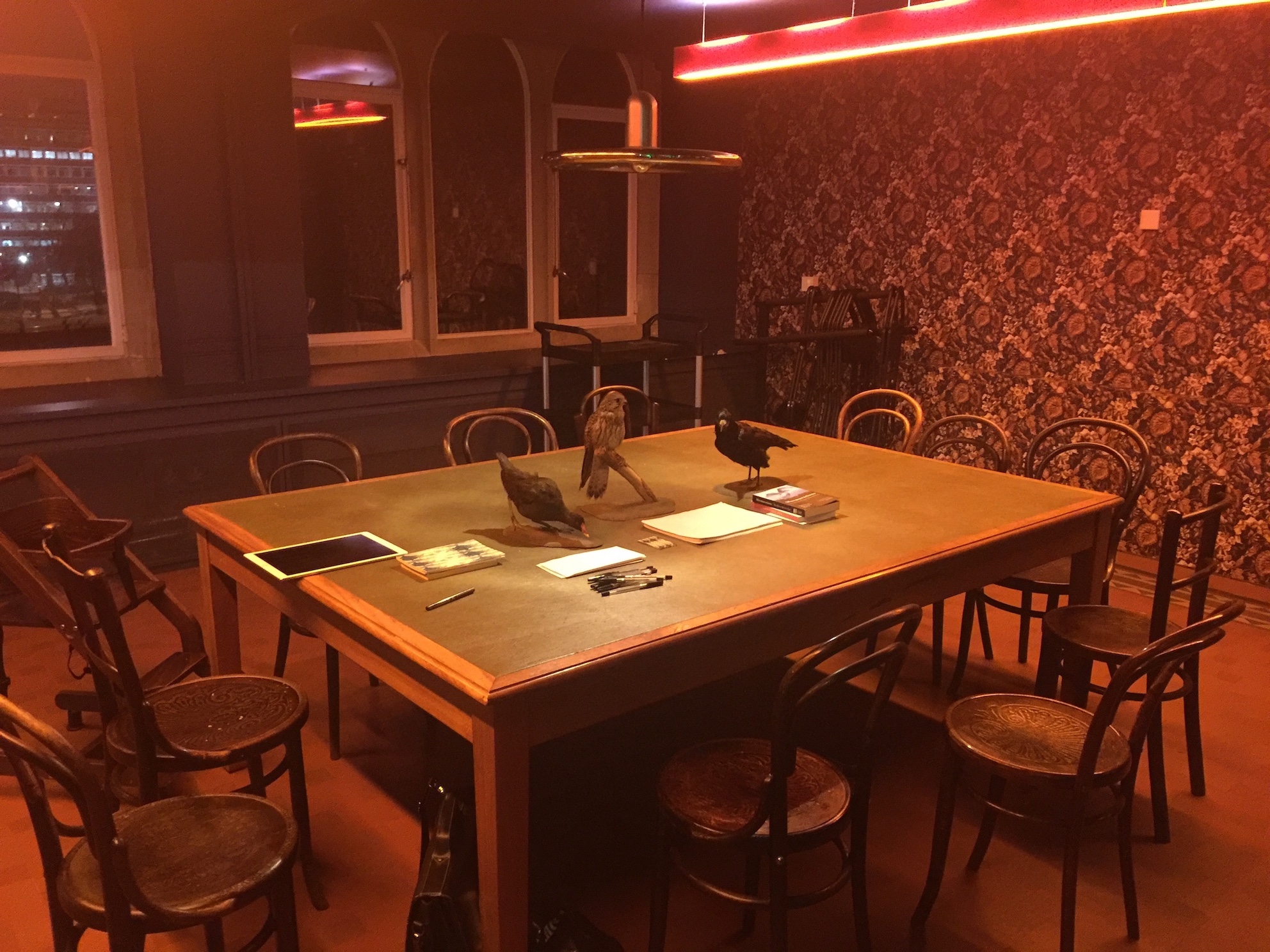
I began with a short series of workshops at the Whitworth Art Gallery and Manchester Museum (autumn 2018 – spring 2019). Here I asked participants to respond to a visual prompt. At the Whitworth, this was an artwork that could be freely chosen after having wandered around the gallery; and at the museum, I selected some artefacts from the holdings on the theme of ‘flight’, and these were presented in the middle of a table, as shown below.
The groups were asked to explore some free writing in response to their prompt over the duration of 25 minutes. We then discussed the experience and approach, and we had an opportunity to read out what we’d written.
Given that the series was funded by the Arts for Health Programme at the University of Manchester, and the workshops were aimed at carers, I also felt it was appropriate to discuss the therapeutic effects, if any. I was interested in the possibility of writing as catharsis, especially while using images or objects as a form of mediation. I was grateful to the participants that we were able to have these conversations towards the end of each session.
More recently, I ran a joint workshop (again on creative writing in response to images and objects) with Fran Hughes, as part of the AHRC conference on Trust and Truth at the University of Cambridge (September 2019). In this case the participants were, for the most part, postgraduates. Here we asked them to work in groups, using a similar method to that used in the parlour game ‘consequences’, to produce creative writing and images. Not only did the exercise result in some highly imaginative first drafts, it also worked fantastically well as an icebreaker and encouraged participants to get to know one another.
At present, I am now working again with Manchester Museum on the Creative Writing for Carers scheme. I have been asked to run a series of sessions through the autumn (2019), which will also function as a short course. With the additional time and scope, I want to explore a wider array of possibilities, especially in terms of how participants might approach their interaction with a chosen artefact. In addition to grounding what can often be highly specialised ideas (such as ekphrasis) in the playfulness of creative writing sessions, I also hope to glean new ideas for my own practice and add a social dimension to my research activity.
By Isabelle Parsons, PhD student, English Literature (1)
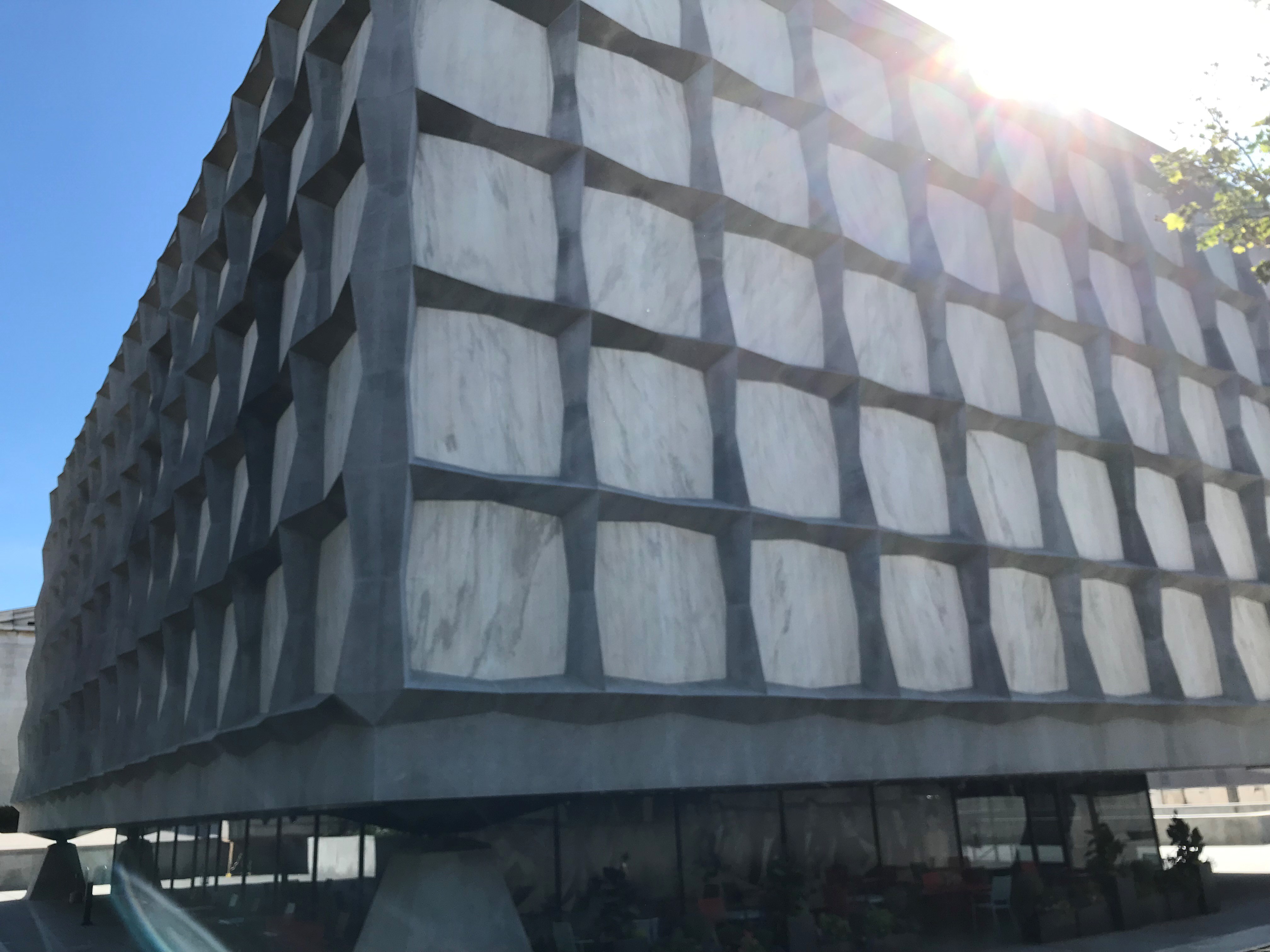
It’s a Monday morning in June and I’m standing in front of the imposing granite and marble cube that is the Beinecke Rare Book and Manuscript Library at Yale University. I’ve spent the past four years studying published texts, correspondence, biographies and scholarship relating to Edith Wharton’s work, especially her portrayals of women through the use of secrets and silences. Now I’m about to examine the most relevant portions of the archival paper trail of her life.
The Beinecke Rare Book & Manuscript Library
3 June – Heaven under surveillance
Inside the Beinecke cream-coloured carpet muffles sound, black leather-backed chairs surround generous desks, and Gertrude Stein looks down from the wall.
The manuscript for The Age of Innocence is being scanned off-site, so I move straight on to A Backward Glance. I note Wharton inserting the phrase ‘secret lisp’ to describe the sound of arbutus buds in the spring woods near Mamaroneck.[2] Then she adds the word ‘secret’ to describe her reading practice as ‘a secret ecstasy of communion’, before explaining why she’s chosen this particular adjective.[3] Understanding dawns – Wharton is saying that she attaches value to concealment, in an autobiography that is noticeably reticent.
4 June – Hunting for silences in The Reef
Sophy’s manifesto-like exclamation, ‘“I wanted it––I chose it. He was good to me––no one ever was so good!’”, where every pause drives home her certainty, is absent from the manuscript.[4] And the narrative leaps from Anna learning about Darrow and Sophy’s past, to a chapter I don’t recognise from the published text, one where she wakes up ‘an hour or two before dawn, got up and threw open the shutters of the bedroom windows. The intense silence of a muffled sky hung in the woods and fields.’[5] This, then, is transmission history in action, showing me Wharton’s creative mind at work.
5 June – Wharton writes women
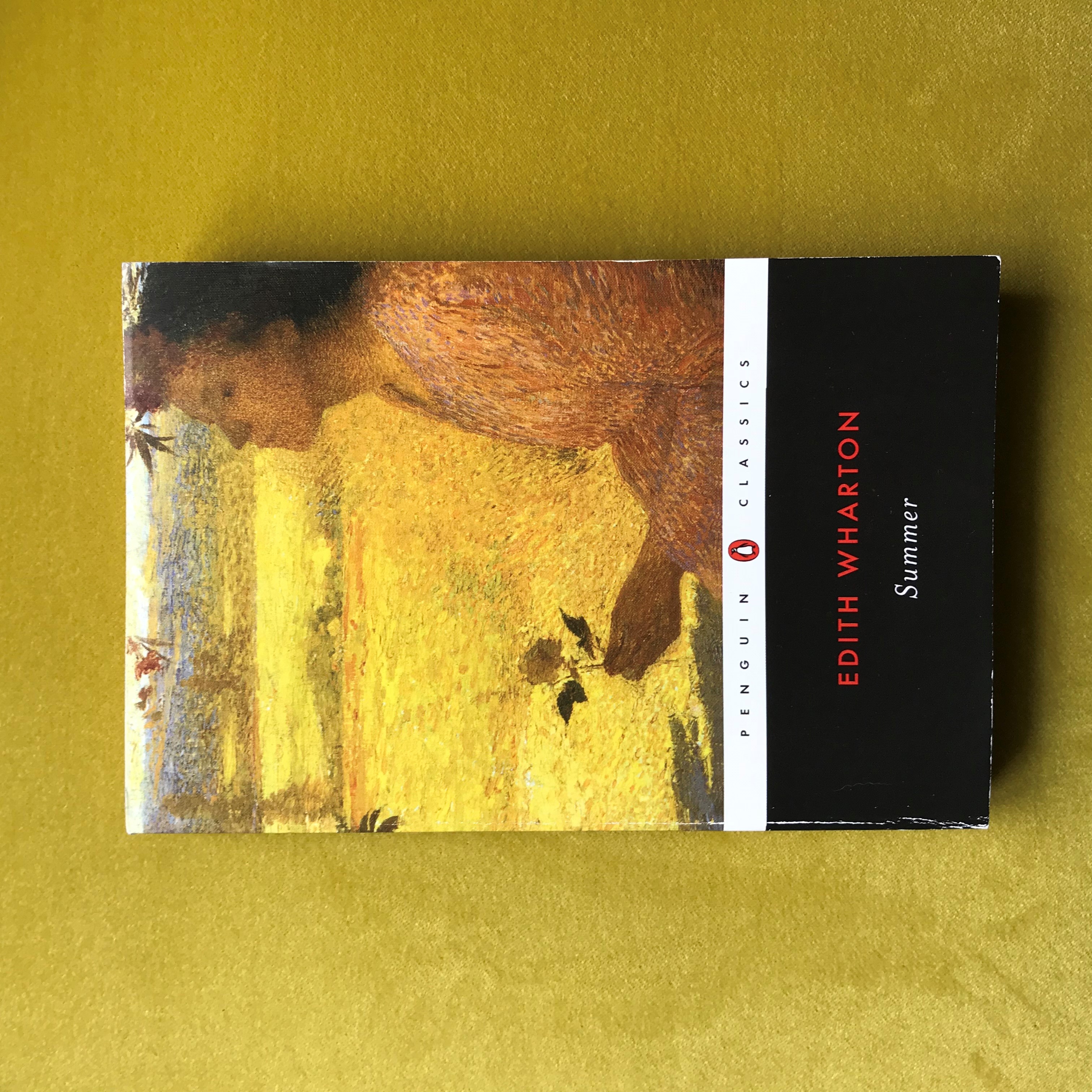
Lawyer Royall says something extraordinary in the manuscript of Summer, omitted from the final text: “Every thing I’ve done in my life’s been a failure,” he broke out suddenly –– “and now I’ve made a failure of this too.”’[6] The next folder I open includes the view of The Literary Supplement of the London Times (1917), which finds that Royall and his ward
[…] are remarkable beings indeed, a bitter girl and a tarnished old man; […] he is a really rich piece of creation, a masterful louche, obscurely battered and defeated derelict of his world; he does not, one feels, get all the display he should have had.[7]
But the evolution from manuscript to published text makes clear that this story is not about Royall. Wharton wants us to empathise with the girl!
6–7 June – Wharton’s war
Request scan of Wharton’s talk to American soldiers – in Paris? – despite pages missing from document. Her warmth & Francophilia unmistakeable.
Judging by Roosevelt’s letters, he and Wharton egged each other on over American neutrality. Conrad’s letters unexpectedly gentle; it is 1 October 1917 and his son has just visited from the front. Then Bo Rhinelander’s excitement over getting into the thick of things with his ‘D H 4 with a 420 h.p. Liberty Motor’, envy of the English pilots, is palpable in a September 1918 letter to his mother, Wharton’s cousin by marriage.[8]
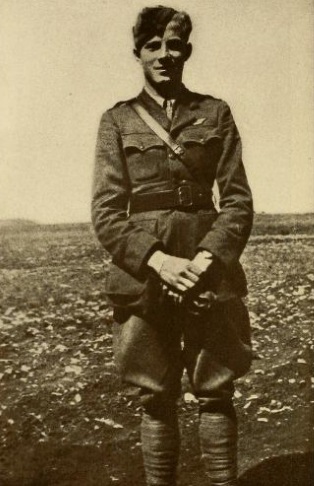
Philip Newbold Rhinelander (1895–1918) [9]The last is a difficult read. Within weeks Bo’s plane is shot down, and Wharton calls on her impressive network to determine his fate.
10 June – Secrets revealed
Unexpectedly discomfited by Morton Fullerton’s clandestine transcription of ‘Terminus’. Wharton destroyed the original, yet I have in front of me her intimate thoughts about a love affair that delighted and then agonised her.
Delve into Henry James’ letters, but his handwriting defies me. Call it a day and get soaked on the way home. Sandals squelching, inspiration strikes; look for Powers’ volume of James-Wharton correspondence on Internet Archive to work out which of James’ letters are not published, and focus on those!
11–12 June – The Wharton marriage
Acrimony of the Wharton separation emerges. In December 1912 she writes to Gaillard Lapsley, ‘I’ve been going through bad times. Teddy [Edward Wharton] is in London, in the clutches of a woman, + I can do nothing. Try not to see him, please. He is pursuing all my friends.’[10] Sixteen months later Lapsley hears, ‘[…] I “get my decree” in another four or five days. I find that Teddy has registered all his various temporary brides as “Mrs Wharton” in the hotels they frequented –– rather a gratuitous last touch of ill-breeding.’[11]
Then it’s early 1914; Wharton sends Lapsley postcards from North Africa containing what can only be described as toilet humour. Stifle my laughter with enormous effort. At the next desk scholars sombrely examine medieval manuscripts.
13 June – Paper trail of a life
Wharton’s 1920 diary tracks Age of Innocence’s relentless progress, and shows Walter Berry moonlighting as her New York courier, hand delivering to Appleton the novel’s completed chapters as sent to him.
Swallowing hard again, now over diary entries for Berry’s death, and maids Elise and Gross’s.
14 June – Time passes
Photograph 1938 letter from Yale president Charles Seymour to Lapsley regarding gift of Wharton’s papers. Confirms willingness to provide ‘careful housing and protection’, ‘that the correspondence and biographical material will not be accessible for a period of years, roughly corresponding to a generation’, and that Wharton’s manuscripts ‘will be accessible only to bona fide students of literature and that none of the unpublished material be published until the copyright expires’. He agrees also to ‘the necessity of guarding against the danger that the material might fall into incompetent or unwise hands in the meantime’.[12]
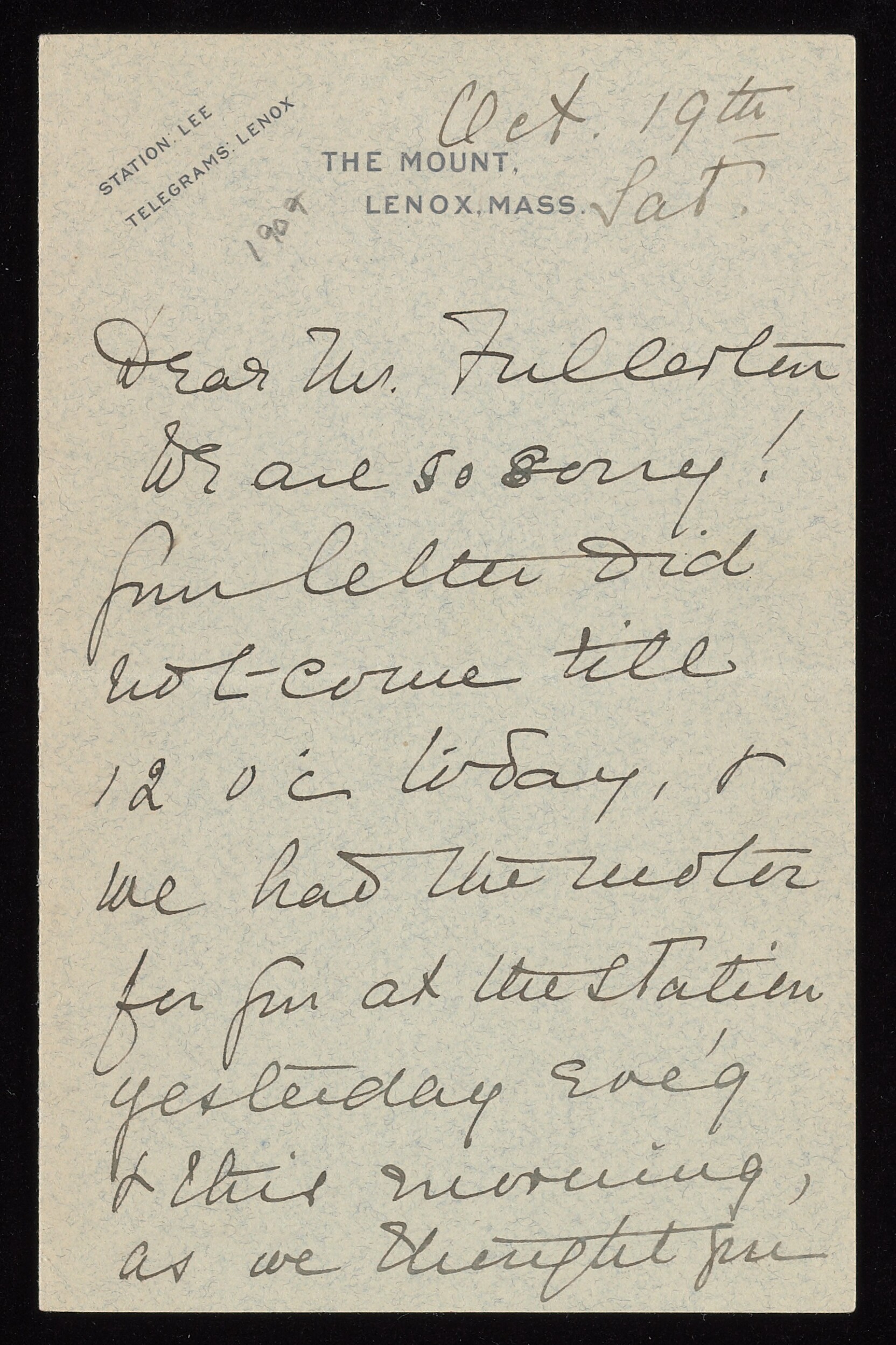
Edith Wharton to Morton Fullerton, 19 October 1907 [13]Back up my notes and photographs one more time, yet resist closing my laptop and returning the last folder to the front desk. How lucky to be of a generation with access to the words and images that today signify Wharton. Sit a while longer, thinking how ten days have wiped away the years between her life and mine.
Notes
1. Isabelle Parsons is an Associate Lecturer and doctoral student in English at The Open University. Her visit to the Beinecke Library in June 2019 was funded through an Edith Wharton Society Award for Archival Research and The Open University’s PRA and RESSF schemes.
2. Beinecke Rare Book and Manuscript Library, Yale University, YCAL MSS 42, Series I, Box 2, Folder 27.
3. Beinecke Rare Book and Manuscript Library, Yale University, YCAL MSS 42, Series I, Box 2, Folder 28.
4. Edith Wharton, The Reef (New York: Simon & Schuster, 1996), p.263.
5. Beinecke Rare Book and Manuscript Library, Yale University, YCAL MSS 42, Series I, Box 11, Folder 320.
6. Beinecke Rare Book and Manuscript Library, Yale University, YCAL MSS 42, Series I, Box 12, Folder 362.
7. Beinecke Rare Book and Manuscript Library, Yale University, YCAL MSS 42, Series I, Box 12, Folder 363.
8. Beinecke Rare Book and Manuscript Library, Yale University, YCAL MSS 42, Series II, Box 30, Folder 916.
9. James W.D. Seymour, Memorial volume of the American Field Service in France: “Friends of France” 1914-1917 (Boston: American Air Service, 1921), n.p.
10. Beinecke Rare Book and Manuscript Library, Yale University, YCAL MSS 42, Series VII, Box 59, Folder 1706.
11. Beinecke Rare Book and Manuscript Library, Yale University, YCAL MSS 42, Series VII, Box 59, Folder 1707.
12. Beinecke Rare Book and Manuscript Library, Yale University, YCAL MSS 42, Series XI, Box 65, Folder 1795.
13. Beinecke Rare Book and Manuscript Library, Yale University, YCAK MSS 42, Series II, Box 25, Folder 774.
One afternoon in October 1974, I was standing in a somewhat Spartan corridor in the University of Leeds in desultory conversation with a tall, lean, slightly stooping gentleman in his mid-fifties. He wore a suit, held a thin-stemmed pipe between his teeth, and was delivering diffident remarks between successive puffs of smoke. There was a slightly gloomy air to his conversation, gloomy but also droll, as if a little dejected and at the same time laughing at his own dejection. On this occasion, however, he had a subdued gleam in his eye, because I had just brought up a subject that interested him. In effect, I had become a participant in his wry despondency, since at this moment in time we had two things in common. Broadly speaking, we possessed a common invitation and a common problem, which could be summed up in the words “What Do We Do Now?”
The pipe-smoking gentleman was the poet D. J. Enright, not long returned to Blighty after a peripatetic lecturing career in, successively Egypt, Japan, Berlin, Thailand and most famously Singapore, writing all the while. His nick-name was “the mendicant professor” and that had been the title of his memoirs, published five years previously. I was not quite as mendicant as he was, but had myself just returned from a lengthy and enjoyable spell lecturing in Africa. Both of us had been invited to spend some time in Leeds, teaching and taking our bearings. The topic of our conversation that afternoon was this: how do you approach the challenge of teaching English Literature in England when all your experience is of teaching it just about everywhere else?
Two qualities, I believe, are necessary to the successful teaching of literature to any student audience: intimacy and distance. When the teacher originates from the same environment as the text, but the students do not, the lecturer must exercise all of his or her imagination and resourcefulness to bring the text alive by translating it into terms the students will appreciate and understand. You begin with a distance that you then attempt to cross, so that by the end of the process the text is as intimately known to the students as to yourself, but in a different way. When the students and the text have a common background, the same factors do not occur, at least to the same extent. But, of course, there are different sorts of distance. There is the kind of distance that is achieved by time, when an historic text has to be made accessible to modern students (which is why a play by Marlowe or Paradise Lost is more challenging to teach anywhere than a modern text, and often a lot more fun). There is the distance achieved by theory, which I usually find unsatisfactory since it sometimes amounts to erecting a barrier of jargon between text and reader. In any case, some students find it alienating, and since the object of the exercise is to remove obstacles, the question arises, why erect this particular barrier in the first place, except to mystify? And then there is the sort of distance posed by some postcolonial books where the element of cultural alienation re-asserts itself, but as it were the other way round.
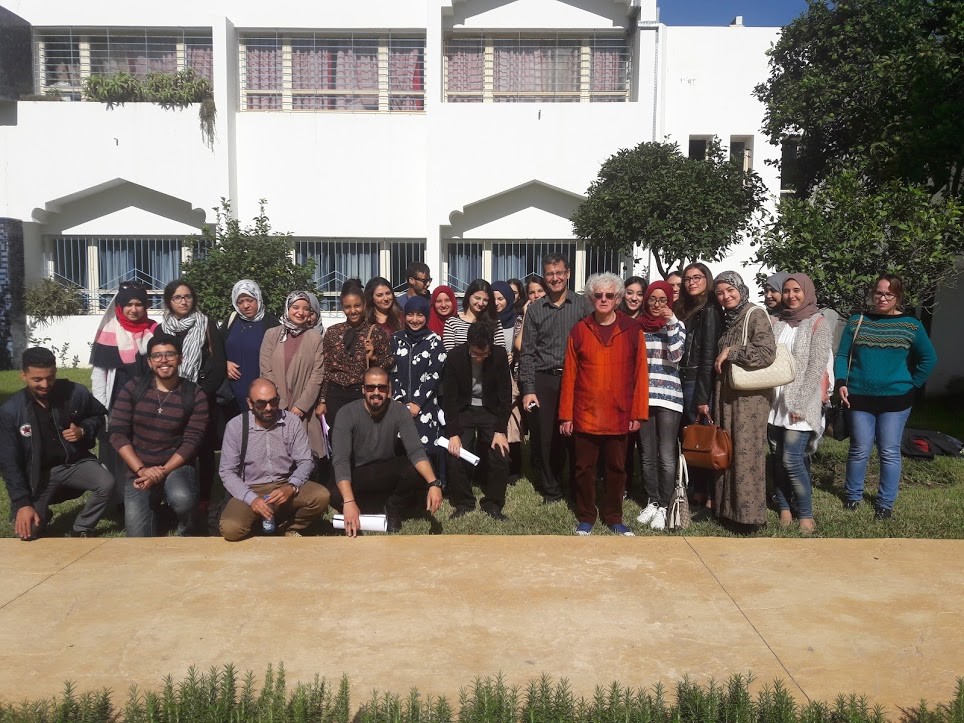
So when in 2015 I became an Emeritus, and the question posed itself once more – “What do we do now?” – the answer seemed to be to return to my academic roots and re-establish that geographical distance between audience and text which I have always found so stimulating. The first chance came towards the end of that year when Dr Nourdin Bejjit, whose doctoral thesis I had co-supervised at the OU, invited me to Morocco on a lecture tour. I flew in to Casablanca, which did not live up to its cinematic reputation, and then journeyed on to Rabat and Fez. I ended with four days in Tetouan, former capital of Spanish Morocco. As in the other locations my primary assignment was to talk about the reception of Eng. Lit abroad, as it is in the present piece. But on the last evening mine host Dr Jamaleddine Benhayoun asked over coffee, “The quatercentenary of Shakespeare’s death is coming up soon. Tomorrow, why not just slip in a talk on the Bard?”
I thought this an excellent idea. The only problem was that, though at Leeds I had spent most of my teaching week on Renaissance Literature and Shakespeare, since moving to London in 1978 I had hardly touched the subject. There was nothing to do except wing it. So at eight-thirty the following morning I was standing on the stage in the largest lecture hall in the university armed with my Kindle and no notes. Before me was an audience of about 500, with some people standing at the back. I had already made up my mind that I would focus my talk on King Lear, drawing inter alia on James Shapiro’s book 1606: William Shakespeare and The Year of Lear, which had recently appeared, but I would obviously have to talk about much else besides, and to set Shakespeare and his theatre in historical context. I started talking as, as I did so, all my buried and neglected knowledge came flooding back. Nobody moved. There are certain moments in one’s life when one loses sense of time, as when writing something, or painting a picture or composing music. When I thought I had finished, I asked Jamal the time. It was half-past eleven, and I had been talking extempore for three hours. That should have been it, but we had already agreed that we would have time for questions. Did anybody have one, I asked. Someone stuck up their hand in the front row and asked if Shakespeare’s plays had anything to tell us about Shakespeare the man. Not the plays, I answered, but the poems were a different matter. As an example I started reciting Sonnet 116: “Let me not to the marriage of true minds/ Admit impediments”. As I started on the second line, I became aware of a slight but growing susurrus in the hall. Gradually, row by row, they were joining in. By I time I reached the concluding couplet the whole hall was involved as the entire student body shouted out the lines: “If this be error, and upon me prov’d,/ I never writ, nor no man ever lov’d.”
We often hear of the incompatibility of Western liberal and traditional Islamic values in North Africa and the Middle East, and the impediment that this places between certain audiences and Western secular literature. What nobody tells us is that the deeply embedded religious culture of these lands allows them continuing access to the rapt expression of ethical truths that the secular West has almost lost sight of. The sanctity of marriage is one of them. How many large roomfuls of British university students know Sonnet 116 by heart? Answers on a very small postcard, please.
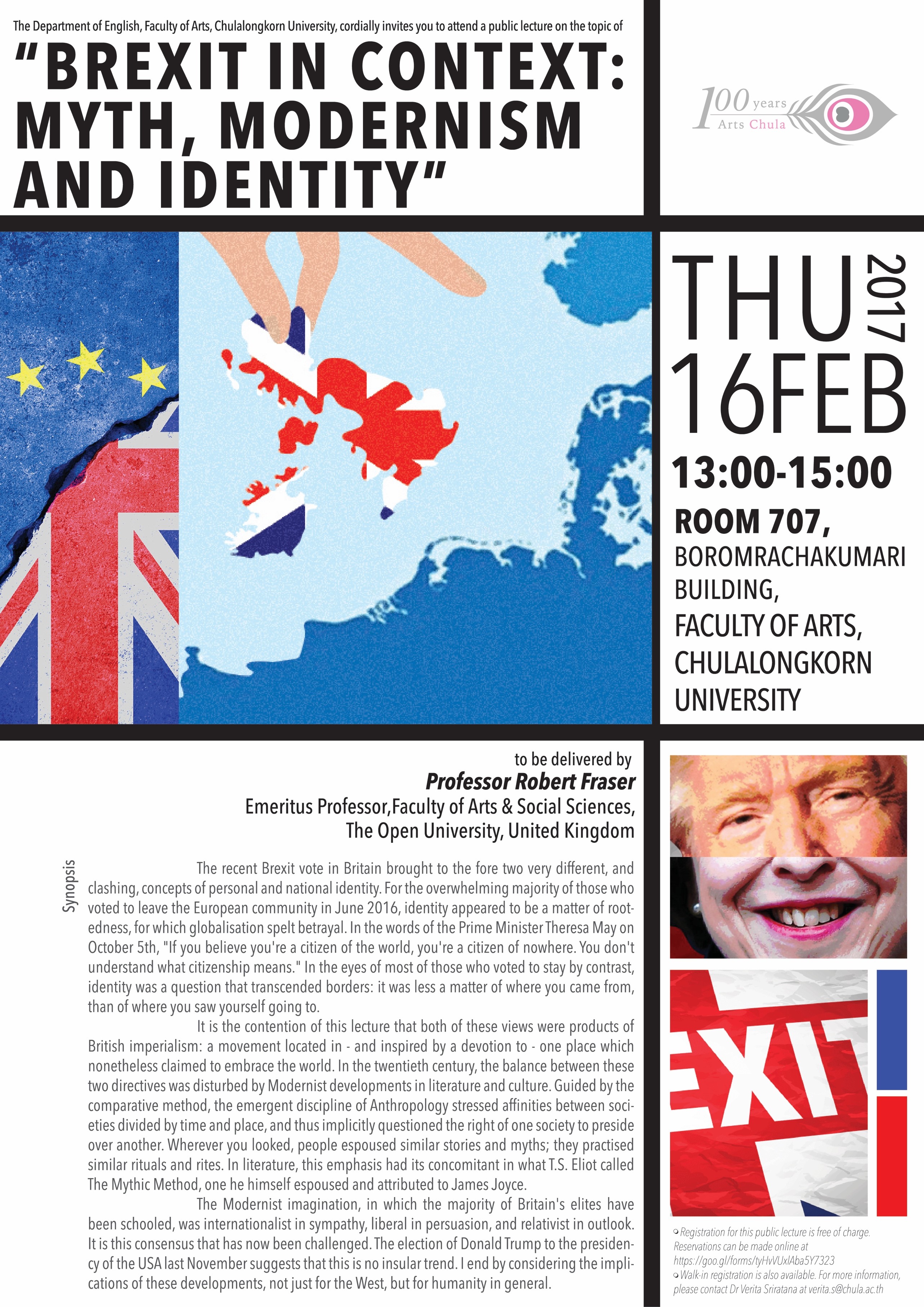
I returned to Tetouan in 2016 and 2017, and will go back there again this coming October. In the meantime, a fresh opening arrived from quite a different direction. Our son works in the amusingly and inclusively entitled “Department of the Universe” at Chulalongkorn University in Bangkok, where he has a postdoc in String Theory. Coincidentally, this is the very university where Enright worked as a lecturer between 1957-9, and so I was very glad when, on one of my paternal visits, the English Department approached me with a peculiar assignment. The Brexit referendum had already happened, and nobody in Thailand could quite understand it. Why should the British nation take such a stupid step? They had invited the British ambassador to explain it all; he had accepted, and then on second thoughts ducked out. Could I step in? I am quite sure that my views on the British withdrawal from the EU were and are the very opposite of those that the ambassador in question might have felt obliged to defend in public, whatever his private misgivings about the matter. I agreed, provided I could go back in time and show how English insularity and English expansiveness have run alongside one another for centuries, and how both are evidenced in the literature. So, John of Gaunt’s “This sceptred isle speech” from Richard II against Defoe’s “The True-Born Englishman”, Hardy alongside Kipling, etc.. The modern parallels were not hard to draw, and de-colonization, I speculated, had brought this identity crisis to a flash-point:
As a result, the British people have been driven into two camps, each of which suffers from a different variety of postcolonial stress disorder. One half of the population has renounced imperialism and the jingoistic patriotism or nationalism that went with it. The other half still espouses a vestigial and sentimental form of patriotic affiliation, a shadowy sense of entitlement without an empire to support it. They clung to this myth or paradigm with increasing desperation as employment opportunities shrank, while in the meantime their globalized compatriots appeared to flourish as never before. In 2016, the tables turned. It was the second group, from which the Brexit campaign had drawn so much of its support, that Theresa May addressed last October in her conference speech, calling them simply the “public”.
In the ensuing question and answer session I was left in little doubt as to relevance of what I’d been saying, not simply to Britain, but also to Thailand. Most countries when you come down to it have their own variety of identity crisis, and Thailand is no exception (nor is Morocco). To address this question in the lecture itself would, of course, have been miles beyond my brief. Neither Enright nor myself were exactly friends to cultural nationalism, but I was not going to fall into his trap when, in delivering his inaugural lecture on “Robert Graves and the Decline of Modernism” at the University of Singapore in November, 1960, he opened with an assault on the government’s policy of nurturing “sarong culture”. Singapore should be open to all influences, he had said, but the following day he found himself hauled before the Ministry of Labour and asked to account for his statements. He was brusquely informed that foreigners should keep their noses out of local affairs, which were none of his business as a mere “mendicant professor”, etc., etc.. Upon which he turned into a Penitent Professor and issued a letter of apology.
There was no need for me to weigh in thus clumsily in 2016 because, almost as soon as I had finished talking, the conversation backwards and forwards across the room took off in a most satisfactory and vigorous way. Just about everybody had an opinion as to the coherence or incoherence, integrity and need for openness of the nation. In Thailand there is a very lively tradition of public debate and dissent, not least among the students. Every year, in February, a football match is played between Bangkok’s two leading universities, complete with cheerleaders and shouting crowds. For the last few seasons this has culminated in a demonstration against the military authorities, pilloried on satirical floats. The latest fixture had just happened, and the authorities had shown no inclination to intervene. The principal comment in the English-language newspapers (of which there are two) was that this year’s offering had been disappointingly low-key and tame.
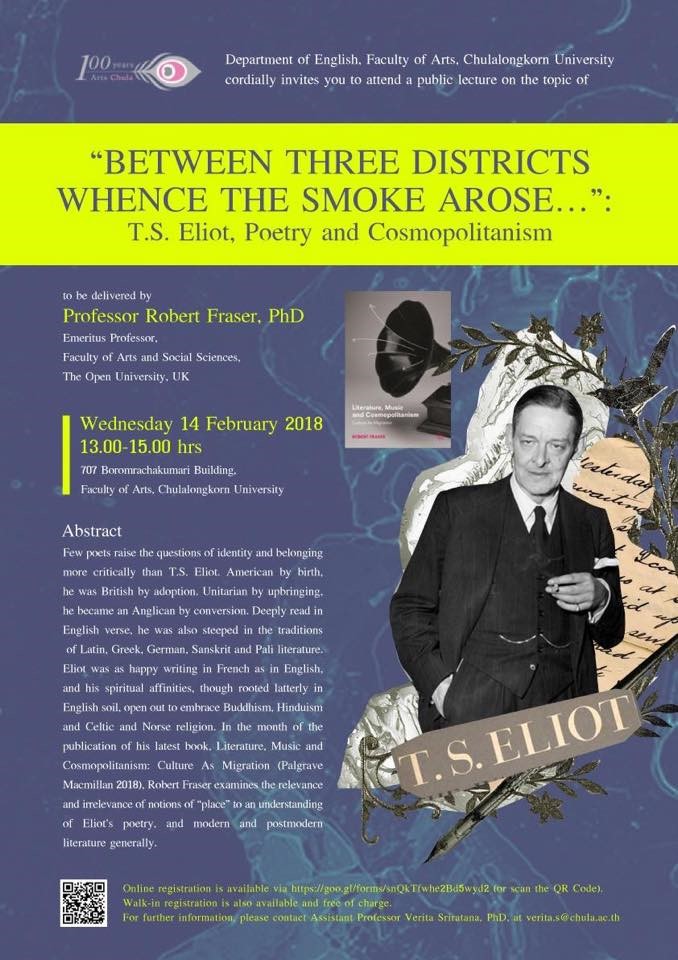
But it is not just nations that are afflicted with identity crises; authors and texts experience them too. The following year I was asked to return to talk about T.S. Eliot and, seeing as a book of mine on cosmopolitanism and cultural migration had just come out, I chose to concentrate on his polyglot and polymathic affiliations. It is no secret that many of these are Eastern since, on registering as a doctoral student at Harvard in 1911, Eliot had chosen to take a whole range of elective courses in Pali and Sanskrit. The result is that, even as late as 1941, coded references to the sacred books of the East pepper his writings. When I sought to demonstrate this, the result was a remarkable and rewarding instance of reverse instruction. I had no difficulty finding people to read out extracts from Buddha’s Fire Sermon or the Baghavad Gita in the original tongues. I supplied translations, but afterwards one member of the audience (admittedly a Russian) took me aside and told me that these had not strictly been necessary. In this context, and with these students, the poems by Eliot that I had been discussing, mostly The Waste Land and Dry Salvages, had stood on their heads. What had seemed supreme expressions of, in one case post-war disillusion, and in the other, of revived Christian spirituality, had become Asian landscapes with incidental glimpses of a crumbling Western world beyond. As a result, the distance and the intimacy had reversed themselves. What was familiar to the students was unfamiliar to me: it was their job to bring me closer to the source. It is my pious hope that the experience had been mutually beneficial. In any case, I had learned a lot.
Teaching, as many of its practitioners will concede, is largely a process of learning. Especially if you are talking to diverse audiences, one of your most valuable pieces of equipment is ignorance, and preparation is often a matter of clearing the mind. As for ignorance, I flatter myself that I am unusually well qualified in that respect. It is a quality not to be scorned by any mendicant professor as he or she next opens up an Atlas, turns to the sunnier pages and inquires “What do we do now?”
One answer is to return to Morocco next February to organize a weekend creative writing workshop in the lovely hill town of Chefchaouen. Would anybody care to join us?
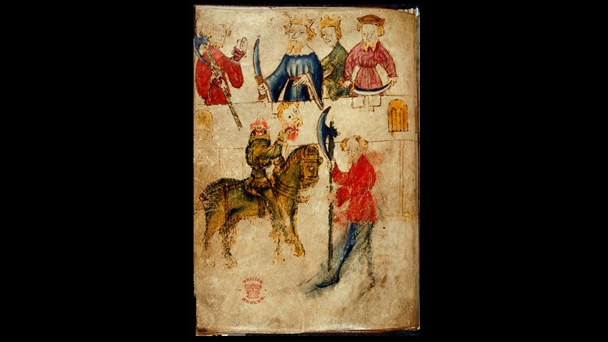
Four anonymous poems in Middle English: Pearl, Cleanness, Patience and Sir Gawain and the Green Knight. Created: c. 1400, North-West Midlands, Creator, Anonymous. Held by: British Library
One of the things that can be the hardest to explain to people who haven’t worked at the OU is how we teach. I’m not in this post going to get into the debates about teaching media (the pros and cons of digital and print have been energetically debated here and elsewhere recently) but rather want to focus on the pleasurable process of writing material for a new module, since I’ve just finished a first draft – in OU parlance, a D1 – on Sir Gawain and the Green Knight.
This will be part of a new level 2 module, The Novel and Beyond, due for first presentation in 2019. (Level 2 is what the rest of the sector calls level 5, and again I’m going to resist the allure of a longer discussion of the manifold weirdnesses of OU nomenclature. If the OU were a religion, you’d see the success of its evangelical strategies in the readiness with which its staff adopt these slight but distinct deviations from normal registers: we work in codes which are just aslant of everyone else’s usages).
I mentioned the pleasurable process of drafting material. In the twenty years I’ve worked at the OU, I’ve always found this part of the job uniquely creative and enjoyable because that process is undertaken in a team environment which is typically energetic, questing and supportive. Added to this, the materials we devise will be studied by thousands of students: unlike conventional classroom teaching, OU modules are less ephemeral, being typically taught for around eight to ten years. That means your work – your enthusiasms and sometimes inevitably your errors of emphasis and judgement – will be shared by a large and shifting audience of students. At its best, working on a new module feels like you get the chance to say something perhaps you wouldn’t say elsewhere, about topics which you otherwise wouldn’t have a chance to engage with, to students and colleagues who are highly receptive to your efforts. That means that your register as a writer needs to be more sprightly – more demotic, less buttoned-up – than it would be in a monograph or book chapter.
This brings me to Sir Gawain and the Green Knight. As a specialist in Renaissance poetry, I often work with medieval texts and writers – Chaucer, Henryson, the Reynard the Fox stories are often on my desk; if pressed, Dante’s Inferno would probably be my Desert Island Book. But I’m not a medievalist, and I hadn’t anticipated getting a Middle English poem onto our curriculum. There are a range of reasons for this. In the dark backward abysm of OU time, a decision was taken that the Literature Department (as it was then) would focus chiefly on texts from the modern and early modern periods, with a smattering of works studied in translation; to all intents and purposes, Literature began with Shakespeare. Much of this was pragmatic: teaching Middle English at a distance was felt to be a step too far, and the staff and practices of the Department developed accordingly.
But new modules promote new ways of thinking. When the team designing The Novel and Beyond started work, we were sure that although we wanted our primary focus to be on prose fiction, we didn’t want that to exclude other genres, other ways of telling stories. After a protracted and increasingly nervous dalliance with Paradise Lost, I thought of Sir Gawain, and in particular Simon Armitage’s scintillating translation – could this be worth a try? It readily fitted into the module’s themes, and everyone was enthusiastic – much more enthusiastic than they were about poor old Milton. In the past couple of months, I have been working on this poem, which students will read in Armitage’s translation, with a smattering of Middle English terms introduced as needed. To adapt a line of Bertilak’s, when Gawain first arrives at the castle, if students listen, they ‘will learn the merits of language’ (l.918).
One of the perennial challenges of this process is integrating written materials with audio and video. When I consider the language and culture of Gawain, I do this through an interview with Professor Helen Barr, who is a specialist on alliterative poetry, and who taught me when I was an undergraduate. This interview outlines both what we know about the poem’s linguistic and cultural contexts, and most importantly, explains the poem’s stylistic recipe – how its alliterative verse form works. During recent months, Gawain has retuned my ear to the charming, distinctive idiom of Middle English alliterative poetry. I chose Armitage’s translation both because he’s a superb poet, and because his version tries to replicate the original poem’s alliterative patterns, which he neatly calls ‘the warp and the weft of the poem’ (p.viii).
Here’s an example from the stanza which Helen reads in our interview. In this passage, the poet describes the hardships of Gawain’s midwinter journey:
Nere slayne with the slete he slepte in his yrnes Mo nightes than inogh, in nakede rokkes.
Armitage’s version isn’t a literal translation, and he finds some wonderful equivalents here:
With nerves frozen numb he napped in his armour, bivouacked in the blackness amongst bare rocks (ll.729-30).
In the interview, Helen pointed out that one of the difficulties of alliterative poetry is the premium it sets on synonyms. The Gawain poet has a multitude of terms for man: burn, gome, rynk, tulk, wye – and, funniest of all to the modern eye, freke, a term which has survived, but with connotations which make it unusable in translation. The Gawain poet thought in synonyms to make his verse form work line after line. What a passage like this shows is that the alliterative pattern can generate evocative new phrases in modern English – ‘with nerves frozen numb’ is a nice periphrasis for ‘Nere slayne with the slete’, while ‘bivouacked in the blackness’ presents a new metaphor for Gawain’s grim journey.
What I particularly enjoyed about this aspect of our conversation was the way that it chimed with aspects of my own research. In my forthcoming monograph, The Art of The Faerie Queene, I argue that it is the limitations of a difficult form – in Spenser’s case, the intricate interwoven pattern of the Spenserian stanza – which enfranchise poetic experiment and new ways of writing. The Gawain poet and Armitage illustrate the same phenomenon. For all these poets, difficult forms lead not to the perhaps overpraised virtues of poetic concision but rather to an increased fullness of expression.
That’s what I hear in Armitage’s rendition of Gawain’s camping trip – a deliberate laying on of it thick, which, while it isn’t conventionally rhetorical, has a zip and a zest which mirrors the north midlands dialect of the original poem. That led me to thinking that there should be more experiment with these old, alliterative forms, and to read a different poem by the Gawain poet, also miraculously preserved in the single Cotton Nero A.x manuscript, Cleanness. Here’s a brief snippet from that poem – a couple of lines I found resonant in this summer of bright sun and elusive shade – when God appears to Abraham to warn him of the destruction of Soddom and Gomorrah:
He was schunt to the schadow under shyre leaves. Then was he ware on the way of wlonk wyes thrynne (ll.605-06)
And here’s my own attempt at a poetic paraphrase:
He had shifted to the shadows under the shining leaves, then he noticed on the bridleway three brilliant beings.
I’m not sure whether I’ll continue with this experiment, but the feel of this poetry, with its emphasis on a more elastic, variable sense of stress than the iambic pentameter of Spenser or Shakespeare is exciting and liberating. In brief, working closely with Gawain has made me newly aware of the oddness of English meters and the chances which have lead to the dominance of some forms rather than others.
Gawain is of course a quest poem. Gawain takes up the Green Knight’s challenge of the ‘lethal’ beheading ‘game’ (l.489), and has to undergo a series of tests which in his own reckoning diminish his self-esteem as he fails to be quite as honest, or as chaste, or as truthful (one of the poem’s key terms) as he would like to think of himself. Writing on this brilliant poem hasn’t been an ordeal to me, but it has reminded me of some of the things I love about working for the OU, which are in themselves related to the idea of a quest: the challenge of writing teaching material on something I am unlikely otherwise to research; the chance to blend different teaching media in what I hope will be an illuminating whole. And, as always, the desire to explain why this particular work might be interesting and worthy of study – how such a fantastical, unrealistic yarn may have some purchase on the way we live our lives today. I don’t yet know how students will react to the poem or my material, nor what my colleagues will think. But I am looking forwards to these encounters in a more optimistic frame of mind than Gawain when he sets off towards the Green Chapel in the last section of the poem:
‘So I’ll trek to the chapel and take my chances, have it out with that ogre, speak openly to him, whether fairness of foulness follows, however fate behaves.’ (ll.2132-35)
Works cited
Simon Armitage, trans. (2009) Sir Gawain and the Green Knight. London: Faber and Faber.
Ad Putter and Myra Stokes, eds (2014) The Works of the Gawain Poet: Pearl, Cleanness, Patience, Sir Gawain and the Green Knight. London: Penguin ebook.
The connotations of the word ‘scholarship’ have always been a bit fuzzy, especially in academia. The OED puts it between, on the one hand, ‘learning, erudition; the collective attainments of scholars; the sphere of polite learning’, and, on the other hand, ‘applied, by unlearned speakers, etc., to educational attainments of a more modest character.’ Politeness and modesty in learning are not the average academic’s forte.
In a 1922 book, the linguist Otto Jespersen had decided a touch impatiently to ‘use the word “philology” in its continental sense, which is often rendered in English by the vague word “scholarship,” meaning thereby the study of the specific culture of one nation.’ That didn’t clear things up particularly. In English-speaking circles ‘philology’ was apt to be received with confusion and trepidation. To academic ears now that sounds like a specific sort of esoteric research.
Under the lens
Of late though, we professional academics in Britain are assured by HE bureaucrats that things have been cleared up. There is ‘scholarship’ and there is ‘research’, and these entail quite different activities. They are funded separately, accounted separately in our workload calculations, understood as leading toward distinct sorts of outcomes. Different centres of excellence (I haven’t come across any other sort) are devoted to each. Since the bureaucrats know that ‘scholarship’ and ‘research’ are different animals, they must have a rigorous definition of ‘scholarship’ at hand.
It seems that British HE bureaucrats have worked on it for a while, or rather have looked for guidance to their counterparts in Australia who have worked on it for a while. A policy paper produced by the Australian Minister for Employment, Education and Training in 1988 did the needful (for a discussion see Moses 1990):
Research systematic and rigorous investigation aimed at the discovery of previously unknown phenomena, the development of explanatory theory and its application to new situations or problems, and the construction of original works of significant intellectual merit.
Scholarship the analysis and interpretation of existing knowledge aimed at improving, through teaching or by other means of communication, the depth of human understanding.
In brief, one deals with new knowledge and the other with existing knowledge, and one is an end in itself and the other serves teaching.
That should have been the end of the matter, but it wasn’t quite. Questions remained. Is there a relationship between the two? Perhaps research is really an aspect of scholarship, or one is a subset or collateral of the other? Moreover, is the kind of work on existing knowledge that serves teaching also not research? Is that not what passes in Education faculties as research? Insofar as academics across all disciplines are exhorted to undertake ‘scholarship’ (apart from ‘research’) are they not being asked to encroach upon the research areas of their worthy colleagues in Education faculties? In the German education system, space for discipline-specific research into teaching practice was conventionally designated as ‘methodology’ within different faculties – in what way is this conception of ‘scholarship’ different? But that idea of ‘methodology’ allowed for a specific sort of research, so why is ‘research’ here separated from it?
Pellucid
The matter was seemingly laid to rest when the British government made it mandatory for all HE institutions to follow an academic workload accounting system (initially with the punchy acronym TRAC). The first TRAC guidance in 2005 put a lid on any debate, and we are still living with it despite slight modifications:
Research Research and Experimental Development (R&D) comprise creative work undertaken on a systematic basis in order to increase the stock of knowledge of man, culture and society and the use of this stock of knowledge to devise new applications. R&D is a term covering three activities: basic research, applied research and experimental development. > Basic research is experimental or theoretical work undertaken primarily to acquire new knowledge of the underlying foundation of phenomena and observable facts, without any particular application or use in view. > Applied research is also original investigation undertaken in order to acquire new knowledge. It is, however, directed primarily towards a specific practical aim or objective. > Experimental development is systematic work, drawing on existing knowledge gained from research and/or practical experience that is directed to producing new materials, products or devices, to installing new processes, systems and services, or to improving substantially those already produced or installed.
Scholarship: Scholarship is activity that updates or maintains the knowledge of an individual; or adds to their skills and experience. The knowledge base already exists elsewhere. > Scholarship is therefore different from Research. In particular, it is different from institution-/own-funded Research. It is important that these terms are clearly distinguished.
I hope that answers all questions and any further debate can now be considered inefficient and impactless academic dithering.






 So, I changed the direction of my research, exploring the relationship between the novel form and home. I thought about the impact of the loss of home (particularly through urban gentrification) and nostalgia, and how nostalgia can be a driver of narrative. I thought about the verbs to leave, to stay, to return and to settle in relation to home in my own work and in two novels by