The podcast from the English and Creative Writing department at The Open University is available to listen on Apple Podcasts, Spotify, Amazon, PocketCasts, and all major providers.
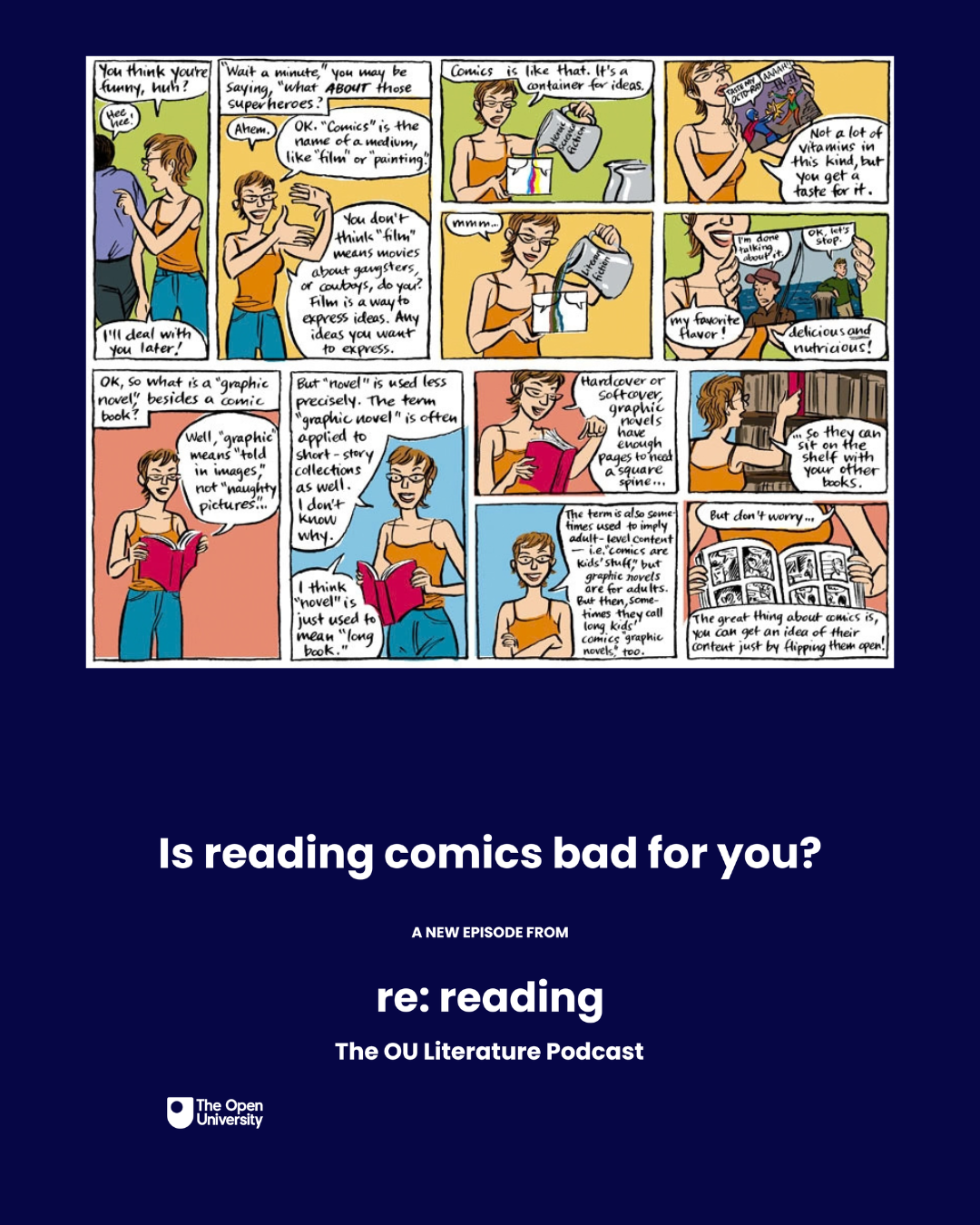
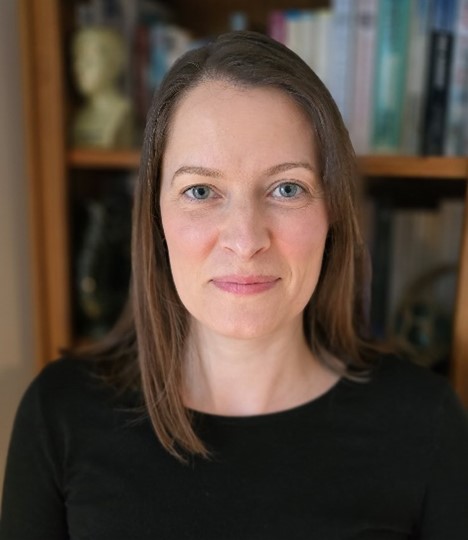
Our new episode features Dr Francesca Benatti and Dr Shafquat Towheed discussing comics.
Are they are good quality reading material?
Search ‘OU Literature Podcast’ on Apple, Spotify, Pocketcast, and all major podcast providers.
The podcast from the English and Creative Writing department at The Open University is available to listen on Apple Podcasts, Spotify, Amazon, PocketCasts, and all major providers.
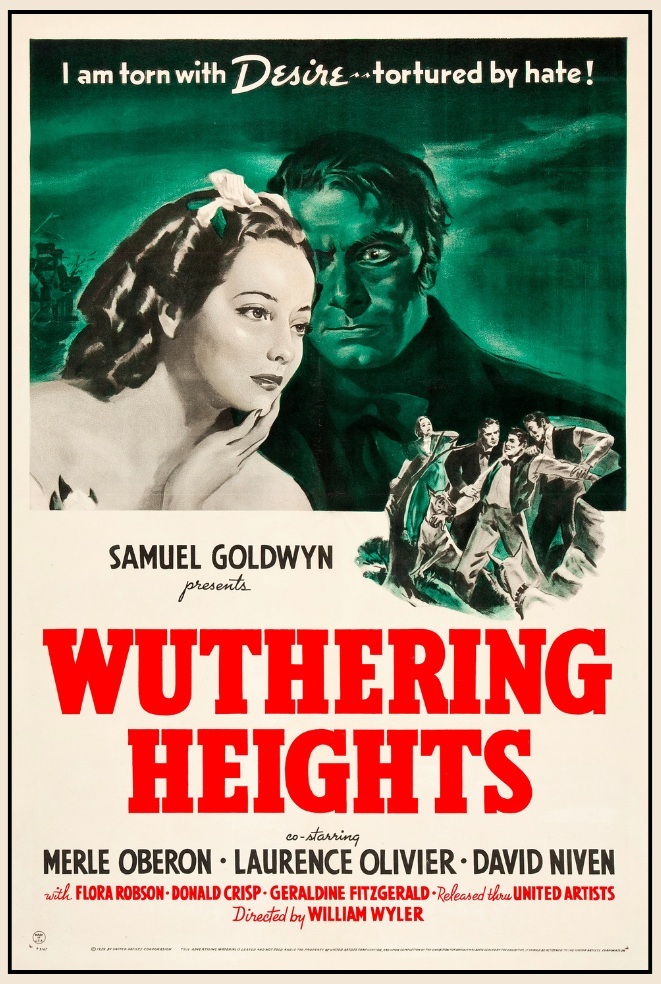
In Episode 1 Dr Jennifer Shepherd and Dr Anna Clarke discuss Emily Brontë’s novel, Wuthering Heights, and the recent film adaptation directed by Emerald Fennell. This is the transcript of Episode 1.
The new OU English and Creative Writing podcast is now live on Apple Podcasts, Spotify, Amazon, PocketCasts, and other major providers.
The podcast, called ‘re: reading – The OU Literature Podcast’ features OU English and Creative Writing academics discussing books, reading, and creative writing. It’s designed to be informative and accessible for the general listener, while retaining academic rigour and offering insights into some of the most exciting research coming out of the English and Creative Writing department.
Episode 1: Much ado about Wuthering Heights features Dr Jennifer Shepherd and Dr Anna Clarke discussing Emily Brontë’s Wuthering Heights, and Emerald Fennell’s recent adaptation, starring Margot Robbie and Jacob Elordi.
There are also several bonus episodes of the ‘5 Books’ series which ran successfully on OU News over the last couple of years. This series has suggestions from ECW academics of the best books to read on a whole range of topics, from bereavement to football. Available now on the podcast are episodes featuring
five classic novels about Italy
five books of apocalyptic fiction
five recommendations of Nordic noir fiction.
Listen for fascinating discussions about reading, creative writing, literary theory, book recommendations, and much more!
English and Creative Writing Staff Tutor Natalie Lewis has been working with colleagues Lania Knight, Dónall Mac Cathmhaoill and Emma Claire Sweeney to explore staff and student attitudes towards the recording of online Creative Writing tutorials. They wanted to determine whether recordings can increase access to tuition without harming the safe spaces students need to develop their creativity.
We caught up with them to discover what they’ve learnt.
Tell us a bit more about your project.
Prior to the 2022/23 academic year, undergraduate Creative Writing modules had opted out of the university’s recording of online tutorials policy. We’d made this decision because we wanted to protect students from potential feelings of vulnerability and inhibition in tutorials that involve sharing personal work.
However, the OU student body includes 70% of students working full or part-time and over 37,000 students with a declared disability. Attending live-streamed tutorials can for many, therefore, be a challenge in itself. We began to ask whether there might be benefits to providing recordings of tutorials, which could be accessed both by those students who’d attended the live-stream and those who’d not been able to make it.
What was your motivation for doing this project?
Creative Writing Lecturers and Staff Tutors had the OU’s strong commitment to accessibility in mind when designing the project. There are many ways in which tutorial recordings can enhance accessibility for those with disabilities, such as providing opportunities to stop and start recordings, to watch at a faster or slower speed, and to remove the need for notetaking in a live setting. Similarly, for those studying alongside work, family, and caring commitments, recordings can mean the difference between accessing tuition and missing out altogether. As Jilly MacKay says in her 2020 article You should record your teaching, the practice of ‘mainstreaming accessibility’ can benefit everyone.
On the other hand, there is a concern that student anxiety could be heightened by being in a recorded environment. This could lead to reduced participation or, worse, non-attendance.
In a practice-based discipline such as Creative Writing, students can benefit from a low-stakes environment where they can experiment with voice, style, structure, and character development. And there’s strong evidence to suggest that anxiety (including social and creativity anxiety) affects a significant proportion of the population. The Mental Health Foundation report on anxiety in the UK in 2023, for example, found that one in five people (20%) are anxious most or all of the time. So, making evidence-based decisions about tutorial recordings is crucial to the student experience.
What were the key things you learnt from it?
When offered a choice, students did not avoid recorded tutorials in favour of an unrecorded equivalent.
Tutorial attendance was not negatively affected by the availability of tutorial recordings. Most students who attended a recorded tutorial (87%) interacted the same amount they usually would in an unrecorded tutorial, suggesting they felt safe in those online spaces.
Students were overwhelmingly positive about the provision of tutorial recordings, which were accessed by an equivalent of nearly 80% of the cohort, showing their popularity in the first year of being available to students.
The steady pattern of students viewing recordings throughout the academic year suggests recordings have a legacy value for those who have fallen behind the study calendar and those who have postponed submission of their final assignment due to extenuating circumstances.
Recordings were particularly valuable for students with work or family commitments and for those with disabilities. The availability of recordings had increased their ability to access tuition.
“[Recordings are] useful for me because I work a lot and have a toddler so attending a tutorial isn’t always an option … and they’re such a good resource.”
“I often find live sessions quite stressful due to interaction, anxiety, and trouble focusing because of ADHD. A recording gives me an opportunity to take breaks and rewind if I didn’t understand something.”
Did anything come as a surprise?
Rather than being a barrier for students with anxiety, recorded tutorials enabled some students to access tuition in their own time and potentially benefit from vicarious learning while listening to their peers participate in academic and creative discussions.
Inevitably, recordings weren’t popular with everyone. For a minority of students who were not in favour of recorded tutorials, concerns were focussed on recordings not providing a full and interactive experience, and recordings acting as a deterrent from attending or interacting in live tutorials. These students are catered for by providing unrecorded tutorial options and maintaining alternative ‘safe space’ environments, such as asynchronous forums, for developing new writing and sharing peer feedback.
A comparison of different Arts and Humanities modules revealed some surprising differences in the numbers of students accessing tutorial recordings. Students of Level 3 English Literature viewed recordings above the average level, as did Music, Art History, and some History students. Whereas Creative Writing, Classical Studies, and interdisciplinary students viewed recordings at below-average levels for Arts and Humanities students.
Tell us about next steps.
The project findings were presented at a recent tuition-planning conference in Milton Keynes to support OU Arts and Humanities colleagues to find the right balance for students in their discipline areas.
Natalie Lewis
Natalie Lewis and Lania Knight are Staff Tutors in English and Creative Writing. Natalie is the Lead Cluster Manager on A215 Creative Writing and is a module team member. Natalie has contributed to recent scholarship projects supporting Creative Writing Associate Lecturers and full-time intensity students. Lania is Lead Cluster Manager for A803 Creative Writing MA (Part 2) and is a module team member. She is also Cluster Manager for A363.
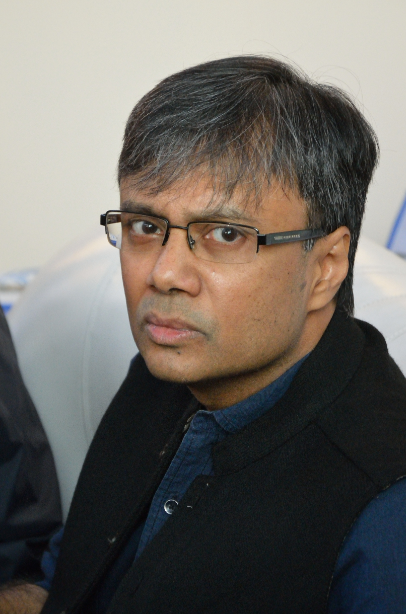
The concluding interview in the MK Lit Fest series, The Long and the Short of It, took place on Monday 25th March 2024, and focused on the novel form. Amit Chaudhuri was in conversation with OU PhD student, Rebekah Lattin-Rawstrone, in a discussion that touched on diverse topics such as the influence of Indian classical music on his writing, the (un)conventional novel, and the importance of the inconsequential. PhD student, Anita Schwartz, offers here a summary of the discussion for those of you who couldn’t make it.
Amit Chaudhuri
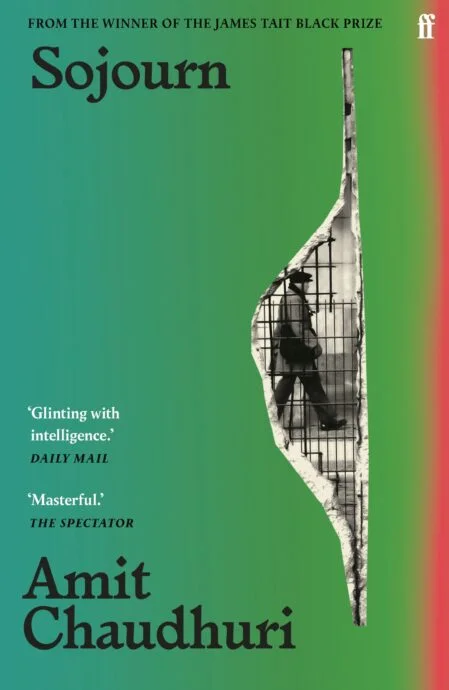
Amit Chaudhuri is the author of eight novels, the latest of which, Sojourn, was published in 2022. His novels have won numerous awards, including the Commonwealth Writers’ Prize, the Los Angeles Times Book Prize, and the Sahitya Akademi Award. He is also an acclaimed musician, poet, and essayist.
Rebekah Lattin-Rawstrone opened the discussion by asking how the structure of Chaudhuri’s novels has been influenced by his musical interests? Chaudhuri revealed that he is unaware of being a singer when he writes, and equally unaware of being a writer when he sings. For him, a model of ‘multifaceted’ creativity, the suggestion of unity between co-existing creative selves, just does not work. He likened this internal detachment to life in India, which for him is always decentred. Wherever you may be, you are listening (and therefore linked) to what is happening in another flat, or on the street outside, but are not distracted by the sounds. It is a disconnection, Chaudhuri said, that he finds fascinating.
Yet, he pointed out, his novels follow a similar framework of improvisation that is present in the Indian classical musical form, the Raga. The musician moves up and down the octave, elaborating and expanding the scale, and finally arriving at the note in a ’round about way’. This, he says, is how he approaches his novel writing, the narrative trajectory is constantly deferred through an avoidance of ‘coming to the point’ that the reader may expect in a novel.
As a teenager, Chaudhuri revealed, his novel-writing began as a rebellion ‘against my own interiority’. Never comfortable with the realist novel as a form, or with the idea that you pour an ‘inner life’ into a character, he instead narrates the modes of being which could have happened. His novels, he explained, depict unimportant everyday events where nothing of consequence has occurred, exploring how the senses inhabit or partake in life, rather than presenting the ‘sensational’ itself. Even objects – or the life of objects – are of great importance in his narratives. The novel as a genre, he elaborated, accommodates the possibility of the object playing a part in the milieu of the character, as they exceed the room where they are placed.
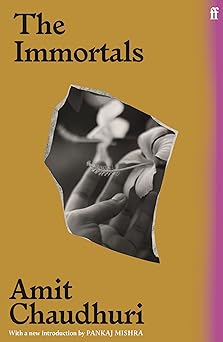
In answer to Lattin-Rawstrone’s question about reader engagement, Chaudhuri explained that he rarely thinks of his audience, as to do so would cause him to freeze, or deliver a novel that wouldn’t please them. Every work, therefore, is based on immediate impulses and stimuli. However, Chaudhuri has a ‘vague sense’ of how the novels will unfold, a theme that is to be investigated. For example, in The Immortals (2010), Chaudhuri explores the precarious position of the artist after the onset of the free market through the relationship between the ‘puritan’, privileged and unkempt teenager, Nirmalya, and the ‘ambivalent’, unprivileged, knowledgeable teacher, Shyam Lal. The comedy and irony of that relationship, Chaudhuri says, ‘went to the heart of life as far as I was concerned’. In his latest novel, Sojourn (2022), a visitor to Berlin is absorbed in the city, feeling both a sense of recognition and a loss of himself and memory. As Chaudhuri explained, the character of the unnamed man emerges into the city as a ‘product’ of the end of the Cold War, and the novel is an exploration of the new world of market forces that energises the narrative.
I will finish with Chaudhuri’s fascinating answer to a question on the personal process of writing and revision. When composing a novel, Chaudhuri reflected, he constantly asks himself, which sentences have a ‘future’ in terms of direction, that somehow hold a promise? He works, he explained, paragraph by individual paragraph, re-reading and deciding if they are ‘dreadful’ or not, and once again questioning: What am I doing? What has future? Every sentence and paragraph, he concluded, must have a life and sense of direction outside of the story. Pluck it out of the narrative, and it should possess the potential for a myriad of directions. It was a perfect note on which to end such an engaging discussion.
Anita Schwartz
Anita Schwartz is a part-time PhD student in the Department of English. Her thesis explores little-known texts in English by Indian women between 1870 and 1947, and the complex debates taking place around reform, nationhood, and women’s position in late colonial Indian society. Her supervisors are Prof. Alex Tickell and Prof. Suman Gupta.
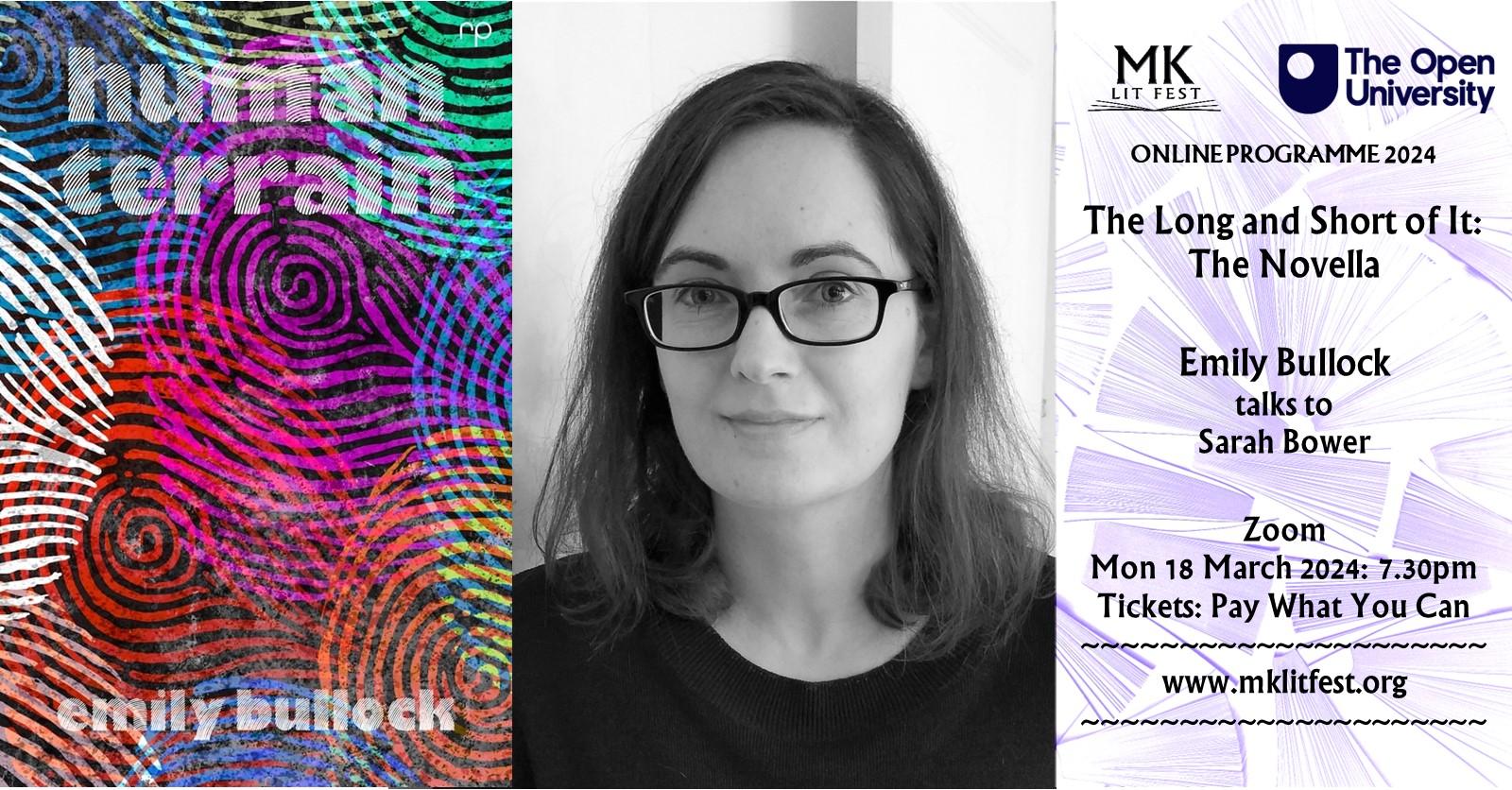
On Monday 18 March 2024, in the third instalment of the MK Lit Fest series The Long and Short of It, acclaimed writer Emily Bullock was in conversation with OU Associate Lecturer and PhD student Sarah Bower discussing the novella, sometimes dubbed literature’s ‘awkward middle child’.
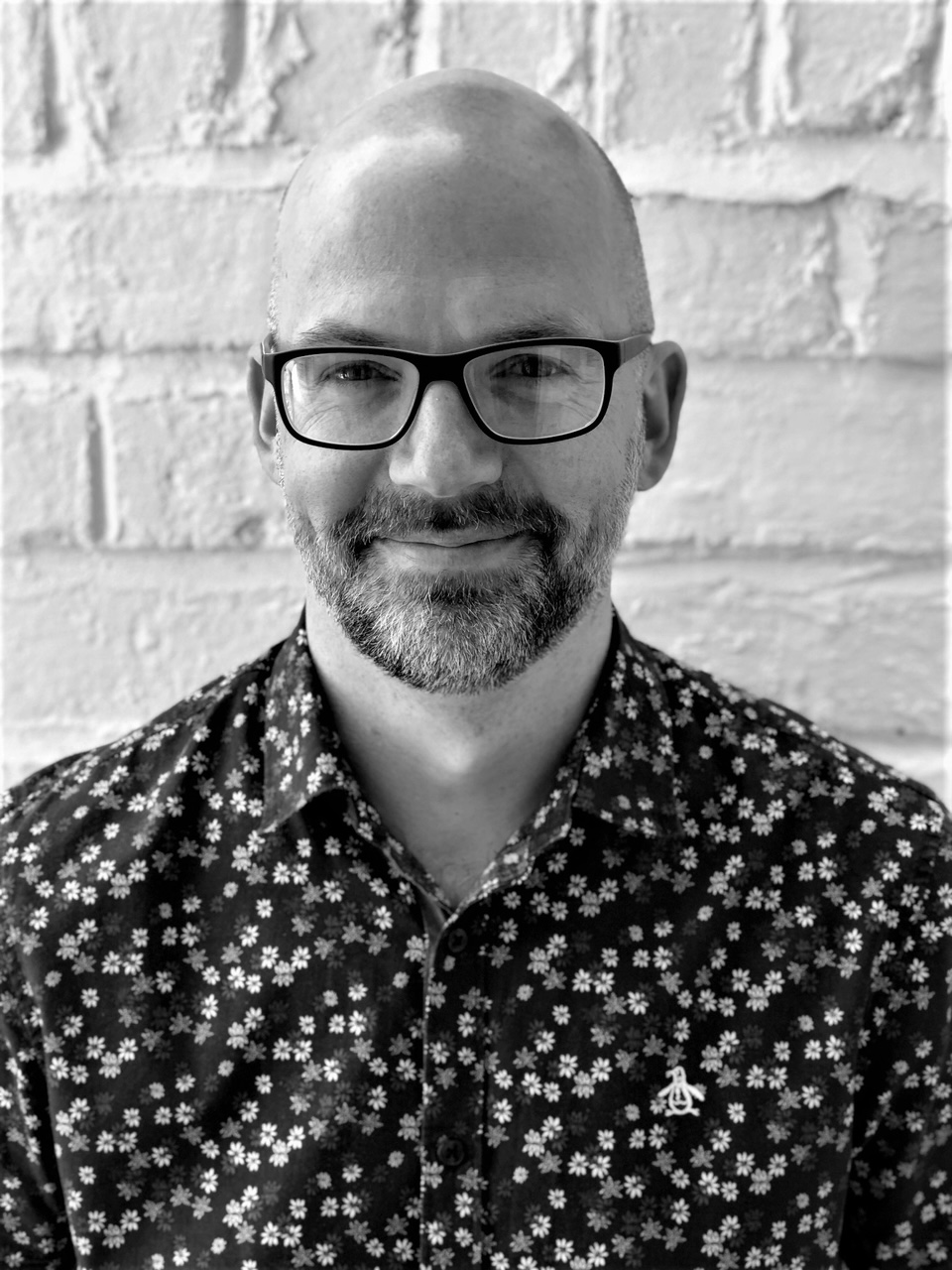
Emily BullockSarah Bower
The novella is for some a bit of a puzzle; too long to be a short story and too short to be a novel. For many mainstream publishers it is a headache to be avoided. For some readers the novella represents poor value for money, for others, it is the most perfect literary form. Although shorter than novel in terms of word count, a novella is not necessarily easier to write, and to write well requires the intense control and refinement perhaps more often associated with poetry.
Interviewing Emily Bullock about her forthcoming publication For Always Only and the form of the novella, Sarah Bower (herself the author of a novella) asked questions that got right to the heart of the matter.
For Always and Only is about the process of reading James Joyce’s Finnegan’s Wake, or at least it is partly about that because a novella is no one-trick pony and is never only about just one thing. There is a degree of irony, noted Bower, in using Joyce’s sprawling and notoriously difficult work as the organising principle for a short, tightly controlled novella. To explain how this works, Bullock gave an account of her own process of reading Joyce, not entirely for meaning, but as a kind of readerly ‘beach combing’, and how she makes Finnegan’s Wake her own by frequently interrupting Joyce with her own lines of thought. Roland Barthes also remarked on this aspect of reading in The Rustle of Language:
Has it never happened, as you were reading a book, that you kept stopping as you read, not because you weren’t interested, but because you were: because of a flow of ideas, stimuli, associations? In a word, haven’t you ever happened to read while looking up from your book? (1986, p29).
In the light of these descriptive accounts of reading and reading while looking up, the connection with Joyce begins to make perfect sense as the backbone of writing that is very much ‘about’ reading.
The process of writing this novella was notable for the amount of cutting Bullock found she was willing to do, such as cutting out her character’s backstory, cutting flashbacks, stripping back description, and ending chapters abruptly. All this cutting, she explained, leaves the remaining gaps to do more work and leaves space for the reader who must invest in the reading process. The reader needs to be particularly alert to what is not on the page. Writers often talk about the balance between showing and telling, but in the case of the novella, according to Bullock, what the writer is not showing and not telling become highly significant.
Bullock’s forthcoming novella is set in a claustrophobic bedsit in Bloomsbury, a location that gives a wry nod to Virginia Woolf’s ‘A Room of One’s Own’ and which is also perfectly sized to provide a counterpoint to Joyce’s Dublin. And yet, the setting offers a similar intensity to Dublin but, of course, achieved in far fewer words. In the reading Bullock gave, her use of lists of items economically created a whole world whilst leaving scope within the tight frame of narrative to express bigger ideas.
In answer to Bower’s question about how a writer might know that the novella is the literary form that would best serve the story they want to tell, Bullock explained that whilst a short story is very often the synthesis of two ideas, and a novel gives ample room for complexities of character chronology, and worldbuilding, stories that are of an experimental nature, stories with strong ideas and those requiring considerable reader engagement might find their ideal form in the pithy perfection of the novella.
In a lively Q&A session Bullock fielded questions on For Always Only (to be published later this year by Reflex Press) and on the form of novella more generally. Enthusiastic audience involvement would suggest that despite the lacklustre support from mainstream publishers, there is an enduring appetite for the intriguing form of novella, and many of the questions and comments raised could have kept us all talking long into the night.
The series will conclude with the novel form on Monday 25 March.
Gwyneth Jones
Gwyneth Jones is a writer of short and flash fictions under the pen name Jupiter Jones, and her work has been widely anthologised. She is currently a PhD candidate at the Open University researching (dis)connectivity in the literary hybrid form of the novella-in-flash. Her supervisors are Dr Jane Yeh and Dr Emma Claire Sweeney.
Step into the enchanting world of Amit Chaudhuri, a literary luminary known for his exploration of diverse creative forms and their connection to the human experience. Join us as we uncover the secrets of Chaudhuri’s work, from his love for Indian Classical Music to his thought-provoking insights on storytelling. Prepare to be inspired and captivated by the brilliance of Chaudhuri’s literary legacy.
One of the most intriguing things about literary giant Amit Chaudhuri’s work, is his interest in the way different creative forms speak to human experience.
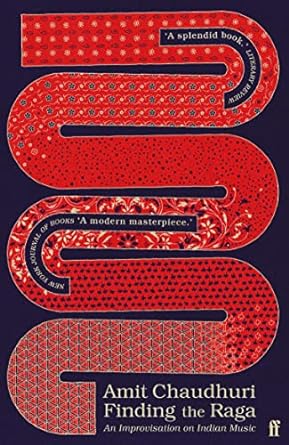
Chaudhuri’s work has always reflected his interest in Indian Classical Music and in the non-fiction work, Finding the Raga, he writes about the difference between experiencing the world as language where the word ‘morning’ is only arbitrarily connected to what we understand the word to mean, and experiencing the world through the representational act of telling stories. He sees the first as akin to poetry and the second akin to narrative forms like the novel.
For Chaudhuri, a Western musical tradition is wrapped up in a linear exploration of the human at the centre of things and the Indian tradition decenters human action and refocuses attention on experiences that slip out of standard narrative interpretation and linger in the present.
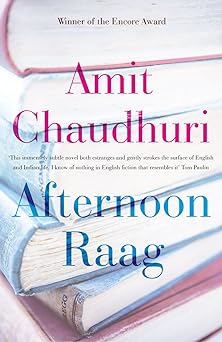
When I read novels like Afternoon Raag or The Immortals it is this ability to discard some of the strictures of beginning, middle and end, and to focus instead on those moments in which time seems to stand still, in which nothing dramatic happens and yet the sense of what it is to be a conscious, breathing human is elegantly brought to life, that makes Chaudhuri’s work so engaging and exciting. This is poetry working within the novel and as a reader I find my way into his work through this intense love of those moments, or moods of being.
This is of particular interest to me as a writer in my third year of a creative writing PhD at the OU, writing my novel, All The Hollow Places, that centres around the last day in the life of Gertrude Bell, the archaeologist, traveller, linguist and political officer who helped to draw the lines around modern day Iraq.
I’ve spent the last few years thinking hard about the ways in which we interpret the world through the many filters of our familial, social, educational and cultural backgrounds. I’ve wondered about how I can reimagine Bell for a modern audience in a way that not only brings her to life on the page, but encourages a reader to question her interpretation of the world and, by extension, their own.
Some of this needs to be done through interrogating that representational, linear act, and just like Chaudhuri, thinking about how to embrace moments out of time that collapse the linear spatiotemporal structures we generally use to situate ourselves. In this way, we can understand what it is like to wake early to the call of the muezzin because we have all had moments of being that seem, in the words of Annie Ernaux in The Years, to ‘float on top of each other’. Annie Ernaux names the feeling of such moments ‘the palimpsest sensation’ and like her, I feel this sensation could be an alternative ‘instrument of knowledge’, one which the novel, that expansive, potentially circumlocutory form, has the ability to wield to startling effect. One which Amit Chaudhuri wields beautifully himself.
One of my favourite passages of Afternoon Raag describes the protagonist imagining his mother making and drinking her early morning cup of tea. This is something she does every morning and, just like this repeated act, we imagine that tea twice. We start with her boiling the kettle to a ‘solipsistic bubbling’ (p24), divert to other things she does throughout the day, other observations about her hair and character, and then we return to the tea: ‘there (on the veranda) she stands with the teacup balanced in one hand, pausing now and then in her thoughts (for she is always thinking) to sip her weak tea politely, watching the lane’ (p26). We are not sure how often the protagonist has actually watched this moment, and understand this rendition of her morning to be one collated over a series of specific moments that together form more of a generalised sensation of his mother moving about the house before dawn, waiting to drink tea as the sun lifts over the horizon. Her habits are the stuff of life, the background comforts of home that offer quiet solace to her son in a cold, damp Oxford, far from his parents’ Bombay flat.
The memory reveals the value in the everyday, the meditative, undramatic moment that weaves through our lives and holds a sense of our identity unshackled by strict chronology and the events that we tend to use to shape our histories (births, marriages, deaths). This is the kind of mood and sensation Chaudhuri evokes with such gentle poetry.
Being asked to interview Amit Chaudhuri for the MK Literary Festival is a dream come true. As he writes in Finding the Raga, ‘a creative work is engendered, almost always at a crossroads’ (p52) and I hope, in our conversation, to tease out the multiple creative impulses that generate his literary and non-literary work, and to find inspiration for my own work as I try to marry past and present, form and content in my novel.
My creative practice PhD combines a novel and critical thesis centred around the life of Gertrude Bell (1868-1926). As a distant relative of Bell, my novel uses multiple perspectives – including a personal one – to explore the controversies of Bell’s life, from her hand in establishing modern day Iraq, to whether her overdose was really suicide. Both novel and thesis examine the ways in which we tell and use stories of the past, searching for new approaches to collective and individual storytelling that might help us think and act differently in the present.
Rebekah-Lattin Rawstrone
Rebekah Lattin-Rawstrone has a Masters in Creative Writing from Birkbeck, University of London, a Masters in ‘Issues in Modern Culture’ from University College London, and a degree in English from Cambridge University. Her fiction has received Arts Council funding and her PhD is funded by the OOCDTP.
On Monday 12 March 2024, we had the privilege to hear the writer RattawutLapcharoensap in conversation with OU Associate Lecturer Dr. Alistair Daniel. In this second instalment of the MK Lit Fest series The Long and Short of It, they explored the unique challenges and pleasures, and possibly also pains, of short story writing.
PhD student, Anne Wetherilt, offers here a summary of the event for those of you who couldn’t make it.
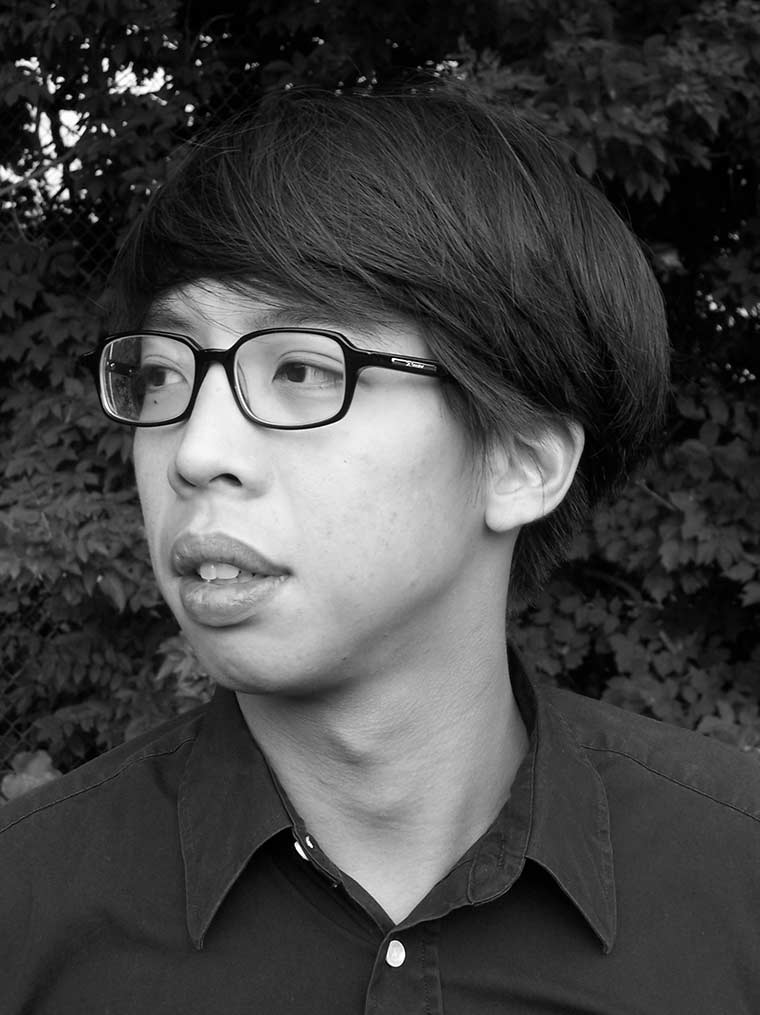
Alistair DanielRattawut Lapcharoensap
Rattawut Lapcharoensap, Alastair Daniel wrote earlier this month burst onto the literary scene in 2005 with his debut story collection, Sightseeing. It won the Asian American Literary Award and was a finalist for the Guardian First Book Award.
Short stories, Edgar Allan Poe famously wrote, need to be read in one setting. But this, Lapcharoensap argues, short-sells the short story. An avid reader of the form – he quotes James Joyce, Frank O’Connor, Sherwood Anderson, Flannery O’Connor, Alice Munro, Katherine Anne Porter and Junot Diaz amongst others – Lapcharoensap is drawn to the short story because of its ability to capture the individual and the collective experience, and its intense awareness of human loneliness.
His short stories have a strong sense of place. ‘I want to write the truth about the communities I felt part of’, he tells us. Indeed, in Sightseeing, he gives us a richly detailed picture of Bangkok in the 1980s and 1990s. The stories are rooted in experiences he witnessed as a young person and carried with him as an adult. And whilst they touch on topical political issues, his main aim is always to tell the truth about his characters’ lives.
When Sightseeing came out, William Sutcliffe, writing in The Guardian praised its ‘novelistic richness’. Lapcharoensap aims to achieve this richness through his characters. Even though a short story gives the reader only a glimpse of the character’s life, you can present the whole person: where they came from; what they have done earlier in their life; how they have lived their life. You can write beautifully and with great emotional clarity, he asserts, a short story need not be short in terms of descriptive power.
In Sightseeing, these stories typically narrate the experiences of young boys or adolescent men. But they are brought to us by older first-person narrators, who calmly observe and report their own earlier encounters with life. This older first-person narrator, Lapcharoensap reflects, brings an interesting perspective to the story. They may have greater articulacy, but often continue to be bewildered.
Given the centrality of place and character in his stories, it is perhaps no surprise to learn that Lapcharoensap usually starts the writing process with a scene or a character. Asking ‘who is speaking’, he expands on a notion, a feeling, a telling detail or bird’s eye view. The story line may emerge later – although sometimes it doesn’t. This early composition is like playing in the dark, he explains, and proceeds without a plan. But planning comes in when he starts revising and here we get a glimpse of the personal discipline Lapcharoensap applies to his writing. Revision is about looking for opportunities to exercise the imagination, he believes. The creative act is not just the initial inspiration – the artist struck by the imagination in his study. Rather, such moments occur in the sequence of drafts, when ‘something beautiful emerges from the lumps of despair’.
For all their promise, short stories can be prone to clichés and pitfalls. Lapcharoensap is particularly wary of the emphasis on epiphany. The Joycean epiphany can be beautiful, he argues, but as a narrative habit it can also be limiting. Not every character needs to act, stumble and learn from their mistakes. Weak epiphanies or false epiphanies abound in short stories, and as a genre requirement, it can limit a young writer in their development and imagination. Another pitfall, he admits, is to create characters like yourself, which you don’t allow to fail or behave foolishly. Invariably, this reduces the richness of the story, and the fictional narration becomes wishful fulfilment.
Part of the joy of being a short story writer, Lapcharoensap notes, is in seeing them published as part of a collection. Each story is written on its own and should stand on its own feet. But they are enriched by their neighbours, as the writer organises them in a particular way to achieve formal and thematic dignity.
Sightseeing closes with ‘Cockfighter’, which at 90 pages is closer to a novella.This particular one did not end, Lapcharoensap explains. ‘It just wouldn’t stop and I continued to be interested in it’. As a reader, he loves the novella – it has the expansiveness of the novel yet requires the rigour and economy of the short story. To this reader of Sightseeing, Lapcharoensap moves effortlessly across the two forms, offering us ‘novelistic richness’, as well as sheer reading pleasure.
The series will delve into the novella form on Monday 18 March and conclude with the novel on Monday 25 March.
Anne Wetherilt
Anne Wetherilt is a part-time PhD student in the Department of English, funded by the Open Oxford Cambridge (OOC) Doctoral Training Partnership. Her thesis – ‘Decolonisation and the Female Middlebrow: Politics, Economics and the Novel’ – studies the work of women writers, who witnessed the end of the British empire. Her supervisors are Prof. Alex Tickell and Prof. David Johnson.
To whet your appetite, Gwyneth shares here why she likes to keep things small.
Flash fiction, which tells a complete story in just a few hundred words, takes brevity as its starting point and as permission to break rules. It holds in tension the practice of narration (the art of spinning out events in an engaging way) and techniques of concision (eliminating all but the most necessary) to imply much more than is actually on the page.
I began writing flash fiction about seven years ago, fascinated by the way it can use form as content and by the way the writer enfolds meaning for the reader to discover. Flash is neither easy nor quick to write, but it does offer great freedom to experiment.
Things that might be difficult to sustain or that would become exceedingly tedious in longer form fiction can be creatively explored within the sandbox of flash. Unusual points of view for instance, unusual tenses (future conditional, perhaps?), or alphabet games. Some inspiration for this comes from the Oulipo Group who impose strange external restrictions to gain writerly freedom – Oulipians are said to be ‘like rats building a labyrinth from which they plan to escape’. These are some of my labyrinths.
Unusual Point of View
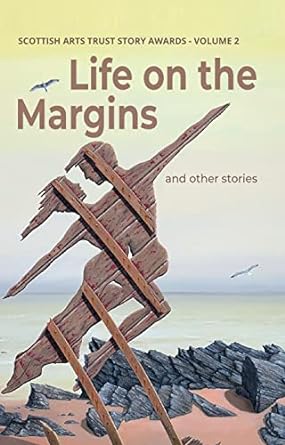
Life on the Margins: And other stories from the Scottish Arts Trust Story Awards (Volume 2)
Writing in second person can be slightly disconcerting for the reader who is asked to identify with the ‘you’ of the narrative. This is an excerpt from my flash fiction ‘Not Lost or Drowned’ published in Life on the Margins, about a woman escaping from a toxic relationship.
You’re staying alone in a caravan. You walk to pass the time. Sometimes you take the bus into town, cruising past trinket shops. You see missing posters, signs of desperation, fly-posted along the coast. She has, or had, the same name as you. Unsettling to see it there above a number to call, day or night. You memorise it, test yourself at the next poster, and the next, till you know it by heart.
Fibonacci Sequences
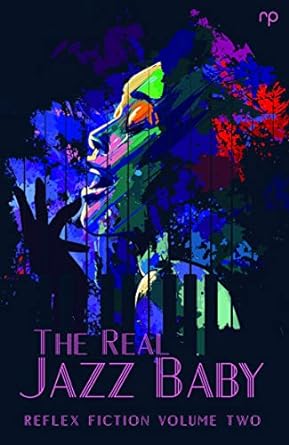
Book Cover: The Real Jazz Baby – Reflex Fiction Volume Two
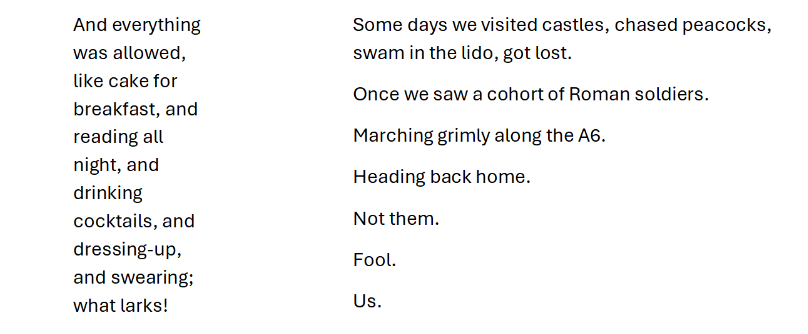
That is, writing in sentence lengths that correspond to the Fibonacci sequence where the last two numbers are added together to make the next (e.g. 1,1,2,3,5,8,13,21, etc). The rigidity of form compels the writer to add and/or subtract words with potentially unexpected results. I wrote ‘Aint no Cure for my Fibonacci Blues’ (published in The Real Jazz Baby) inspired by summer holidays with my slightly batty aunt. It opens with two one-word sentences and builds up to a fifty-five-word sentence and then back down. This is the ending:
Lipograms
The Oulipo group often devised lipograms – omitting one or more letters of the alphabet. The letter e, of course, is the hardest. I tried this in ‘No e in Pornography’ about a man whose ‘browsing history rats him out’ which was published online by Reflex Flash. I think the lack of e gives the writing a spikey brittle quality.
Not so sorry, thinks Nina, for abnormal cravings. Not sorry to bring havoc to Nina’s world. In outwardly lax administrations, such things flourish with abandon. Sonny looks long at icons of dissipation; nothing is off limits to a thin bald man with roving digits.
Breathless Paragraph
A form quite common in flash fiction is ‘the breathless paragraph’, that is, maybe three or four hundred words, written as one continuous sentence. This can result in a soaring arc of narrative or a relentless sense of inevitability. ‘Exegesis’ was published in the anthology In Defence of Pseudoscience
They’ll say she was asking for it, look at her, in her cheap skirt, scuffed heels, bitten nails and it’s obvious how she started out, a skinny, snot-nosed kid off the estate, no pony rides or chocolate eclairs for her, no, it was all ‘never mind your homework, mind your brothers,’ coz her mother was on tablets for her nerves, and what can you expect, absent father, feckless mother, things like that make a girl grow up fast, start using what she’s got to get where she wants, but as the saying goes, fruit doesn’t fall far …
Some other examples of experimental flash fiction from some brilliant writers:
Hermit Crab, taking a ‘readymade’ form such as a recipe, or lonely-hearts ad and telling the story within that form. Tim Craig’s ‘That’s All There Is, There Ain’t No More’ uses cribbage instructions.
Conceit or extended metaphor such as ‘Unbinding’ by Kathryn Aldridge-Morris which begins ‘My mother was a First Edition Pelican original’.
The experimentation and playfulness of flash fiction is a big part of its appeal for me. Sometimes the constraint of the experiment – ‘the labyrinth’ – will be evident in the finished work. At other times, it is nothing more than an escape hatch or a catalyst to spur creativity.
Gwyneth Jones, a writer of short stories and flash fictions
Gwyneth Jones is a writer of short and flash fictions under the pen name Jupiter Jones, and her work has been widely anthologised. She is also the author of three novellas-in-flash, the most recent, Gull Shit Alley and Other Roads to Hell was shortlisted for the Saboteur Award. She is currently a PhD candidate at the Open University researching (dis)connectivity in the novella-in-flash. Her supervisors are Dr Emma Claire Sweeney and Dr Jane Yeh.
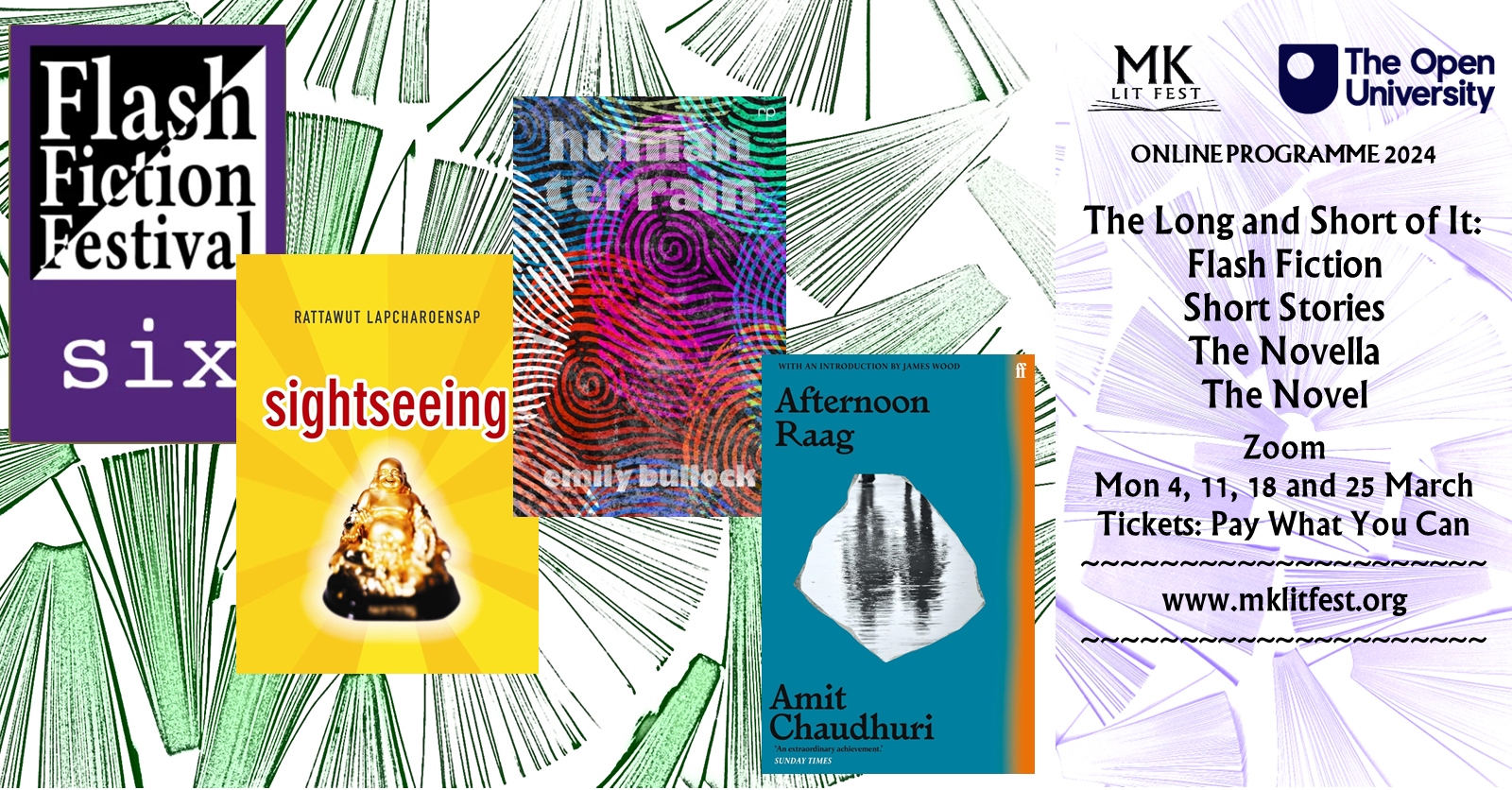
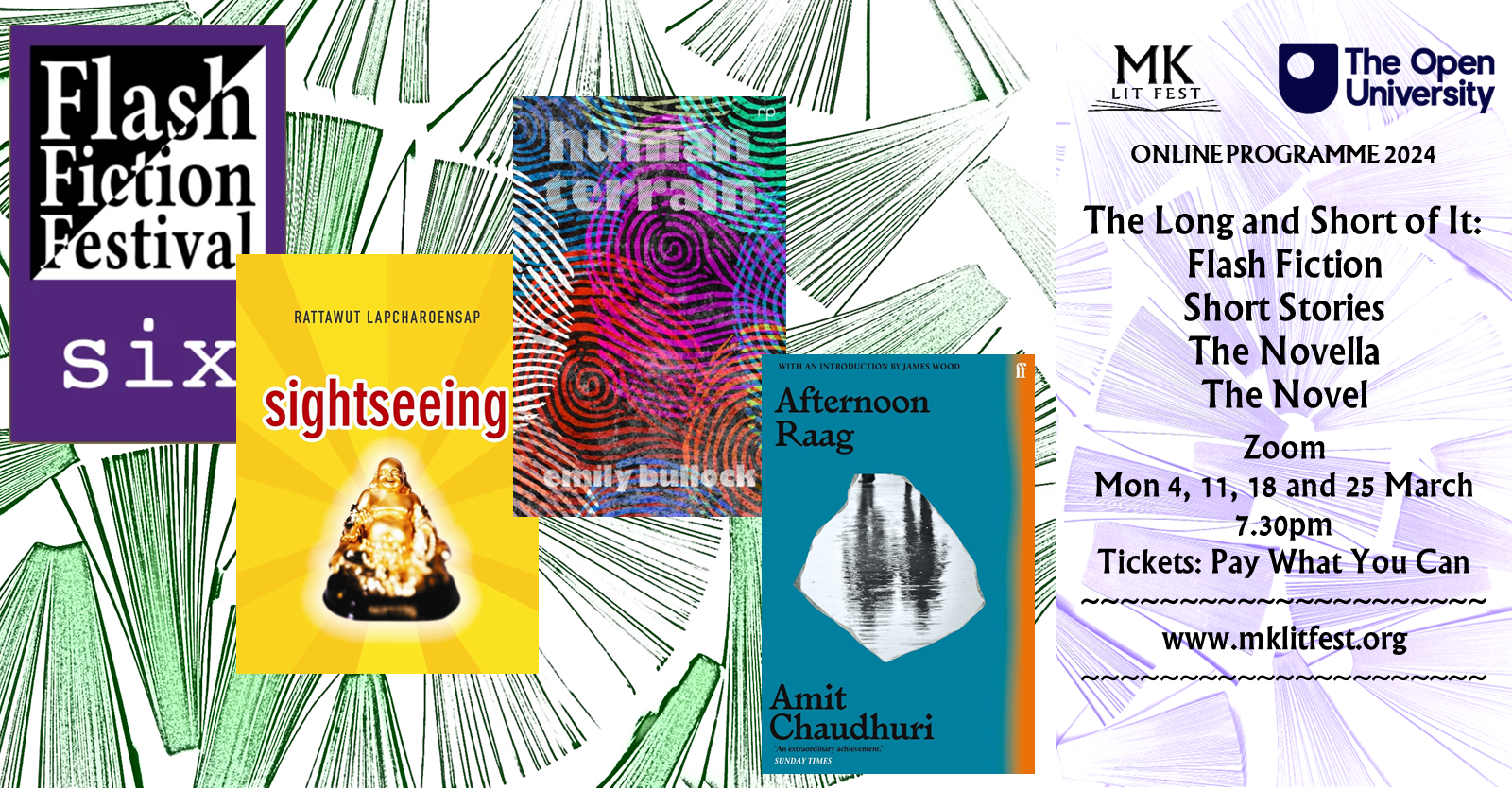
List of The Weekly Online Zoom Series from Monday 4th March – Monday 25th March at 7:30pm
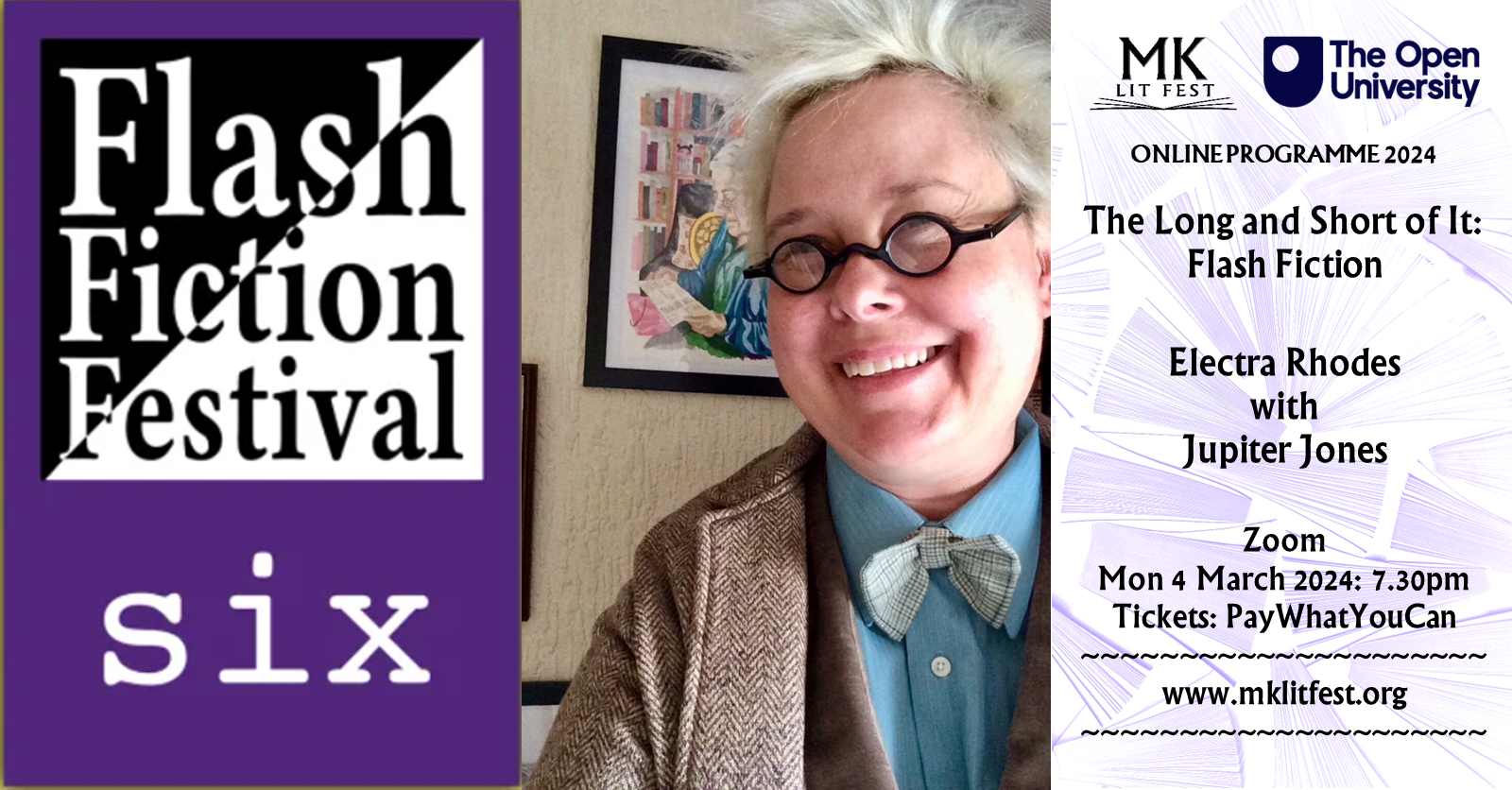
Go to MK Lit Fest’s website to book your free ticket for Gwyneth Jones’ online event with acclaimed flash fiction writer Electra Rhodes
The Open University’s Art’s Research Centre collaborated with Milton Keynes Literary Festival to train OU staff and MK Lit Fest volunteers to chair conversations with authors ahead of our joint events series, The Long and Short of It: From flash fiction to the doorstop novel.
Here, part-time PhD student, Antonia Saunders, who attended the training on campus, shares with us what she learnt.
The training was led by Julia Wheeler, a writer, journalist and interviewer who worked for the BBC for more than fifteen years. Julia chairs discussions at festivals across the UK as well as in the Middle East and North America. She has moderated events at The British Library, The Royal Geographical Society and onboard Cunard’s Queen Mary 2.
What’s the role of a moderator?
A great moderator is hardly noticed. You are offering a space for the author to shine. This includes asking relevant, interesting and concise questions. It’s your job to judge and manage the energy of both the audience and the author. A good sense of timing is crucial. Give the author the chance to respond engagingly to your conversation-starters, and leave time for questions from the floor. When an event is going well, you hardly notice the moderator.
How should a moderator prepare?
The weeks before: be the class swot. Become acquainted with the author’s latest work or the book they are promoting. A close reading will help you to form relevant questions related to central themes. It’s also beneficial to have some knowledge of the author’s backlist. Reading reviews can help to open up ideas from another perspective, and previous interviews can help you to avoid well-trodden ground and come up with some fresh and insightful questions. Follow the author on social media. Have they posted something recently that you can ask them about? Tailor your questions to the audience and event. Keep your questions focused on the guest as a writer. Remember, you aren’t revising for an exam, you are preparing for a fascinating conversation. What do you hope to discover about the author and their work?
One week before:be a safe pair of hands.
Contact the author to remind them of the event blurb, time and place. Include your own short bio so that they have a sense of who you are. Tell them how much you are enjoying the book and pull out something specific to praise.
Confirm whether the author is planning to read from their work, making clear that a reading should not last for more than two minutes. With a poet, you might weave a few short readings throughout the conversation, and you might end with a reading too. With prose, one short reading is sufficient.
Be upfront about certain themes you’ll need to cover to be true to the event description. Ask if there is anything the author would especially like you to ask – that dream question, perhaps, that no one has asked about before. Don’t close the conversation down by asking if there’s anything they do not want to cover. If the author happens to raise any no-go areas, though, be sure to respect them.
The hour before: You’re in charge!
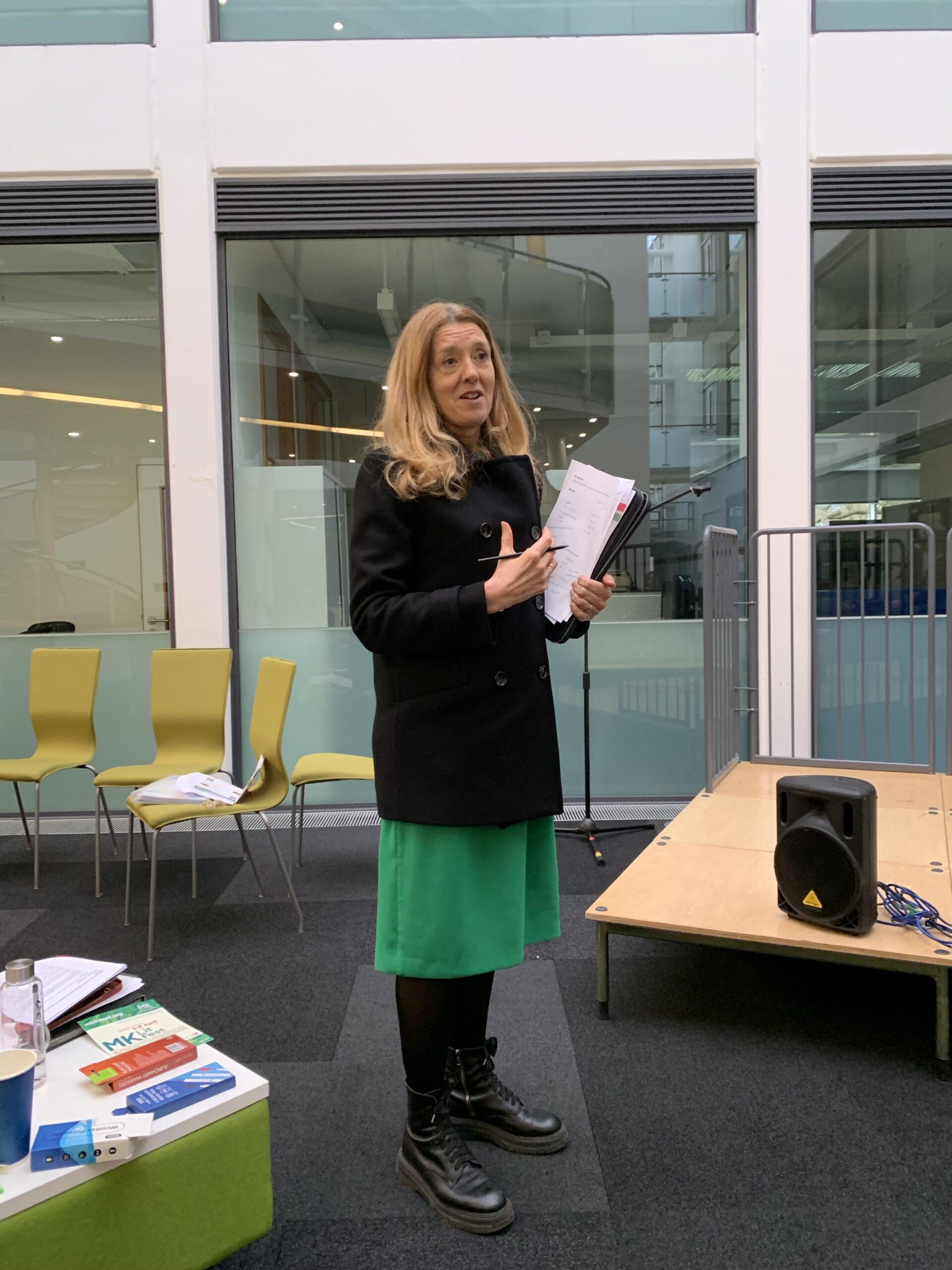
Arrange the chairs so that you are angled towards one another while facing the audience. Bring a cookbook stand to position the book the author is promoting. Engage technical staff to check the audio equipment is working. Ensure the stage is clear of any trip hazards. Pour out the water before. Brief any volunteers who might be holding the roving mics. Ask them to keep hold of the mics where possible to prevent an audience member from hogging it, and to allow the volunteer to move quickly to the next question to avoid delays. Show the space to the author and advise them that you will enter the stage first and motion them to their place. Be confident and politely assertive.
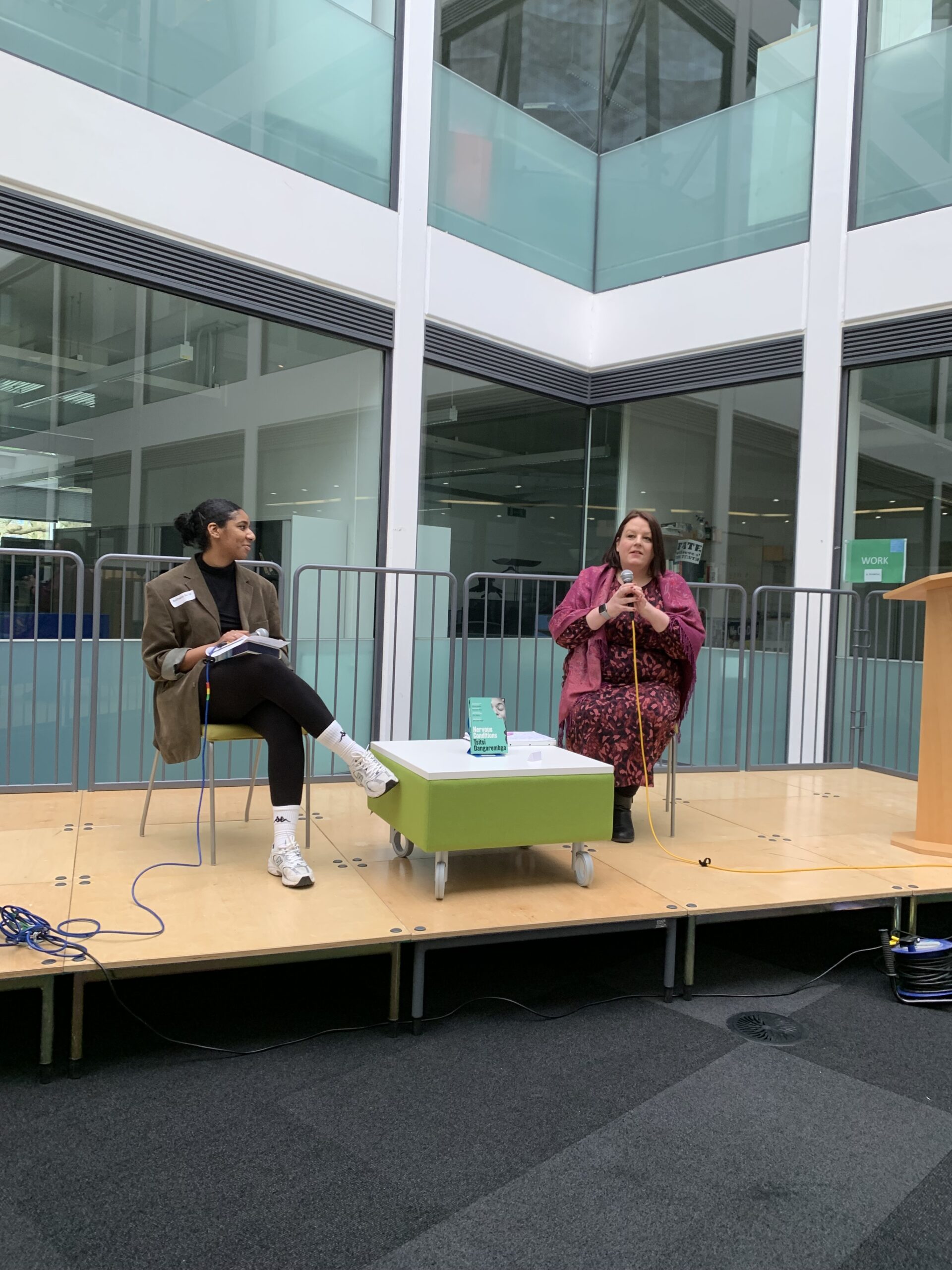
OU PhD student Antonia Saunders (right) is interviewed on stage by an MK Lit Fest volunteer.
How should a moderator handle the event itself?
Introductions: Short and punchy
Your introduction should include your name, the name of the event, and a brief description of the author and their work, ensure you mention their latest book. Three or four lines should do the trick. The audience is there to hear from the author so segue swiftly into your first question.
The conversation: Wear your research lightly
Distill your research into a one-page cheat sheet, which you can hide behind a copy of the author’s book! You should avoid referring to this too often, but it can offer a crutch to remind you of important quotations, or to jog your memory with a question to keep a conversation on track. But it’s important to listen to your guest and respond to their answers appropriately, rather than stick to a pre-formulated list of questions. It should be a conversation not an interrogation! By briefly summarising the author’s answer you can segue into a deeper exploration of that topic, or you can close it off and move onto another area of interest. Don’t necessarily ask your best question first, rather give the author the chance to warm up. Ask open questions (what, why, how, tell us about, to what extent) to encourage the author to open up. Be prepared to keep the conversation going if the author is a little timid or to anchor the conversation if the author is very talkative. Have a phrase to bring things back if things go wrong. Responses like ‘people always ask that’ or ‘That’s wrong’ can be disconcerting, so have a very open question up your sleeve. ‘What would you like readers to take from the book?’ or ‘What inspired you to write about…?’ Try to maintain eye contact and ensure your body language conveys that you are engaged by what the author has to say.
Handling a panel: Create a dinner party vibe
You’ll need knowledge of one or two texts by each author. Keep in touch with all guests on an email chain. Set up the chairs in a curve, with you at one end and the author you expect to be easiest to work with at the other end. Ensure you give each panellist equal opportunity to speak, regardless of status. A question like ‘how does that resonate with you?’ can be a good way of acknowledging one response before moving onto the next author. Allow the conversation to flow, and don’t be afraid of a little controversy. Set some hares running!
Online events: The same but different?
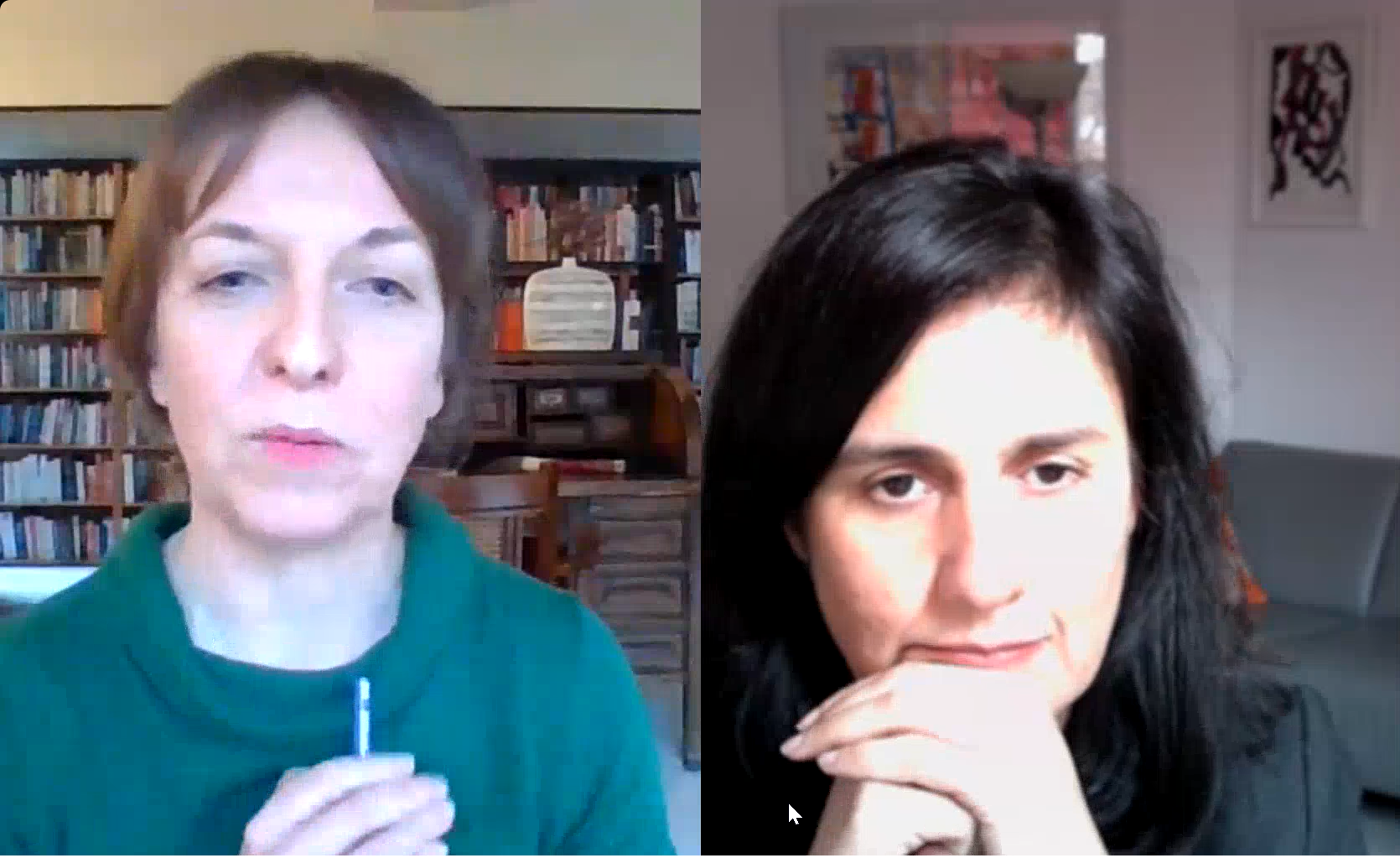
Kamila Shamsie (right) in conversation with Emma Claire Sweeney. Spot the deliberate mistake?…They are not similar distances from the screen!
Check your download speed to ensure your WiFi is working at sufficient speed, and switch off any alerts. Think about the aesthetics of the screen. Lighting should be in front of you, and the author’s book visible behind you. Log in with the author ahead of time to position yourselves a similar distance from the screen. Wear bold un-patterned clothing. Give yourself enough time right before the event to ensure everything is working. Mute and turn off audience cameras during the main discussion. If an event is hybrid, direct one of your first questions to the author dialling in to ensure their voice enters the room early on.
You will need to make extra effort to inject energy into an online conversation to keep it lively and engaging. It’s a good idea to pull questions out of the chat as you go along, rather than saving them all for the Q&A. Remember to nod and smile as the author is talking to show your engagement.
The Q&A: The question in that is…
Establish boundaries at the beginning of the session. Ask the audience, for the sake of time, to keep questions short and punchy. If the audience member gives a comment rather than a question, try to rephrase it as a question. If a question is particularly long, then announce your intention by saying ‘I’m just going to interrupt you there’. This takes the heat out of the interaction. Avoid saying that you have time for one more question in case that question is a dud! And have a supplementary question ready in case the discussion dries up.
Closing: End on a high
Keep to time. Audience members might have other places to be, and event organisers often have a swift turnaround between events. Put as much thought into your closing word as your opening ones. Thank the audience for coming. Give clear directions about where the book is on sale. Thank the author too, of course.
Afterwards: Be kind to yourself
There are almost always things you might have done differently in hindsight. But if you’ve kept your own ego in check, and helped the author take centre stage, then it will have been a job well done.
Antonia Saunders
Antonia Saunders studied for both her BA and MA at The Open University. Her part-time PhD looks at the construction of a Jewish Identity in histories and novels of the nineteenth century, and considers the literary and historiographical contexts of representations of Jewish people and Jewish Identity. She is co-convenor of the GOTH (Gender and Otherness in the Humanities) Postgraduate Forum, and she’s chaired discussions on the trope of the ‘Madwoman in the Attic’, gender fluidity in the arts and humanities, the non-human as other, and most recently, feminist readings of fairytales. Her supervisors are Prof. Delia Da Sousa Correa and Prof. Suman Gupta.