In a new publication, OU Creative Writing lecturer Dónall Mac Cathmhaoill and Kevin De Ornellas of Ulster University explore ageism as presented in Edward Bond’s ‘Shakespearean’ trilogy about aged men
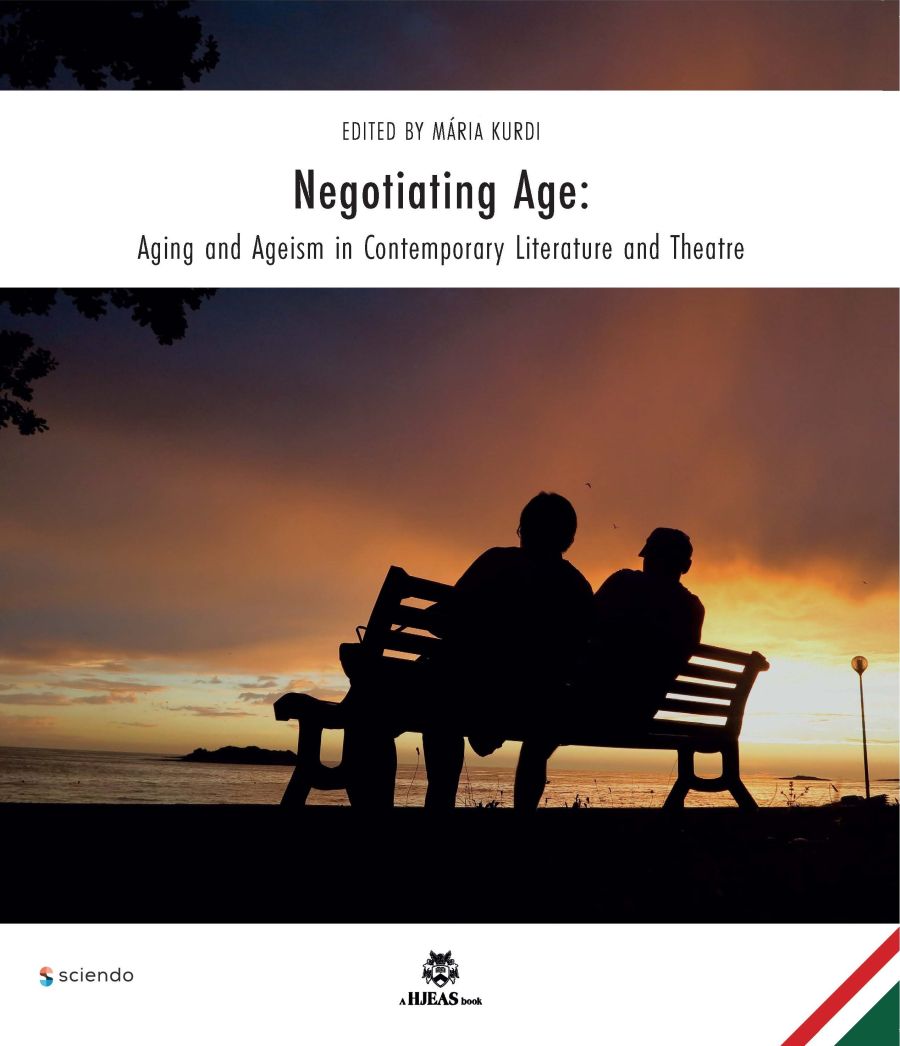
Negotiating Age: Aging and Ageism in Contemporary Literature and Theatre, edited by Mária Kurdi, and published by Debrecen University Press
It is argued that three plays by Edward Bond, born in 1934, should be regarded as a loose trilogy—and that the plays are united because they use the legacy of Shakespeare to provoke uncomfortable reflections on aging and ageism.
Two Bond plays are renowned for addressing the vexed legacy of Shakespeare head-on.
Lear (1971) is an uncompromising appropriation of King Lear in which Bond ‘corrects’ Shakespeare’s too-casual treatment of the under-represented effects of the mad king’s actions on the poor of the mismanaged kingdom of Britain.
Bingo (1973) is a bitter depiction of a dying Shakespeare who realizes that his art has been worthless because it has done nothing to frustrate murderous inequalities in post-Tudor England.
It is less well known that The Worlds (1979) is also a Shakespearean adaptation. The story of an arrogant company director, Trench, who loses his position and degenerates into a rabid, destructive, tramp-like, terrorist-supporting misanthrope, is an adaptation of Timon of Athens.
Bingo is a quasi-biographical conceit; the other two plays are radical appropriations.
Julie Sanders’s definition of appropriation as opposed to mere adaptation is important here. She argues that appropriation represents more decisive journey away from the informing text into a wholly new cultural product.
In other words, appropriations, such as those by Bond, are new works in their own right. They are not adaptations of Shakespeare but radical new plays contrived to perpetuate Bond’s theatrical, political, and moral vision.
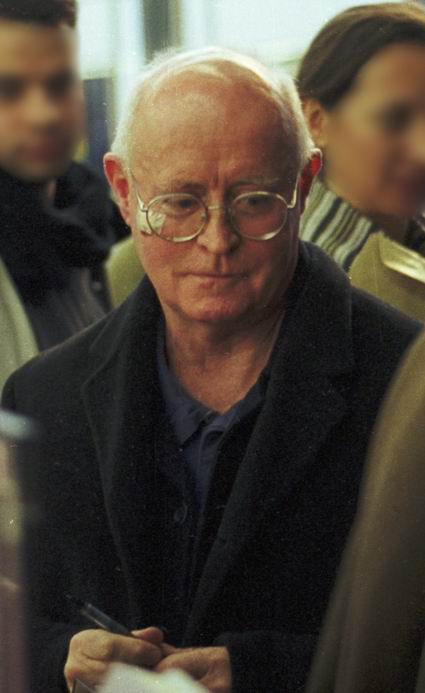
Edward Bond at the Théâtre National de la Colline, Paris, January 2001. Author: D. Tuaillon. Permission is granted to copy, distribute and/or modify this document under the terms of the GNU Free Documentation License.
Many critics have written about Bond’s engagement with Shakespeare—especially Lear and Bingo. But none have afforded The Worlds the same attention as the previous two.
Crucially, critics have, understandably, concentrated on the quasi-Brechtian staging techniques in Bond’s plays as well as the blistering, uncompromisingly leftist critiques of historical and contemporary economic and social inequalities. But none have addressed the arguably more humanistic issue of ageism.
This is important because the lead characters in the three plays are all victims of ferocious ageism. Despite his callousness, Bond’s Lear is a man more sinned against than sinning because his aged impotence and alleged senescence are met with even more overt contempt than in Shakespeare’s original.
Shakespeare, in Bingo, is openly mocked for willful inactivity by his supposed friend, Ben Jonson, and by his shrewish daughter, Judith.
And Trench, in The Worlds, is revered when fit to run his company but ruthlessly marginalized and discarded when he is forcibly retired from his own executive board.
The descent into psychological torment that all three lead characters endure is directly related to ageism. Aging is almost entirely presented as a cause for scorn and derision in these plays. Bond generally sidesteps any sense of aging well: in his plays, good aging cannot be bought. The three leading characters addressed in this essay do improve as people—but only within themselves and in a manner unnoticed and/or unappreciated by their contemporaries.
The plays are set variously in ancient Britain, in Jacobean England and in late-1970s Britain: it is widely acknowledged that Bond rightly or wrongly sees consistent economic discrimination across these vastly different eras. It should, we argue, also be apparent that Bond sees bigotry towards the aged as being another social malady that is consistent across centuries and even millennia.
Shakespeare’s plays are full of reflection on aging and on inter-generational conflict. Characters in Shakespeare plays often ‘retire’: King Lear relinquishes his kingship; Lady Macbeth skulks off and gives up on public life; and Prospero breaks his staff.
Across Bond’s three plays, he appropriates Shakespearean meditations on aging and juxtaposes them with his own observations about society’s disregard for those who are no longer economically productive.
This blog post is an adapted extract from: Kevin De Ornellas and Dónall Mac Cathmhaoill (2024) “You’ll Get Old Sitting There”: Contempt for Aged Males in Three ‘Shakespearean’ Works by Edward Bond. In: Kurdi, M. (ed.) Negotiating Age: Aging and Ageism in Contemporary Literature and Theatre. Debrecen University Press, 26-47.
The authors would like to thank Anoush Simon for practical assistance in the production of this essay.
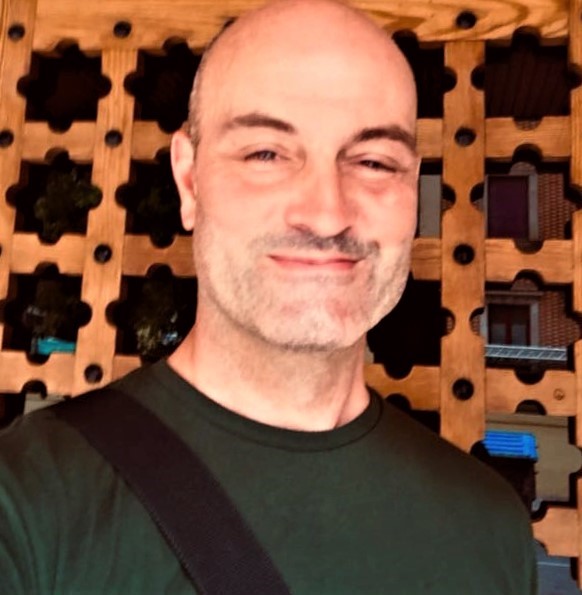
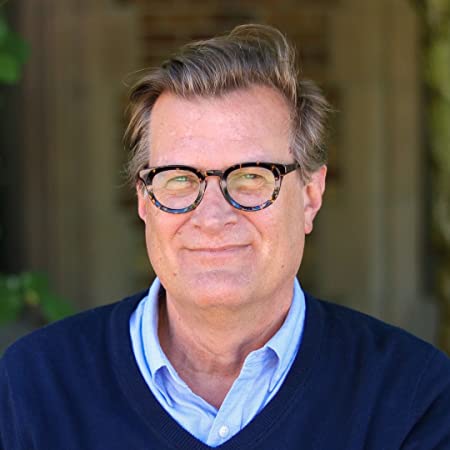
Dónall Mac Cathmhaoill, a lecturer in Creative Writing at The Open University
Dónall Mac Cathmhaoill is a lecturer in Creative Writing at The Open University, United Kingdom. His research interests are in authorship and structures of production in theatre for social change, and theatre in post-conflict societies. Upcoming publications include a chapter on ethics and aesthetics in applied theatre in the Wiley Blackwell Handbook of Literary Evaluation, chapters on writing drama in the upcoming Creative Writing Handbook from Bloomsbury, and a monograph on post-conflict Irish theatre for University of Exeter Press.
Kevin De Ornellas, a Lecturer in English at Ulster University
Kevin De Ornellas is a Lecturer in English at Ulster University. His PhD is in English Renaissance Literature from Queen’s University Belfast, and his research focuses on drama on stage and on the page – especially Renaissance and post-War drama. He is also interested in the study of representations of animals and the environment in literature and culture. His publications include The Horse in Early Modern English Culture (2013), chapters in several books, among them The Wiley Blackwell Companion to Contemporary British and Irish Literature, and the Companion to Literary Biography. He is an editor of the forthcoming Wiley Blackwell Handbook of Literary Evaluation.
What initially motivated you to reconsider notions of realism, reality and the novel?
I was interested in exploring a number of potentially inter-related phenomena: the rise of auto/biography and memoir; the seeming rejection, on the part of some writers, of the novel – or at least current novelistic forms and expectations; and a sense on the part of some critics and writers that post-modernism had run its course, and that it was necessary to turn elsewhere for a literature fit for the 21st century.
I was also intrigued by comments made by Karl Ove Knausgaard and Rachel Cusk that seemed to echo a desire for an end to fakery and fabrication, which they associated, rightly or wrongly, with novelistic conventions (the need for plot, a narrative arc, a focus on ‘showing’ rather than ‘telling’). I wanted to investigate their desire to find forms of writing more attentive to the realities and complexities of experience. There did, in some senses, seem to be what writer David Shields terms a reality hunger (2010).
I have spent the best part of 30 years engaging with literature and particularly the novel. So Knausgaard’s dissatisfaction with invention and rejection of the kind of novel writing in which he had previously engaged, alongside Cusk’s experiments in a new kind of writing following the ‘creative death’ (The New Statesman, 2021) she felt she had undergone in the aftermath of her memoirs, prompted me to consider what was happening on the fiction/auto/biography/memoir front.
I wanted to understand the motivations of some successful writers who appeared to have turned their backs on fiction and were keen to stay closer to the outline, if not the substance, of their own lives. Rather than make things up, writers such as Knausgaard and Cusk felt the need to engage with the particulars of the world around them, seeing writing as a way of thinking through some of the big questions such as the impact of death and/or divorce on family life, what it means to be in love, the toll that having children can take on one’s ambitions to be a writer, and what it means to be a man or a woman at a particular life-stage in the 21st century.
Can you tell us a bit more about the terms ‘radical realism’ and ‘autofiction’?
The term ‘radical realism’ derives from prior usage in other disciplinary contexts (eg. politics, philosophy and art). I was particularly interested in its application by Caroline Levine (2000) to the work of John Ruskin; and to an article by Philip Tew (2001) on the work of B. S. Johnson. Bringing together ideas about predominantly literary realism/s with a focus on what might be seen as ‘radical’ in relation, for example, to Karl Ove Knausgaard’s My Struggle series was of course tricky, given the already wide-ranging literature on various realisms (eg. social realism, psychological realism, hyper-realism, to mention but a few). However, in helping to situate Knausgaard’s seemingly radical attention to detail and to the minutiae, some would say trivia, of everyday life alongside his concern to overthrow conventionalized ideas about the novel and its investment in storied fictions, the term helped make sense of what otherwise seems like a contradiction in terms: the notion of ‘a non-fictional novel’, Knausgaard’s own description of his work which he deploys to confront and interrogate fiction as the creation and maintenance of a sustained illusion, while seeking to get as close as possible to the realities of lived experience.
The term ‘autofictional narratives’ in the book title was a way of flagging up current interest in ‘autofiction’, another contentious and increasingly widely used term that goes beyond its initial application by Serge Doubrovsky, academic, literary theorist, critic and writer, to his self-designated autofictional novel, Fils. I begin by rehearsing the history of autofiction as a primarily French phenomenon before looking briefly at the way in which its usage as a neologism in English has increased exponentially in the last 5 years. So, for example, if you plug the term autofiction into the library search function, you’ll find 4,506 entries across the period 1976 to 2023, a 47-year span. Of these, 3,464 entries span the last 10 years, while 2,421 relate to the just last 5 years. These figures constitute evidence of a boom in (talk about) autofiction and the autofictional.
Your monograph engages in detail with the work of four writers – Rachel Cusk, Xiaolu Guo, Karl Ove Knausgaard, and Jeanette Winterson. What led you to focus on these particular writers?
My case studies centred on writers who have written both novels and works either classified as memoirs or autobiographies or works that appear to ‘document’, at some level, aspects of their own lives.
Knausgaard and Cusk provide an interesting pairing as they share a rejection of conventionalized novel forms, and have each set out to get closer to lived experience in their work. They also share an interest in contesting societal and culturally sanctioned views of ‘masculinity’ in Knausgaard’s case and ‘femininity’ in Cusk’s case. And they have both managed to antagonize members of their own families as well as many readers through their painfully honest accounts, as they would see it, of aspects of their lives.
In the case of Jeanette Winterson and Xiaolu Guo, I didn’t anticipate many parallels, given their very different cultural and linguistic backgrounds. However, insofar as they both hail originally from humble origins and have had to forge their own literary paths, sometimes in the face of fierce opposition, and have both been, from the off, unconventional novel writers who have produced, unsurprisingly perhaps, unconventional ‘memoirs’, they turned out to have quite a bit in common. Indeed, their work as a whole can be seen to reflect a number of self-projections or versions of self along a fact-fiction continuum and their so-called memoirs unsettle ideas of what a memoir might be.
Fiona Doloughan
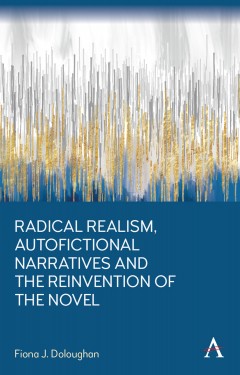
Fiona Doloughan’s research revolves around the development of the novel and on the forces (societal, cultural, technological, linguistic) shaping that development. She has published three monographs, the most recent of which is Radical Realism, Autofictional Narratives and the Reinvention of the Novel (Anthem Press, 2023).
On September 13, she’ll be delivering a lecture entitled Crisis? What crisis?: Rachel Cusk’s Reinvention of the Novel for the Twenty-first Century at Salve Regina University, Newport, Rhode Island.
On September 20, she’ll be at Agnes Scott College, Decatur, Georgia, giving a talk co-sponsored by the departments of English, French, and Spanish on what it means to be a female writer today.
In this bonus summer post, Jennifer Shepherd, Chair of the Faculty of Arts and Social Sciences team in Ireland, shares a behind-the-scenes glimpse into the Open University’s partnership with the John Hewitt Society’s annual Summer School.
What does summertime mean to you?
For me, it’s festival time.
Each summer, I find myself in the picturesque cathedral town of Armagh, Northern Ireland at the Marketplace Theatre, home to the annual John Hewitt International Summer School. Now in its 36th year, the festival is hosted by the John Hewitt Society, established to celebrate the legacy of local poet, art historian and social activist John Hewitt.
Hewitt’s legacy is everywhere in evidence here in Armagh in late July, as a diverse group of writers, visual artists, musicians, political commentators and social entrepreneurs gather to celebrate the power of story to explore some of the most pressing social issues we face today on the island of Ireland.
It’s warm and unpretentious and full of surprises.
One day the mainstage hosts eminent Irish playwright Frank McGuiness, sharing the wit and wisdom of a literary career spanning over 4 decades; another day finds bestselling crime writer Denise Mina discussing her take on hard-boiled crime fiction; still another, a round table of political commentators and journalists pitch ideas for engaging citizens meaningfully in the Northern Ireland political system.
Everywhere there’s story, whether it takes the form of images – such as Nigel Swann’s haunting photographs of the ‘Yellow Star’ houses of Budapest – or music, provided by award-winning folk artist Jack Warnock.
As an OU academic based in Northern Ireland, I have the pleasure of managing a partnership with the John Hewitt Society on the delivery of the Summer School. It’s a natural fit since the Open University has much to offer local conversations around politics, history, and creativity.
Collaborating with the John Hewitt Society for the last decade has allowed the Open University in Ireland to showcase the incredible quality of our teaching and research, particularly in the area of creative writing.
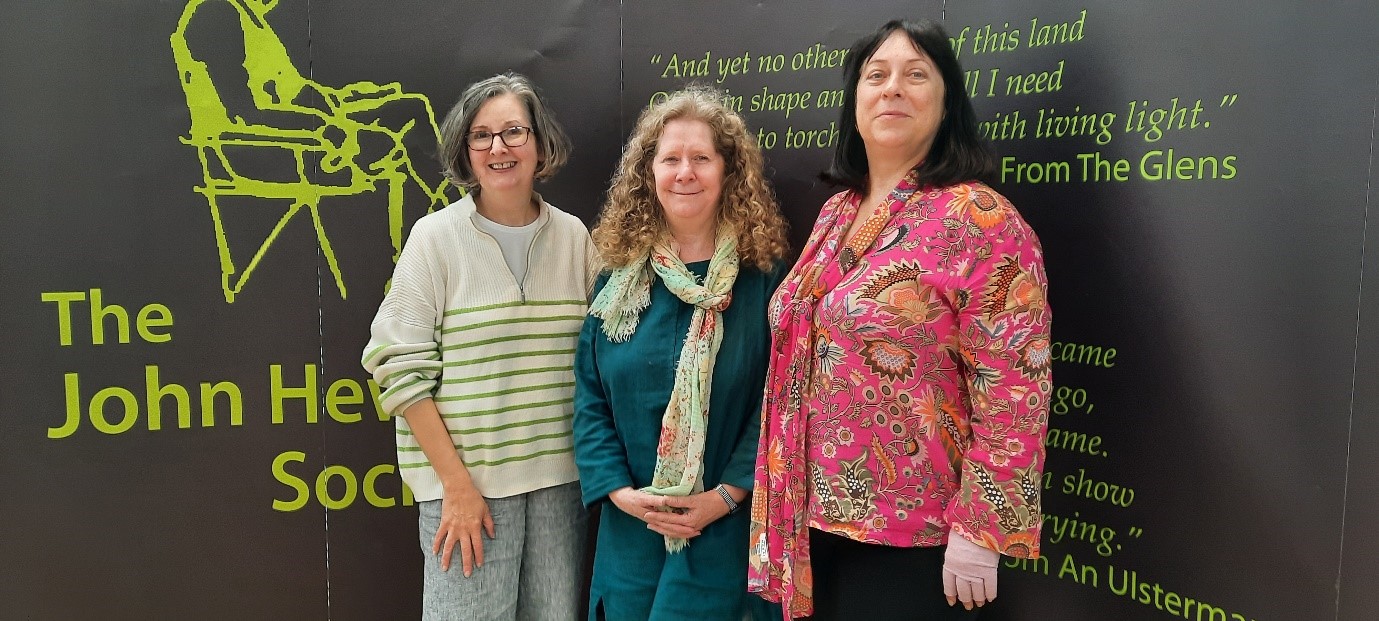
Heather Richardson, Nessa O’Mahony, and Siobhan Campbell
It’s a pleasure to meet festival-goers during the week who have signed up for workshops led by OU writers – this year, we were joined by novelist Heather Richardson, and poets Nessa O’Mahony and Siobhan Campbell. Festival-goers are full of praise for our teachers, noting that OU writers really ‘see’ each student and bring out the very best in them and their writing.
‘Oh, you’re with the OU,’ is how I’m often greeted when I introduce myself in the busy foyer between events—because if there’s a proverbial zero degrees of separation in Ireland, the same holds true here for the Open University.
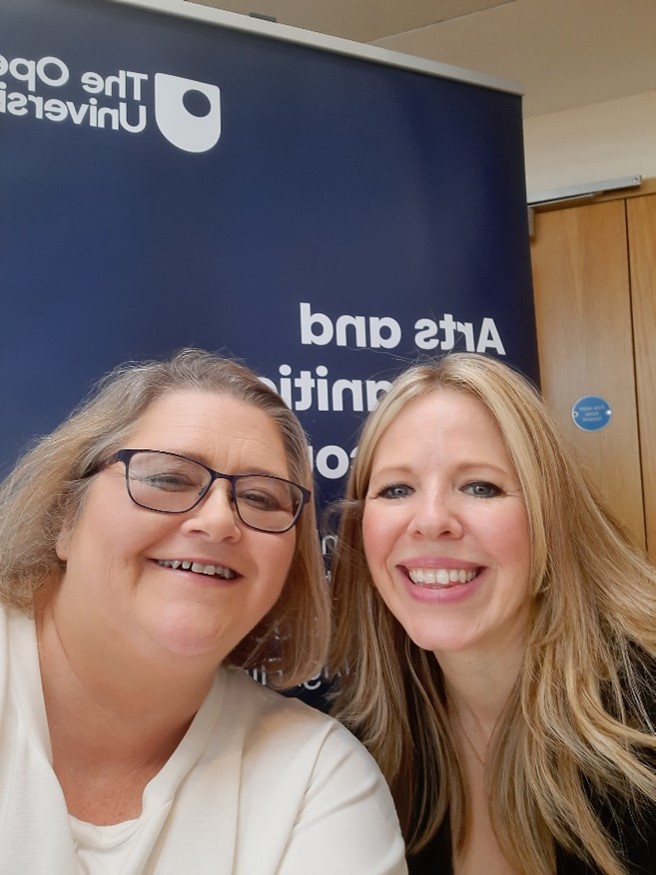
Jennifer Shepherd (right) with former OU student
At the local book vendor’s festival stall, a man tells me his friend is studying on the new English Lit MA and really enjoying it. I encounter a woman at the OU pop-up stand who confides that she’s already got a place reserved on an MA programme and wonders if she can get further details. Another man lingers over the OU leaflets on display and tells me a long story about a professional life that took many unplanned turns. He always wanted to study law but never got the chance – did I think it was too late for him? A former OU student of my own waves from across the crowded foyer and makes her way over for a catchup and selfie.
She reminisces fondly about her first OU module and grins at the memory of her debut at an Open University open mic night, the first of many engagements over the years as an accomplished poet and flash-fiction writer.
And maybe this is what I like most about my annual pilgrimage to Armagh each summer: to see the power of story at work in unexpected places. While speakers on the mainstage are inspiring us with tips for master storytelling or compelling new visions for a shared future in Ireland, I’m seeing something just as exciting at my Open University pop-up stand. People talk about their daily lives and, when they do, I get a glimpse of the way in which OU study allows people to write new futures for themselves and shape the story of their own lives in fresh and exciting ways.
Jennifer Shepherd
Originally from Canada, Jennifer Shepherd completed her PhD at the University of Alberta and post-doctoral fellowship at the University of Hull. She is a Senior Lecturer and Staff Tutor in the Department of English Literature and Creative Writing at the OU. As chair of the FASS team in Ireland, she is responsible for facilitating local knowledge exchange and engagement opportunities, as well as maintaining partnerships with Ireland-based organisations which include the John Hewitt Society, the Belfast Book Festival, and Dublin/Belfast Culture Nights.
We kicked off our series on the PhD journey and beyond, with a post from an English Literature PhD student, which offered a glimpse into a trip to an archive. This month, one of our Creative Writing PhD students, Alistair Daniel, shares his reflections on a very different form of research.
The customs officer flipped the pages of my passport and frowned. ‘What’s the purpose of your visit?’ he said.
I removed my fingers from the biometric scanner, leaving little crescents of sweat. I had not been looking forward to this question.
‘I’m doing research for a novel,’ I said.
The officer frowned. ‘Why?’ he said. ‘Can’t you just make it all up?’
Creative writing research has an image problem. While few people question the idea of research in other disciplines, in my experience, when you tell someone you’re doing creative writing research, they start to smile, visualising a pair of air quotes that hover over the word ‘research’ like a sceptical drone. If, when pressed as to the nature of this ‘research’, you admit that it involves spending five days in a bed and breakfast outside Hallowell, Maine, where you plan mostly to sit by a lake, the smile tends to broaden considerably. This is just a jolly, says the smile. You’re having a laugh.
Even if your trip doesn’t bear a suspicious resemblance to a holiday, the question still stands: what is creative writing field research for? After all, some writers don’t seem to need it. Shakespeare never went to Verona. And it’s amazing what can be gleaned nowadays from YouTube and Google Earth. Did I really need this field trip at all?
Montreal, the novel I was planning to research, is set not in Montreal but in a summer camp in central Maine where my protagonist, a hapless 19-year-old philosophy student called Simon Pritchard, has come to work in the kitchen. When not dicing carrots, Simon plans to spend his time transforming himself into a philosopher. To cut a medium-length story short, his plan goes tragically wrong.
Over the previous five years, I’d done the work of imagining Simon and his world – of making it all up – but that (I didn’t tell the customs officer) was partly why I needed to go: I needed to see how much of it was true. But there were other reasons as well. As a philosophy student, Simon is full of romantic Sartrean ideas about self-transformation. He finds an idyllic spot by a lake, a boulder hidden from the rest of the camp, and attempts to philosophise there, making phenomenological observations about his surroundings and noting them down. I needed to know what he would note. I needed to see what he saw. I needed to sit by a real Maine lake on a real Maine rock observing real Maine dragonflies, insects and birds, observing the kind of moss that grows on the Eastern Hemlock, touching the bark of an Eastern White Pine, hearing the unsettling cry of a loon, inhaling the stench of lake mud and Amber Solaire. I needed the sort of rich sensory detail that can’t be conjured by watching videos on YouTube.
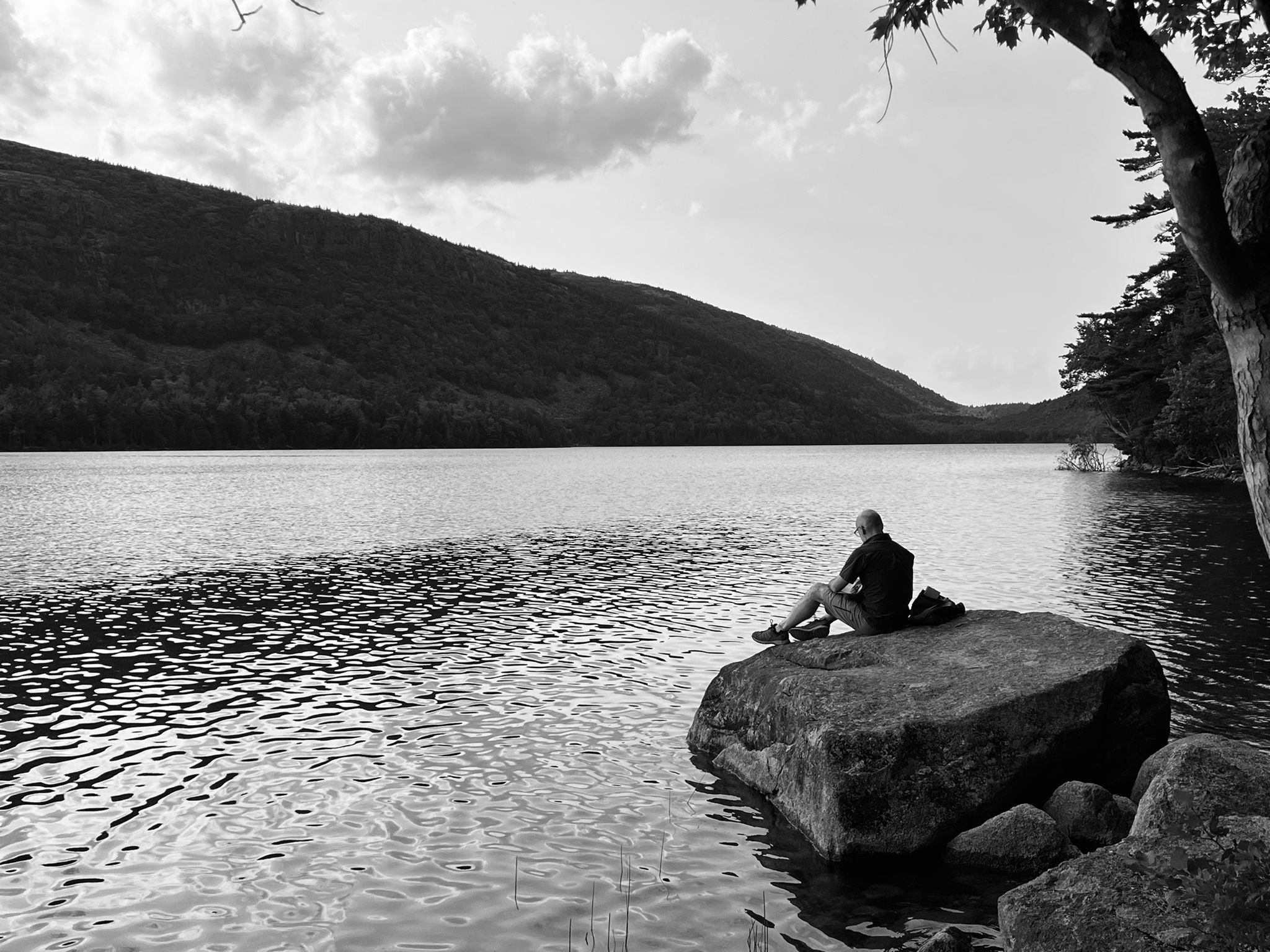
Alistair sitting on a rock at the edge of a vast lake, notebook in hand.
Arriving in Boston I was excited, but anxious. Any writer knows that the timing of research, as much as the research itself, can be crucial. I’d originally applied for a grant in 2020, but Covid intervened. It intervened again in 2021 and by the time I was finally able to go, in the summer of 2022, my novel was almost complete. What if I’d got everything wrong? I was due to submit my PhD in three months’ time. How much would I really be prepared to rewrite at this stage? On the other hand, if it turned out I’d got everything right – that you can, in fact, make it all up – I would have wasted both my time and the university’s generous research grant. The trip would have looked – and felt – like a jolly.
In the end, I needn’t have worried. As I travelled around Maine, following in Simon’s footsteps, I soon realised how worthwhile it would be. Some things, I discovered, I’d got more or less right. There were plenty of rocks at the edges of lakes, many of them suitable for sunbathing and phenomenology. The loons really did sound insane. In this respect, the trip was good for my writerly confidence.
But I made fresh discoveries too. I drove the freeway Simon takes towards Canada – a road you can’t find on YouTube. I ate Maine dishes of the kind served at summer camps (popovers, whoopie pie). I walked out to Bar Island at low tide, a trip Simon takes with the kitchen crew. Two friends in Freeport showed me how to cook a lobster, which Simon does in a climactic scene at camp. I auditioned five different lakes and half a dozen rocks. None of them were exactly what I’d imagined, but between experience and imagination I worked up something that felt right.
And it was while sitting on those rocks that I had some entirely new ideas. I’d already pictured the movements of the dragonflies at the edge of Simon’s lake – after all, I’ve seen dragonflies elsewhere – but I hadn’t realised that Maine has so many kinds. And I discovered that they were hard to identify, even with a guidebook in hand. In previous drafts I hadn’t considered this. I’d imagined Simon buying an Audubon guide and painstakingly identifying each type. In practice, I realised, that would be hard. Dragonflies tend not to stay still, nor do they match the pictures in the book. Very little, in this world, matches the picture. I’d not considered this, or how a somewhat rigid and unimaginative boy like Simon might struggle to cope with the dragonflies’ refusal to conform to a neat taxonomical system. Or how this refusal, this resistance of the world to classification, perfectly suited a novel in which Simon continually pigeonholes other people, fitting them into his own taxonomical system, with fatal results. In this way, I came home with far more than 24,000 words of fresh description: I had new metaphors for the themes of the novel, and new ways of presenting character.
Next time, I’ll tell the customs officer.
Alistair Daniel
Alistair Daniel is an Associate Lecturer in Creative Writing at the Open University, where he is completing a PhD in Creative Writing. He has an MA in Creative and Life Writing from Goldsmiths and has taught at the University of the Arts London and the University of East Anglia, where he held the Charles Pick Fellowship. His short stories have been published in magazines and journals including The Missouri Review, The Stinging Fly, Narrative, Litro, The Irish Times and Stand. He was shortlisted for the Bridport Prize in 2011 and 2020.
In recent months, several members of our Creative Writing team have been collaborating with our local bookish friends at Milton Keynes Literary Festival.
On Saturday 15th April, lecturer Lania Knight interviewed fellow novelist and life writer Kit de Waal about the extraordinary journey she has made since first voluntarily reading a novel at the age of 22.
Saturday was also be a big day for those writers who have been shortlisted for MKLitFest’s MinK2023 Writing Competition. In the leadup to tomorrow’s announcement of the winners, we caught up with Open University PhD graduand, Patrick Wright, who acted as a judge for the poetry categories.
Tell us a little about your first encounters with poetry and your journey to becoming a poet.
My mother used to recite quite a bit of poetry around the house when I was growing up — poems such as ‘Night Mail’ by W.H. Auden and William Wordsworth’s ‘Daffodils’. This was my first introduction to rhythm and rhyme. We also had a few anthologies lying around that I’d dip into. I recall studying poems by Norman Nicholson at school and I was especially taken by ‘Windscale’.
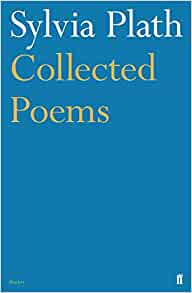
My interest was only really piqued though by my discovery as a teenager of Sylvia Plath. I saw then what poetry could do in terms of confessionalism and free verse. I began to experiment with writing my own poems at this time — without a clue about what I was doing. It wasn’t until I studied for an MA in Creative Writing, at the Centre for New Writing, University of Manchester, that I truly started to learn the craft and see myself as a poet.
How has winning awards and having poems selected for anthologies affected your writing life?
It’s given me encouragement. Poetry can be a solitary activity and there are times when I wonder if it’s worth the investment. Is it too rarefied or self-indulgent? However, moments of praise and recognition always make the sacrifice worthwhile. There can also be a tinge of glamour at times. Though I’ve learnt to not feel too intensely about the ups and the downs. I can’t rely on the fruits at the end of the process: writing must be enjoyed for its own sake; and yet there’s certainly a kick that comes with having work accepted by a magazine or anthology, and that feeling can be quite addictive. I’m now more confident too and willing to take additional risks: with form for example or having the courage to break the rules I was taught. With the success that’s come my way, I’m also persuaded that my poems can sit alongside the poets I admire.
You are an award-winning poet yourself, and now you have judged MK Litfest’s flash fiction competitions. From your experience on both sides of the process, what would you say makes for a prize-winning poem?
I suppose it must tick several boxes at once. Technical elements should be considered; but there’s also the theme, the way a poem strikes at the heart of something in the zeitgeist, or how it leaves an impression. There’s also the inevitable subjective aspect, and what I think works best at a given moment. It’s often fine margins — and I have no doubts that my thoughts as a judge might have changed if I’d read the same poems again another time or in a different mood. Taste and a complex set of characteristics that the reader values (some of which are hard to pin down) will often shape the final verdict. So, my message to poets is: Don’t be discouraged and keep writing. There’s every chance that next time you will have your work chosen.
Tell us a bit about some of the poems you shortlisted for MK Litfest.
In the 14-19 group I enjoyed ‘My Roots’, ‘To all you ash-grey men’, and ‘The Aftermath’. I thought that ‘My Roots’ was particularly impressive with the poet’s clear adherence to the theme (Milton Keynes and green spaces), awareness of form, organised stanzas, and memorable images.
In the 20-plus group, I liked ‘The Green’, ‘The Other One’, and ‘Covid Spring’. Each of these had a distinctive voice and demonstrated a striking or unusual use of language. ‘The Green’ stood out for me with its neat couplets and appreciation of sound.
How has your work and research at the OU shaped you as a poet?
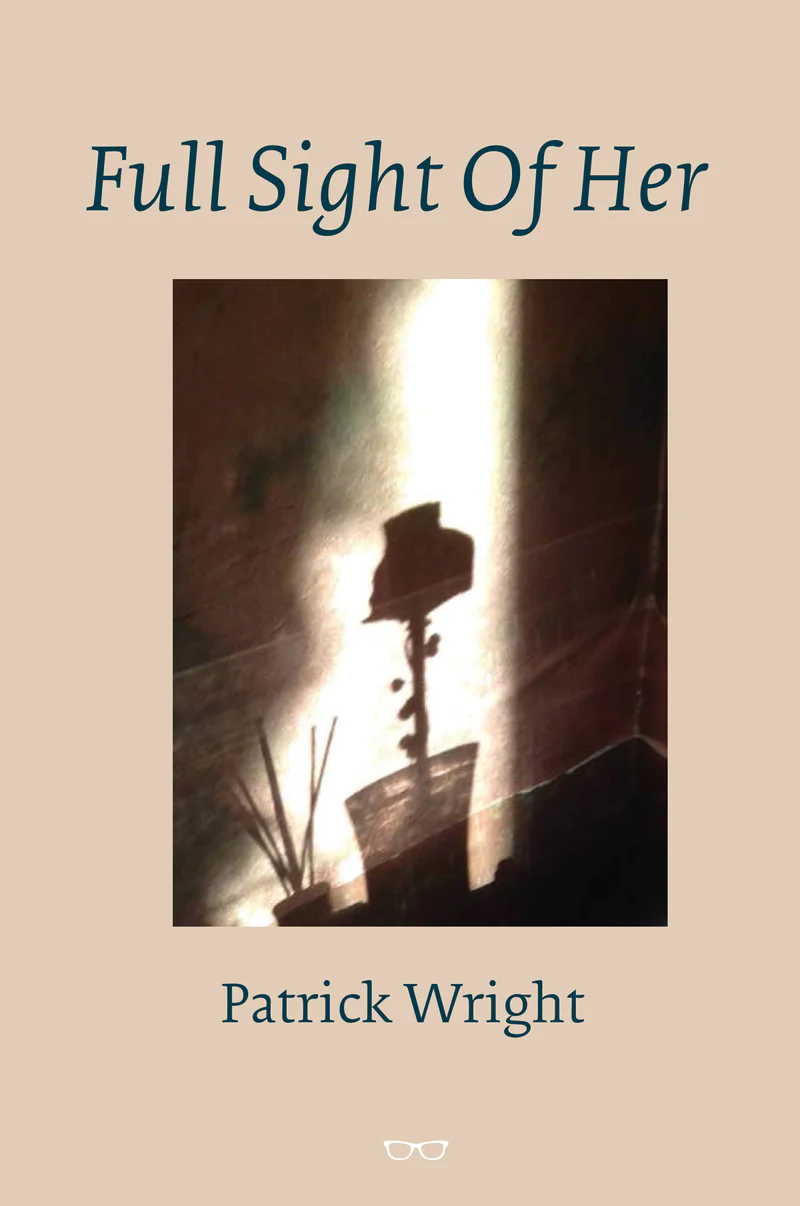
Looking back, my PhD in Creative Writing (Exit Strategy: Ekphrasis through the lens of the abstract and the formless) was a way of going in another direction from my first collection (Full Sight of Her). I was clear from the start that I wanted to be open to new forms, constraints, and feedback — always in the hope of allowing me to find a new voice and not sound like myself. This striving to get away from what I’d done before is one reason the collection is called Exit Strategy. It was about having a book of poems that could be expressive of a new identity, and I achieved that. The critical part helped me become more aware of other poets and where my writing fits in the present landscape.
Aside from new ways of making a poem in response to modern art (the focus of my thesis), I’m particularly interested in aligning myself with the current trend of exploring hybrid forms, such as the prose poem or the lyric essay. My current project follows in this vein: a memoir that includes prose poems.
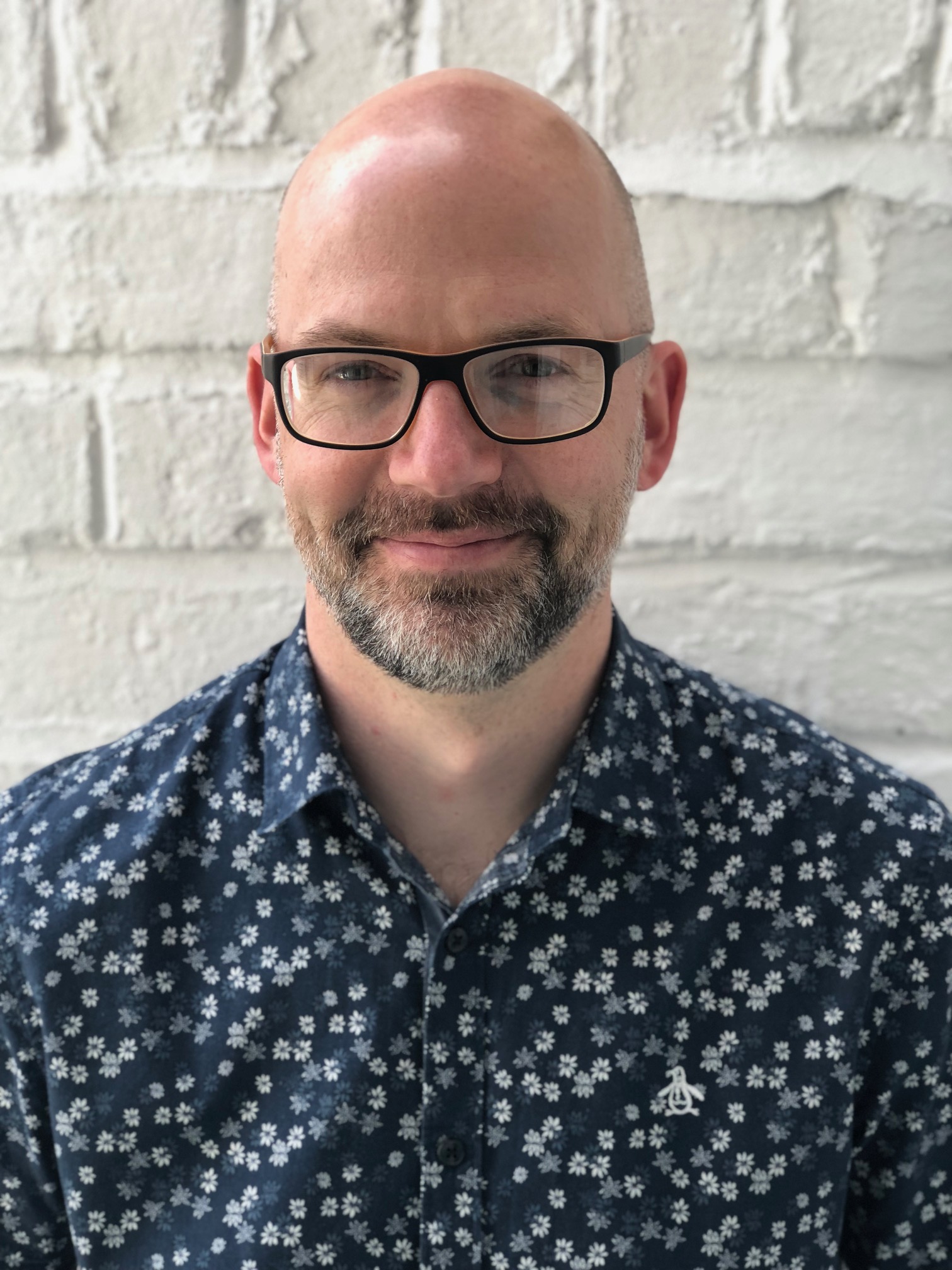
Patrick Wright has a poetry collection, Full Sight of Her, published by Eyewear and nominated for the John Pollard Prize. He has been twice shortlisted for the Bridport Prize and teaches English Literature and Creative Writing at the Open University. He has just completed a PhD in Creative Writing on the ekphrasis of modern and contemporary art, supervised by Jane Yeh and Siobhan Campbell.
Open University PhD graduand, Patrick Wright, and current PhD student, Gwyneth Jones, acted as judges for Milton Keynes LitFest’s MinK2023 Writing Competition. All the shortlisted entries will be published in an anthology, and the winners will be announced at the Anthology Launch at Milton Keynes Library on 15th April 2023.
To mark the announcement of the shortlisted entries, we caught up with Gwyneth Jones, who judged the flash-fiction categories and is a prize-winning author of flash herself.
What is flash fiction and how did you first discover it?
Flash fiction, in a nutshell, is a very short story. Exactly how short is debateable but certainly less than 1000 words, perhaps as few as 200, and it should feel absolutely complete in itself. Flash can be any genre it chooses. It can dress up, dress down, dress to impress, or go commando. It’s a delinquent midget-gem that resists pigeonholing.
Very short fiction has been around for ever – just think of Aesop’s Fables. But flash fiction really began to gain traction as a genre in the late 1980s. Today it has a wide international fanbase and is published in literary magazines, anthologies, single-author collections, and also, of course, online. The immediacy and connectivity of the internet has proved an excellent forum for these punchy bite-sized fictions.
It was on the internet that I stumbled across flash fiction competitions. Entering gave me a way of finding out if my writing was any good – which it wasn’t at first – but I learned by reading the entries that were better than mine, the ones scooping prizes. After a while, I got hooked, got listed, got published.
As a writer, what attracts you to the form?
The chance to experiment in a way that might not be sustainable in long-form fiction. Flash can be very disruptive, disregarding ‘rules’ about writing, such as having a beginning, middle, and end. Scrap that! Flash hardly gets past the beginning. Flash is always close to the end. You might start in the middle, in media res, or you could squeeze that out altogether and trust the reader to fill in the gaps. Another rule: ‘create original characters’. Or you could use archetypes to save thousands of words. Take Goldilocks: your reader already knows she’s an adventurous, entitled, blonde who’s very, very picky. With only a few hundred words so much is possible; you could write about a nanosecond, a lifetime, or an eon. You could write from an unusual point of view, or in the negative, or in a Fibonacci sequence. Flash can handle some serious subjects, but the form is very playful.
You have won the Wild Words competition and been long/shortlisted for the Bridport, Bath Flash Fiction, Reflex Flash, and the Quiet Man Dave prizes, and now you have judged MK Litfest’s flash fiction competitions. From your experience on both sides of the process, what would you say makes for a prize-winning flash?
A title that works hard – something that interacts with the text; pin-sharp specificity, nothing anodyne, clichéd, or generalised; careful attention to the sound of the words because flash is great for reading aloud; and, of course, absolute economy – not one single wasted word, no lazy word choice. As with all great fiction regardless of size, voice is important. Voice is the thing that snags the reader from the start. It’s in the vocabulary, the syntax, the imagery, and the things left unsaid.
After that, the elusive prize-winning quality is something that’s hard to describe – but you know it when you read it – and you want to go back and read it again, and again. Roland Barthes called it the punctum. He was talking about photographs, but I think it translates. It’s some unexpected detail or moment, some splinter beyond the ordinary subject that pierces you and isn’t easily forgotten. Julio Cortázar talks about this power as a story ‘rupturing its own limits’, spilling out and illuminating something beyond the page. The best flash fictions do this; they remain with you like an earworm or a bruise.
Tell us a bit about some of the flashes shortlisted for MK Litfest.
The theme was ‘Green Spaces in the City’ and there was a lot of inventiveness in the shortlist with some writers speculating on the future and about how our relationship with the natural world might develop. One that made me laugh out loud, was written as an email to mankind, warning of an imminent plant-life revolution. There were also some finely penned observations of present-day concerns including one about a woman with a young child searching for a new home and measuring spaces both urban and green with the span of her hands. My personal favourite came from the younger age category (14-19 years) and it was the shortest by far, just 188 words. A quirkily voiced stream of consciousness that exactly captured the crowding and leaping of thoughts, and how one thing leads to another. It had slant, and resonance, and compression; I just adored it from the very first read.
How has your study at the OU shaped you as a writer of flash fiction?
I’ve learned a lot about the craft of writing and applied that to flash fiction, but the most surprising thing is discovering that a ‘being a writer’ isn’t the solitary endeavour I first imagined. I did an MA in Creative Writing here at the OU and was lucky enough to be part of group of incredible, talented writers; we’re still in touch on a regular basis, swapping work and cheering each other on. Now, I’m doing a PhD, and the circle is smaller, but the support and the camaraderie is every bit as good. My time at the OU has spurred me to get involved and make connections out in the wider world where the flash fiction community is vibrant and welcoming with a multitude of workshops, discussion groups, and festivals. I’ve benefitted enormously from the advice and generosity of other writers, and hope to pay that forward. But still, all this sociability and joining in is learned behaviour; if I wasn’t a writer, my dream job would be lighthouse keeper.
Jupiter Jones
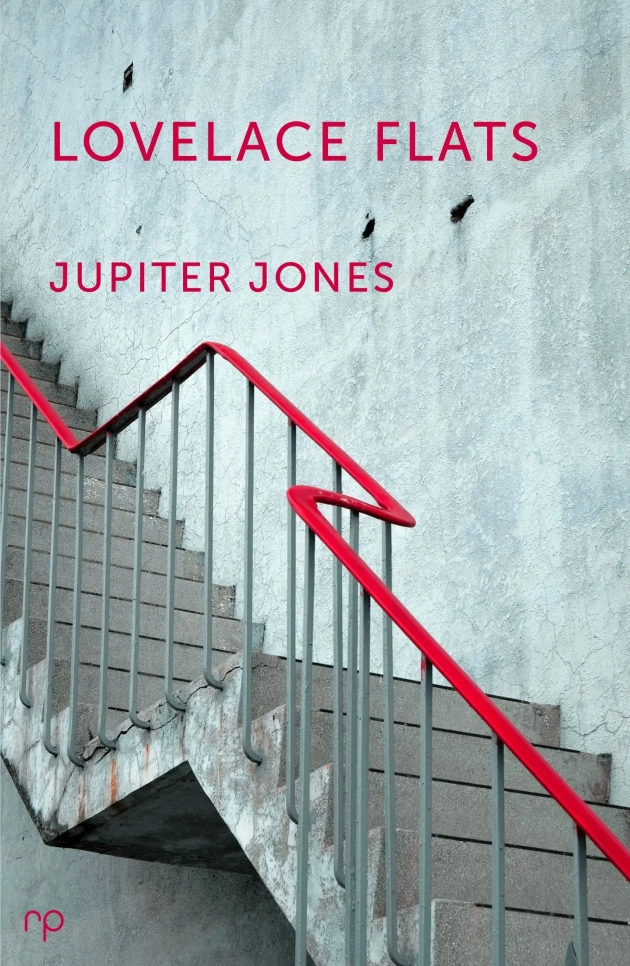
Gwyneth Jones lives in Wales and writes short and flash fictions. Under the pen name Jupiter Jones, she is the two-time winner of the Colm Tóibín International Prize, and her stories have been published by Aesthetica, Brittle Star, Fish, Scottish Arts, and Parthian. Her first novella-in-flash, The Death and Life of Mrs Parker was published by Ad Hoc Fiction, the second, Lovelace Flats by Reflex Press and the third, Gull Shit Alley and Other Roads to Hell by Ad Hoc. She is currently a PhD candidate at the OU researching form and narrative purpose in the novella-in-flash.
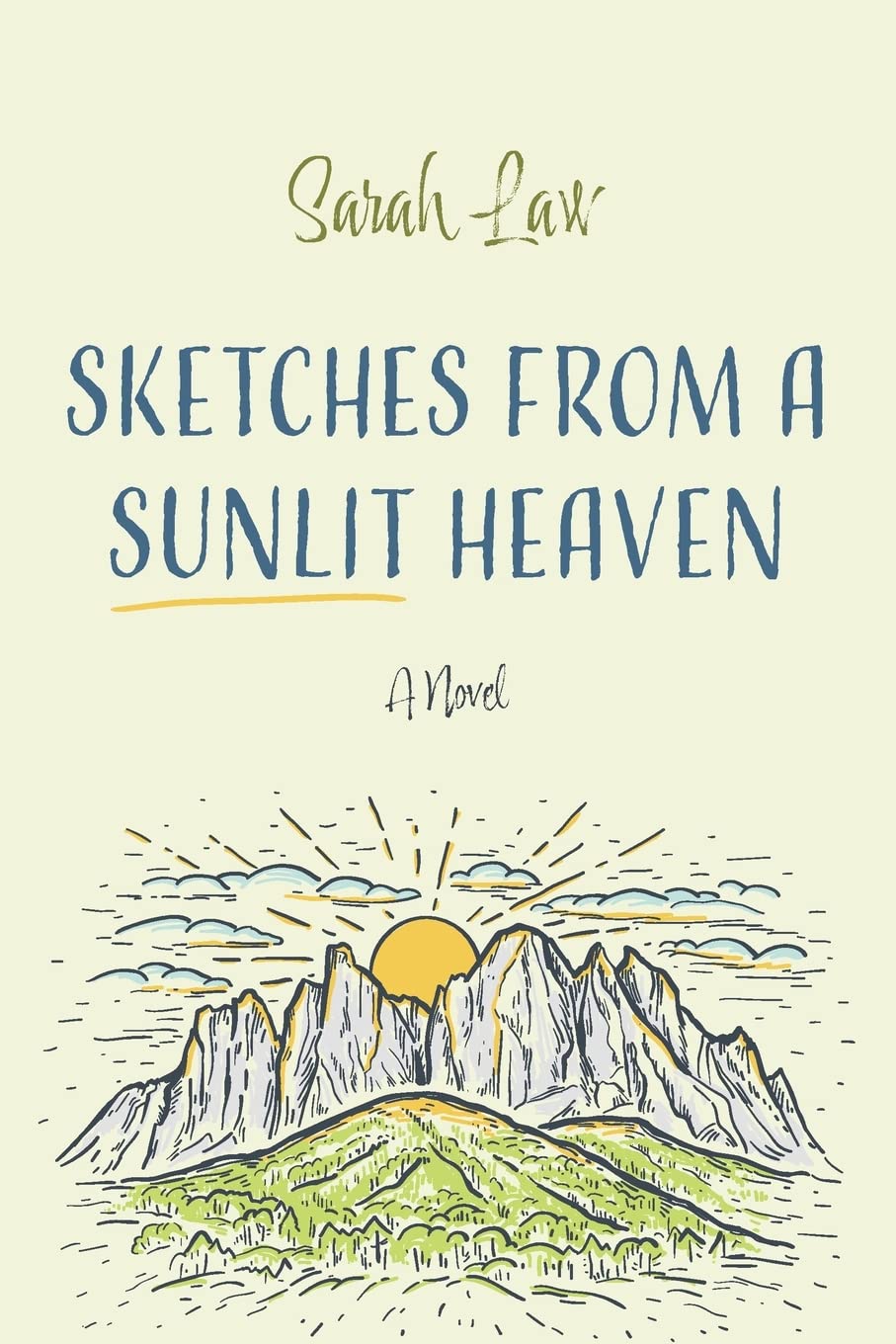
Today, we hear from one of the Associate Lecturers who teaches on our Creative Writing MA programme. Sarah Law draws back the curtain to reveal some of the choices and happy accidents that lie behind the final form and title of her recently published novel Sketches from a Sunlit Heaven.
Sometimes writing allows us to meet characters who we don’t correspond with in terms of time or culture, but who speak to us anyway. My novel, Sketches from a Sunlit Heaven, arguably falls into this category: historical fiction where my characters, based on real people, tell their stories.
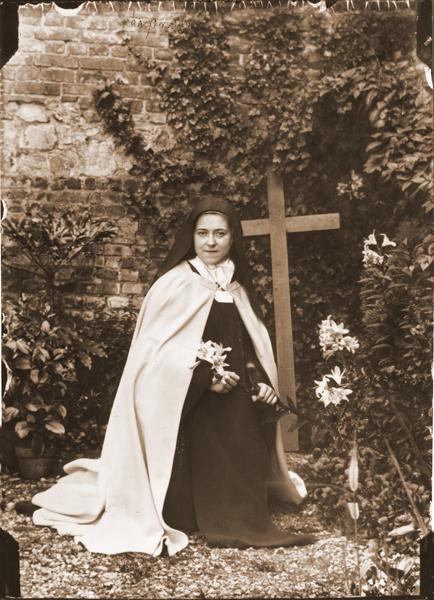
By way of an introduction to my subject matter: I have an endless fascination with the ‘Little’ Saint Therese. She lived in a Carmelite Monastery in Lisieux, France, for nine short years before dying of tuberculosis in 1897 at the age of twenty-four. Her own memoir is full of sweetness but granite-tough underneath. Rare archive photos reveal lively eyes and a subtle smile full of some secret I still want to hear. Most unusually, three of her blood sisters and a cousin joined her in the same monastery. One sister was an artist and photographer. Another became prioress for much of her long life, and together they supported the cause of Therese being canonised, which she duly was in 1925 when, had she lived, she would have been fifty-two years old.
I started writing a fictionalised biography, hoping to deepen my knowledge of this young nineteenth-century nun. Then, as I read about her family, particularly her blood sisters, I heard their voices in my head (I mean this figuratively, of course). Pauline, the prim, practical community leader. Marie, the warm-hearted dreamer. Celine, the fiery-tempered artist. And Leonie, the difficult loner. Add in cousin Lucie with a beautiful singing voice, and Maurice, a missionary who fails and fails again, but with whom Therese, toward the end of her life, corresponds with the tenderness of an ethereal lover. Six different perspectives emerged: six distinct, but related, takes on Therese. But how were they going to work together? As each character’s narrative grew, so did my concerns about a clunky jumping from one chapter to another, from one account to the next, especially as they would substantially be going over the same events as each other.
I paused to reflect. I decided that my options were:
Change the novel’s narrative perspective back to the third person, potentially becoming an authorial presence in my own right;
Revise my narrative strategy to just one sustained first-person voice;
Somehow intercalate my various first-person speakers (or at least some of them) into one chronological narrative.
While I considered each option seriously, I decided I wanted to retain the polyphony of multiple voices, even if they weren’t the longest-lived or most substantial in terms of narrative length. I wanted the book to offer a multidimensional account. A series of fragments mapped over Therese’s life and beyond. A mosaic.
Something clicked into place: this was how the novel itself wanted to emerge. A mosaic or a series of sketches, as each speaker passed the narrative between themselves. Sketches from a Sunlit Heaven had found its form and, incidentally, soon afterward, its title.
I embarked on an intense period of copying and pasting as I took what felt like brief but complete episodes from all six of my first-person narratives. I wanted to proceed in chronological order, but alert to the poetic magnetism produced by selective juxtapositions of my speakers’ accounts. Of course, I’m not the first novelist to choose multiple speaking characters (‘intradiegetic narrators’, if you will). From Wilkie Collins’s The Woman in White to George Saunders’ Lincoln in the Bardo, the polyphonic approach to narrating a novel has been successful across recent centuries. Virginia Woolf’s The Waves remains one of my favourite modernist novels. A very tall order to write anything on par with these great works! But, to paraphrase the words of poet Robert Browning in ‘Andrea del Sarto’ a writer’s reach should exceed their grasp, or what’s a heaven for?
As I continued to cut, paste, shape, and write, I imagined jigsaw pieces fitting together to make a whole picture. Neither mosaics or jigsaws are perfect analogies, but both echo images in the novel: pieces of mosaic from the Roman Forum that teenage Celine cherished, and later, Lucie’s imaginative consideration of the ‘jigsaw’ view of Normandy seen from above – looking down from a sunlit heaven.
Two more motifs appeared as the novel grew into its ultimate structure. Firstly, that of letters. Therese, her sisters, and others close to them or the family wrote to each other a lot. I haven’t framed any narrative fragments as letters per se, but their usual length—from a few hundred words to a thousand or so—is reminiscent of a letter. The epistolary novel is the earliest form of the novel genre in English, so there is perhaps an echo in my work of its literary ancestor. My characters write to each other, request letters, read, receive, and even dream letters. And then there’s the sketch. A sketch is brief, descriptive, often urgent, suggesting with few lines, and judicious shade and hatching, larger issues than itself. Something Celine literally does, as do the others, figuratively. Sketches from a Sunlit Heaven secured its place as my novel’s name.
Combing through my draft, I found it fell into fourteen sections, each bound by dates, and housing narrative fragments that developed the section’s essential kernel—Vocation, Discipline, Legacy, and so on. An introductory section, Glimmerings, also appeared.
It’s strange how, in the end, a novel largely emerges of its own volition. Despite the planning and researching, even historical fiction does too. Holding the published book in my hand, I can say the process of writing it is still part mystery.
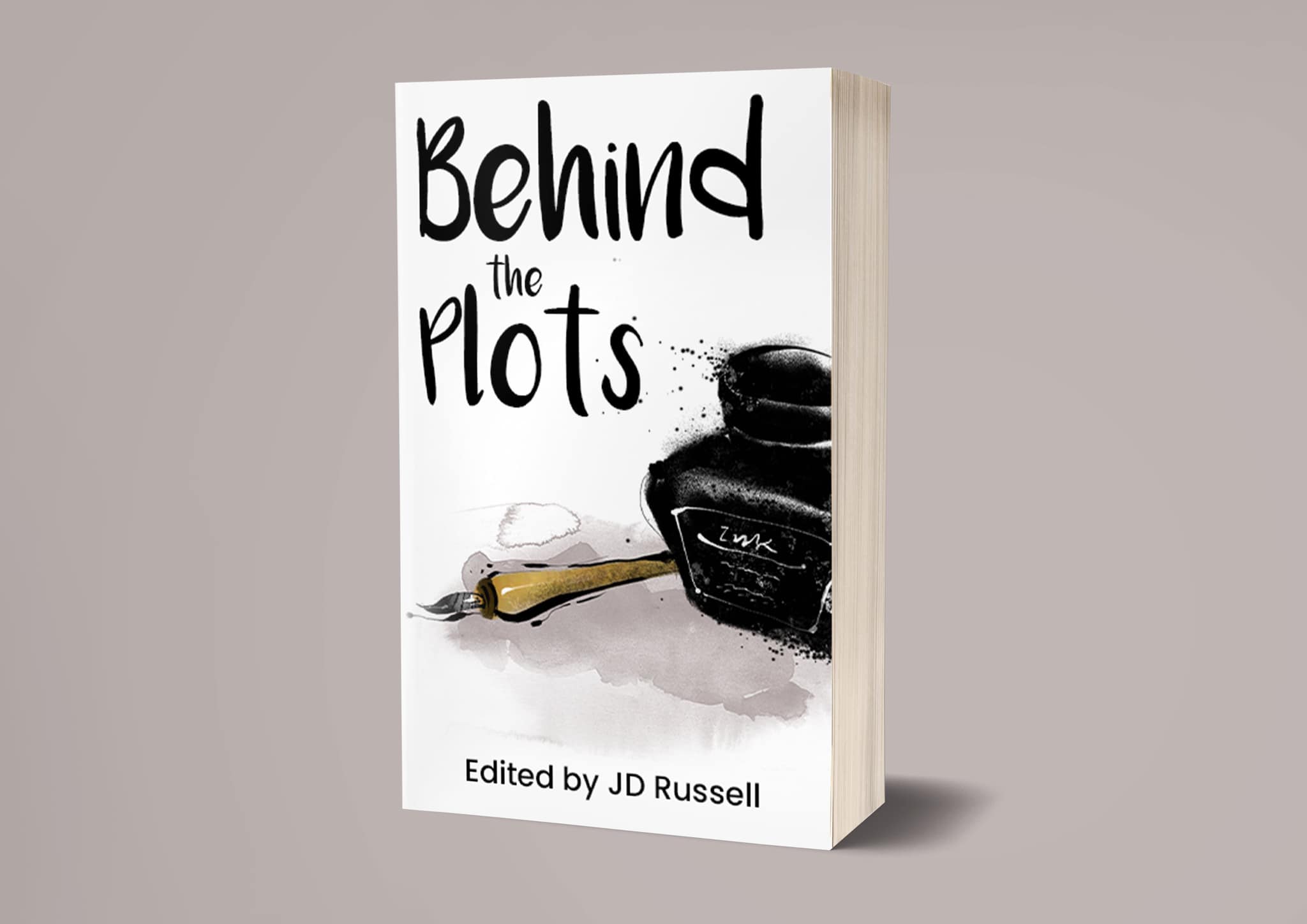
With thanks to Writing Bad for permission to publish this blog, which is an abridged version of an essay Sarah Law originally published in Behind the Plots.
DrSarah Law is an Associate Lecturer for the Open University. As well as a novel, she has published six poetry collections and writes academic and creative nonfiction. She also edits the online journal Amethyst Review, for new writing engaging with the sacred. She lives in Norwich.
Dean de la Motte’s name will be familiar to anyone who attended our February 2019 Contemporary Cultures of Writing event, ‘The lives of others: research and writing’. The panel’s chair, OU Senior Lecturer Fiona Doloughan, suggested that both Dean and his fellow speaker might be breaking out of their comfort zones by applying their intellectual and emotional energy to new genres. Fiona Sampson was turning from poetry to biography, while Dean was moving from literary criticism to the writing of fiction.
Now that Dean’s novel Oblivion: The Lost Diaries of Branwell Brontë has been published by Valley Press, Fiona D. catches up with him again to discuss why he made the transition from authoring academic to creative works, and what he has learnt in the process.
Fiona: Congratulations on the publication of your novel. Tell us about your long-standing interest in the Brontës, and how you came to be particularly interested in the sisters’ lesser known brother, Branwell.
Dean: I read the Brontës in school, though I confess that I was not any more interested in them than I was in Dickens or Eliot, and arguably less so than in Hardy, whom I still love. In the mid-1990s I was designing a course called ‘Writing the Nineteenth Century’, where I paired works of fiction with works of history, including Charlotte Brontë’s Shirley and a book on the Luddite rebellion. I read Juliet Barker’s magisterial The Brontës and learned for the first time the full story of the family, including how Branwell fit into the family dynamic.
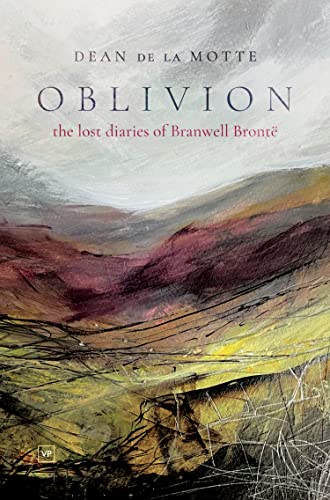
Oblivion: The Lost Diaries of Branwell Brontë published by Valley Press
I was utterly fascinated with him, perhaps because I could (at least in remembering my 20-something self) relate to him, if not to his actions at least to his character traits and flaws.
I conceived the idea of a novel called Oblivion, inspired by a) the oblivion into which he and his works have fallen; b) his own attempts to drink (and perhaps drug) himself into oblivion; c) the recurrent theme of a desire for oblivion (the word appears often in his poetry) or escape from the sorrows of existence, and d) his famous portrait of his sisters, where he painted himself out, or ‘into oblivion’. I wanted the book to be something of a tribute to the style, structure and themes of his sisters’ works, though I didn’t yet know that the book would take the form of a first-person diary.
Fiona: As an academic who specialized in 19th-century literature in France and England, in some ways your interest in the Brontës is consistent with your research expertise. But why did you decide to write a novel, rather than, say, a more conventional academic monograph?
Dean: I must confess that like Branwell, I once had a burning desire to be known primarily as an author of creative works. Unlike the Brontë siblings, however, I had available the more ‘practical’ path of an academic career. I often think all of the Brontës, including Branwell, might well have become professors had they lived a century or more later! In addition, I really am a scholar of nineteenth-century France, though I have written one article on teaching Emily Brontë’s Wuthering Heights.
Oblivion arose from a never thoroughly defeated desire to write a novel, my fascination with Branwell (including his similarities of character to me, which allowed me a ‘safe’ sort of confessional or therapy space), and my love of the language and historical period of the Brontës.
I went into academic administration for nearly 15 years and shelved the project, but never stopped thinking about it or reading works by and about the Brontës. When I moved back to full-time teaching in 2014, I at last had the time (a sabbatical plus subsequent summers) to write the historically detailed (and long) novel you now have before you.
Fiona: One of the original impetuses behind the development of Creative Writing in the US had to do with sharpening and sensitising the critical faculties of academics and giving them the opportunity to understand ‘from the inside’ what goes into the making of a piece of literature. Did writing a novel allow you to put aside your critical faculties and venture into more creative terrain in a way that writing a monograph might not?
Dean: The process has given me enormous empathy for all those who attempt to write and publish creative works. It is hard and emotionally exhausting work, especially if, as was my case, you are drawing on your own psychic life (which I think writers nearly always do, by the way).
I have, since finishing the book, been able to use my insights and discoveries in my teaching, notably to address the construction of characters and narratives generally, and the works of the Brontë sisters in particular. I don’t think writing a biography or study of Branwell’s poetry would have provided the level of awareness I have gained from writing Oblivion.
In addition, I’m not terribly interested in or impressed by Branwell’s body of work; rather, it was his life juxtaposed with the lives and works of his sisters, and the period in which they lived, that fascinated me.
Fiona: Publishing and promoting your book this year was the culmination of years of writing, drafting, reworking and editing. Can you say more about how you succeeded in obtaining a publisher? And what did it feel felt like to engage directly with readers ?
Dean: I was fortunate to find a small independent publisher, Valley Press, located in Scarborough, a stone’s throw from where Anne and Branwell worked, and where Anne died and is buried. They do beautiful work and allowed me to publish the book – which, at 250,000 words, is admittedly very long – as I had envisioned it. I’m not convinced one of the large multinational corporations would have permitted it. In many cases, readers are great fans of the Brontës, so I am already among kindred spirits. The feedback I’ve gotten from people who’ve read the novel has been enormously gratifying, because I seem to have accomplished what I set out to do.
Fiona: Do you have plans to write another novel? If so, would it be rooted in 19th-century British culture or might you turn to a different part of the world? I know you’ve been working on Victor Hugo of late.
Dean: I don’t yet know, but I’ve got several ideas. One involves a Frenchman who sails to my native California in the 19th century, only returning to France at the end of the century. I continue to be fascinated by the enormous upheavals and transformations in France during the period 1830-1870 , as well as the ‘long 19th century’ of 1789-1914.
Dean de la Motte
Dean de la Motte was born and raised in California’s San Joaquin Valley, and studied English, French, and comparative literature at UC Santa Barbara, UNC Chapel Hill, and the University of Poitiers. He has published articles and books on 19th-century French literature and culture, as well as numerous essays on the teaching of literature, including Emily Brontë’s Wuthering Heights. The father of two grown children, de la Motte lives in Newport, Rhode Island, and spends most summers in France. Oblivion: The Lost Diaries of Branwell Brontë (Valley Press, 2022) is his first novel.
Fiona Doloughan
Fiona Doloughan is a Senior Lecturer in English (Literature and Creative Writing) and Qualifications’ Lead for English at the OU. She has a dual background in Comparative Literature (University of North Carolina at Chapel Hill) and Applied Linguistics (University of Reading). While her research focusses on contemporary narrative forms in literature, she is also interested in translation and creativity. She has published two monographs (Continuum, 2011; Bloomsbury, 2016) with a third, entitled Radical Realism, Autofictional Narratives and the Reinvention of the Novel, due to be published by Anthem Press in February 2023.
Here at the Open University, we have recently launched a Creative Writing scholarship for our masters degree programme. These scholarships are aimed at low-income UK residents from Black backgrounds, and 16 students will be funded over the next 5 years.
This qualification offers opportunities to develop skills in fiction, poetry, creative nonfiction and scriptwriting. Students get to write in a genre of their choice and experiment with at least one other through practical and inspiring activities. By the end of the programme, students will have produced a substantial piece of their own creative writing to a professional standard, honing their practice through sharing, reading and critiquing the writing work of peers in online forums.
Since applications are open until 29 July 2022, we thought it might be useful for those still trying to decide whether to submit to hear from some recent and current Creative Writing MA students. We happen to have had a flurry of poetry success stories recently, so we have interviewed a group of MA students and graduates who have each won a high-profile award and/or published a collection or pamphlet.
What was the highlight of your experience on the OU’s MA in Creative Writing?
Marian Christie:For the first time, I felt part of a writing community, with an engaged and supportive peer group and a tutor who was generous with insightful comments, suggestions and encouragement.
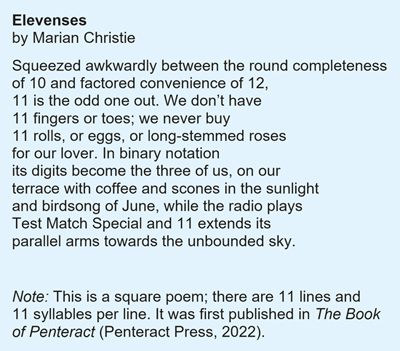
One of the exercises we were given during the MA was to write a poem that uses numerical sequencing in its structure. This was a revelation to me, leading me to explore the Oulipo movement and contemporary mathematical poetry. I started using mathematical imagery and visual elements in my poetry, and my tutor encouraged me to experiment with these forms further.
Viv Longley: The highlight for me was having my poetry taken seriously and critically particularly by my super tutor. I had never been appreciated in this context before.
Zoë Walkingon: The members of my tutor group have made each other laugh, squeal with outrageous delight, and feel genuinely touched by one anothers writing. I am always amazed by how such different responses and writing are generated out of the same prompt activities.
And what did you find most challenging?
Zoë Walkingon: The most challenging aspect for me personally has been the amount of time spent in front of a screen, because I also work full time from home at a computer all day. The fact that the learning is all in chunks means this screen-based activity can be spread out over each week though. Also, I tend to still write the old-fashioned way – into a notebook, and only use my computer to type up when something is looking half decent.
Marian Christie: Most challenging (but also very rewarding!) was preparing an extended and cohesive collection of poetry for the End of Module Assessment. This required me to reflect on my own relationship with the poetry that I write and the themes that preoccupy me, both consciously and subconsciously. It introduced me to the skills of careful editing and attention to detail, of making choices on inclusion and sequencing, and, above all, it served to clarify my own poetic voice.
Viv Longley: I had anticipated that it would prove challenging to write in more than one genre. But there was real power in having to take a different option in the second term. I produced some non-fiction that introduced me to another form of writing altogether, and I have returned to this genre a lot since.
How did your learning on the MA feed into your published writing?
Viv Longley: It took me a long while even to consider that someone else might read my poetry, let alone publish it. Essentially, I used to think of my writing as ‘mine’ and ‘private’. The first step was to get used to there being a ‘reader’ – be that another student or my tutor.
Zoë Walkingon: I have been writing poetry as a hobby for a few years now, but until I started the MA I didn’t know much about the technicalities. I was always more interested in the ideas. Now, I feel I am developing a language to better understand how poetry works and am perhaps also developing an ability to edit my work.
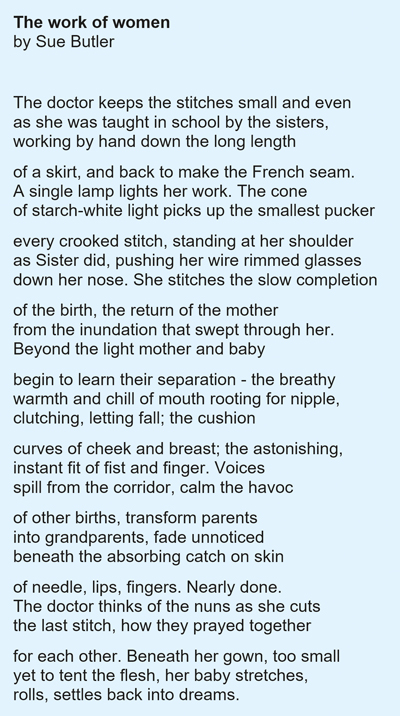
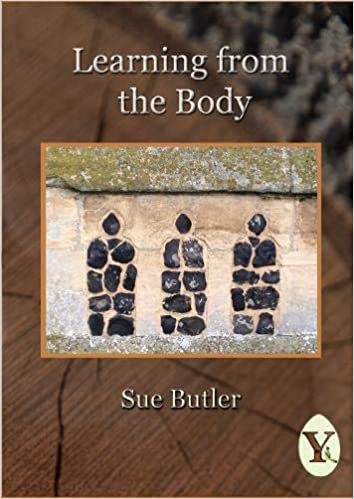
Sue Butler: The module on poetics, particularly the poetics of bearing witness, was especially significant to me. Consideration of my own poetics – the material I might use from the lives of others, and the use I might make of it – led to some poems being returned to the ‘bottom of my computer’ while others were reworked. ‘The Work of Women’ is one of these. I had learnt (been conditioned?) to consider my own needs, motives and concerns secondary to those of others around me. Now, I acknowledge and foreground the lens through which I wish to write – that of woman, mother, witness to suffering.
Which aspect of teaching from the MA comes back to you most often?
Sue Butler: To turn early drafts inside out, upside down, chop them up and glue them back together. I still consider myself to be an insufficiently adventurous editor, but I no longer get over-attached to early drafts.
Viv Longley: It has given me a set of tools that I now carry around with me. It is exactly what my work needed to give it polish, style and most of all, my voice. Other people recognise my writing as ‘mine’. I learnt to trust the feedback of some of my fellow students, and we are now working on producing an anthology of poetry called Daughters of Thyme. A shout out for Jane Keenan and Sue Brice with whom I am sharing this venture.
What advice would you give someone considering embarking on the OU’s Creative Writing MA?
Viv Longley: Hush your busy mind saying that you are not good enough. Go for it, enjoy it, roll in it, do your absolute best at everything, never underestimate yourself. You never know where you’ll land up. Such a challenge at my age too. The brain is now alive and alerted.
Sue Butler: I would say to a new student get over your shyness early. Relish the constructive criticisms of your peers. Give feedback yourself – you will learn to feed back to yourself on your own poems as well as building a supportive and effective tutor group.
Zoë Walkingon: One of the worries I had myself before starting on the MA was that writing was a hobby that I loved, and I worried that studying it in a more formal sense might kill the enjoyment for me, and, heaven forbid, might even start to make me fall out of love with writing! I have not found this to be the case. In fact, doing the MA has made me write more than I usually would.
Marian Christie: Make the most of your tutor group! Your fellow students provide a safe, supportive and welcoming community within which you can experiment with form, style, voice and technique, and in the process learn from each other. Members of my tutor group have kept in touch after graduating, sharing our work, celebrating successes and commiserating rejections, and meeting up both online and occasionally in person too.
If hearing from these current and former creative writing students has whet your appetite, you can find out more on our website aboutour masters degree programme. And remember that applications are open for our scholarshipuntil 29 July 2022.
Sue Butler, a retired GP took up walking and Creative Writing in retirement – both unpredictable forms of meditation on life in all its grace, pain and peculiarity. Her pamphlet ‘Learning from the Body’ is published by Yaffle press. It reflects the intimate connection General Practice brings with many lives, the gift and burden of that connection. Her poems have been published in One Hand Clapping, Poetry and Covid, Spelt, and the Hippocrates Prize Anthologyfor 2020.
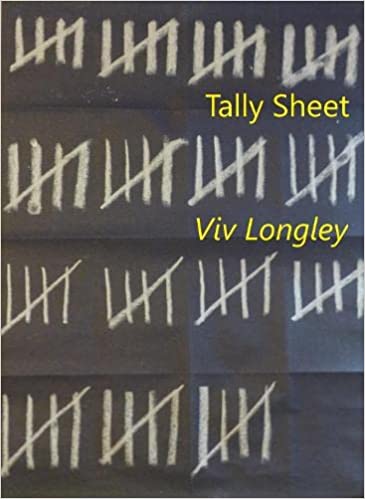
Viv Longley is now in her eighth decade. She was educated at Oxford High School for Girls, Hull and Warwick Universities. Her career culminated in Head of the Policy Unit in Kirklees Council. A secret writer for many years, Viv is a long-term member of Agbrigg Writers in Wakefield, and a contributor to their publications. Viv’s collection Tally Sheet was published by Currock Press, and praised by Ian McMillan for her use of ‘detail, rhythm, observation and a kind of “speech made visible” to underline and celebrate our common humanity’.
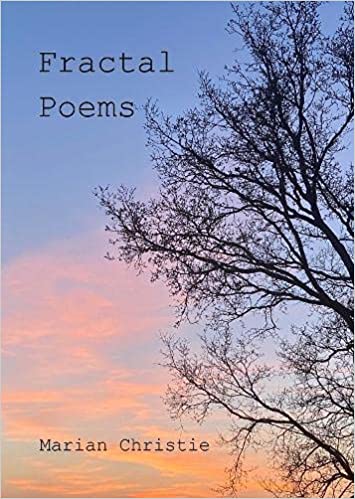
Marian Christie was born in Zimbabwe. She has an MSc in Mathematics and an MA in Creative Writing, both from the OU. Her work often explores the interface between poetry and mathematics. Publications include Fractal Poems (Penteract Press) and a collection of essays, From Fibs to Fractals: exploring mathematical forms in poetry (Beir Bua Press).
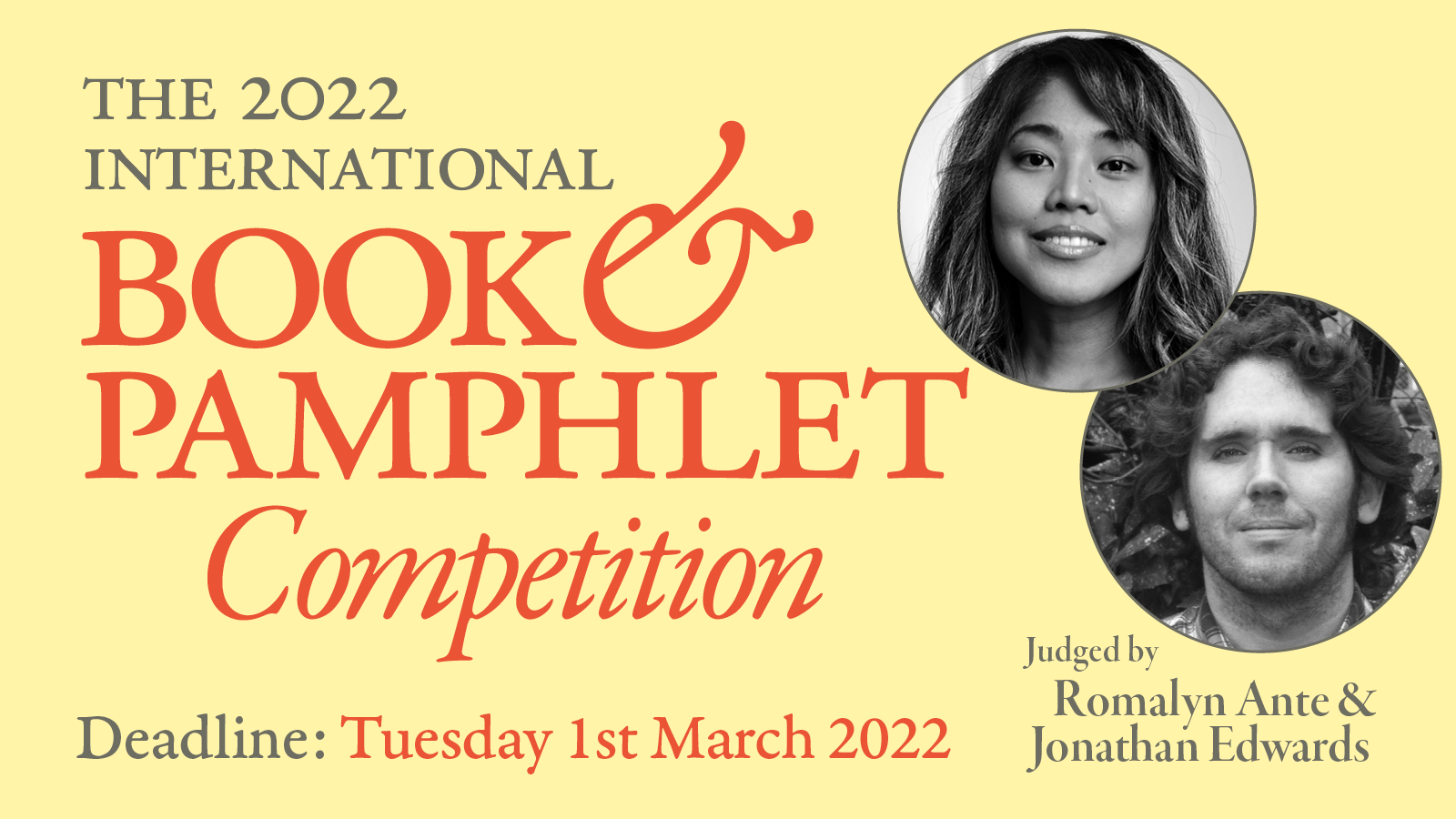
Zoë Walkingon lives in Bedfordshire. She has had work published in The North, Strix, Hinterland and various anthologies. Her collection, I hate to be the one to tellyou, won the 2022 International Book & Pamphlet Competition. Judge Romalyn Ante praised Zoë’s poems for erupting with ‘beauty and emotional resonance’.
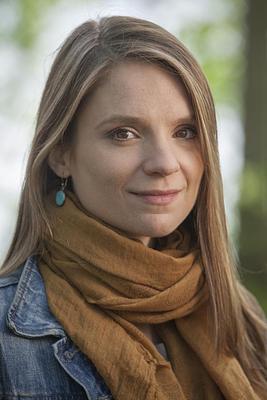
Meghan Flaherty, Associate Lecturer on A215, has recently been awarded a Scottish Book Trust Ignite Fellowship. The fellowship offers talented professional authors practical and financial support for exploring new avenues or making new breakthroughs. Meghan will be working on her second book, a memoir about motherhood, memory, and the self – the stories we tell each other in order to live and how those narratives define us. We asked her to tell us about juggling her roles as mother, writer and OU tutor.
Motherhood is hard. It’s even harder (I tell myself) when your children are small and the world has gone haywire. The pandemic has forced so many of us to juggle so much, and in such claustrophobic space. How can you possibly be a person, a writer, a mother, a pre-school teacher, a playmate, a chef, a maid, a student, a professional and keep your family safe and healthy all at once? (Not to mention keeping up with all the latest parenting advice on Instagram—and falling ever short.)
I say this and I’ve had it easy. My family has weathered its particular challenges, but we’ve managed to tread water for the past two years. In all of the uncertainty, we’ve never feared for a roof over our heads, and despite a few nursery colds (when nursery is open) and the persistent stress, we’ve managed to fend off harm. We’re lucky. My husband and I have jobs that don’t require us to leave the house in lockdowns. Our kids are young enough to not mourn what they have lost in this new normal. (And young enough, thank heaven, not to require help with any maths homework.) We are not high risk (in any category), and so we’ve managed fine, despite the occasional storm clouds of depression and that niggling, insurmountable anxiety, the fatigue of functioning in so much flux.
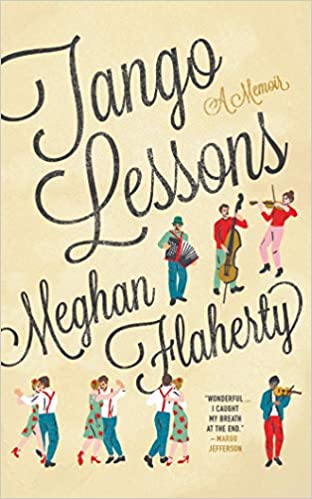
Tango Lessons: A memoir by Meghan Flaherty
What I haven’t managed to do (apart from keeping my skirting boards clean and being perfectly patient with my children) is write. I sit here typing this beside a pile of pages—the mess of which I hope to call my second book. This lump of untouched draft, this tome of half-baked words, is the albatross of my pandemic, of my past five years. Granted, during that time, I also had two children under two (both of them nutters), moved across the world, and lost a beloved parent to leukemia. (Not to mention: made it through the Trump administration.) I’ve had my share of good excuses.
My kids came first. Then lockdowns. Then the move. More lockdown. Toilet training. The purchase of our first house. Another move. My husband’s thyroid surgery. Working to pay the bills. Grieving. More bills. When was there time to sit down at my desk and do art? And if I’d found the time, where was the energy? The inspiration (from the Latin ‘in’/‘spirare’, to inhale, to breathe in)?
I’ve recently been given the gift of an Ignite Fellowship from the Scottish Book Trust, which includes a much-appreciated bursary, the promise of a week’s retreat (!!!), and mentorship, but above all else: a vote of confidence. Someone outside of my house, my head, telling me to put my bottom in my chair and get this done. A reason to pick up this doorstop on my desk and make a book of it. Even when I think I’m too exhausted to access the part of me that writes. The part I’ve shaded over with these other roles, back-burnered and forgotten. You’ll understand why I fumble here for words; my gratitude feels inexpressible.
Since I started teaching at the OU, I’ve been so impressed by the tenacity of my students. Most of whom, I note, are juggling so much more than I. That they manage to keep pace against the current of this pandemic, managing their own families and jobs and stresses, their own mental health and learning challenges, to pursue their degrees (and churn out stories, essays, poems) is remarkable. As I steer them through their module this year, I hope to channel some of their resolve and pluck.