Apparently True: Writing A Novella By Accident

Creative Writing PhD student and Associate Lecturer Sarah Bower found herself inadvertently crafting a novella during the second lockdown summer of 2021. Ahead of Monday’s online event with fellow OU novella writer Emily Bullock, Sarah  unveils how writing a novella helped her uncover hidden layers of her larger literary endeavors.


Rather as Withnail and I went on holiday ‘by mistake’, in the second lockdown summer of 2021 I wrote a novella by accident. In August 2023, it was published by Story Machine as Lines and Shadows. Admittedly, it seems an odd sort of mishap, and you would be within your rights to doubt my assertion that it was an accident at all because who writes an entire book – even a short one – by accident?

Let me tell you how and why it happened.

I was in the first summer of my PhD in creative and critical writing, for which I am writing a much longer novel, part of which, set in 1968 and 69, is about the role of women in the manufacture of spacesuits for Apollo. End of year marking was over, there was little or no prospect of diversions such as test cricket or holidays. The PhD beckoned. I opened up the file…
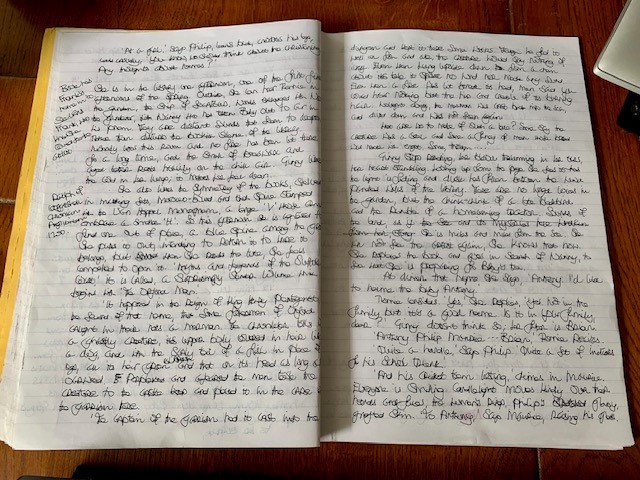
Notebook with two pages of handwritten notes…and picked up a notebook in which I started writing, by hand and with no conscious forethought, something completely different.

I headed it ‘Ghost Story’ and wrote: ‘The letter from the Ministry of Defence was lying on Ginny Matlock’s plate when she came down to breakfast.’ Beyond that point I knew very little.

Fiction writing is a peculiar process. The writer is split between the mechanical brain which wields the pen or types on the keyboard, undertakes the research, knows how to spell and where to put a comma (most of the time). Then there is the parallel universe of the imagination in which she is not only not herself but may be many others. F. Scott Fitzgerald wrote, in The Last Tycoon, ‘Writers aren’t people exactly. Or, if they’re any good, they’re a whole lot of people trying so hard to be one person.’ The writer is never entirely in control of all these people and sometimes, the ones who have been waiting patiently in the background – perhaps for years – decide they’re tired of waiting and elbow their way to the front of the queue.

The character waiting for me was, in the Romantic tradition, a place: the Suffolk coastal town of Orford. I had lived in Suffolk and known I wanted to write about Orford for many years, not only for its bleak, beautiful and ever shifting landscape. I had written about the East Anglian coastline and its unpredictability before, in my novel Erosion. But Orford has a strange history, which transports the imagination from a medieval merman to nuclear weapons testing and Cold War listening posts. It had lain dormant in my subconscious for twenty years or more, and it was initially a mystery to me why it chose to rise to the surface in that particular summer.
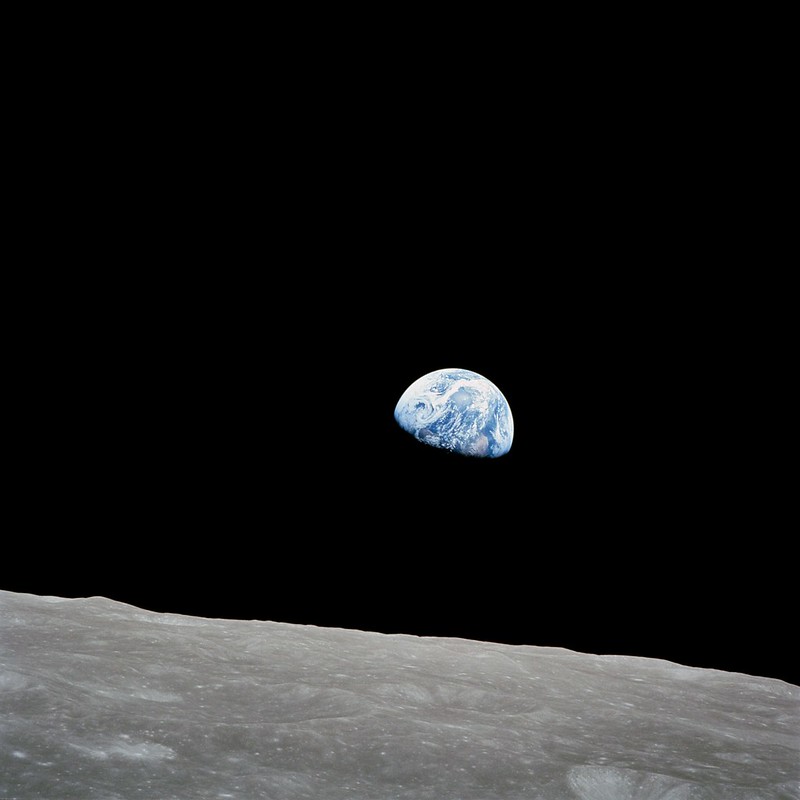
Image from outer space looking at the Earth
Earthrise 1968

The novella is set between 1960 and 1962, culminating with the Cuban Missile Crisis, in a fictional village called Aldeford. This is closely based on Orford but the inability to conduct either location research or visit the relevant archives in Ipswich due to lockdown meant that I could not achieve the historical accuracy necessary to set my story in the real place. This was liberating, however, as was scribbling in a notebook in the unstructured spaces of my day – while waiting for the kettle to boil, eating breakfast, watching the bath run. I was daydreaming on paper. The characters conjured into being this way – Ginny, the mathematics prodigy from Manchester, her society girl housemates, the Korean war hero Philip and the mysterious Artist – had the freedom to do as they wished and to tell me what they wanted to.

It wasn’t until they had finished and fallen silent that I understood their function in the process of a whole lot of people trying to become me. I realised, during the course of discussions with my editor which helped to sharpen the novella’s focus, that its creative impulse was a means of delving into the deep backstory of my PhD. It prepared the ground for writing about the proxy war that was the space race and the real war in Vietnam that was the grisly underbelly of America’s triumphant moonshot. Kennedy became president in 1960 and made his ‘We Choose to Go to the Moon’ speech at Rice University in 1962, a month before the missile crisis. While my characters’ lives and loves and encounters with ghosts and spies were unfolding on a secret airforce base in Suffolk, the building blocks for 1968 – for everything from student riots to Earthrise – were being assembled in America.
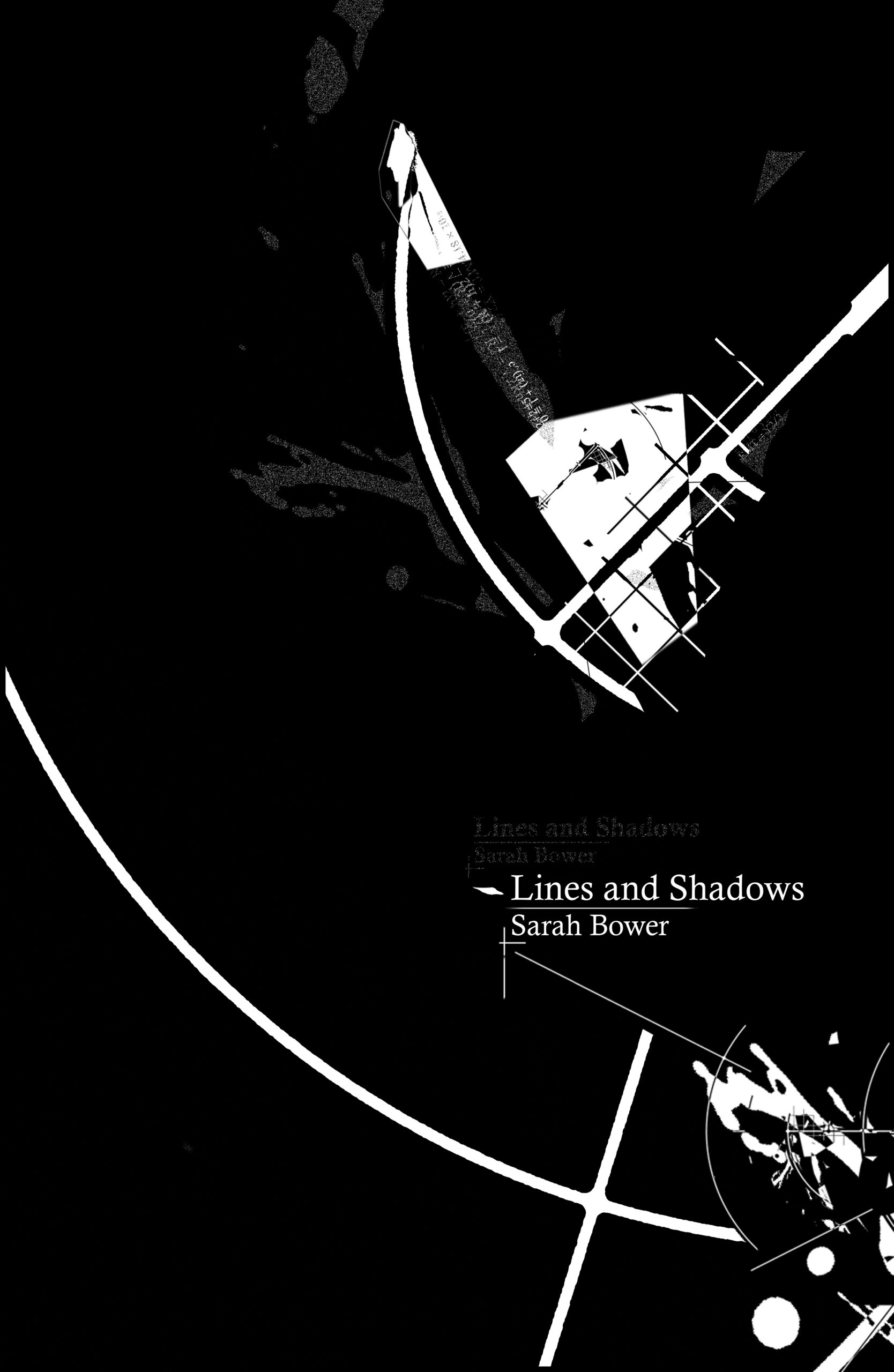
Black and white book cover featuring a white image of a satellite
Lines and Shadows by Sarah Bower

Lines and Shadows is my first novella. At 40,000 words it is long for the form but about half the length of a novel.

Perhaps, in the context in which I was writing, it took this form because the novella too shape shifts like the Orford coast. Neither novel nor short story, it is commonly seen as originating in fourteenth century Italy with Boccaccio’s Decameron. The word ‘novella’ translates from Italian as ‘a short story related to true, or apparently true, facts.’ What better way to describe a book written by accident, set in a fictional version of a real place and tucked into the corners of another book altogether.
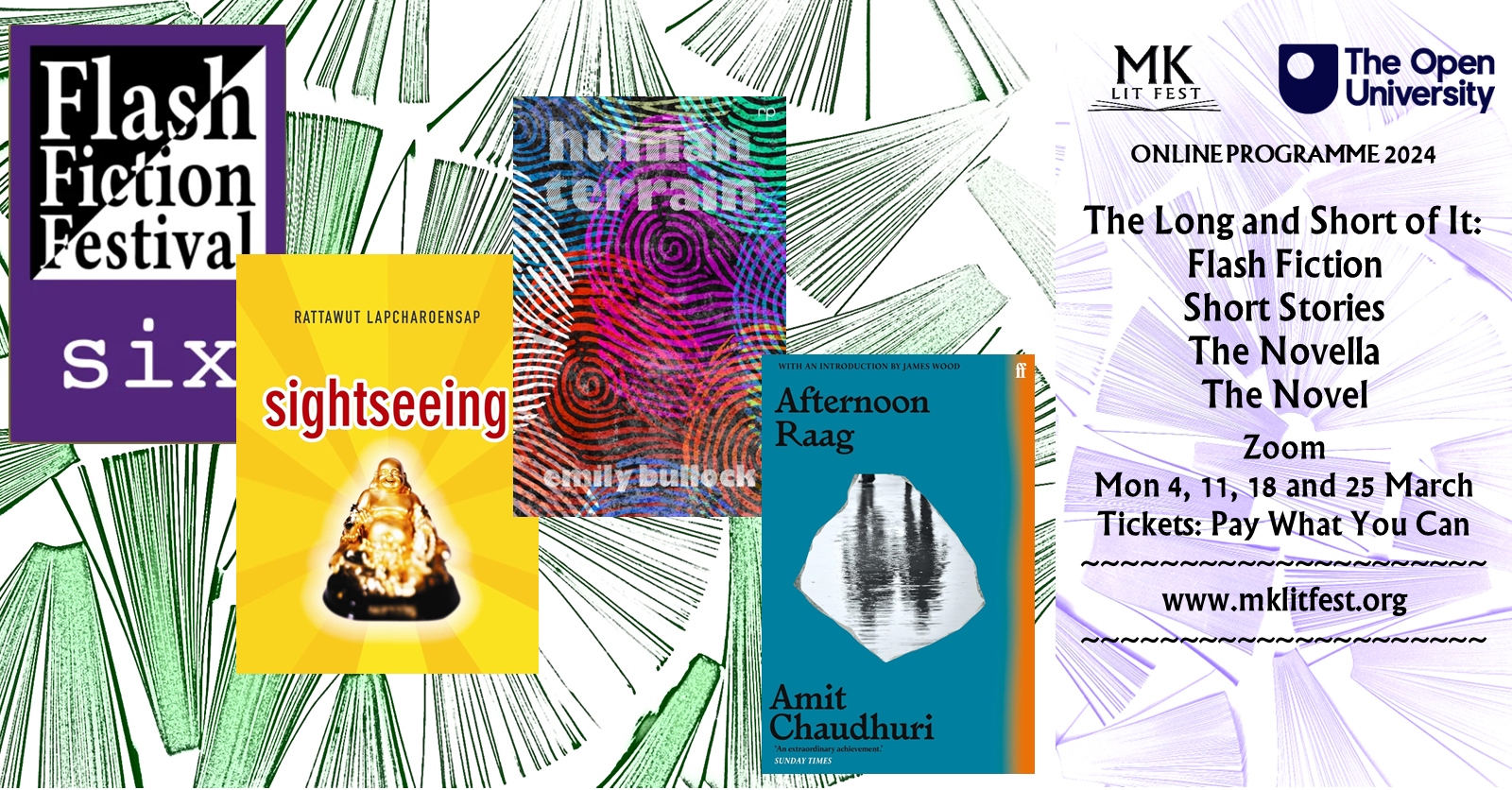
Banner advertising upcoming Monday evening online events: Short story, 11 March; Novella, 18 March; Novel, 25 March. Images of book covers by each of the guest authors.

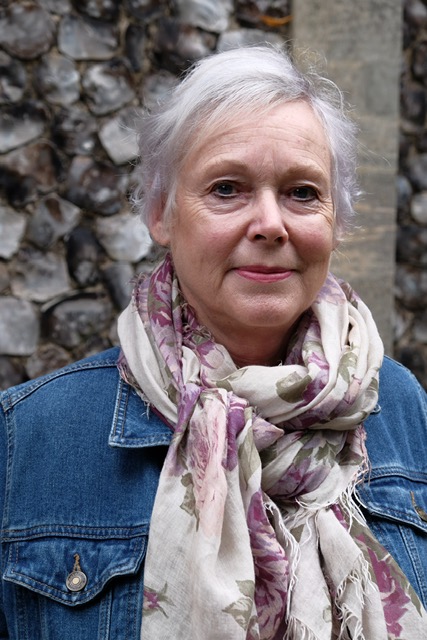
A headshot of a woman with short grey hair, wearing a denim jacket and a white and pastel-pink scarf.
Sarah Bower

Sarah Bower is an Associate Lecturer at the OU, where she is also reading for a PhD in creative and critical writing. She is the author of three previous novels. Her first, The Needle in the Blood, winner of the 2007 Susan Hill Award, was re-issued in September 2023. She also writes short fiction and has edited anthologies of memoir and of literary translations into English. She is currently working on a book of prompts and inspirations for creative writing for imprisoned people.
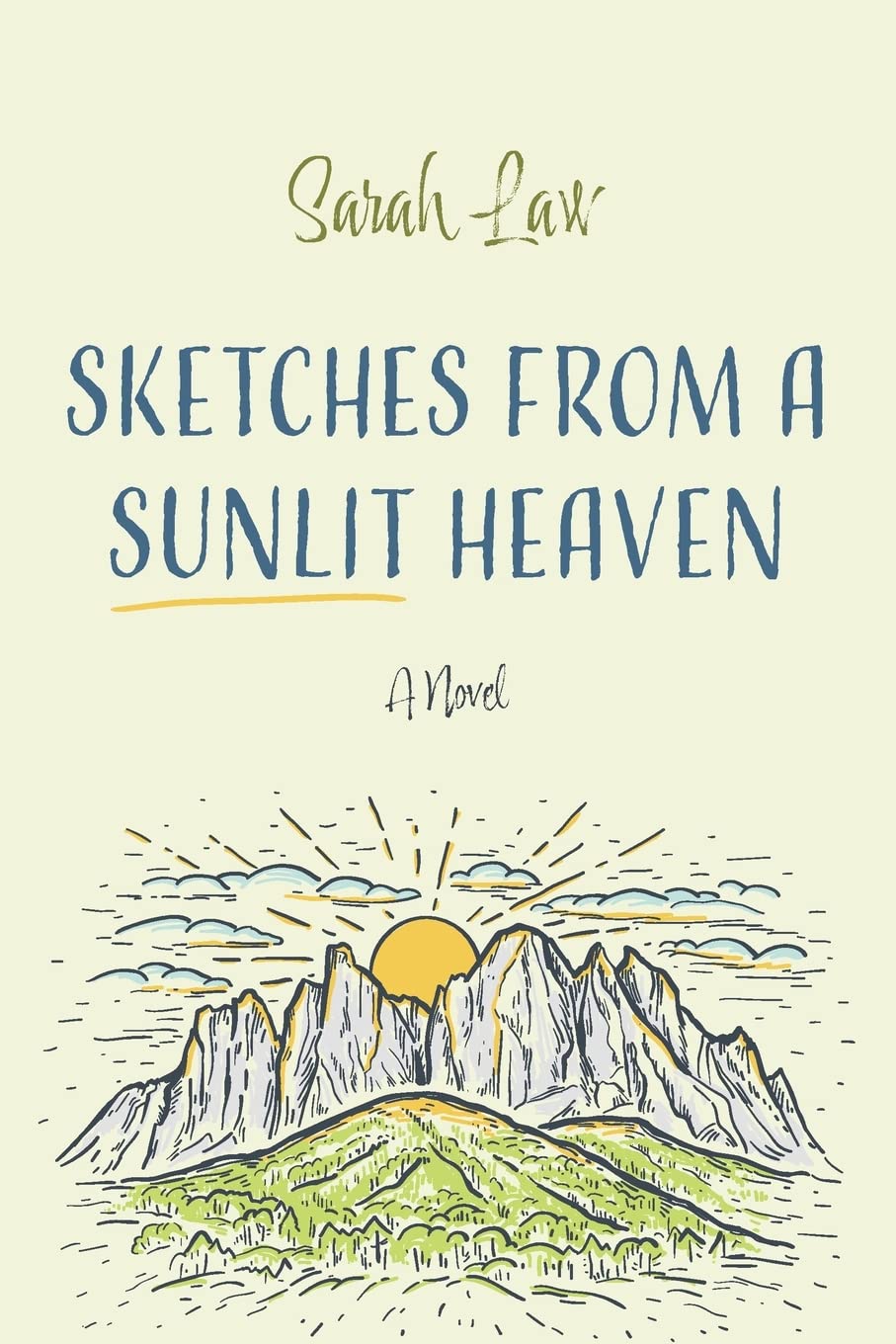
Sketching in Shadow and Sunlight: Writing Multivocal Historical Fiction by Sarah Law

Today, we hear from one of the Associate Lecturers who teaches on our Creative Writing MA programme. Sarah Law draws back the curtain to reveal some of the choices and happy accidents that lie behind the final form and title of her recently published novel Sketches from a Sunlit Heaven.

Sometimes writing allows us to meet characters who we don’t correspond with in terms of time or culture, but who speak to us anyway. My novel, Sketches from a Sunlit Heaven, arguably falls into this category: historical fiction where my characters, based on real people, tell their stories.

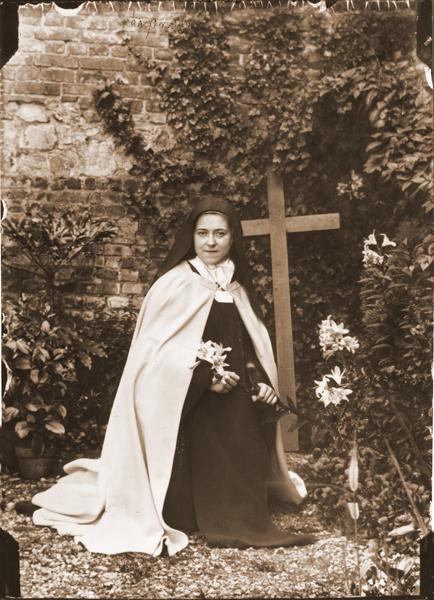
July 1896, in the sacristy courtyard. Licensed for non-commercial use by Copyright Office Central de Lisieux

By way of an introduction to my subject matter: I have an endless fascination with the ‘Little’ Saint Therese. She lived in a Carmelite Monastery in Lisieux, France, for nine short years before dying of tuberculosis in 1897 at the age of twenty-four. Her own memoir is full of sweetness but granite-tough underneath. Rare archive photos reveal lively eyes and a subtle smile full of some secret I still want to hear. Most unusually, three of her blood sisters and a cousin joined her in the same monastery. One sister was an artist and photographer. Another became prioress for much of her long life, and together they supported the cause of Therese being canonised, which she duly was in 1925 when, had she lived, she would have been fifty-two years old.

I started writing a fictionalised biography, hoping to deepen my knowledge of this young nineteenth-century nun. Then, as I read about her family, particularly her blood sisters, I heard their voices in my head (I mean this figuratively, of course). Pauline, the prim, practical community leader. Marie, the warm-hearted dreamer. Celine, the fiery-tempered artist. And Leonie, the difficult loner. Add in cousin Lucie with a beautiful singing voice, and Maurice, a missionary who fails and fails again, but with whom Therese, toward the end of her life, corresponds with the tenderness of an ethereal lover. Six different perspectives emerged: six distinct, but related, takes on Therese. But how were they going to work together? As each character’s narrative grew, so did my concerns about a clunky jumping from one chapter to another, from one account to the next, especially as they would substantially be going over the same events as each other.

I paused to reflect. I decided that my options were:

  1. Change the novel’s narrative perspective back to the third person, potentially becoming an authorial presence in my own right;
  2. Revise my narrative strategy to just one sustained first-person voice;
  3. Somehow intercalate my various first-person speakers (or at least some of them) into one chronological narrative.

While I considered each option seriously, I decided I wanted to retain the polyphony of multiple voices, even if they weren’t the longest-lived or most substantial in terms of narrative length. I wanted the book to offer a multidimensional account. A series of fragments mapped over Therese’s life and beyond. A mosaic.

Something clicked into place: this was how the novel itself wanted to emerge. A mosaic or a series of sketches, as each speaker passed the narrative between themselves. Sketches from a Sunlit Heaven had found its form and, incidentally, soon afterward, its title.

I embarked on an intense period of copying and pasting as I took what felt like brief but complete episodes from all six of my first-person narratives. I wanted to proceed in chronological order, but alert to the poetic magnetism produced by selective juxtapositions of my speakers’ accounts. Of course, I’m not the first novelist to choose multiple speaking characters (‘intradiegetic narrators’, if you will). From Wilkie Collins’s The Woman in White to George SaundersLincoln in the Bardo, the polyphonic approach to narrating a novel has been successful across recent centuries. Virginia Woolf’s The Waves remains one of my favourite modernist novels. A very tall order to write anything on par with these great works! But, to paraphrase the words of poet Robert Browning in ‘Andrea del Sarto’ a writer’s reach should exceed their grasp, or what’s a heaven for?

As I continued to cut, paste, shape, and write, I imagined jigsaw pieces fitting together to make a whole picture. Neither mosaics or jigsaws are perfect analogies, but both echo images in the novel: pieces of mosaic from the Roman Forum that teenage Celine cherished, and later, Lucie’s imaginative consideration of the ‘jigsaw’ view of Normandy seen from above – looking down from a sunlit heaven.

Sketches from a Sunlit Heaven is published by Wipf and Stock.

Two more motifs appeared as the novel grew into its ultimate structure. Firstly, that of letters. Therese, her sisters, and others close to them or the family wrote to each other a lot. I haven’t framed any narrative fragments as letters per se, but their usual length—from a few hundred words to a thousand or so—is reminiscent of a letter. The epistolary novel is the earliest form of the novel genre in English, so there is perhaps an echo in my work of its literary ancestor. My characters write to each other, request letters, read, receive, and even dream letters. And then there’s the sketch. A sketch is brief, descriptive, often urgent, suggesting with few lines, and judicious shade and hatching, larger issues than itself. Something Celine literally does, as do the others, figuratively. Sketches from a Sunlit Heaven secured its place as my novel’s name.

Combing through my draft, I found it fell into fourteen sections, each bound by dates, and housing narrative fragments that developed the section’s essential kernel—Vocation, Discipline, Legacy, and so on. An introductory section, Glimmerings, also appeared.

It’s strange how, in the end, a novel largely emerges of its own volition. Despite the planning and researching, even historical fiction does too. Holding the published book in my hand, I can say the process of writing it is still part mystery.

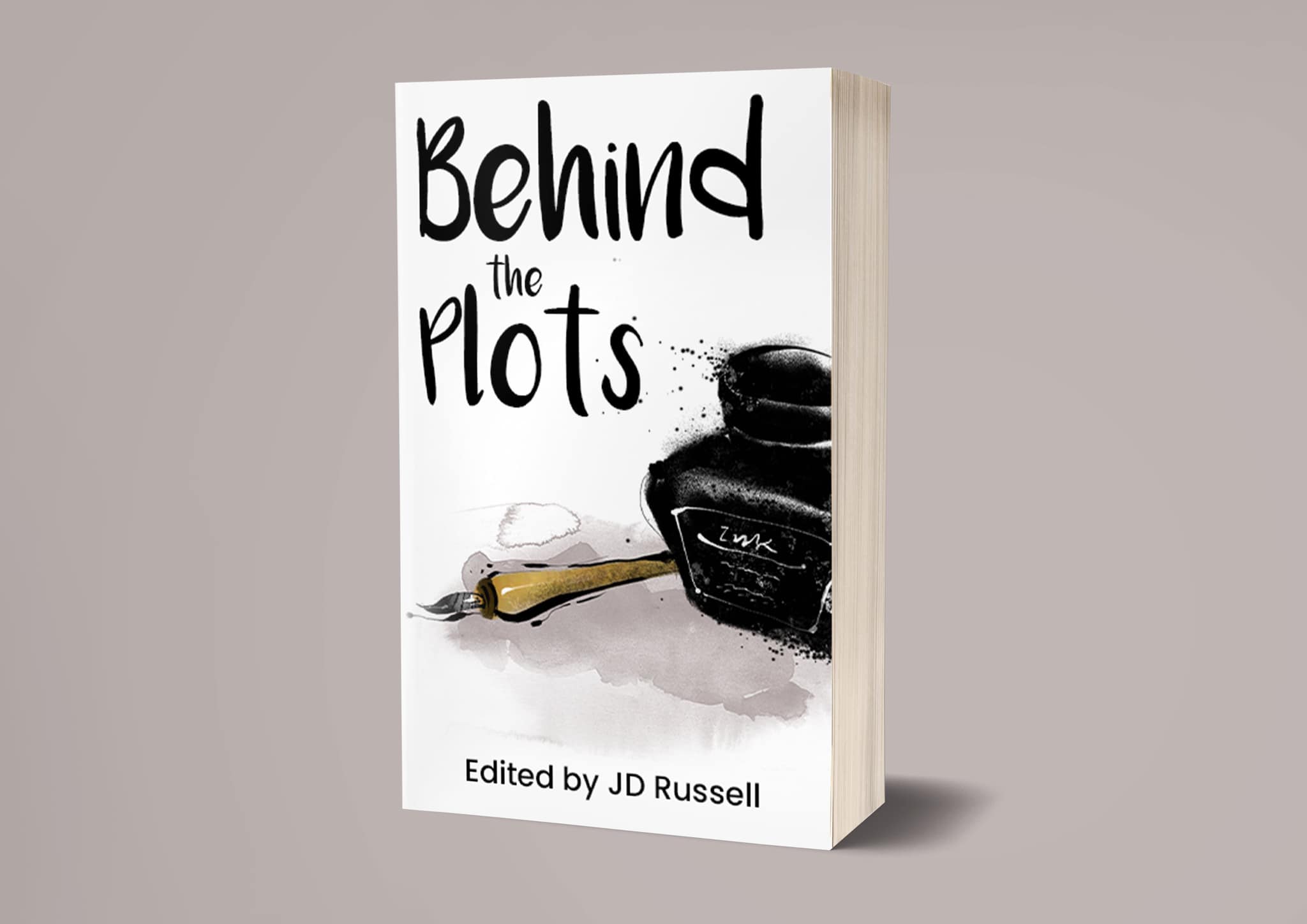
With thanks to Writing Bad for permission to publish this blog, which is an abridged version of an essay Sarah Law originally published in Behind the Plots.

Dr Sarah Law is an Associate Lecturer for the Open University. As well as a novel, she has published six poetry collections and writes academic and creative nonfiction. She also edits the online journal Amethyst Review, for new writing engaging with the sacred. She lives in Norwich. 


Writing in Lockdown

Jo Barnden, AL on A215 and A363

For those first, intense weeks of lockdown, I seemed to be out of step with the rest of the world. Everyone was telling Twitter how much time they had to walk through nature and take up knitting, to make TikTok videos and bake bread (if they could track down yeast). Frankly it sounded wonderful but it was not my experience. Quite the contrary, I was chained to my desk trying to write a novel in four weeks – the most intense working challenge of my life.

It started when my agent rang me out of the blue to say that my publisher had ‘had an idea’ and thought I might be the writer to bring it to fruition. Piatkus publish my historical novels as Joanna Courtney. These are works set in 1066 and earlier that take at least a year to research and write, but what they wanted from me now was a contemporary novel, a lockdown love story. Needless to say, we had to move fast.

I was perhaps not as bizarre choice as that makes it sound. Two years ago I’d started writing contemporary fiction as Anna Stuart for another publisher, Trapeze. Both books (Bonnie and Stan and Four Minutes to Save a Life) had done well so hopefully that was some quality assurance for them. More importantly they knew that I’m quite efficient when it comes to writing – though none of us were sure if ‘efficient’ would add up to a 70,000-word novel in four weeks.

This, I was told, was an ‘IP (Intellectual Property) Project’ in which the core idea for the novel had been invented by the publisher – to be precise a lovely editor called Hannah – and I was the ‘hired pen’ to bring it to life. It’s not like ghost writing as I was simply given a handful of characters and a plot outline with the rest very much mine to bring to life. However, because it was her idea the editor was very bought in and very, very helpful in how we put it together. That was to be invaluable in the intense weeks that followed.

I loved the basic concept and the characters seemed to come to life for me instantly so I fleshed out Hannah’s core plans and within a week we had signed a deal. It was hard to credit. Having spent years and years trying to land a novel contract, I felt as if I was suddenly being handed one on a plate – now all I had to do was write it. Simples! Except that my normally empty house was now filled with a husband working from home, two kids who should have been doing GCSEs and A-levels, and a 23-year-old stepson who’d had to flee his lovely job in the ski-bars of Whistler. It was a worry. I like a quiet house to write in and I certainly wasn’t going to get that.

As it turns out, however, the young folk quickly went nocturnal, leaving things pretty quiet until at least midday and with my husband working with China we were both at our desks by 7am – my most productive time anyway. Plus, to be fair to the kids, they stepped up and took on both the cooking (enthusiastically) and the cleaning (less so!), so all I had to do was shut myself in my little office and write. To be honest, I loved it.

The novel is called Just the Two of Us and is about a middle-aged couple whose kids have left home and who are on the brink of divorce when they find themselves locked down together. All that enforced time in the house pushes them to explore the things that have messed up what was once a wonderful marriage and to see if, perhaps, there’s a way back to happiness. It cuts between the current story and flashbacks to their long, shared past and was fun to write, if a little tricky in terms of timelines.

That, however, is where my editor came in. I provided the first 28,000 words in a week (it was a hell of a week!) and she was back to me two days later – that’s almost unprecedented in the publishing world! It was the same again once the first draft was done three weeks later. We chatted on the phone and over email and tinkered with second and third drafts and, miraculously, six weeks after I signed the contract, we sent Just the Two of Us to copy edit at 80,000 words. It was a whirlwind but fantastic fun and, most importantly, early reviews from NetGalley readers suggest that people are really enjoying it.

How did we do it? I’ve no idea! I’m a planner. I always have a full chapter-by-chapter synopsis of my novels, historical or contemporary, before I start so that I can hit the ground running and I think that helped here. I have no idea how people manage to just start writing without knowing where the novel is going, but everyone has to write the way that suits them best. It seems that for me that is in a manic, concentrated run.

Lessons learned? The biggie is that traditional publishing houses can be more mobile and responsive than they usually let on and I think that’s the way they’re going to have to go with digital-first publishers producing books so nimbly these days. For myself, it confirmed that I like working under pressure – and that I really like not doing housework!!

My agent did scare me the other day by saying ‘I know how fast you can write books now, so I expect at least three next year.’ In this, she will be disappointed. Just the Two of Us was a one-off, driven by the strange coronavirus circumstances we all found ourselves in. I may not have learned to knit, or made TikTok videos (to my kids’ relief) but I did write a lockdown love story.

Jo Wilde is on twitter and facebook as @jowildeauthor

A little literary tourism: in search of Hilary Mantel

Shafquat Towheed, Senior Lecturer in English

Hilary Mantel has been lauded for reviving the fortunes of the historical novel in English, for being the first woman writer to have won the Booker Prize twice (2009, 2012), and for selling over five million copies of her books – but where did it all start? Where did Mantel become a writer, hone her craft, and enter the public domain as a published novelist? What were the social and environmental circumstances that facilitated her arrival as an author? 

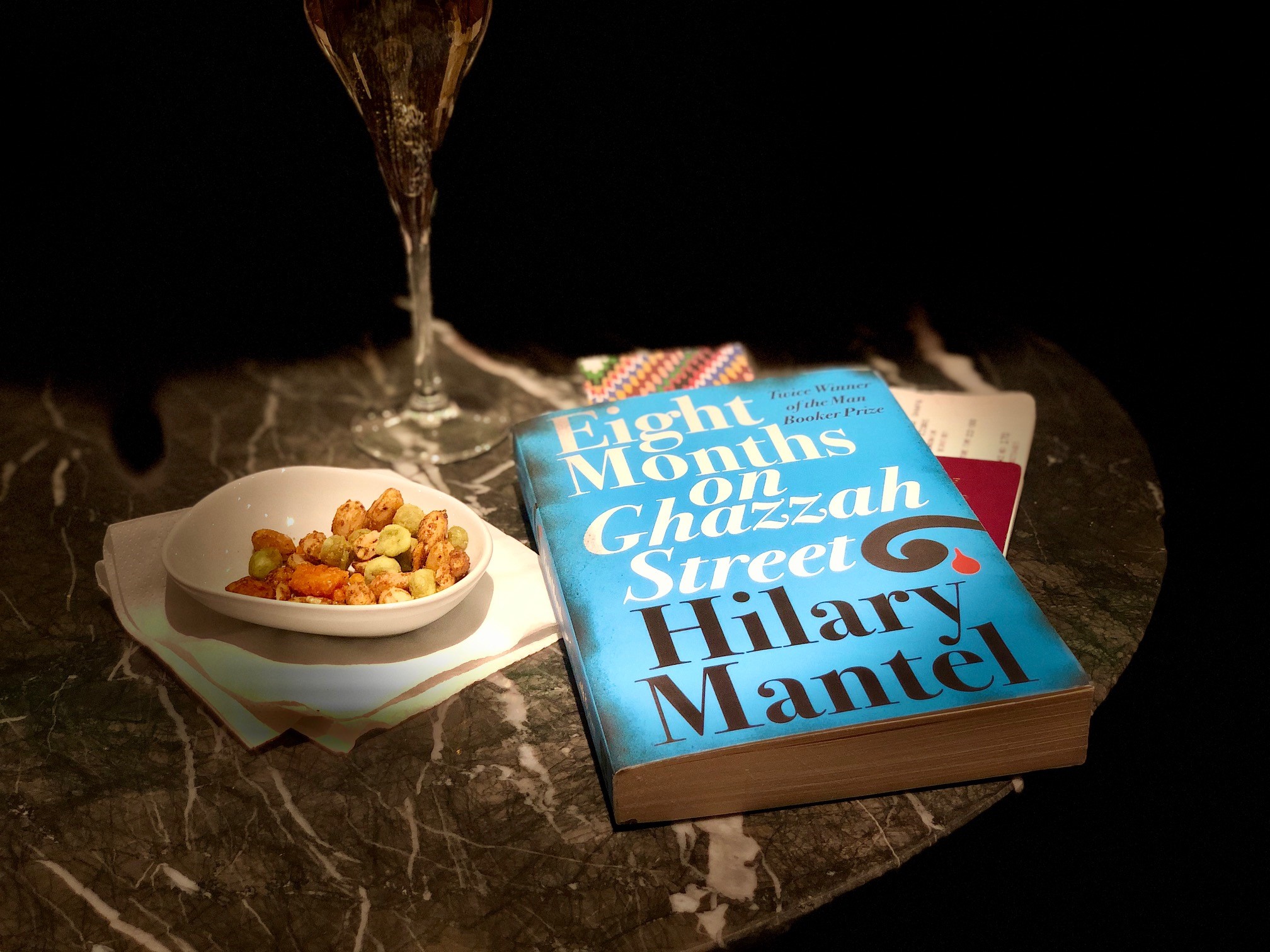
 I had recently been reading Mantel’s third novel, Eight Months on Ghazzah Street (London: Viking, 1988), which is set in Jeddah, Saudi Arabia, in 1984-85, and tells the story of Frances Shore, the unhappily married cartographer wife of a civil engineer on an expatriate work contract in the Kingdom. The novel is perhaps the best evocation of 1980s Saudi Arabia written by a woman in English, and carefully reconstructs the oppressive, punitive environment that she encounters. A mapmaker stranded in a city without signs, Frances Shore observes that pavements in Jeddah exist to stop cars crashing into buildings, and not for the benefit of pedestrians. Her large apartment on Ghazzah Street has windows with views of blank compound walls, and she can only glimpse a view of the sea by climbing to the roof. Denied the opportunity to work or drive, Frances Shore reads her way through all the detective novels she can find, while keeping a diary of her claustrophobic life and trying to reconstruct the lives of others around her. It is a compellingly atmospheric novel. 

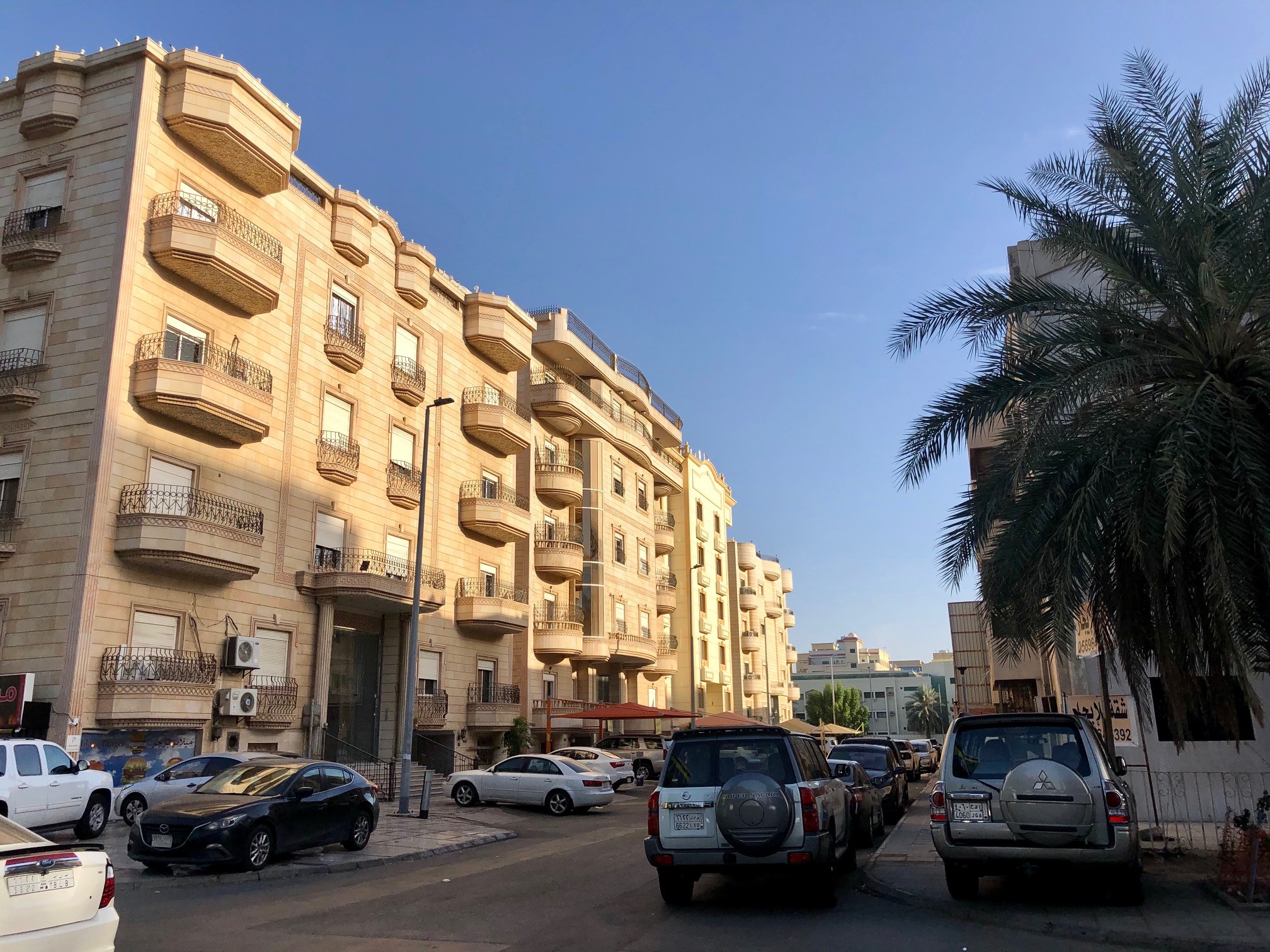
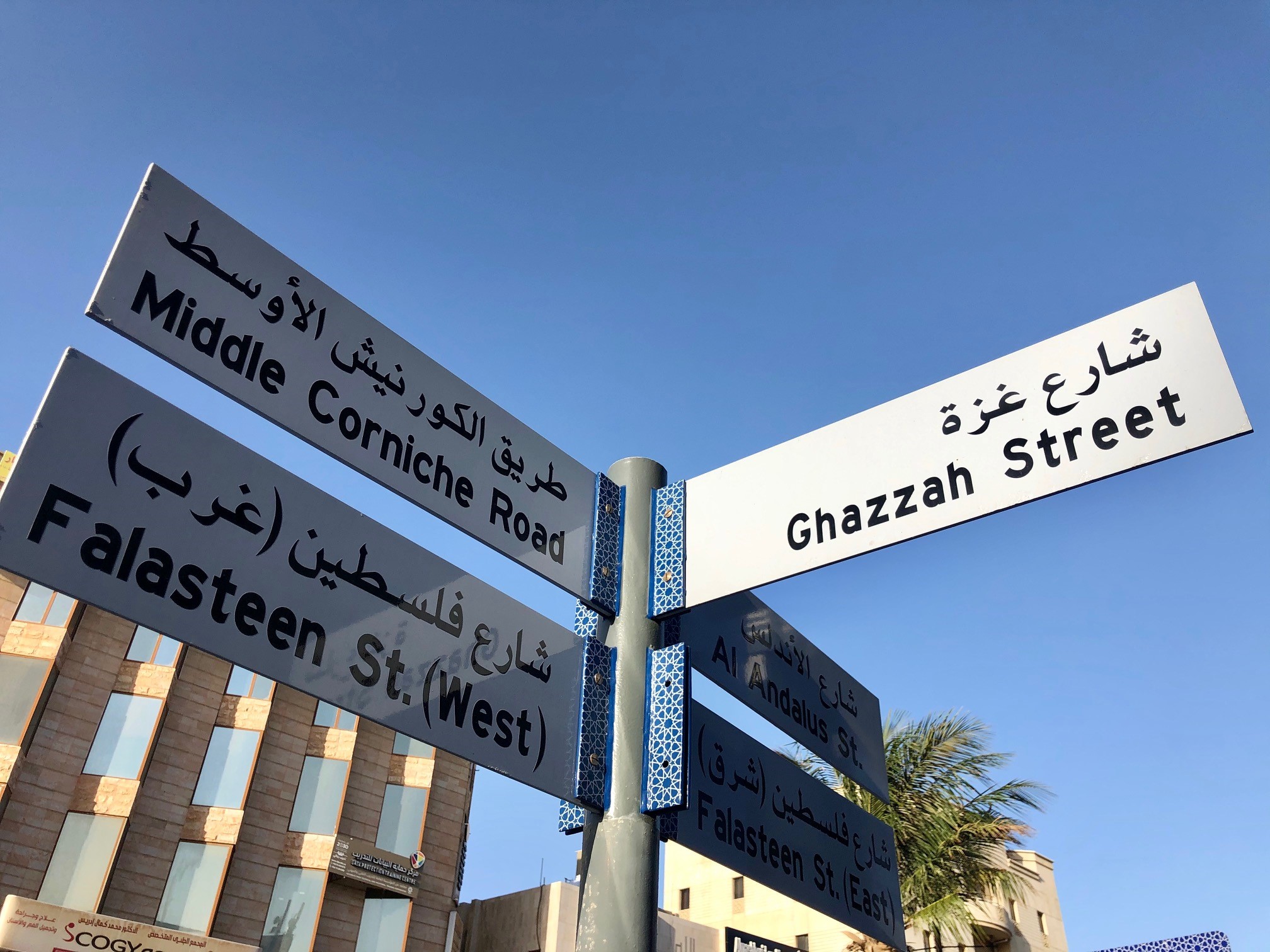
When I recently went to Saudi Arabia for a short visit, I had to go and find Ghazzah Street, and see the place that Mantel had reimagined in her fiction for myself. Within 72 hours of setting foot in the Kingdom, I was there, and a spot of surreptitious literary detective work (and pilgrimage) had begun.  

 So here is Ghazzah Street, 9 blocks in from the sea, in Hamrah in Jeddah’s downtown, just off Shari’eh Falasteen (Palestine Street). Several of the buildings look plausible as the likely home of Frances Shore in the novel -which thinly fictionalised the first apartment Mantel actually lived in. Much has changed – Ghazzah Street now has a swanky business hotel, Palestine Street is beautifully pedestrianised, and women are allowed to drive – but parts of the built environment dating from the 1970s and 1980s are exactly as Mantel would have encountered and thinly fictionalised in the novel. In fact, Mantel spent not eight months in Jeddah, but stuck it out for four years, in three different addresses in Jeddah and one outside of the city, accompanying her geologist husband. 

Mantel hated her time in Saudi Arabia and to the best of my knowledge, has never been back. And yet, it was those four years, living in the most gender repressive society on earth, that was the crucible that forged her as a writer. She had time to write, as denied the ability to work or drive, she could do little else. Like her fictional character Frances Shore, Mantel read her way through the British Council Library’s collection of detective fiction, and similarly, kept a diary of her day to day life. She arrived as a housewife and left as a professional writer, with two novels under her belt, and the material – her Jeddah diaries – for her third, Eight Months on Ghazzah Street, ready to go. She worked through her material and wrote the novel back home in England during the winter of 1986, in a world that ‘always seemed to be dark’. Even before the novel was published, Mantel’s Jeddah material was winning awards: her first literary prize was as the first ever recipient of the Shiva Naipaul Memorial Prize for Travel Writing (1987) for a piece on Jeddah. 

 So, if you are thinking of the place that turned Hilary Mantel from a geologist’s wife into an awardwinning novelist, look to Jeddah, and not just for the inspiration for Eight Months on Ghazzah Street. Surely, there could have been no better preparation for writing about absolute male patriarchy and the divine right of kings in Tudor England than having lived in the Kingdom of Saudi Arabia? Perhaps even more ironically, Mantel now has a readership within the Kingdom: Wolf Hall and Bring up the Bodies are both openly sold and read there, as my own visit to Jarir Books, Jeddah’s largest physical and online book retailer, located just a few kilometres away from Ghazzah Street, proved. 

Voices from the Past: Peterloo and New Historical Fiction

It’s exciting to hear that Hilary Mantel’s novel The Mirror and the Light will be published in March 2020. Like many thousands of historical fiction fans, I am impatient to see how she concludes her epic trilogy about the life of Thomas Cromwell. However, I’m also keen to see historical fiction focus on the lives of those who have been given only a footnote in the historical record.  Earlier this month I organised a conference in Manchester with my Creative Writing colleagues Heather Richardson and Joanne Reardon, commemorating the anniversary of the Peterloo Massacre and considering the role of historical fiction in celebrating marginal voices from the past.

Held at the People’s History Museum, the conference brought together a number of speakers including writers and academics from different disciplines. The keynote was Jacqueline Riding, historical consultant to Mike Leigh for the film Peterloo.

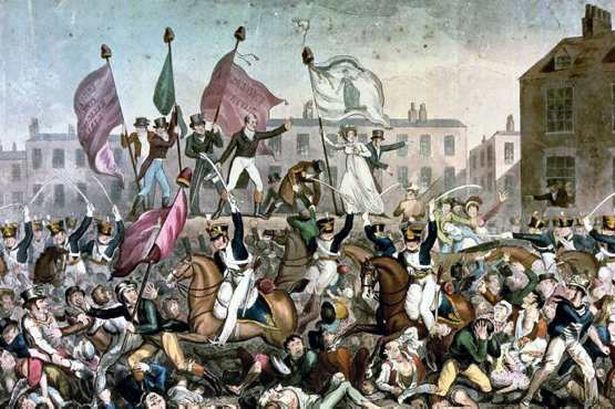
Jacqueline briefly summarised the events that took place on 16 August 1819. On that day at St. Peter’s Field, a combined force of local yeomanry cavalry and British-army regulars  tore through a pro-democracy meeting of 60,000 people. Many of the local yeomanry were drunk.  At least 15 people were killed or died later from their injuries, including an infant and two women, and over 650 were beaten and maimed. This terrible event is the focus of increasing interest, with a number of books published recently including Jacqueline’s Peterloo: the Story of the Manchester Massacre.

The first panel discussion looked at the way in which historical fiction writers interact with historical fact, and why they tell the stories they do. Novelist Emma Darwin suggested that often readers go to historical fiction looking for stories that aren’t covered by history, sometimes focused on whole sections of the community, sometimes on individual voices that have not been heard, citing the example of Joseph O’Connor’s Ghost Light which tells the story of Maire O’Neill, partner and muse of Irish playwright J. M. Synge who became a successful Hollywood actress.

Michael Green talked about his novel The Ghosting of Anne Armstrong, and his research process. It is based on the story of a 14 year old girl who went before a justice in Northumberland  in 1673, accusing her neighbours of witchcraft. Michael came across the story on a plaque in his local pub, and became engrossed in the research journey, which eventually led him to the National Archives at Kew where he found Anne’s depositions. Her unlikely story caught his imagination: ‘A voice gets me and won’t go away.’

The panel ‘Touching history – tactile historical fiction’ focussed on the importance of tactile objects when connecting with the past. Vivienne Richmond presented on her work on the clothing of the working class and talked about her book Clothing the Poor in Nineteenth Century England. It is hard for us to understand the way that clothing was coded in the past, and historical fiction set in the Victorian period – such as The Crimson Petal and the White by Michel Faber – can help decipher such codes, because writers producing work for 21st century readers make information explicit which would have been implicit in the work of Victorian writers.

Vivienne also suggested that as the scraps of fabric that mothers left with their babies when leaving them at the Foundling Hospital in London are often vibrantly patterned, we can assume that they wore dresses made from such fabrics. The concept that we generally have of ‘the poor’ wearing clothes that were shabby and drab would only apply to the most deprived.

Heather Richardson talked about her research process in her novels Magdeburg and Doubting Thomas, and her recent project ‘A Dress for Kathleen’, in which she commemorates the life and death of her aunt Kathleen during a blackout in World War II by making a dress using a contemporary dress pattern and creating an artefact that blends the verbal and the tactile.

The conference also encompassed new ways to present historical fact. Graphic novel Peterloo: Witnesses to a Massacre, a collaboration between cartoonist Paul Fitzgerald ‘Polyp’, artist and activist Eva Schlunke and academic Robert Poole, demonstrates that it is possible to distil detailed academic knowledge into the succinct visual form of graphic art.

The final panel event was a ‘Big Book Group’ discussion in which Emma Darwin talked about her book The Mathematics of Love, which encompasses the Peterloo Massacre, and her latest publication: This is Not a Book about Charles Darwin. Emma described how The Mathematics of Love began as a response to a writing exercise where the prompt was ‘watch’. Immediately the image came into her mind of a red-coated English soldier watching a girl bathe in a Spanish river – and so her main character was born.

Throughout the conference there was a sense of connections being made and links being forged, and of possibilities for future collaborations. One conclusion is that this is a vibrant, multifaceted form that offers continually evolving interpretations of past realities. There is a full report of this conference on the Contemporary Cultures of Writing site.