
Gender and Otherness in the Humanities (GOTH)

Interview with (Peg) M A Katritzky, Senior Research Fellow, Department of English & Creative Writing

Can you tell me more about Gender and Otherness in the Humanities (GOTH)?

In 2019, GiTH (Gender in the Humanities) a research group active in the Arts Faculty of The Open University from around 1990 to 2013, was relaunched as GOTH (The Centre for Research into Gender and Otherness in the Humanities). A substantial US award funded the launching of GOTH as a Research Centre based in the OU’s School of Arts and Humanities, Faculty of Arts and Social Sciences, and a three year GOTH Doctoral Studentship, awarded to Chris Dobson in 2020.

Our annual programme of events, planned and guided by our Committee and Advisory Board, is designed to appeal at various levels. We support OU researchers and postgraduates with specialist interests wishing to strengthen their interdisciplinary network; additionally, we welcome all OU employees and postgraduates with more general GOTH-related interests wishing to meet colleagues and enjoy a cultural experience, at whatever level of engagement. GOTH currently has more than 50 members.

Are you talking about the Humanities at any time, or is there a focus in terms of historical period?

We welcome collaboration with the Faculty’s historically focused research groups, such as those for the Classical, Medieval & Early Modern and Post-Colonial periods. Rather than having a specific historical focus, we aim to support members’ GOTH-related research interests. In connection with one of these, ShAC, I published a book chapter (“Margaret Cavendish’s Female Fairground Performers”) in The Palgrave Handbook of the History of Women on Stage, 2020 (see publicity poster with Bernardine Evaristo below). GOTH provides a platform for members’ research bids, and has recently submitted a GOTH-based bid for European funding for EURO-PPP (Trans-European Performance, Practice and Patronage as Cultural Heritage). If successful, this collaborative international three year project will examine live travelling performance of every period, with particular emphasis on the present.
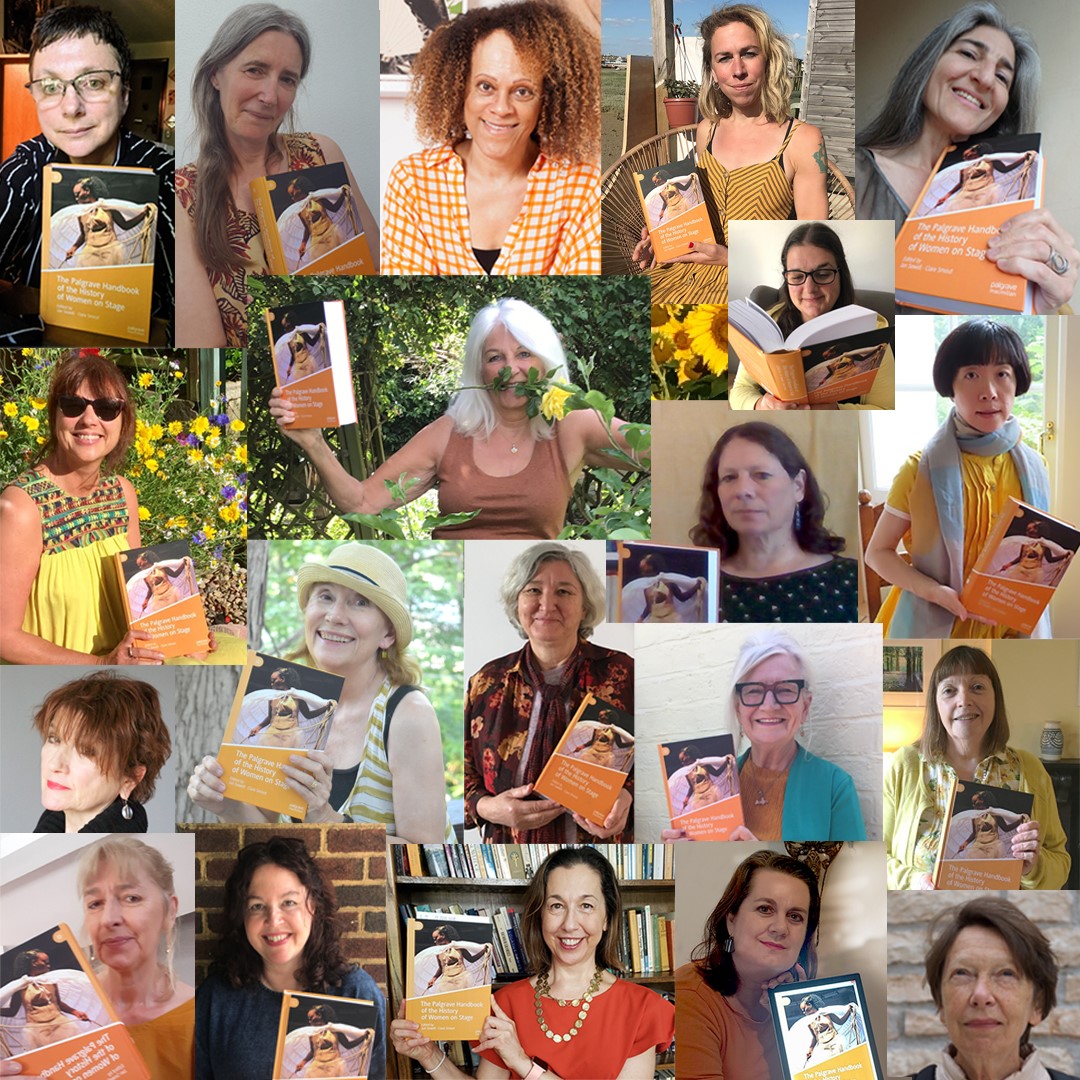
Poster for The Palgrave Handbook of the History of Women on Stage, 2020

What events are you holding online? Are there ways in which lockdown and online meetings gives a group like GOTH greater global reach?

For now, we are adapting our regular events to the pandemic by going online with our entire events programme, and maximizing current opportunities to attract inspirational overseas presenters and widen participation:

* The live performances at our October 2019 launch party led to requests for more live theatre visits. While that’s on hold, Christine Plastow led an October 2020 online viewing of the recorded livestreamed production of By Jove Theatre Company’s Medea LIVE, followed by lively online discussion; more performances will follow.

* Our first Reading Group (‘Nationalism and Feminism’) was a live event led by Suman Gupta in January 2020; on 3 December 2020, Francesca Benatti will go online with our second Reading Group (‘Digital Comics’).

* Similarly, the first GOTH / Health & Wellbeing PRA Joint Annual NetWorkshop was held live in January 2020, with around 20 delegates enjoying excellent presentations by PG Kim Pratt and postdoc Sally Blackburn-Daniels, and an informative funding workshop led by Shaf Towheed (English) and Gaynor Henry-Edwards (WELS), followed by a Research Showcase of members’ recent publications and funding successes. The second Joint Annual NetWorkshop (4 Feb 2021), featuring OU speakers Sophie-Grace Chappell (keynote, Philosophy) and Naomi Barker (Music) will be online.

* Our inaugural GOTH Awayday was to Hardwick Hall in May 2019. Plans for London Awaydays led by Clare Taylor and Gemma Allen are on hold while the Committee explores options for moving our Awaydays online.

* The Annual GOTH Research Symposia, funded by a modest US follow-on award in 2020, were planned as specialist invitation-only residential research workshops. The first (20-21 May 2021) has moved online; we are honoured that GOTH board member Noémie Ndiaye (University of Chicago) has agreed to present the keynote.

* An exciting new development is the monthly GOTH PG Forum. Postgraduate convenors Chris Dobson and Sharon Wiseman (English) and Kim Pratt (Classics) welcome all OU postgraduates with GOTH-related interests on the first Thursday of each month. They first met on 5 November 2020; future activities include a takeaway party on December 3.

What would you like to see GOTH achieve?

Essentially, GOTH seeks to promote an awareness of the centrality of diversity to an understanding of the humanities, both within the OU and in society more broadly. We aim to support the GOTH-related activities and interdisciplinary exchanges of OU colleagues and postgraduates. More generally, we seek to continue the OU tradition of providing conventional academic institutions with helpful templates for online events, ever more relevant in the current circumstances.
Voices from the Past: Peterloo and New Historical Fiction

It’s exciting to hear that Hilary Mantel’s novel The Mirror and the Light will be published in March 2020. Like many thousands of historical fiction fans, I am impatient to see how she concludes her epic trilogy about the life of Thomas Cromwell. However, I’m also keen to see historical fiction focus on the lives of those who have been given only a footnote in the historical record.  Earlier this month I organised a conference in Manchester with my Creative Writing colleagues Heather Richardson and Joanne Reardon, commemorating the anniversary of the Peterloo Massacre and considering the role of historical fiction in celebrating marginal voices from the past.

Held at the People’s History Museum, the conference brought together a number of speakers including writers and academics from different disciplines. The keynote was Jacqueline Riding, historical consultant to Mike Leigh for the film Peterloo.

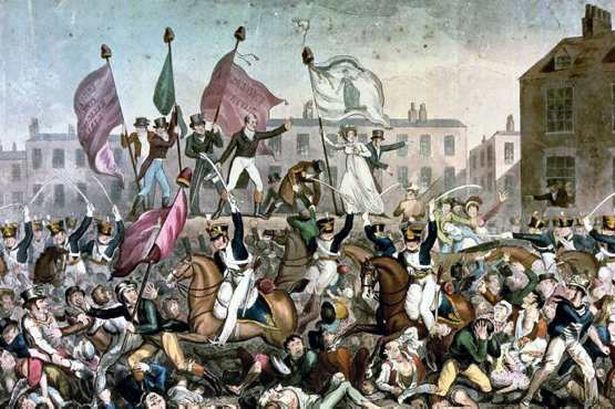
Jacqueline briefly summarised the events that took place on 16 August 1819. On that day at St. Peter’s Field, a combined force of local yeomanry cavalry and British-army regulars  tore through a pro-democracy meeting of 60,000 people. Many of the local yeomanry were drunk.  At least 15 people were killed or died later from their injuries, including an infant and two women, and over 650 were beaten and maimed. This terrible event is the focus of increasing interest, with a number of books published recently including Jacqueline’s Peterloo: the Story of the Manchester Massacre.

The first panel discussion looked at the way in which historical fiction writers interact with historical fact, and why they tell the stories they do. Novelist Emma Darwin suggested that often readers go to historical fiction looking for stories that aren’t covered by history, sometimes focused on whole sections of the community, sometimes on individual voices that have not been heard, citing the example of Joseph O’Connor’s Ghost Light which tells the story of Maire O’Neill, partner and muse of Irish playwright J. M. Synge who became a successful Hollywood actress.

Michael Green talked about his novel The Ghosting of Anne Armstrong, and his research process. It is based on the story of a 14 year old girl who went before a justice in Northumberland  in 1673, accusing her neighbours of witchcraft. Michael came across the story on a plaque in his local pub, and became engrossed in the research journey, which eventually led him to the National Archives at Kew where he found Anne’s depositions. Her unlikely story caught his imagination: ‘A voice gets me and won’t go away.’

The panel ‘Touching history – tactile historical fiction’ focussed on the importance of tactile objects when connecting with the past. Vivienne Richmond presented on her work on the clothing of the working class and talked about her book Clothing the Poor in Nineteenth Century England. It is hard for us to understand the way that clothing was coded in the past, and historical fiction set in the Victorian period – such as The Crimson Petal and the White by Michel Faber – can help decipher such codes, because writers producing work for 21st century readers make information explicit which would have been implicit in the work of Victorian writers.

Vivienne also suggested that as the scraps of fabric that mothers left with their babies when leaving them at the Foundling Hospital in London are often vibrantly patterned, we can assume that they wore dresses made from such fabrics. The concept that we generally have of ‘the poor’ wearing clothes that were shabby and drab would only apply to the most deprived.

Heather Richardson talked about her research process in her novels Magdeburg and Doubting Thomas, and her recent project ‘A Dress for Kathleen’, in which she commemorates the life and death of her aunt Kathleen during a blackout in World War II by making a dress using a contemporary dress pattern and creating an artefact that blends the verbal and the tactile.

The conference also encompassed new ways to present historical fact. Graphic novel Peterloo: Witnesses to a Massacre, a collaboration between cartoonist Paul Fitzgerald ‘Polyp’, artist and activist Eva Schlunke and academic Robert Poole, demonstrates that it is possible to distil detailed academic knowledge into the succinct visual form of graphic art.

The final panel event was a ‘Big Book Group’ discussion in which Emma Darwin talked about her book The Mathematics of Love, which encompasses the Peterloo Massacre, and her latest publication: This is Not a Book about Charles Darwin. Emma described how The Mathematics of Love began as a response to a writing exercise where the prompt was ‘watch’. Immediately the image came into her mind of a red-coated English soldier watching a girl bathe in a Spanish river – and so her main character was born.

Throughout the conference there was a sense of connections being made and links being forged, and of possibilities for future collaborations. One conclusion is that this is a vibrant, multifaceted form that offers continually evolving interpretations of past realities. There is a full report of this conference on the Contemporary Cultures of Writing site.