OU News
News from The Open University
- Home
- The JANUS camera on the JUICE spacecraft observes a cosmic visitor on its way to Jupiter
The JANUS camera on the JUICE spacecraft observes a cosmic visitor on its way to Jupiter
Posted on • Science, maths, computing and technology
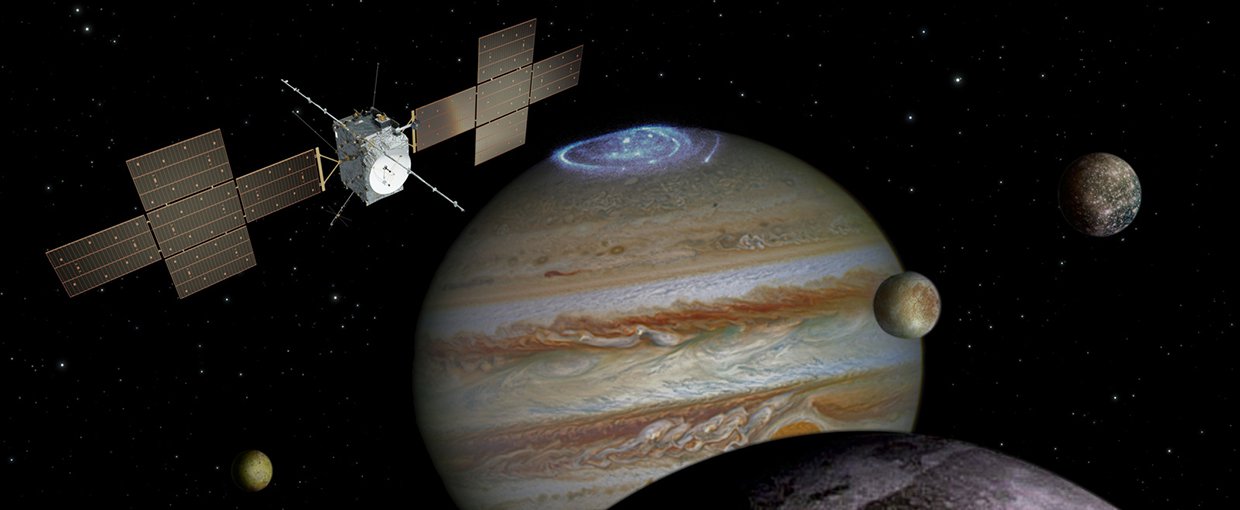
Space researchers from the Open University Atmospheric Research and Surface Exploration group, led by Prof. Manish Patel, and the Centre for Electronic Imaging, have helped image an interstellar visitor to our Solar System.
The European Space Agency JUICE mission to Jupiter carries the JANUS camera, which uses UK-built Teledyne e2v detectors provided by The Open University. The instrument is led by Prof. Pasquale Palumbo in Italy, with an international consortium including Germany, Spain and the UK. JANUS is a high-resolution camera, designed to operate and survive in the intensely harsh radiation environment of Jupiter, and will study the atmosphere of Jupiter and the surfaces of its icy moons when it arrives at Jupiter in 2031.
There has been significant coverage of the visit of comet 3I/ATLAS to our Solar System in recent months, heralding the third detection of an object that originated from far beyond our own Sun. The JUICE mission is currently on its long voyage to Jupiter, and has been keeping an eye out for the cosmic visitor along the way.
Operating an instrument on the other side of the Solar System
As part of its epic voyage to Jupiter, the JUICE spacecraft is currently on the other side of the Solar System, looping its way around the inner planets and the Sun to gain enough speed to fling it out towards the distant orbit of Jupiter. JANUS was able to take images of the comet as it passed by, taking images from a distance of around 65 million km from the comet, revealing an incredible view of the cloud of gas streaming away from it and the structure within the heart of the comet’s glow.
A huge amount of effort went into making these observations happen, particularly because JUICE was hidden behind the Sun – out of sight, out of reach, and unable to communicate with Earth.
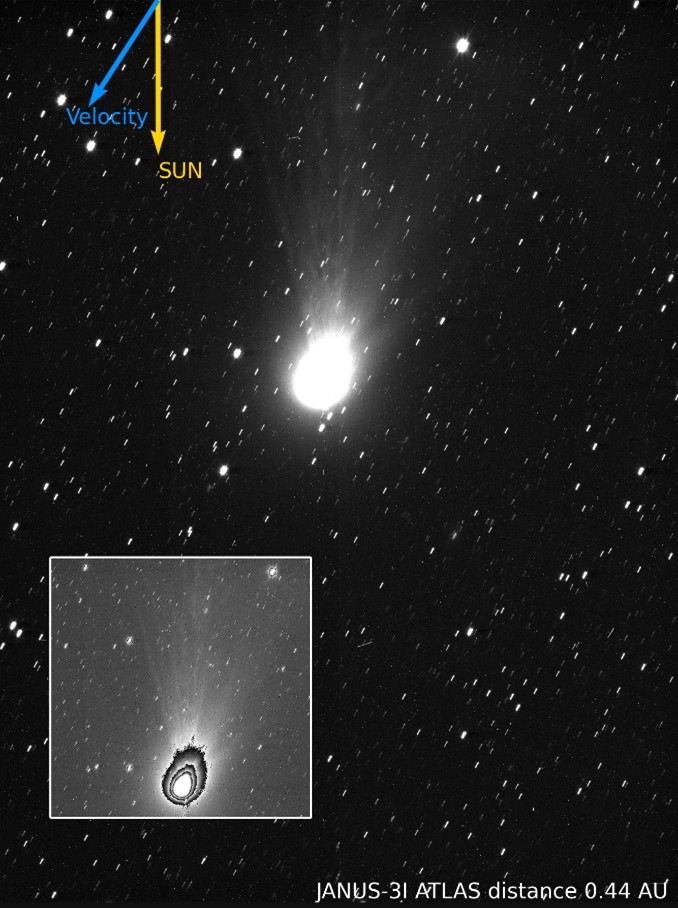
This image from the JANUS camera shows the bright halo of gas known as the coma around comet 3I/ATLAS, with long tails of jets and streams of dust and gas stretching away from the comet. The inset in the image shows the same object, but processed to highlight the coma structure. (image: https://www.esa.int/ESA_Multimedia/Images/2026/02/First_glimpse_of_comet_3I_ATLAS_from_Juice_science_camera)
Prof. Patel, who is the UK-lead for the JANUS instrument, said:
’This is an incredible achievement by the team – taking an image of an unknown object in a poorly defined orbit, not really knowing if you will hit the target or not, is an exceptional display of excellence by the operations team for JANUS and JUICE. It is an honour to work with them, in particular the instrument team for JANUS at the OU.’
He added:
‘The camera was 278 million km from Earth, and the comet was 65 million km away from the camera. I forget that this kind of thing is exceptional. I can’t operate my phone camera from across the room, but somehow we can do this.’
I’ve seen things you people wouldn’t believe…
JANUS took the images of the comet back in November 2025, but has only just been able to download the images to Earth, because the Sun was in the way blocking communications, and the download rate is incredibly slow at such a large distance. While the comet originates from beyond our own Solar System, the images from JANUS help confirm that it behaves in a similar way to known comets, confirming our understanding of these objects extends beyond our own Solar System.
Now, JUICE is heading into deep space, to continue its long march towards Jupiter. JUICE will continue looping around the inner planets – it will next encounter Venus, which will fling it back out towards Earth for another flyby later this year, providing the speed necessary to get all the way out to Jupiter by 2031.
Dr. Amit Kumar, from Prof. Patel’s research group and the Centre for Electronic Imaging at the OU, who is currently working on testing the JANUS detectors, said:
‘I am thrilled to have recently joined The Open University and to be part of such an exciting space mission. Capturing images of a comet from beyond our Solar System is truly remarkable. They not only offer fascinating science but also allow us to further test and understand the performance of the JANUS camera as we continue our journey towards Jupiter.
My job is to ensure that we get the very best performance from the OU-provided detector, which sits at the heart of the JANUS instrument. I am looking forward to analysing these images and having lots of fun with them in the coming months’
Further information regarding the JANUS observations of 3I/ATLAS from the European Space Agency can be found here, as well as from the JANUS lead institute in Italy.
The OU team working on this project includes Prof. Manish Patel, Dr. Konstantin Stefanov, Dr. Matthew Read, Dr. Amit Kumar, Prof. Matt Balme, Martyna Hodges, Dr. Jon Mason and Dr. Mark Leese.
(Header image: https://astrobiology.nasa.gov/missions/juice/ , credit: ESA/NASA/ATG medialab/University of Leicester/DLR/JPL-Caltech/University of Arizona)


Explore

Undergraduate
Postgraduate
Policy
-
Follow us on Social media
-