OU News
News from The Open University
- Home
- Study of climate–carbon behaviour through the ages gives vital lessons on the earth’s capacity when under threat
Study of climate–carbon behaviour through the ages gives vital lessons on the earth’s capacity when under threat
Posted on • Maths, Science, Science, maths, computing and technology

A detailed study of past changes in the Earth’s climate-carbon system – dating back 539 million years – shows the close links between the vulnerability of life on the planet and the long-term shifts it experiences.
The multi-disciplinary paper, led by The Open University (OU) and published in the journal Nature Communications and available to read on this link, saw scientists use carbon and oxygen isotope records, mathematical modelling and more, to identify five long-lived climate-carbon regimes of the past.
They found that the Earth system was sustained amid these relatively persistent states for tens or even hundreds of millions of years, with sharper transitions between the various climate periods. But analysis also showed that the biosphere was generally more vulnerable close to the transition point of these changing periods.
The study provides a new framework for understanding why similar environmental disturbances can have very different biological consequences at different times in Earth’s history.
Study helps distinguish between triggers of crises and the underlying background
Lead author Dr Ivan Sudakow, Lecturer in Applied Mathematics at the OU said this does not mean that every mass extinction has been directly caused by a transition between climate states.
Instead, it shows that the backdrop of climate and carbon cycle change over generations greatly impacts the long-term condition of the Earth system, and how robustly it can respond to unexpected forces like volcanism, rapid warming, changes in ocean conditions, asteroid impacts etc.
Mass extinctions are often studied as separate events, with attention focused mainly on their immediate causes. In this study, scientists also considered the long-term state of the climate and carbon cycle in which each biological crisis occurred.
This helps to distinguish between the immediate trigger of a crisis and the background conditions that may already have made the biosphere more vulnerable.
The study used carbon and oxygen isotope records, recurrence analysis, early-warning indicators, mathematical modelling and fossil biodiversity data to identify five long-lived climate–carbon regimes.
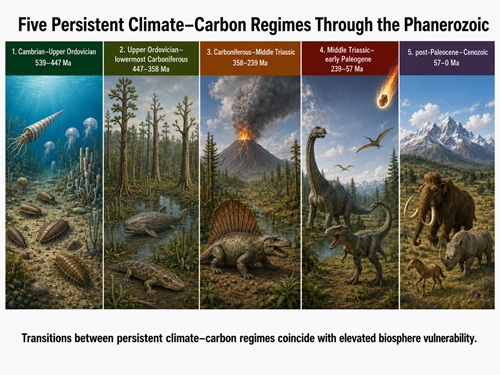
Lead author’s AI-generated depictions of five climate-carbon regimes
It focused on how the Earth’s climate–carbon system was organised during the period when complex life existed and evolved, and how changes between long-lasting climate states were connected with biological vulnerability.
The same framework could be used in future studies to compare different groups of organisms, ecosystems, geographical regions and geological intervals. It could also help test whether the same environmental disturbance produces different biological effects under different long-term climate states.
More generally, the work contributes to the mathematical understanding of how climate states can remain persistent over very long periods and then reorganise. This type of modelling is largely missing between short-term climate projections, usually focused on decades or centuries, and models of the extremely distant future evolution of the Earth and Sun.
Dr Sudakow initiated and organised the original research working group at the International Centre for Mathematical Sciences, led the work through all stages and coordinated the scientific contributions from the different disciplines and institutions.
His scientific contribution focused mainly on the mathematical parts of the study, including data analysis and the conceptual climate–carbon modelling. He also partnered with the co-authors to combine the mathematical results, geological evidence, climate reconstructions and fossil biodiversity data into one common framework.
The collaboration was also developed and supported through the Mathematics of Mass Extinctions Research Network, Ma(th)ssX, which I established to bring together researchers from mathematics, palaeontology, climate science and related disciplines:
Dr Sudakow said:
“Our results suggest that the Earth’s climate and carbon cycle remained in a small number of relatively persistent states for very long periods. The transitions between these states were also periods when the biosphere appears to have been particularly vulnerable.”
“We are not saying that every mass extinction was caused by a transition between climate states. Our main point is that the long-term condition of the Earth system may influence how strongly life responds to volcanism, rapid warming, asteroid impacts and other major disturbances.”
“This work was possible because researchers from mathematics, climate science, geology, palaeontology and data science worked together. No single discipline could address this question alone.”
The research team includes scientists from The Open University, the University of New Mexico, Vilnius University, the Potsdam Institute for Climate Impact Research, the University of Potsdam and the National Physical Laboratory.
“This is extremely interdisciplinary research produced by a very international and scientifically diverse group,” added Dr Sudakow.
Read more in the published paper in Nature Communicationsn via this link.
Main image: Compilation image, submitted by lead author showing a range of transitions between persistent climate-carbon regimes (created using AI).


Explore

Undergraduate
Postgraduate
Policy
-
Follow us on Social media
-