OU News
News from The Open University
- Home
- OU experts lead geological mapping of Mercury
OU experts lead geological mapping of Mercury
Posted on • Science, maths, computing and technology
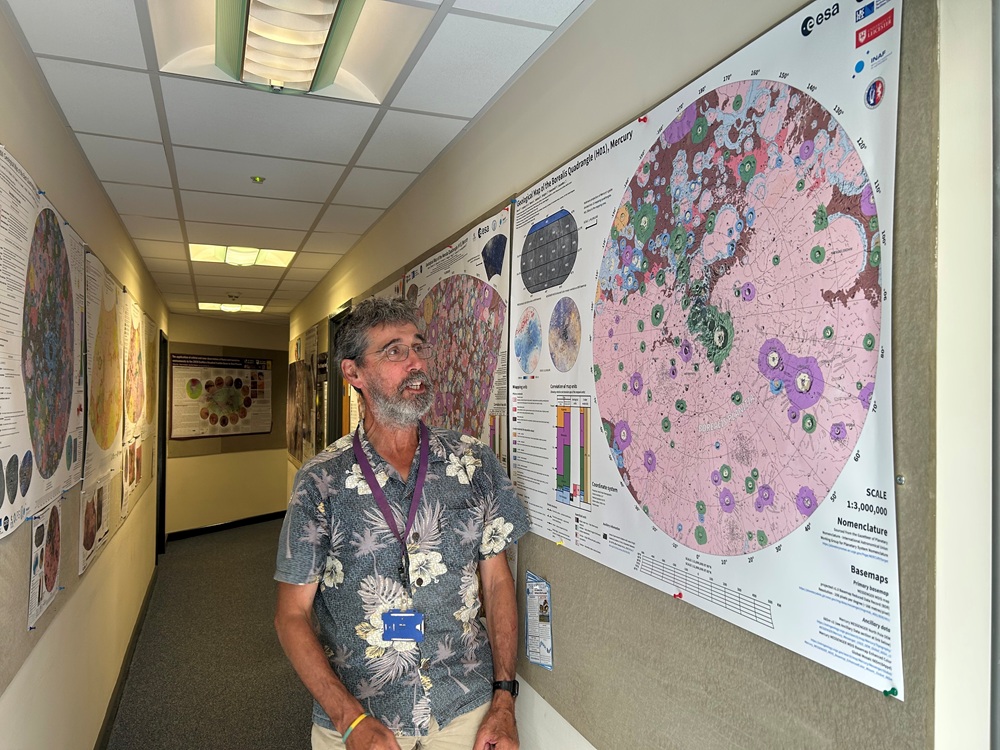
Experts from The Open University (OU) have led geological mapping pole to pole across Mercury, culminating in the publication of the north pole ‘quadrangle’ map.
A total of 15 mapping quadrangles have been defined covering the whole of Mercury, several of which were produced by current and former OU PhD students. OU maps include both poles and a continuous strip of other quadrangles connecting the two.
The map of Mercury’s north polar region, the final contribution from the OU, was published earlier this month in the Journal of Maps.
The north polar map project led by Dr. Benjamin Man, a former OU PhD student and now a Visiting Fellow at the university while employed by the European Space Agency in Madrid.
On the research, Benjamin said:
“I have been very fortunate to have mapped not one but two of Mercury’s quadrangles, one in the southern hemisphere (H13) during my PhD and now the north pole as a fellow.
“Mercury is such a diverse planet and our contributions help complete the global picture of Mercury’s surface geological units, providing key scientific context and targets for the BepiColombo mission.”
Professor David Rothery, who oversaw the OU map projects, said:
“It’s great to have mapped Mercury pole to pole. Contributing to this project was fertile ground for PhD students, and we’ve turned up so much science about past volcanic activity and recent fault movements on Mercury along the way.”
Other collaborators of the project span Europe, notably at the Istituto Nazionale di Astrofisica (INAF) in Italy, and the global geological mapping project is to be presented in its entirety 1–4 September at the Mercury 2026 Conference in Leuven, Belgium, which both Benjamin and David will be attending.
The project is particularly timely because the BepiColombo mission is currently coasting into orbit about Mercury and these maps will provide geological context for the new images and other data expected from next spring.
The OU plays a key role in the joint ESA/JAXA BepiColombo mission to Mercury, with academics, including Prof Rothery, having been part of the mission’s monitoring camera (MCAM) team during cruise, and Co-Investigators on the main science payload that will come into operation when BepiColombo is in its final orbit. Dave is leading the OU part of a STFC-funded “Large Award” to study Mercury from orbit using BepiColombo’s Mercury Imaging X-ray Spectrometer, which will map the composition of the planet’s surface.
Read the paper in full online.
Header image: Prof David Rothery in front of map created by Benjamin Man, credit the OU


Explore

Undergraduate
Postgraduate
Policy
-
Follow us on Social media
-