OU News
News from The Open University
- Home
- JANUS: the camera on the JUICE mission to Jupiter that just keeps coming back for more
JANUS: the camera on the JUICE mission to Jupiter that just keeps coming back for more
Posted on • Science, maths, computing and technology
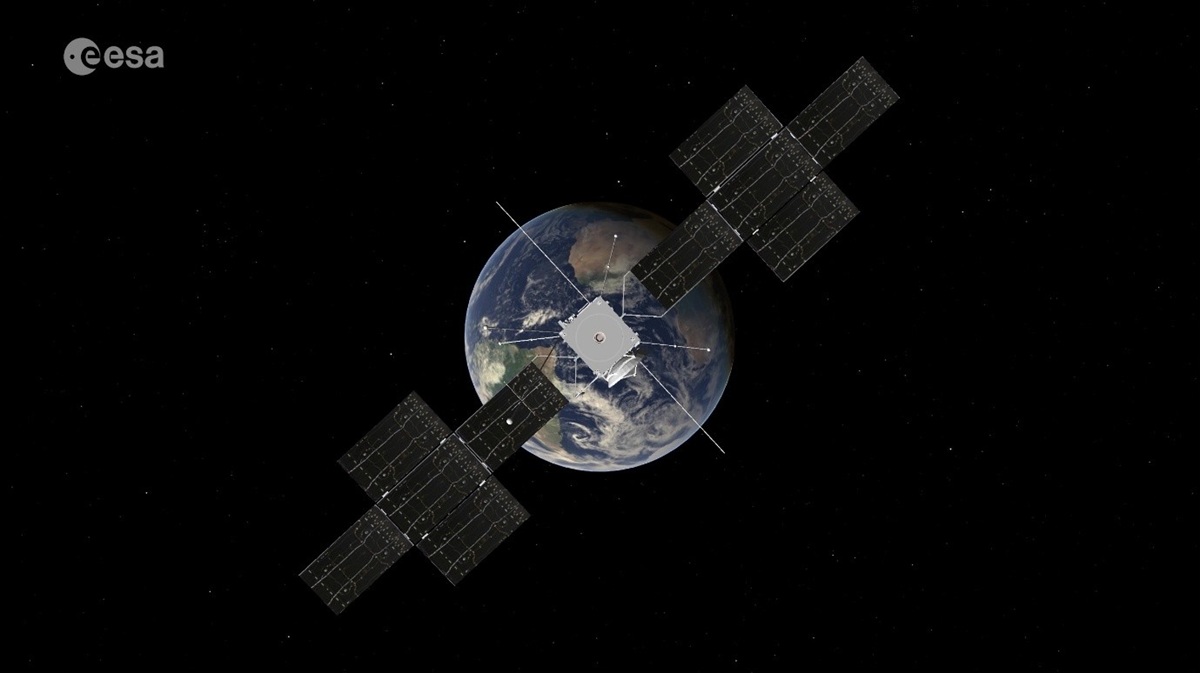
Space researchers from the Open University Atmospheric Research and Space Exploration group, led by Prof. Manish Patel, and the Centre for Electronic Imaging, have once again helped take images of the Earth and Moon from space as the JUICE spacecraft makes it epic voyage to Jupiter.
The European Space Agency JUICE mission to Jupiter carries the JANUS camera, led by Prof. Pasquale Palumbo in Italy, which uses UK-built Teledyne e2v detectors provided by The Open University. The instrument consists of an international consortium including Germany, Spain and the UK. JANUS is a high-resolution camera, designed to operate and survive in the intensely harsh radiation environment of Jupiter, and will study the atmosphere of Jupiter and the surfaces of its icy moons when it arrives at Jupiter in 2031.
Throw the boomerang and it keeps coming back
As part of its epic voyage to Jupiter, the JUICE spacecraft must loop its way around the inner planets and the Sun like a boomerang to gain enough speed to perform a ‘slingshot’ manoeuvre to fling it out towards the distant orbit of Jupiter. This means performing flybys of the Earth a few times, to build up the speed slowly, for free, using the force of gravity. The JUICE spacecraft is on its second flyby of the Earth since launching in 2023, and each flyby of the Earth and Moon gives JUICE the opportunity to flex its scientific muscles ahead of its main mission at Jupiter.
Each time JUICE passes the Earth and the Moon, its science payload (including the JANUS camera) is activated to take measurements. JANUS happily took images of the Earth and Moon, during the flyby. These observations help the science team understand how the instrument works in space, and provide essential in-flight data needed to tweak the camera to ensure that we get the best possible images when it arrives at Jupiter in 2031.
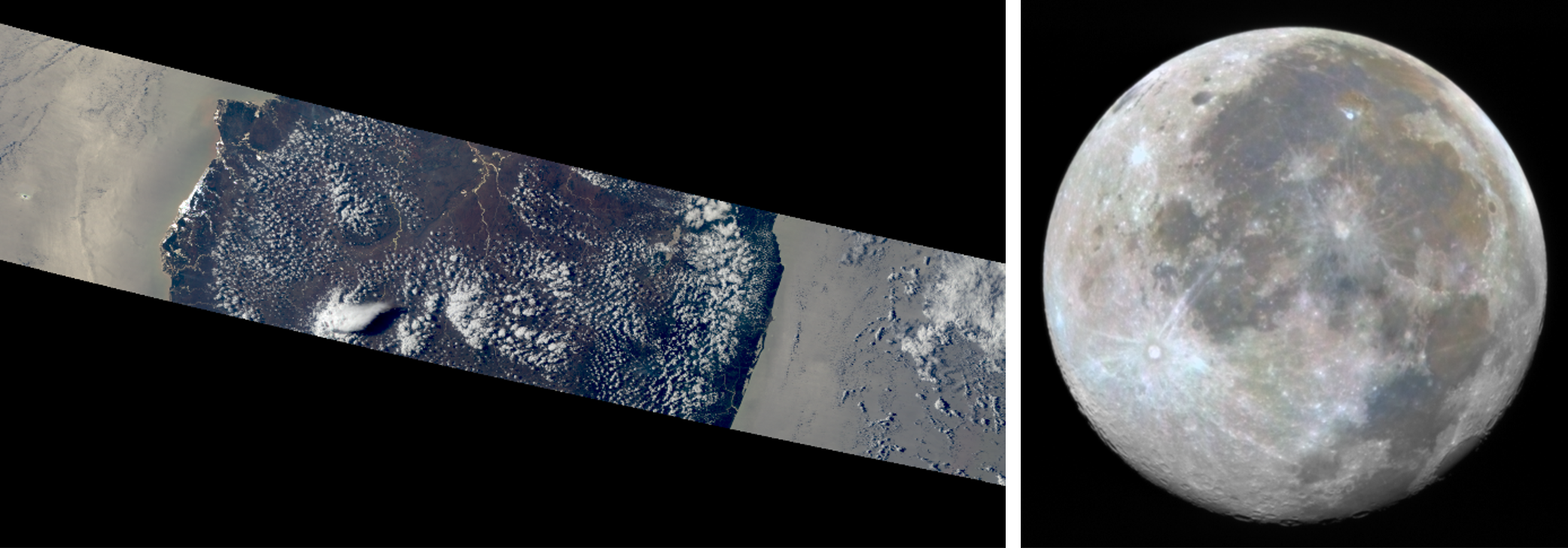
JANUS images taken during the Earth flyby, showing (left) the island of Madagascar, and (right) the Moon in a colour-composite image. Credit: ESA
Prof. Patel, who is the UK-lead for the JANUS instrument, said:
’JANUS and the JUICE spacecraft keep swinging by, hurling round the inner Solar System like a scientific boomerang of excellence. The images we got of Earth and the Moon are glorious – it is a testament to the technical team, the beauty of the images we now see.’
He added:
‘JANUS is heading off back into the depths of space. In a year or so, JANUS will swing by the Earth again, for the last time, before leaving home and cutting its own path into the Solar System. So it is au revoir for now, rather than goodbye.’
Seeing our world from so far away…
Now, JUICE is heading into deep space, to continue its long march towards Jupiter. JUICE will continue looping around the inner planets – it will next encounter Venus, which will fling it back out towards Earth for another flyby later this year, providing the speed necessary to get all the way out to Jupiter by 2031.
Ryan Goldhawk, from Prof. Patel’s research group, is currently working on coordinating spaceflight activities across JANUS and several other spaceflight projects, said:
‘It is really exciting to be involved in this kind of mission. I am relatively new to Manish’s group, but being involved in something like this is so much fun, and I am in awe of the images we are getting from the JANUS camera.
My role in the team is to make sure everything works, and to solve the day-to-day challenges that get in the way of the whole team getting on with their work. At times like this, I can see the impact of our collective efforts as a team – seeing those images of our own world from so far away, and the Moon up close, is a reminder of how special this world is.‘
Further information regarding the JANUS observations during the Earth flyby from the European Space Agency can be found here, as well as from the JANUS lead institute in Italy.
The OU team working on this project includes Prof. Manish Patel, Dr. Konstantin Stefanov, Dr. Matthew Read, Dr. Amit Kumar, Prof. Matt Balme, Martyna Hodges, Dr. Jon Mason, Ryan Goldhawk and Dr. Mark Leese.
Header image credit: ESA


Explore

Undergraduate
Postgraduate
Policy
-
Follow us on Social media
-