OU News
News from The Open University
- Home
- Open University scientist selected for leading role in Mars exploration
Open University scientist selected for leading role in Mars exploration
Posted on • Science, maths, computing and technology
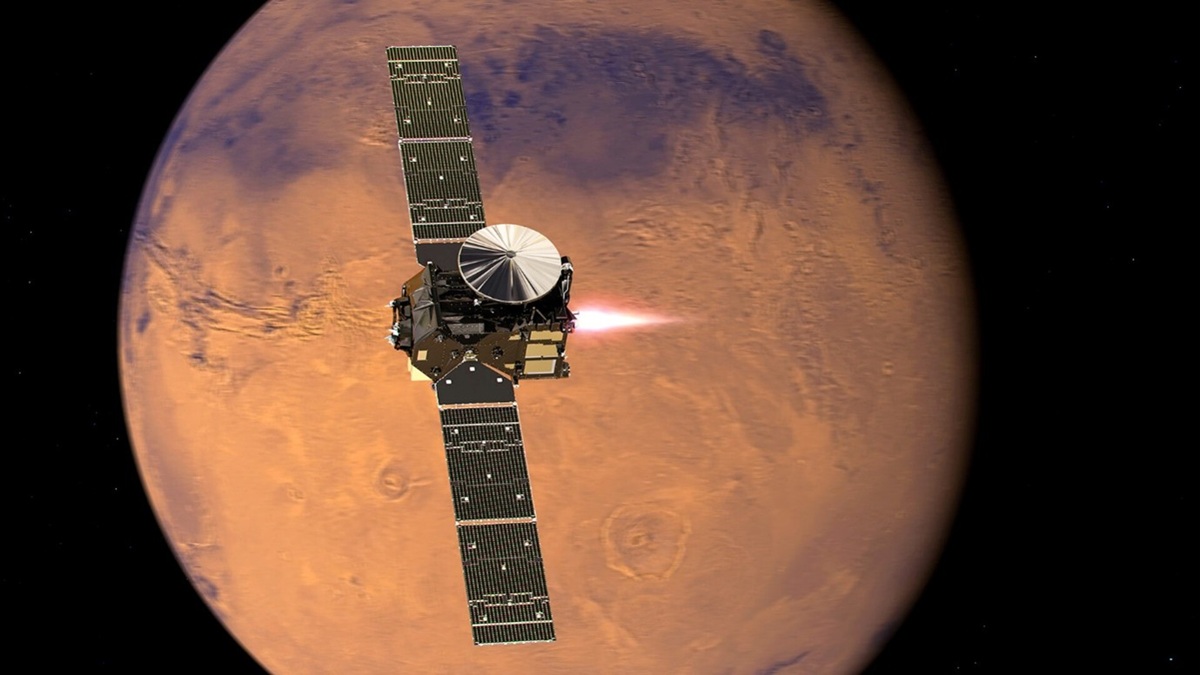
James Holmes, an atmospheric scientist at The Open University (OU), has been selected as an Interdisciplinary scientist (IDS) for the ExoMars Trace Gas Orbiter (TGO) team. An IDS holds equivalent status to an instrument lead except working across all instruments on the spacecraft.
James’s appointment to this role was announced as TGO celebrated 10 years in orbit around Mars since arriving in 2016 and has been investigating the planet’s atmosphere, climate and surface environment. In this new role, James will develop new approaches to combine observations from across the spacecraft’s instruments, bringing together different perspectives on Mars to address fundamental questions about its atmosphere, surface and water cycle.
James, who undertakes his research as part of the OU’s Atmospheric Research and Space Exploration group said:
“Mars is a complex and constantly evolving world, where the atmosphere, surface and subsurface are all connected. Instruments on the ExoMars Trace Gas Orbiter provide complementary observations and my IDS project aims to bring these different observations together to build a complete picture of how Mars works as a system.”
“It is a real honour to have been selected as an Interdisciplinary Scientist for the ExoMars Trace Gas Orbiter mission. TGO has an outstanding suite of instruments, and I am excited to work with the international science teams to explore what new things we can learn by combining their observations in new ways. I hope this will not only lead to new scientific discoveries, but also help guide future observations and collaborations across the mission.”
James’s research will build on his world-leading expertise in data assimilation, a technique that combines spacecraft observations with computer models to reconstruct how a planet’s atmosphere evolves in space and time. Similar approaches are used for weather forecasting where you live, to produce a coherent picture of atmospheric conditions from observations that are incomplete in space and time.
His project will bring together observations from the suite of instruments on ExoMars TGO. By combining measurements of atmospheric temperature, gases and aerosols with images of clouds, dust and surface ice, and measurements of near-surface hydrogen, the research will investigate how processes in the atmosphere and at the surface interact.
Manish Patel, who leads the OU Atmospheric Research and Space Exploration group, said:
“James is a perfect example of how excellence brings success – he has led the field of atmospheric data assimilation on Mars for several years now, and his excellence is now being recognised by appointments like these. The UK Space Agency has helped him develop as a scientist and the Open University has shown unwavering support in James’s ability and potential. It is fantastic to see this now being recognised on the international stage by the European Space Agency. James has a bright future ahead of him. ”
Matthew Cook, Head of Space Exploration at the UK Space Agency, said:
“Congratulations to James on this fantastic appointment as an Interdisciplinary Scientist for the ExoMars Trace Gas Orbiter mission, searching for the chemical signs of life in the atmosphere of the Red Planet.”
Matthew added:
“Having previously benefitted from a UK Space Agency Exploration Science Fellowship, James’ appointment is a great example of how we are supporting our talented researchers to earn leadership roles on world-class ESA missions.”
Header image credit: ESA/ATG medialab


Explore

Undergraduate
Postgraduate
Policy
-
Follow us on Social media
-