OU News
News from The Open University
- Home
- Open University experts at heart of landmark SMILE mission launch
Open University experts at heart of landmark SMILE mission launch
Posted on • Science, maths, computing and technology
UK scientists, including those from The Open University (OU), are at the heart of SMILE, a pioneering mission that launched today and will transform our understanding of how Earth is protected from the Sun.
The Solar Wind Magnetosphere Ionosphere Link Explorer (SMILE) — a joint mission between the European Space Agency (ESA) and the Chinese Academy of Sciences (CAS) — lifted off on 19 May aboard a Vega-C rocket from Europe’s Spaceport in French Guiana.
Now in orbit, SMILE will provide scientists with the first complete picture of how Earth’s magnetic field responds to the solar wind — the constant stream of charged particles emitted by the Sun.
When the solar wind intensifies into solar storms, the effects are felt here on Earth. GPS systems can fail, shortwave radio communications can be knocked out, and, in the most extreme cases, power grids can be overwhelmed.
The more we understand about how and why these storms occur, the better placed we are to protect the infrastructure that modern life depends on — from the satellites guiding aircraft and emergency services to the energy networks keeping homes warm.
SMILE will give scientists the tools to build more accurate space weather forecasts, helping to reduce the worst effects of solar storms before they strike.
The UK at the heart of the mission
The UK Space Agency has committed around £15 million in funding to support UK involvement in the ESA-CAS SMILE space mission, supporting a significant British contribution to the mission’s science and technology.
British researchers are leading the mission’s science at the highest level. The OU’s Centre for Electronic Imaging (CEI) has been developing and testing cutting-edge detectors (charge-coupled devices, or ‘CCDs’) for over 10 years. These detectors form the heart of the soft X-ray imager (SXI) instrument, which captures images of the Earth’s magnetosphere.
The radiation environment in space will result in long-term damage to the CCDs over the course of the mission, as well as contributing additional and unavoidable signal within the CCD images. Researchers at the OU will be concentrating on optimising CCD performance to maximise the science return of the mission through modelling and experimental campaigns.
Dr Thomas Buggey, Calibration Scientist at the Open University, said:
“SMILE is the first space telescope to look at Earth’s magnetic field using X-rays, allowing scientists to uncover, for the first time, exactly where and how the solar wind interacts with our planet’s magnetic shield.
Teledyne e2v, based in Chelmsford, has worked closely with the OU to supply the CCD detectors — the largest ever flown for X-ray detection.”
Caroline Harper, Head of Space Science at the UK Space Agency, said:
“SMILE represents exactly the kind of ambitious, collaborative space science that the UK excels at. Our researchers and companies haven’t just contributed to this mission — they are leading it in key areas, shaping the science and building the technology that will give humanity its clearest view yet of how Earth responds to the Sun. The data SMILE returns will benefit not just scientists, but forecasters and engineers working to protect the technology that keeps essential services running. This is UK space at its best.”
Protecting life on Earth from solar storms
Alongside its scientific discoveries, SMILE will deliver real-world benefits by helping to improve space weather forecasting. Severe space weather events — where solar storms disturb Earth’s magnetic environment — can disrupt satellites, knock out communications systems, and damage power infrastructure.
The UK SMILE team has already begun working with the Met Office Space Weather Operations Centre to explore how SMILE data could strengthen forecasting capabilities, helping to reduce the worst effects of solar storms on the ground and in orbit.
A landmark international collaboration takes flight
The launch marks the culmination of a historic partnership — the first time ESA and China have jointly selected, designed, built, launched, and will operate a space science mission together. More than 250 European and Chinese scientists will carry out research using the data SMILE collects for years to come.
SMILE will address three of the most pressing open questions in space science: what happens where the solar wind meets Earth’s magnetic shield; what causes magnetic disturbances on the night side of Earth; and how we can better predict the most dangerous solar storms.
Dr David Hall, CEI Director at the Open University, said:
“We have been working on the SMILE mission in the Centre for Electronic Imaging at the Open University for over a decade. I can remember the first meetings with Teledyne e2v and our collaborators, discussing the best detector architecture for the Soft X-ray Imager, and now those detectors are in orbit. It’s a great feeling to see so many years of work finally come to fruition, but now the real work begins to make sure the instrument performs at its best and delivers the exciting science we’ve all worked so hard towards.”
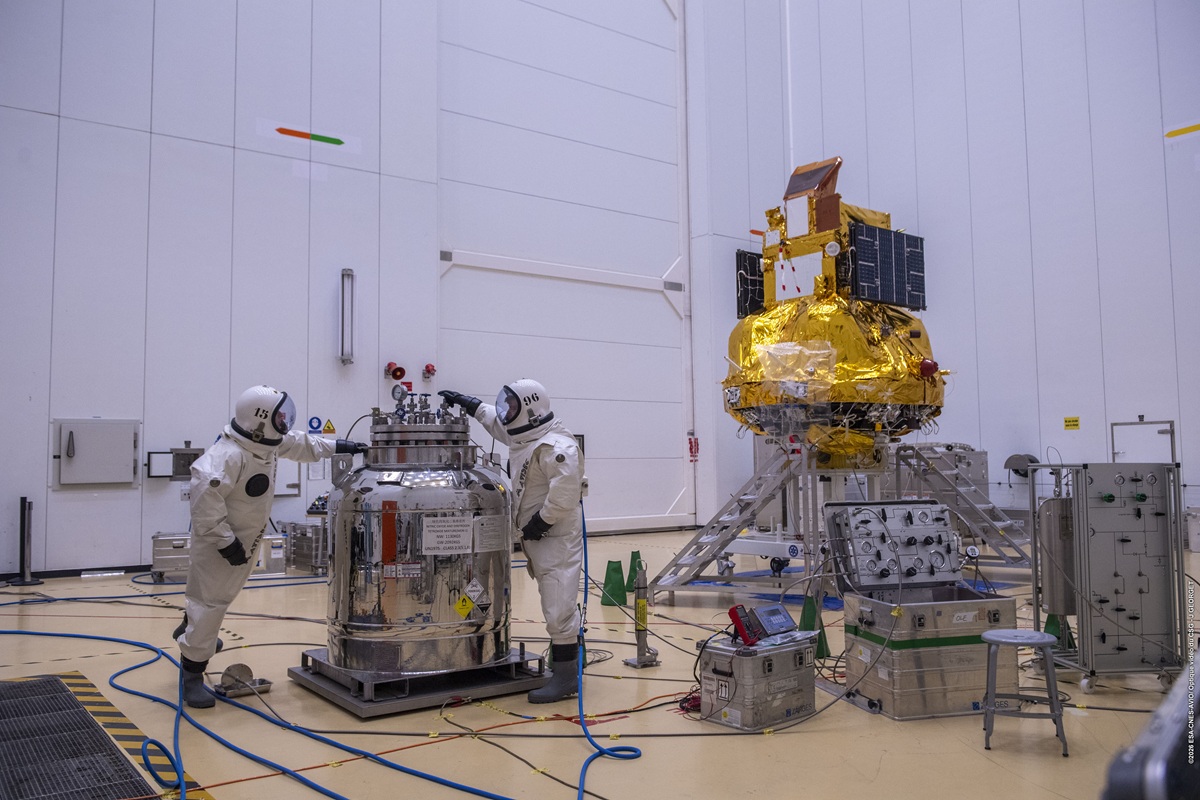
Header image: SMILE being fuelled for launch.
Credit: ESA/CNES/Avio/Optique vidéo du CSG–J. Georget


Explore

Undergraduate
Postgraduate
Policy
-
Follow us on Social media
-