

By Alexandra Okada
Knowledge is moving faster than ever. Ideas travel quickly, collaborations span continents, and research outputs increasingly evolve across multiple formats, platforms, and timelines. In this context, making intellectual production visible is no longer optional — it is an important scholarly, ethical, and professional practice.
For the eco-outwards researcher, visibility is not about self-promotion. It is about CARE-KNOW-DO: care for ideas and (co)authorship; knowledge through recognition and transparency; and doing through interaction that advances institutions and the wider field.
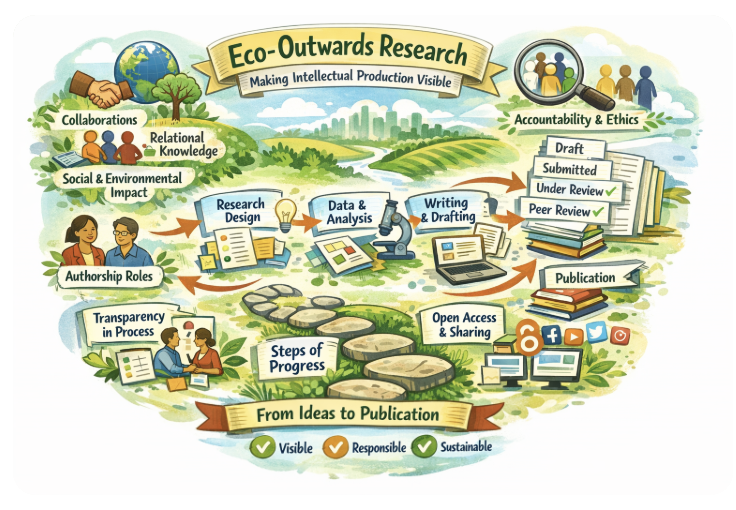
Why visibility matters in eco-outwards research
Eco-outwards research values:
- relational knowledge
- collaborative authorship
- long-term social and environmental impact
- transparency in process, not only outcomes
Yet traditional academic cultures still privilege the final publication over the thinking, designing, and planning that make research possible. When early intellectual work is invisible, so are:
- intellectual production,
- authorship trajectories,
- collaborative contributions,
- and the ethical foundations of research.
Registering intellectual production from design to planning is a precious action.
It makes stone steps visible — the steps that allow knowledge to advance responsibly and sustainably.
From private drafts to shared accountability
Whether working collaboratively or individually, accountability is key in eco-research and in any field. Making your authoring process explicit allows:
- peers to understand your contribution,
- organisations to recognise workload and leadership,
- the field to trace how knowledge evolves.
This is especially important in interdisciplinary, participatory, and sustainability-focused research, where contributions are often distributed and non-linear.
A clear language for research production stages
Using shared, transparent labels helps normalise early-stage scholarship while maintaining academic rigour. The following categories can be used consistently across research plans (RSDP), professional development records (CDSA), CVs, and dissemination spaces:
- Under development – manuscript in preparation
- Submitted to a journal – submission completed, awaiting editorial decision
- Under review – accepted by the editor and currently in peer review
- Accepted with revisions – revisions requested and in progress
- Accepted (in production) – accepted, in typesetting, ready to be published
Where each stage belongs
To maintain clarity and integrity:
Items 1–3
(Under development, Submitted, Under review)
→ should be listed in personal plans, such as:
- Research & Scholarship Development Plan (RSDP)
- Professional Development or CDSA records
Items 4–5
(Accepted with revisions, Accepted in production)
→ can be included in your CV
Item 5
(Accepted – in production)
→ is appropriate for Organisational Online Repositories (ORO), social media, and public dissemination
This approach protects academic credibility while ensuring that intellectual work is not erased simply because it is unfinished.
Making your contribution visible: practical recommendations
Eco-outwards researchers can strengthen visibility and accountability by:
-
Documenting research design early
Record conceptual frameworks, methodological choices, and ethical positioning as scholarly work. -
Using consistent status labels
Apply the same publication-stage language across plans, CVs, and reports. -
Clarifying authorship roles
Make explicit who led design, analysis, writing, coordination, or community engagement. -
Valuing process as scholarship
Treat planning, piloting, and iterative design as legitimate intellectual contributions. -
Aligning visibility with audience
Adjust where and how you share work depending on whether the audience is institutional, academic, or public. -
Embedding accountability in collaboration
Transparent authorship protects relationships and supports ethical co-production.
PhD students and Early Career Researchers
For PhD students and Early Career Researchers, visibility of intellectual production is a form of academic care and protection. Much of their scholarly labour takes place in early, exploratory, and collaborative stages — designing frameworks, piloting methods, coordinating partnerships, and contributing to collective writing — yet this work is often invisible in traditional publication-focused cultures.
Making research processes visible allows emerging researchers to evidence intellectual leadership, clarify authorship trajectories, and receive recognition for contributions that shape projects long before formal outputs appear.
In eco-outwards research, where knowledge is co-produced and responsibilities are distributed, transparency helps safeguard ethical collaboration, supports fair attribution, and enables PhD researchers and ECRs to build credible scholarly identities grounded in process, not just outcomes.
Multilateral organisations and international funders
For multilateral organisations and international funders — such as UNESCO, the European Commission, UN agencies, development banks, and global foundations — visibility of intellectual production is essential to ensure accountability, trust, and long-term impact.
Eco-outwards research often unfolds across institutions, countries, and communities, with knowledge emerging iteratively through design, piloting, and collaboration rather than only at the point of publication. When early intellectual work is made visible, funders can better understand how evidence is generated, how partnerships function, and how ethical, epistemic, and social responsibilities are embedded throughout the research lifecycle.
This transparency supports fair recognition of contributions, strengthens monitoring and learning processes, and enables organisations to assess not only what outcomes are produced, but how knowledge advances policy, practice, and capacity-building in sustainable and equitable ways.
A final reflection
Eco-outwards research is about responsible futures. That responsibility begins long before publication. By making intellectual production visible — from first design ideas to final typesetting — researchers honour not only outcomes, but the processes, people, and values that shape them.
Visibility is not about speed.
It is about care, clarity, and collective trust.
"Document, share, and reflect on each stage of your research —
visibility is a key form of mentorship, accountability,
and scholarly growth."
Glossary
RSDP – Research & Scholarship Development Plan:
- A forward-looking planning document
- Used to set out research goals, outputs, leadership, and timelines
- Common in UK universities (including OU), sometimes under slightly different names
- Typically internal, developmental, and reviewed annually or bi-annually
CDSA – Career Development & Staff Appraisal (sometimes Contribution & Development Staff Appraisal):
- A reflective and evaluative process
- Used to review workload, achievements, leadership, and professional growth
- Also largely UK-specific, tied to HR and promotion frameworks
- So in short:
RSDP = planning future research
CDSA = reviewing and evidencing contribution