Rethinking Researcher Development with upSkill.Map
Alexandra Okada
What happens when global challenges, digital learning, and leading researchers converge in Paris? At UNESCO’s event on AI and the Future of Education, the answer became clear: a vibrant exchange of ideas on how education and research must evolve for a rapidly changing world.
This year, I had the opportunity to present our work on Global Education and Digital Transformation at The Open University. It was both exhilarating and humbling to contribute OU perspectives to such a global conversation.
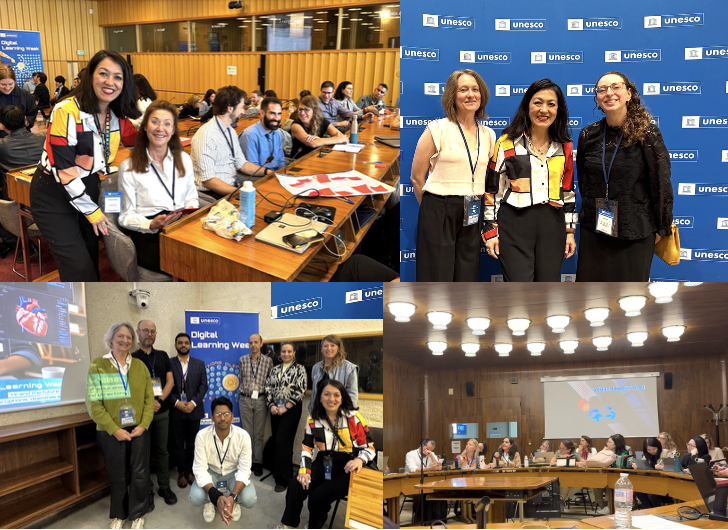 Image 1: UNESCO – Digital Learning Week: AI and the Future of Education
Introducing upSkill.Map
On stage, I shared two interconnected pieces of work: the European METEOR project, which supports researchers in developing transversal competences, and a new tool I’ve been developing—upSkill.Map.
Despite its name, upSkill.Map is not a treasure map with X marking the spot (though I rather like that metaphor!). Instead, it works more like a compass—helping researchers navigate today’s complex research environment by reflecting on three essential questions:
-
CARE: What values guide my work, and how do I act responsibly towards people and planet?
-
KNOW: What knowledge and technologies am I engaging with—and am I doing so critically?
-
DO: How does my research create meaningful impact in the world?
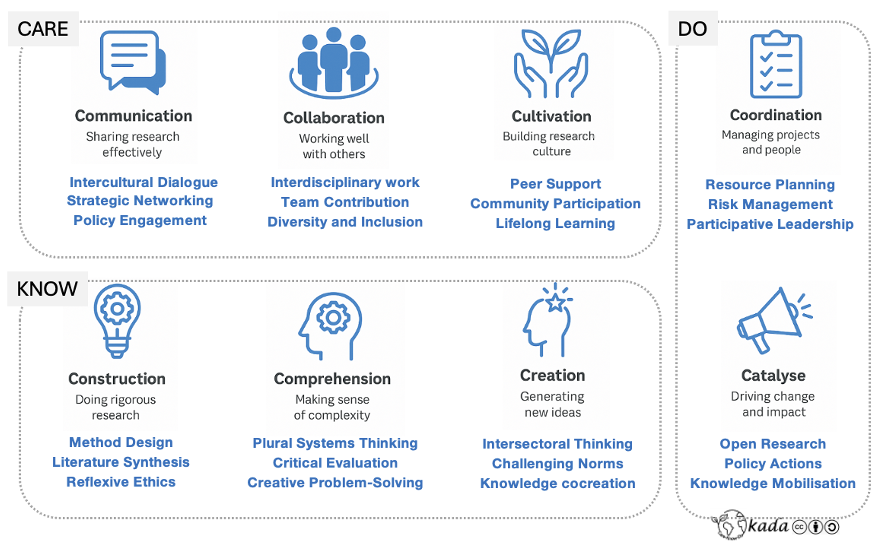
Image 2: Okada (2025) upSkill.Map
When we piloted upSkill.Map with doctoral researchers, I was struck by their strong commitment to collaboration, resilience, and responsibility. The process also revealed where institutions could do more—particularly in supporting interdisciplinary and impactful research, and in raising awareness to engage more participants interested in research for fair and sustainable futures.
Why this matters (and why it was fun)
For me, upSkill.Map is about sparking curiosity and enjoyment in the researcher’s journey. It offers a space to connect values, knowledge, and action in ways that feel more like an adventure map than a checklist. Sometimes the steps are neat, sometimes improvised—but always moving towards something meaningful.
The metaphor progression tells the story: not a treasure map (fixed endpoint) → compass (directional tool) → adventure map (exploratory framework)
For the OU, this work serves two important purposes: it enriches our doctoral education with fresh approaches to transversal skills, and through the METEOR project (Methodologies of Teamworking in Eco-outwards Research, funded by the European Commission), it connects us with international partners to co-create new models of researcher development for a just and sustainable future.
As I said in Paris:
“Research is not only about advancing knowledge—it’s about aligning innovation for a sustainable future. Tools like upSkill.Map can help us do both.”
Looking ahead
Being at UNESCO was also a reminder of the joy of research. It’s easy to focus only on the seriousness of global challenges—AI, climate change, social justice—but events like this highlight the creativity and playfulness that make research sustainable. Conversations over coffee, sketches on napkins, debates spilling out of lecture halls—all reflect the spirit that research can be both impactful and enjoyable.
That’s the balance I hope upSkill.Map can bring: helping researchers grow not just as specialists, but as curious, adaptable global citizens—ready to collaborate, improvise, and lead with purpose in an interconnected world.
An invitation to Rumpus
I’d love to hear from fellow OU researchers: What skills do you think tomorrow’s researchers will need most—and how do you bring fun and curiosity into your own research practice?
Links I shared at UNESCO Digital Learning Week:
AI and the Future of Education
-
Okada, A. & Vaz, G. (2025). Rethinking AI in Research with Ancestral Wisdom for Future Generations. UNESCO – Futures of Education. [LINK]
-
Okada, A; Sherborne, T; Panselinas, G; Kolionis, G. (2025). Fostering Transversal Skills through Open Schooling supported by the CARE–KNOW–DO Pedagogical Model and the UNESCO AI Competencies Framework. International Journal of Artificial Intelligence in Education. Springer. [LINK]
-
Okada, A. (2025). Knowledge Cartography for Young Thinkers: Sustainability Issues, Mapping Techniques and AI Tools. Advanced Information and Knowledge Processing. Springer. [LINK]