Archive for the ‘History of the OU’ Category

50 objects for 50 years. No 10. OU Collected texts

Monday, June 25th, 2018


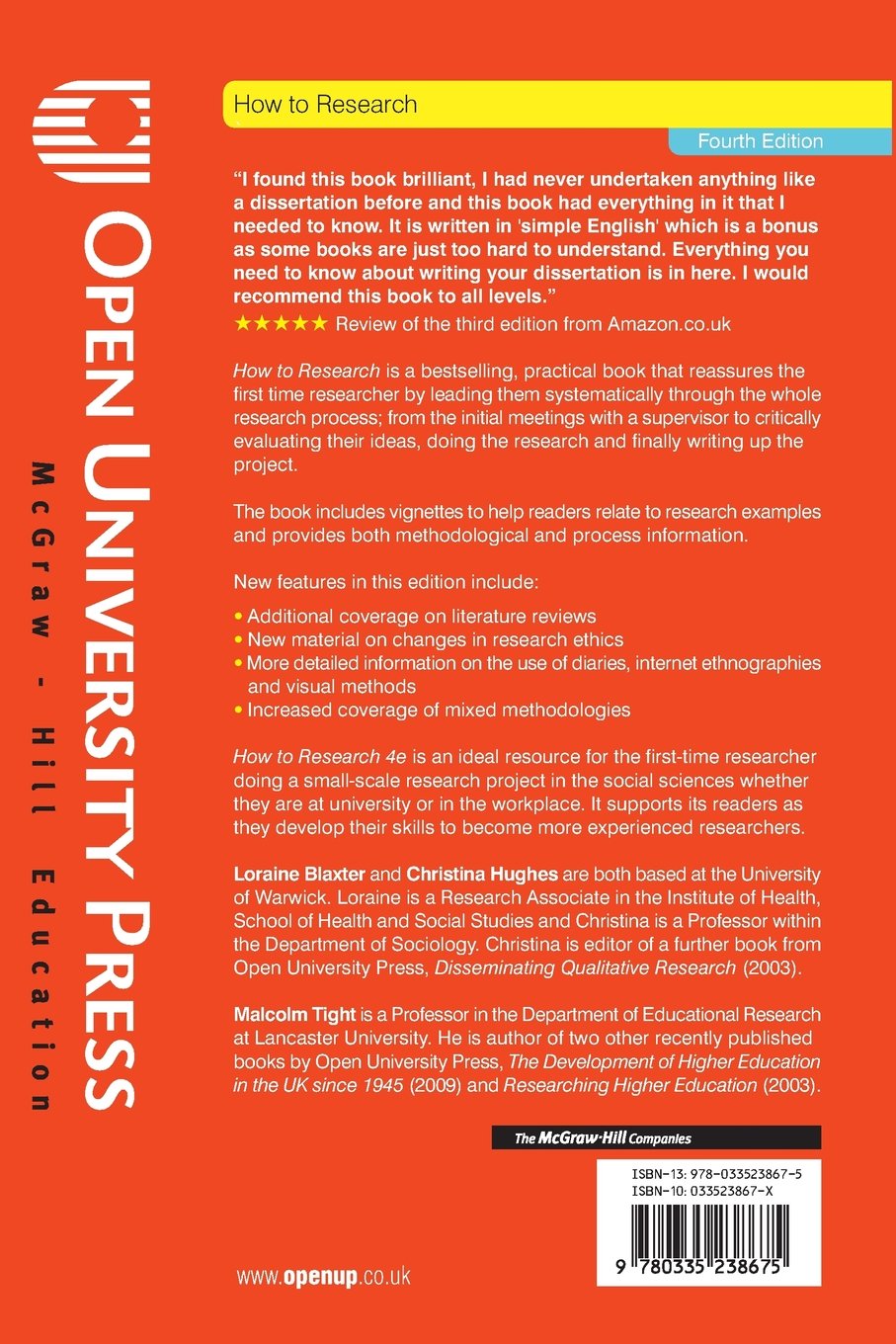
From the start many OU students found access to an academic library difficult. In recognition of this collections of important articles and chapters were collated, bound and posted out to students. Some were co-published, with the OU logo on the cover.
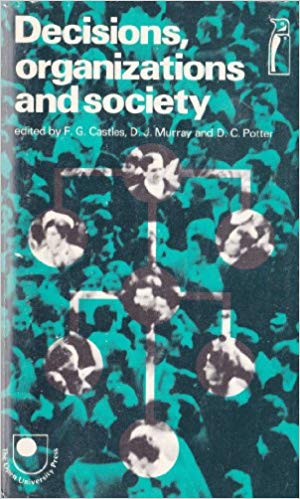
This week’s object has been proposed by Alan Shipman. A former business journalist now teaching and researching at the OU Alan has taught (among other topics) personal finance and his research interests include Chinese multinational business and the foundations of the market economy.

In the below five bullet points Alan Shipman reflects on why Decisions, Organizations and Society: Selected Readings, edited by FG Castles, DJ Murray and DC Potter; Penguin Books in association with the Open University Press, deserves to be an OU symbol 50 years on:

  • It’s one of the ‘selected readings’ collections that gave students a whirlwind tour through the classic ideas and authors in a subject area, explained and contextualised by short introductory notes by the editors. These were widely used by other universities, and had a general nonstudent readership, thanks to co-publishing and the availability of cheap paperback editions. Authors featured in the readings include some who were rising to prominence then, and are still influential 50 years on: eg Herbert Simon (management sciences, organisational psychology, economics); Mancur Olson, Robert Dahl, Ralph Miliband (political science), Tom Bottomore (sociology).
  • It’s one of the earliest, published in 1971, and is edited by 3 prominent academics who’d already joined the OU (David Murray was Professor of Government, David Potter a Senior Lecturer and Francis Castles a Lecturer in the Faculty of Social Sciences).
  • It shows how the OU was, from the start, instrumental in promoting social sciences and breaking through their disciplinary boundaries – the readings focus on topics that transcend these (power, decisionmaking, organisation, hierarchy) and so they mix politics, economics, sociology, cognitive psychology, social psychology and management studies).
  • It shows how the OU’s wide audience facilitated partnerships with leading mass-market publishers, including Penguin.
  • The editors’ writing style also contains some heroic early attempts to escape the institutionalised sexism of the times. From their introductory definitions: “Two ladies meet in a dark street, whereupon one lady deliberately stops, produces a pistol and demands money from the second lady. There is decision (the first lady could have chosen to walk on down the street), and there is power (the second lady’s behaviour is controlled as a result of her relation with the first lady)…

The three editors.

As well as contributing to Decisions, Organizations and Society: Selected Readings Frank Castles also offered a critique of the organization of the OU itself. Having taught face-to-face in universities in York and Australia he had, on arriving at the OU, to adapt to the system he termed ‘Divide and teach: the new division of labour’, in Jeremy Tunstall, The Open University Opens, 1974. Castles found that the OU’s division of labour, with central academics, local tutors, educational technologists, the BBC, a variety of outside expert advisors, counsellors and specialist summer school teaching staff, led to ‘tensions… suspicion and conflict … bitter disputes … enormously increased work-load’. However, he concluded that it was such role specialization which ‘makes the Open University possible at all’.

David Potter, a Berkeley graduate BA 1954, MA, 1959, gained a PhD from the LSE (1962). He worked at Oakland University in Michigan and published on British imperialism in Asia and post-independence consequences. His first book was Government in Rural India, 1964. He then went to Simon Fraser University, British Columbia, Canada where he earned tenure in 1969. Shortly afterwards, in the same year, 11 members of the 16-strong Political Science, Sociology and Anthropology Department were not granted tenure, which, in effect, meant that they were fired. Potter supported their protest strike and was himself fired. He came to the Open University. He was appointed as a Professor of Political Science in 1989 and had 15 of his books published by 2002, when he was designated a Honorary graduate of the university. On retirement he was made a professor emeritus.

David Murray joined the OU in September 1969 as Professor of Government. He chaired and was a member of several main OU committees before being seconded to the University of the South Pacific between 1975 and 1978. In 1980 he was made Chair of the Examinations and Assessment Committee. Between 1983 and 1988 he was a Pro-Vice-Chancellor. He then helped to set up The Open University of Hong Kong before becoming a Pro-Vice-Chancellor again in 1990–91. He subsequently worked with the Higher Education Quality Council (which became The Quality Assurance Agency for Higher Education) and retired in 1999.
50 objects for 50 years No 8. The Wilson Building

Monday, June 11th, 2018

As Mary Wilson died a few days ago on June 6 2018, this week’s object commemorates her family’s contribution to OU by considering the Wilson Building on the Walton Hall campus, seen on this video.

It is here that Harold’s role is outlined. He had a vision of a university of the air and, as Prime Minister, he had the clout, to ensure that his idea, voiced in 1963, was developed by Jennie Lee and others and implemented by 1969.

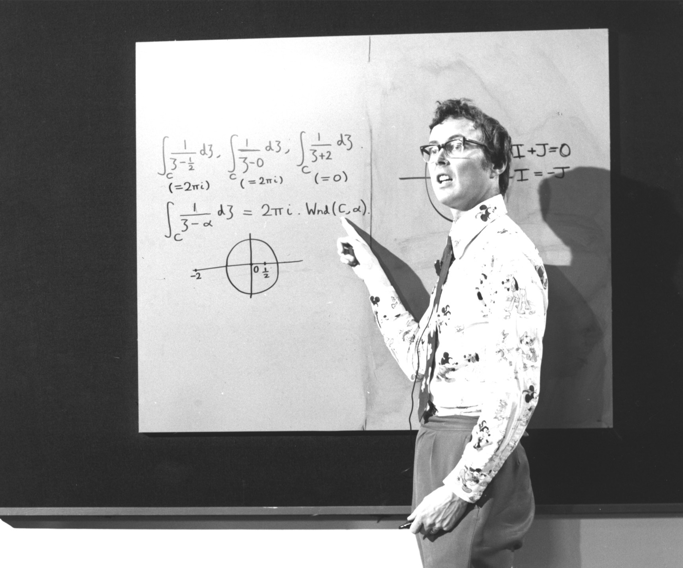
Mary and Harold married in 1940 and had two sons. One son, Giles, became a teacher and later a train driver. The other, Robin (born in 1943) taught at the OU. After a difficult start, as the interview panel was anxious not to be seen to favour the son of a Prime Minister, Robin was appointed. His significant academic qualifications and huge enthusiasm were soon demonstrated. He became a Professor, the Head of the Mathematics Department and a Dean of his Faculty. Despite the supercilious portrayal of an OU mathematics don called Robin by Cambridge graduate Hugh Laurie in A Bit of Fry and Laurie, Robin Wilson’s innovative and supportive teaching of mathematics (he is pictured above) has been fondly remembered by many students. Numerous OU learners have memories of the frightening and incomprehensible world of school maths dispelled by Robin’s engaging ability to teach.

The Wilsons were able to see beyond party politics. Robin graciously recognised the role of Margaret Thatcher in the development of the OU, calling her its ‘stepmother’. Her role at the OU has been assessed elsewhere.  Mary Wilson attended Thatcher’s funeral. She was also present at one of Harold’s last public engagement’s, the opening of the OU building named in his honour.

Wilson’s press secretary called the OU Wilson’s ‘monument’.  The description is an apt one if the reference is to the words written for Christopher Wren, lector si monumentum requiris circumspice (‘Reader, if you seek his monument – look around you’).

The story of the Wilsons is reminder that for many families once one person becomes involved with the OU other family members become entangled. Couples married after meeting at residential schools, there are many staff who have spouses, and offspring working for the OU and many students swear that it was the support of family members which got them through their degrees. If you visit the OU’s Milton Keynes campus, when you next pass the Wilson building, give it a second glance and maybe give a nod to Harold.

50 objects for 50 years No 7. Urgent Educational Materials

Monday, June 4th, 2018


It is June and, for many of those studying 60-point modules which started last October, that means final assessment-related gloom and stress. In my household the OU student, studying two modules at once, is currently looking a little hollow-eyed and desperate. I am reminded of the donkey unable to decide between the hay of EMA deadline (Aaargg! But is due Tuesday!) and the straw of revision (Yikes the exam is on Thursday!) I can see the temptation to be fair and avoid both in equal measure. Moving on from animal fables, I’m hoping for a safe passage between Scylla and Charybdis.

In these circumstances it is time to remind ourselves of the pleasures of study.

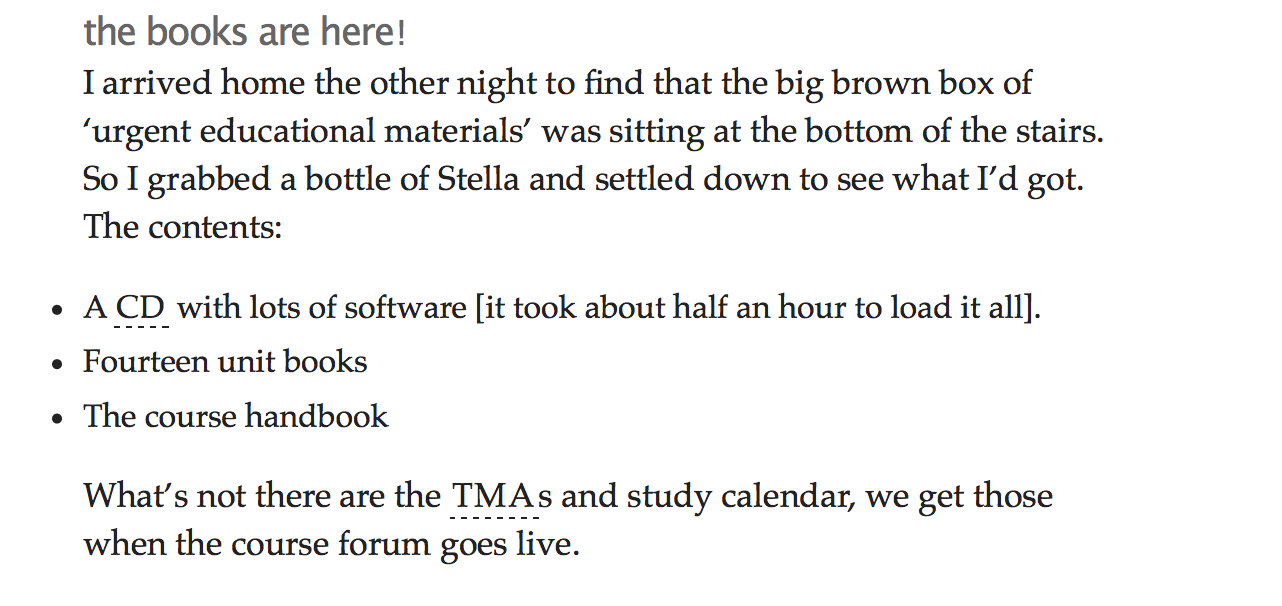
For many it starts with the delivery of that parcel marked ‘Urgent Educational Material’. It was suggested that one of our 50 objects be the packaging sent to OU students. It tells the recipient that learning is so vital that they have immediately to rip open the cardboard and start studying. As this blogger noted in 2007:

The contents are unknown and there is room for speculation. What is inside? There have been records, cassettes, video disks, computers, models of the human brain and of course study guides. These ones are for U216.
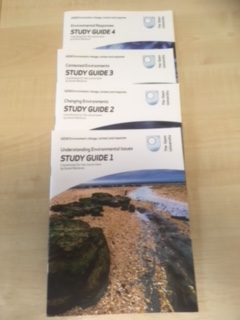
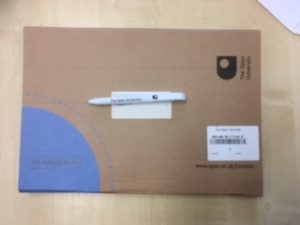
Professor Grainne Conole, formerly of the Open University recalled, ‘I did an OU Spanish course and you get this amazing box labelled “Urgent: Educational Materials”.

And here is OU student, Carolyn Jones,

Anyone else studying with the Open University?
If you are, you’ll know that their study packs of books and DVDs arrive in cardboard boxes prominently marked Urgent: Educational Materials I’m not making fun. I really do love the idea that education – of any kind, for anyone – is urgent, important, worth making way for.

Of course if you are still in your pyjamas when the postie dashes down the street to give you the parcel, the breathless deliverer might not be fooled by any pretence that you are going to immediately do an experiment, write an essay or complete an iCMA.

Neil Anderson’s reaction was to reach for the alcohol.

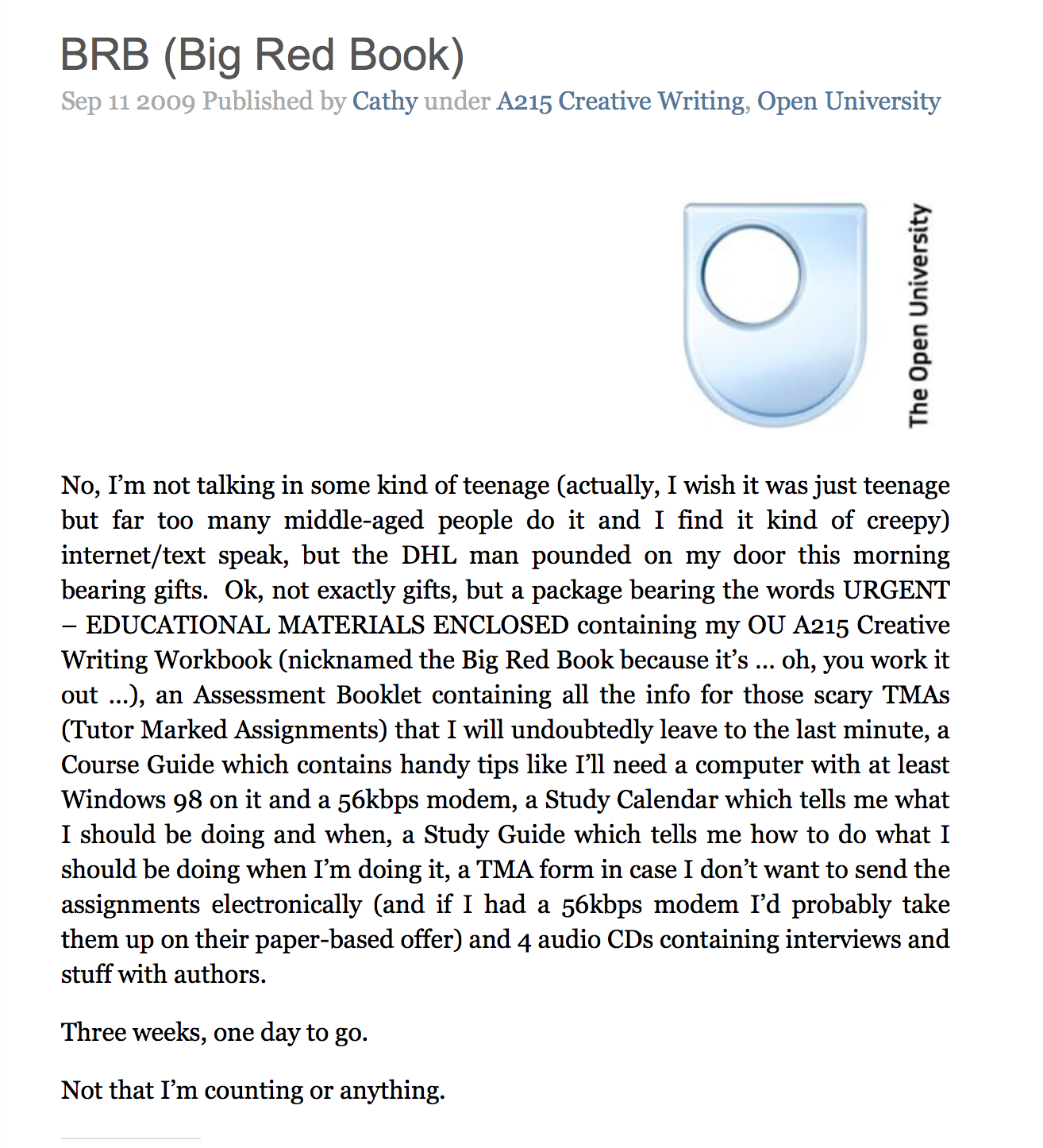
Other students have described the moment. Jackie Diffey felt that when mailings arrived it was ‘like getting a Christmas present’. Vida Jane Platt wrote, ‘Oh the bliss of waiting for the new year’s course material to drop through the letter box and the pleasure in doing those TMAs’. Elinor Ashby remembered how ‘I was often so excited by the arrival of my units that I would stand over the cooker stirring home-made soup whilst avidly reading’. Here is Cathy from 2009 recalling the DHL man pounding on the door ‘bearing gifts’.

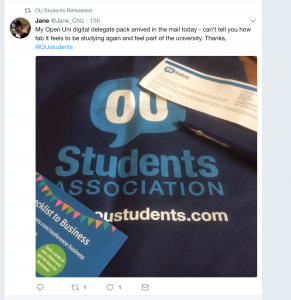
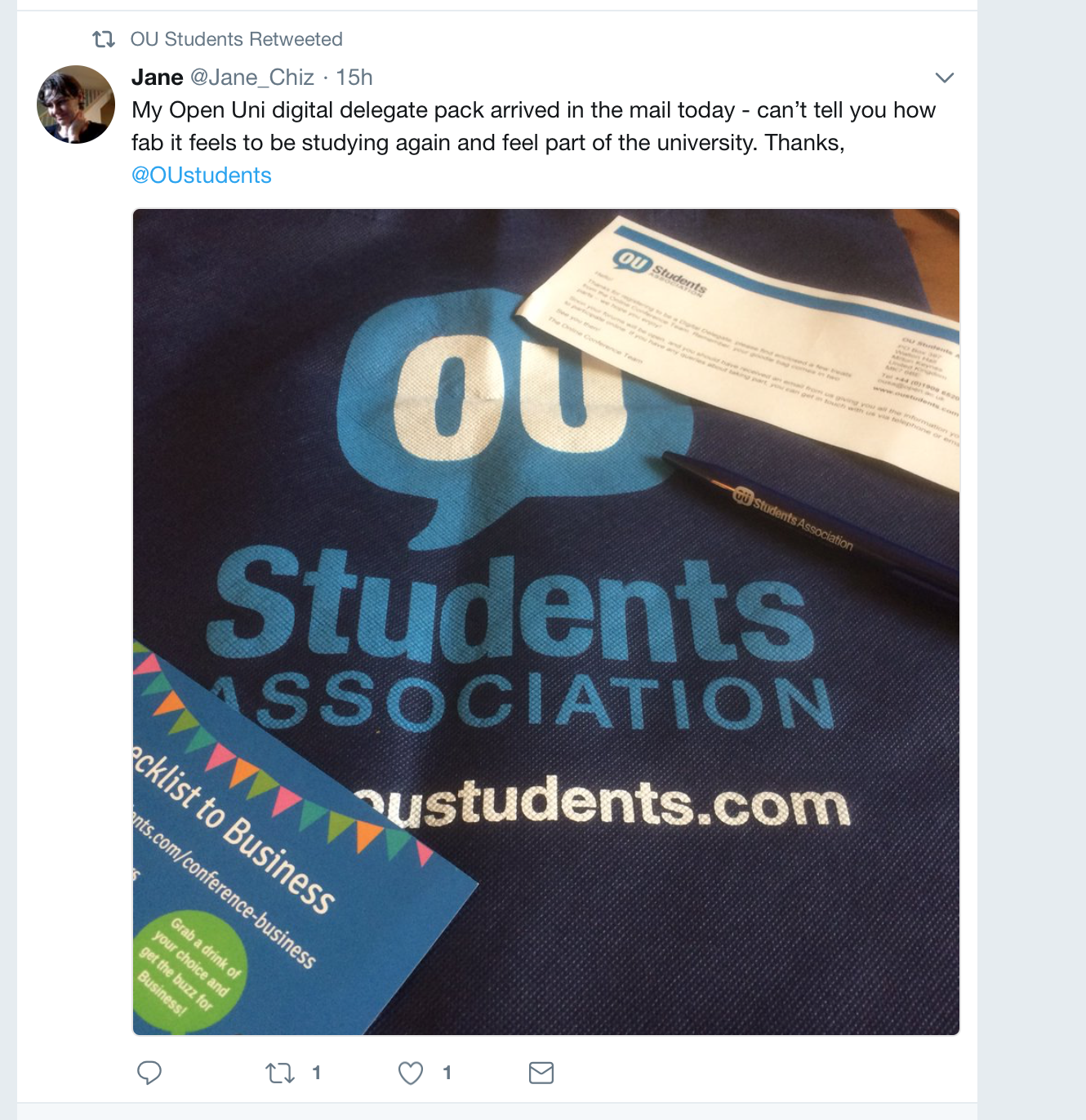
The object this week is the world of possibilities presented by the unopened package. It may even be a ‘digital’. As Jane noted on Twitter.

The act of opening the box will not release evils upon the world, in the manner of Pandora, but will enable me to acquire knowledge. Mysteriously understanding will waft out of the parcel and into my brain without any hard work from me. Having read a bit about how people learn, this might be a bit unrealistic. However, my  faith might be  useful model. As exams loom, perhaps what the OU-student-in-the-house needs is the confidence to believe that this time hope will triumph over expectations.

50 objects for 50 years. No 6

Monday, May 28th, 2018

‘I’m the self inflicted, mind detonator…I’m a Firestarter’

Each Monday I present a new object. In this weather those not frantically revising may well be enjoying barbeques. So I’ve selected an appropriate element as my object of the week. As a clue to what it is, I’ve turned to an OU module so fresh that it hasn’t even been presented. Environment and Society, DD213, is due for release in October 2018. Here is a sneak preview of the opening sentence:

Fire is both a naturally occurred chemical reaction on Earth and a tool adapted by humans. It can modify environments and serve to shape social interactions between individuals, groups of humans and the places in which they live.

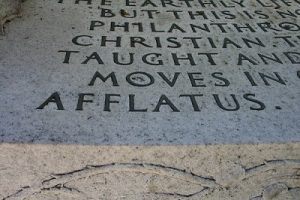
The idea of something which is essential, which can modify environments and shape social relations can be applied to education.When, at its opening on 24th April 1969, the OU’s first Chancellor Lord Crowther sought an image for the human mind he compared it ‘to a fire
which can be set alight and blown with the divine afflatus’.

Crowther contrasted this idea of an inspiration, which comes from the word inspire, meaning to breathe or blow onto, with the image of the mind as a vessel into which one could pour knowledge. The OU, by providing intellectual tinder and matches, could inspire learners to light the fire in their bellies, or minds. Moreover, they were encouraged to seek out tutors and fire questions at them. It also brings to mind the legend of the phoenix, a bird which regenerates through fire. The distinctive avian pops up in the series of stories about a character who appears to have limited opportunities until his life is transformed when he attends an educational establishment, Harry Potter.

At the time of the OU’s opening a popular educationalist was Paulo Freire. Freire argued that much of what was called education amounted to ‘educational banking’. Teachers filled the heads of learners with their narratives, even if these narratives were not relevant to the learners. Treating learners as ‘‘receiving objects’, reinforced existing social relations and impeded the development of a student’s critical consciousness. It required students to be passive and did not encourage dialogue. Transmission-focused teaching prevented students from renewing cultural knowledge through thoughtful conversations. However, Freire argued, this was not the only way to proceed. If learning involved the learners and encouraged activity and non-hierarchical, dialogue, then, through that learning, people could ‘make and remake themselves’. Learners, could make their own meanings with the new knowledge they constructed being based on what they already knew and what they were trying to achieve. This idea of learning, not as pouring cold water, but lighting fires, was perhaps in Crowther’s mind when he spoke back in 1969. At the OU’s first degree ceremony, in 1973, an honorary doctorate was presented Freire.

Crowther’s image might have reminded listeners of the importance of air for combustion, how the circulation of air can ensure that thinking is not congested, how the airwaves could be used to deliver the materials and support the interactions necessary for learning. Yet, while OU broadcasts travelled through the ether, the university did not emerge out of thin air, nor were its subsequent achievements confined to the realm of the abstract.

Crowther’s image of fire may also have built on associations of fire with truth, sometimes a rather painful disruptive truth. While fire serves many other functions in stories and songs there are plenty of literary reminders of this role. These include the Biblical account of Moses who rather unwillingly received Divine Instruction from a fire, a burning bush in a desert of ignorance. Luke cites Jesus as  holding the revolutionary and disruptive view that ‘I came to cast fire on the earth, and would that it were already kindled!’ When exiled Russian revolutionaries established, in 1900, what became the most successful underground Russian newspaper in 50 years, they called it Iskra (Spark). The name was later adopted by the OU branch of the University and College Union for its newsletter.

Fire’s association with truth was perhaps reinforced by the comic inversion of this in Hillaire Belloc’s 1907 poem Matilda Who told Lies, and was Burned to Death which [plot spoiler alert] concludes as below:

For every time she shouted ‘Fire!’
They only answered ‘Little Liar!’
And therefore when her Aunt returned,
Matilda, and the House, were Burned.

While for students, education can be the lighting of a fire which provides warmth, they are also entangled in their societies, communities, families. Others around them, witnesses to the changes, can feel burned. In a play, later film, about an OU student, Educating Rita, Rita’s husband resents the time she spends studying. A genuine student, interviewed in an early study of the OU, captured the sense of the challenges provided by learning through the OU when she summarised her experience thus: ‘It messes up your whole life, but it’s worth it.’

A century before the OU Louisa May Alcott wrote her novel Little Women. In this she sets out some of the emotions you might associate with writing a TMA which can involve both inspiration and perspiration:

She did not think herself a genius by any means; but when the writing fit came on, she gave herself up to it with entire abandon….The divine afflatus usually lasted a week or two, and then she emerged from her “vortex,” hungry, sleepy, cross, or despondent.

Having started with the Prodigy, I’ll conclude with Elvis Costello, who reminded us that indoor fireworks while they can ‘dazzle or delight or bring a tear’ can also ‘still burn your fingers’. Education, sociable, collaborative engagement which enables you to see things in a different light, can be edgy, risky, can throw your preconceptions over a cliff or into a furnace. But that is also its pleasure.

50 objects for 50 years. No 5. The logo

Monday, May 21st, 2018

Walter Perry, the University’s Vice-Chancellor is  said to have had the idea for the original logo in 1969 and Douglas Clark, Director of Design produced it. Something like 40 versions were produced with different proportions and different positions for the the roundel, the‘O’. Perry and Clark argued for the roundel not to be centred and won. The BBC objected, because it felt that as the logo would appear on the television the Corporation should make the decision.

Looking at the logo of the simple circle of a moon (O) in the dark sky of the U reminds me that the OU has taken over from night schools. These opportunities for part-time adult study had developed in the UK in association with industrialisation. The first opened in Salford in 1772 was aimed at for adult mechanics. Similar institutions followed as did sandwich courses at universities, university courses for non-enrolled students, and a London Society for the Extension of University teaching. Outside the HE system the WEA was founded 1903. Harold Wilson’s original idea was to connect existing extramural departments, the WEA, broadcasters, correspondence courses and night classes together to create a scheme for degrees to be awarded by an established university. He did not initially envisage an institution with a charter and autonomy but a consortium of existing universities using television and the post. When creating the OU Jennie Lee MP was keen to stay well away from that image of adult education.

We have a great tradition of adult education in this country but we have to be careful that it does not become a little dowdy and mouldy. The days when people would go out to the old-fashioned night schools and sit on hard benches are receding. They are now looking for a different kind of environment. There was a kind of passion for hair shirts from hon. Members opposite today, a passion I do not share.


Here
 Romy Wood shares her thoughts on how University branding could help or hinder learners. She suggests that there might be people for whom the word ‘university’ is off-putting. For some it ‘might bring to mind for older people late night BBC programmes where men in corduroy jackets pointed at blackboards’.

The RP37A VHF Herald Hacker radio was issued for use in Study Centres. The OU version was blue and had the logo in place of the local stations. It had a telescopic aerial and was an FM-only radio as in the early 1970s, OU television programmes were on BBC2 and radio programmes on Radio 3 VHF.

Perhaps the O is also a globe, for the OU logo is familiar around the world and the OU is a global brand. Most other distance learning universities have the name ‘Open’ in their title. The Catalan logo echoes that of the British one.

The unlocked lock of the Netherlands also pays homage to the original. It is echoed in the Australian version.

One can see the O resting in the U in India’s version.


Pakistan’s Allama Iqbal OU might be seen to include a moon, but it is crescent not a full moon. Nevertheless it retains the word Open.

An exception is the Open University of Japan (放送大学, Hōsō Daigaku. It was, until 2007, called (in English) The University of the Air. The focus of the name was on the medium, not the message. Perhaps that swoosh might be television signals.

The OU logo has been available in a variety of media. It became mobile on the television screen, with the O turning. The image became synonymous with learning. In the TV series Life on Mars (first broadcast 2006–07) the time-travelling central character’s understanding of his situation was significantly improved through a late night OU-style television programme which offered highly relevant knowledge. It has changed over time. Here is a striped version.

There was also a 21st century, rather more glassy, variant. It still retains that  ‘O’ and ‘U’ combined reminiscent of Barbara Hepworth (whose son taught at the OU) and also  resembling the coat of arms such as one might expect from a venerable educational institution. The OU does have a Coat of Arms and that may well feature in another week.

The current version is very similar to the original. Perhaps you have memories of the introduction of the updates? There was even a signature tune to accompany it. This was the first five bars of Leonard Salzedo’s 1959 composition, Divertimento. However, that piece of music, is an object (if that is best term) for another day. Information on the history of the logo can be found in ‘Armorial Bearings of The Open University’ by N. Woods (1992).

OU module at centre of new book

Wednesday, May 9th, 2018

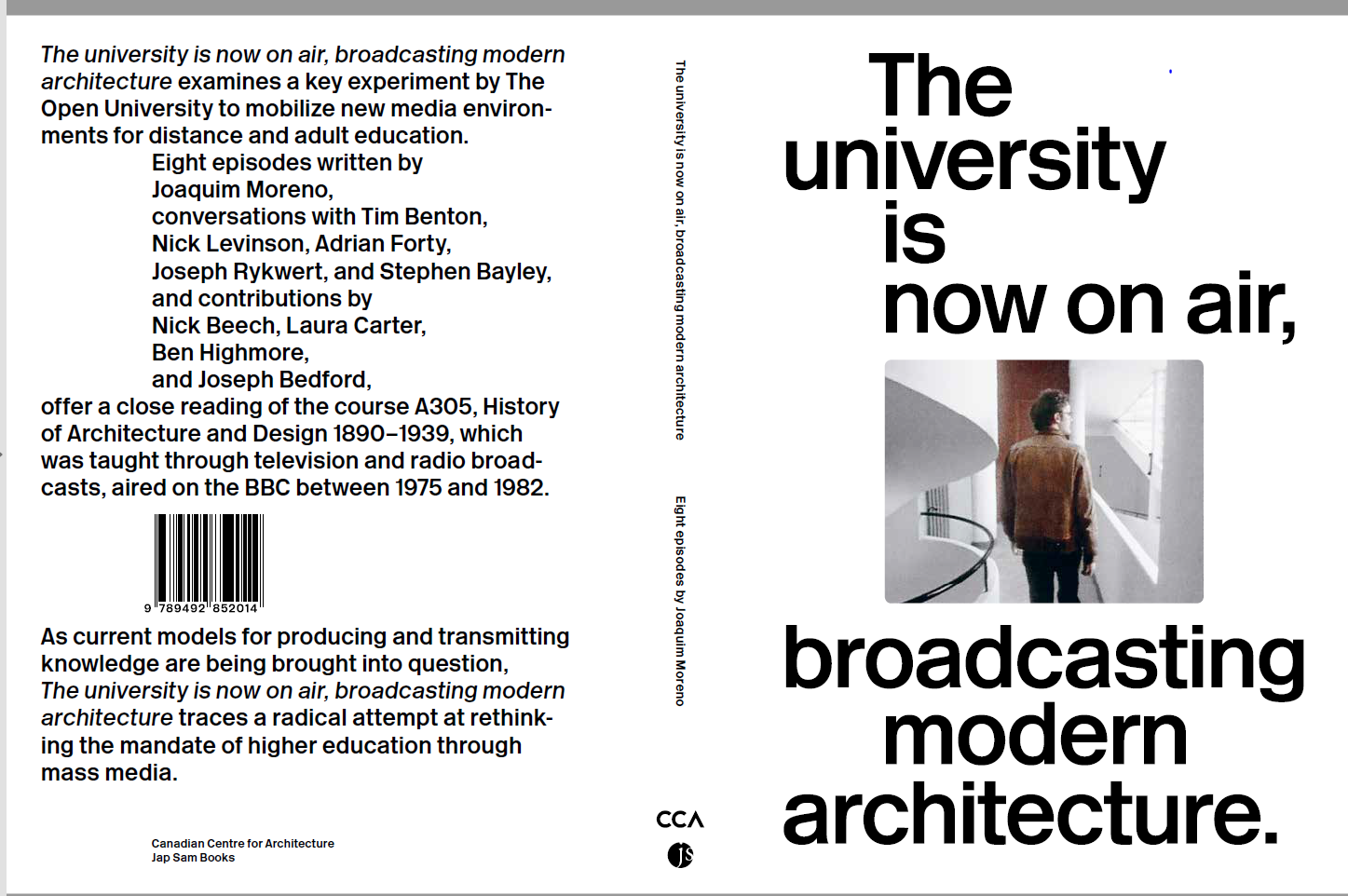
This new book, The University Is Now on Air: Broadcasting Modern Architecture explores the Open University as a critical point of convergence between mass media and mass education.

The book focuses on the module (course) A305, History of Architecture and Design 1890-1939, as a reference point for current discourse on open-source and online educational models.

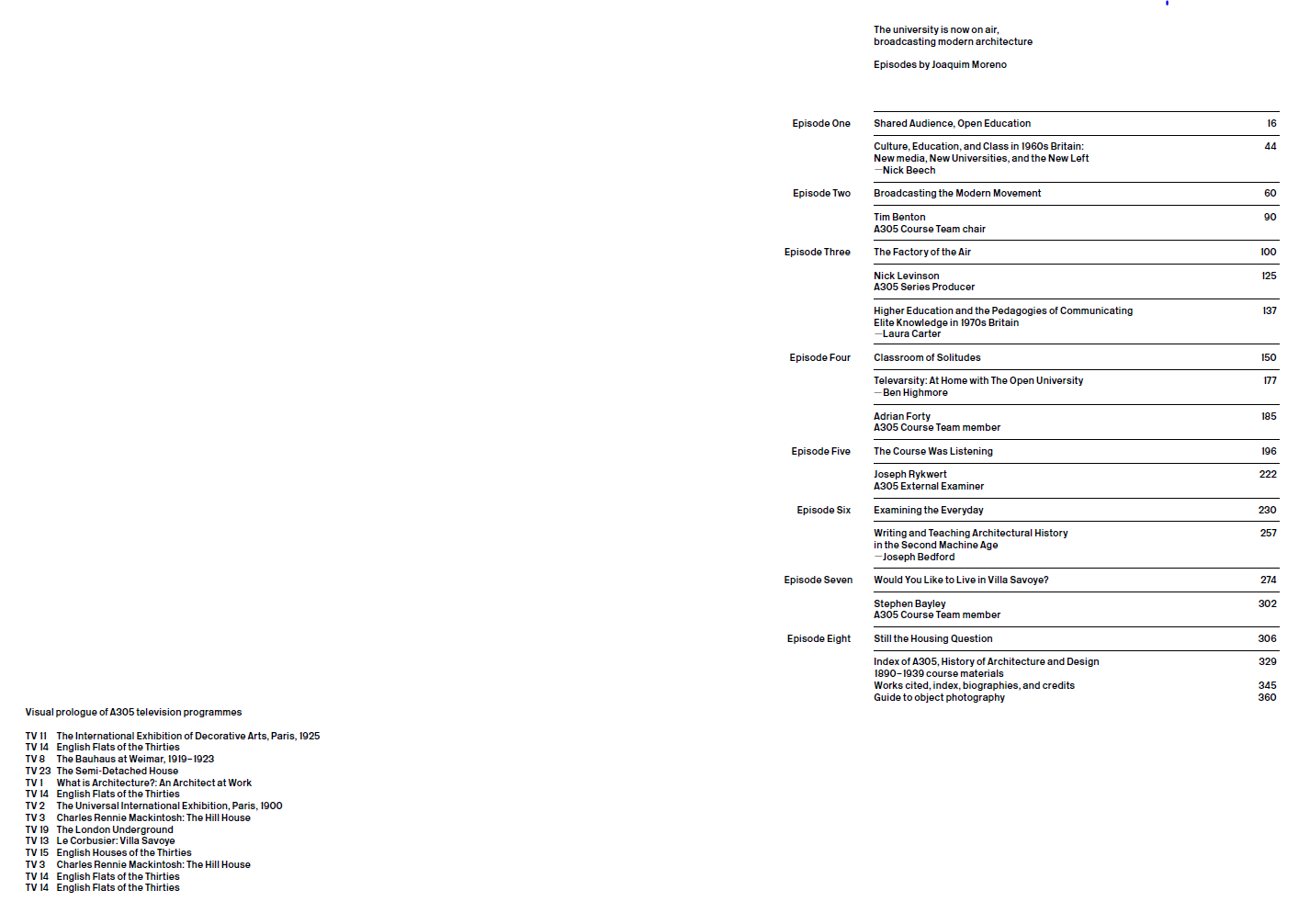
Different aspects of A305 are analysed and there are conversations between Joaquim Moreno (who curated an exhibition ‘The University Is Now on Air: Broadcasting Modern Architecture’) and central figures involved in the creation and production of the course. These are Stephen Bayley, (interviewed here) Tim Benton, Adrian Forty, Nick Levinson, and Joseph Rykwert. There are also essays that frame broader questions of architectural historiography, media history, and the pedagogical and political circumstances of the period. These are by Joaquim Moren0 who has previously considered A305, see here. On the exhibition see  here and here. It is reviewed as an ‘alternative history of the modern movement’, here.

The A305 Course Chair recalled that the teaching materials included 24 television programmes, 32 radio programmes and a Radiovision Booklet. He has assessed the course here and here.

The book is a co-publication with Jap Sam Books, designed by Jonathan Hares (Lausanne and London).

50 objects for 50 years. No 2. The McArthur microscope

Monday, April 30th, 2018


In 1929, in need of a portable instrument for use in the jungle, Dr John McArthur conceived the idea of the light-weight microscope. He developed his concept while a prisoner-of-war and sold his first one in 1957. It had enjoyed sales of about 1,000 by the time that the OU showed an interest about a decade later. However, the OU wanted a simpler, plastic version for its Home Experiment Kits. The OU’s first Vice Chancellor felt that ‘carrying out of experiments at home by students would be a vital part of offering correspondence tuition in science and technology’, see here. The university recognised that many of its students would be unfamiliar with delicate scientific mechanisms or would find it difficult to keep their study materials safe from other family members. It did not want a delicate rack and pinion system for focusing and the objective lens had to be robust. McArthur met the deadline and about 7,000 of these tiny (5in x 3in x 1in), cheap, microscopes were to be mailed to the first students at the OU in the first HEKs. It has been called a ‘gem of a portable microscope’ and ‘legendry in its application and construction’. It has also been described as ‘an amazing little instrument… although small, lightweight and almost entirely plastic, it makes a very serviceable field instrument’.

The OU wanted its students to have the opportunity to be active learners not passive recipients, to understand that science did not require specialist laboratories or a campus. The home could become a place for university-level study. The inclusion of the microscope in Home Experiment Kits showed the OU’s commitment to putting learners at the centre and of adapting technology to ensure they were supported.

In the 1970s a large-scale project invited children to draw a picture of a scientist. Men in white coats and wild hair abounded. Instead of a university being outside the normal and day-to-day, instead of scientists being white-coated men, the OU gave scientific instruments to people, including my mum an early OU student. There was spluttering and ridicule in the press about the ineptitude of housewives but the OU persisted. The idea of a university and of who could be a student, was transformed. The OU enabled science to be more than an activity for men in white coats in labs, housewives could study in their own homes, submariners could study under the waves.

Subsequently the OU’s Virtual Microscope has been developed to allow students with internet access to explore digitized slides and thin sections in a browser window. There are several specialist microscopes. They enable OU students to gaze upon images which leading scientists and academics are also examining.

We interrupt this programme

Sunday, April 29th, 2018

A305, History of Architecture and Design 1890–1939 was taught 1975-82. Here Charlotte Lydia Riley, Owen Hatherley, and Jonathan Bignell show the material and then comment on it, with their reflections on history, architecture and media. https://www.cca.qc.ca/en/issues/25/a-history-of-references/57217/we-interrupt-this-broadcast


The OU in fifty objects: further commentary

Thursday, April 26th, 2018


More suggestions as to objects which tell a story about learning and life at the Open University have arrived. They include mug mats, the gowns rented out to those who students who attend graduation ceremonies. These have been available since the first award ceremony. There was also a vote for the diaries issued to staff. Thanks to Ian, Heather and Caroline for those ideas. It has been proposed by Jerard, Caroline and Linda that we celebrate the box marked “Urgent Educational Material’ the home experiment kits and the slippers. When staff first started work on the Milton Keynes site while building work was in progress. One of those first on the site was Joan Christodoulou, who recalled the ‘a sea of mud’ and that ‘everyone was allocated slippers’ Christopher Harvie recalled that:

the campus was so covered in mud that people had to trample around in welly boots. People were issued with slippers when they went into the teaching rooms. Walter Perry greeted us like Trevor Howard in a Second World War movie. He said, ‘Some of you chaps might be wondering why you have been brought here.’

When older staff and former staff were interviewed almost a decade ago the story of the slippers was one of the most frequently told tales. See Hilary Young, ‘Whose story counts? Constructing an oral history of the Open University at 40’, Oral History, 39:2 (Autumn 2011), p.102.  This story was discussed in relation to Greek myths, here and as a possible icon of the OU.

Although it was the television which made the OU famous it also entered peoples’ homes via the letter box. Students received a wide range of items in the post including microscopes, books and home experiment kits. The latter, known as HEKs at the OU, where almost everything is reduced to an acronym, formed part of the name of an early computer set out, (H)ome (E)lectronic (K)it compu(TOR) – HEKTOR. There is an item about Europe and HEKs here.

This eclectic mix reflects the memories of staff and students and the excitement of opening the unknown, be a crate at summer school or a parcel in the post. I’m looking forward to more ideas as to what the OU means to you.

The OU in fifty objects: some suggestions made by staff and students

Tuesday, April 24th, 2018

Reminder of the 2018 strike by UCU members at the OU

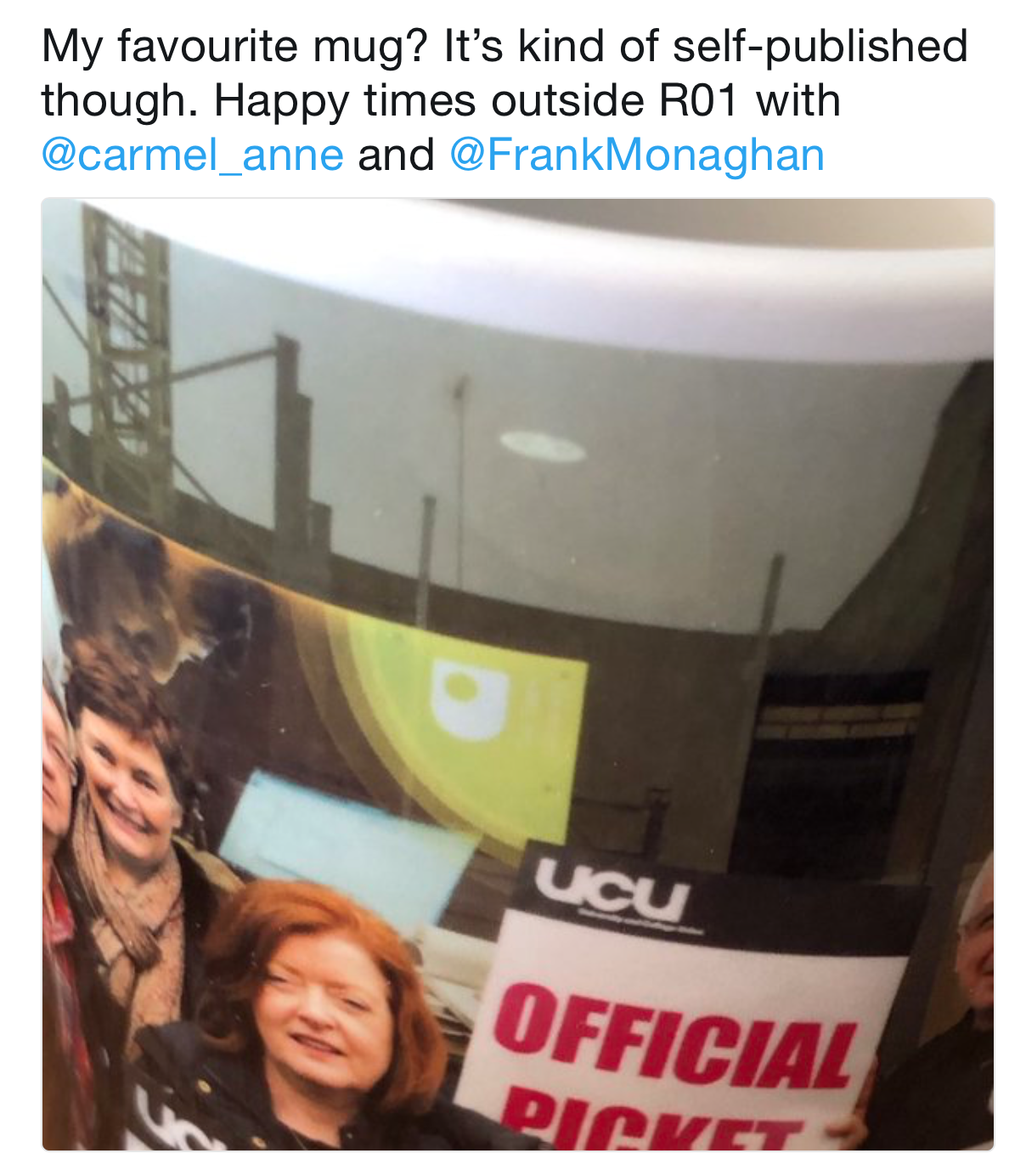
People have proposed objects which tell a story about the distinctiveness of the OU and its approach to learning and teaching and have also suggested personal narratives. Alison sent a picture of a mug onto which had been printed a photo of University and College Union strikers from the OU in the Spring of 2018. Margaret (Mags) suggested the repurposed kitchen table or cupboard. One of the distinctive impacts of the POU has been to take higher education off the campus and put it into kitchens and onto buses and into prisons. It is often while at home that students receive both their first parcel of OU materials and, after they have completed an assignment have sat awaiting the results. Jon thought of both of those occasions when he proposed that ‘It had to be the fabled brown box that materials turned up in that caused equal fear and excitement (and latterly the frustration when I couldn’t find scissors fast enough to cut the plastic strapping!)’ He then added ‘Surely the F5 key has to get its own entry as well (as any student that has ever waited for results will tell you)’. Here is a blog from another student posted in 2011:

I always stress about test results; not so much before the test, but while I’m waiting to find out how I did. You’re alerted by the OU Student site when results are in.

<F5><F5><F5><F5><F5><F5><F5><F5><F5><F5><F5><F5><F5><F5><F5><F5><F5><F5><F5><F5><F5><F5><F5><F5><F5><F5><F5><F5>

I’ve worn the letters off my F5 key.

Anyway – results are in. For TMA01, the assessment for Book 1 – Global Warming, I achieved…

*drum roll*

96 per cent!

*thud*

That was the sound of my jaw dropping. I’m absolutely delighted, to be honest.

The Open University does not just exist in people’s homes. It has also made use of university premises, for tutorials and summer schools. For his object Chris proposed ‘Residential school crates! Fanfold computer paper! Green pens! Yellow special circa folders!’. For those who have ever attended or indeed packed for, residential schools, and I have done both, this may help you recall the excitement, the enthusiasm, the learning, the discos of summer schools. Typically students would be in residence for typically one week. They would attend lecturers and seminars, work in the laboratories or go on field or gallery or museum trips. Here is Sally Ford’s recollection of her experiences of a residential school on the Nottingham University site. She studied SXR205, Exploring the molecular world:

The first day of activities was so hectic, I thought I would be left behind at times, but on voicing my worries to my fellow students I realised that everyone was in the same boat, and more importantly, we were all helping each other and working as a team instinctively. Over five- and-a-half days, I had written over 80 pages in my lab notebook. More importantly, I had put an awful lot of theory into practice, and got vital laboratory experience that I would not have been able to gain other- wise.

Looking forward to further ideas.