Archive for the ‘History of the OU’ Category

50 objects for 50 years. No 1. The Royal Charter

Monday, April 23rd, 2018
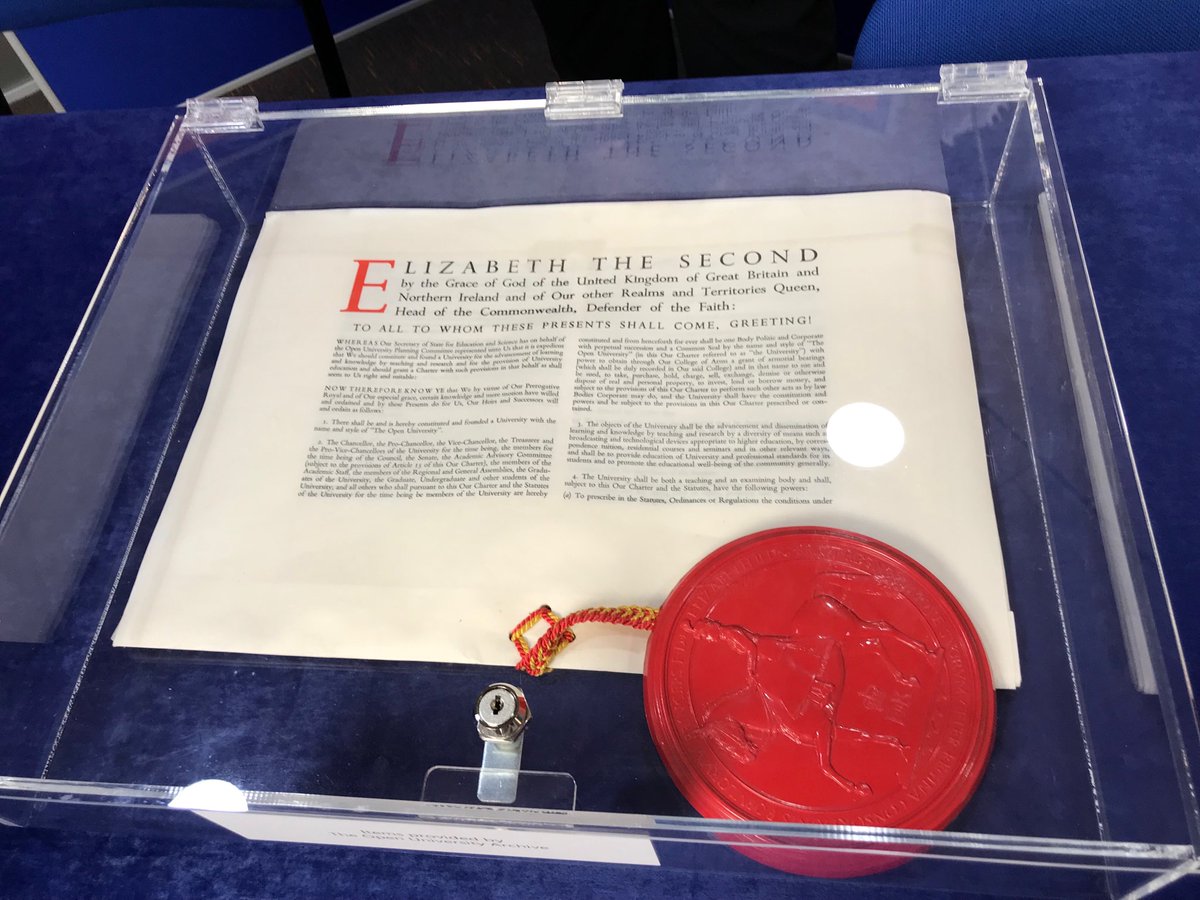
Today 23 April 2018, is the anniversary of the granting of a Royal Charter to the Open University. A year hence it will be the 50thanniversary of the Open University. To mark that half century, we will be writing about 50 objects which have made the OU. You are invited to make proposals for your favourites. Maybe it was the first parcel you received with OU materials or the gown you wore to your OU graduation. Perhaps it was the coffee that your partner brought you at midnight as you struggled to complete a TMA.


This week the object is the Royal Charter. Written by the OU’s Planning Committee it provided the OU with a bulwark of respectability against its detractors andunified the OU into a single legal entity. It unites learners and staff, indicates that this is an institution of quality and it frames how we address, construct and bolster communities. It reminds us of how the OU has united strangers and supported co-operation between learners.


Higher Education institutions do not require Charters in order to confer degrees or to operate. Many have not got Charters and some were only granted Charters after they opened. The University of Essex admitted its first students in 1964 and was granted a Royal Charter in 1965. The University of Keele was founded in 1949 and only received its Charter in 1962. The BBC has a Charter, but it has to be renewed every decade. The incorporation by a Royal Charter (alterable onlyby the agreement of The Queen in Council) gave considerable status to the OU when it was an institution without any students, which was to be based in many sites, which was of unproven popularity with the electorate and which was distained by many MPs. The OU’S Royal Charter proclaims respectability, community, outreach.


Although it was not clear in 1963, when Harold Wilson called for a university of the air, that there would be a new university with its own charter, the idea gained ground as Wilson’s rough notes were expanded and the OU was planned. One reason for a Charter might have been to prevent the Open University’s enemies closing it down when the Labour government lost power, as it did a few months after the Charter was granted. William van Straubenzee, the Conservative junior minister for higher education in the 1970–74 government, was reported as saying of the OU ‘I would have slit its throat if I could’. He blamed the outgoing Labour education minister Ted Short for some ‘nifty, last-moment work with the charter that made the OU unkillable’.


On 23 April 1969, two days after a human first walked on the moon, the Royal Charter of The Open University was granted. The Charter stated that ‘the objects of the University shall be the advancement and dissemination of learning and knowledge by teaching and research by a diversity of means such as broadcasting and technological devices appropriate to higher education, by correspondence, tuition, residential courses and seminars and in other relevant ways’.


The OU’s Charter was based on that of Warwick University, opened in 1965. In its emphasis on openness, the OU echoed the motto of another new university, Lancaster (opened 1964): Patet omnibus veritas (Truth lies open to all). The first stated objective about the need to advance and disseminate learning and knowledge, was similar to statements in the charters of other universities of the 1960s. York’s focus was on enabling ‘students to obtain the advantages of University education’; Lancaster wanted to use the ‘influence of its corporate life’; and the University of Warwick has almost identical wording to these two.


The OU’s Charter contained an additional objective: ‘to promote the educational well-being of the community generally’. It was this obligation to the wider community that led to the development in the 1970s of the ‘Continuing Education’ programme with courses such as P911 ‘The first years of life’ and P912 ‘the pre-school child’.It is this same obligation within the charter that informs continued University collaboration with the BBC on current popular programmes such as Child of our time, Coast and Civilisations.


The Charter set out the regulation of the university. There would be a Council, ‘the executive governing body of the university’, a Senate and a non-executive general assembly, ‘the organ through which the feeling of a corporate institution would be generated’. The university also had its own regional organisation. At first it was It was intended that the General Assembly, representative of both students and staff, would elect representatives to the Council and Senate through regional assemblies. Changes to the Charter have been suggested. These are difficult to make and have led to lively debates.


The Charter did not grant the OU autonomy, the university’s finances were subject of close government scrutiny from the beginning. It was forbidden to carry over income from one year to another unless the expenditure was for the development of teaching materials. The OU could not accumulate reserves, nor own property against which it could borrow money and it was subject to annual review.


The Charter obliged the university ‘to make provision for research’. However, when the OU sought to make provision for postgraduates it was derided by Rhodes Boyson, a head teacher who was to become a Conservative MP in 1974. He argued that the OU only wanted to do this ‘because it expects that no one will accept its degrees as worthy of postgraduate extension’. Despite the difficulties and scepticism, research played an important role at the OU from the beginning. Steven Rose, the OU’s first professor of biology, established the Brain Research Group which was importance in the development of the new field of neuroscience. He recalled that, when offered a post at the OU ‘made it very clear at the start that I wouldn’t go unless there were research facilities … this was going to be a university like any other university’. He received funding from the Medical Research Council, ‘so from the very beginning … we’d actually got research going’. The OU awarded its first PhD in 1972.


Since the first Charter the OU has launched its own Student Charter.


OU history features in exhibition at the Canadian Center for Architecture in Montreal

Monday, March 19th, 2018

Architecture on the air: The story of Open University’s televised classroom. A new exhibition looks at a pioneering, mixed-media college course exploring modern architecture

https://www.curbed.com/2018/1/12/16886438/modern-architecture-education-open-university-exhibit


Pygmalion, Zeus and OU slippers

Tuesday, June 14th, 2016

On 11th June, Jess Hughes and Dan Weinbren discussed how Greek myths have been employed to help us understand the history of the OU. Professor Sewart argued that the OU was like Athena, in that it sprang forth, fully armed, from the head of Zeus. However, Dan Weinbren suggested that this myth marginalised the longer roots of the OU in 18thC part-time courses for adults, nineteenth century correspondence courses and 20th century radio and television. It also marginalised the role of women, notably Jennie Lee, and the role of the state and the market.

We also discussed the value and uses of Ovid’s ‘Pygmalion’ tale, updated by Bernard Shaw just prior to the First World War and again in the film ‘My Fair Lady’ before there was another incarnation in the 1980s with ‘Educating Rita’.

In addition, we considered if the slippers and wellies story, now so frequently retold, was a myth of the OU. See here for the discussion.

Remembering Asa Briggs, 7 May 1921 – 15 March 2016

Wednesday, March 23rd, 2016

Today’s Times carries a tribute to Asa Briggs in the ‘Lives Remembered’ section on page 55. Asa’s association with the OU was not in the obituary last week.

For an account of the relationship between  Asa and the OU see the chapter by Daniel Weinbren in this book

Asa’s work is discussed here by the OU’s Professor of Social History and Asa himself.

Radio Coventry and Warwickshire remembers the OU’s only nationwide awards ceremony

Wednesday, March 23rd, 2016


Here is the URL to BBC Radio Coventry and Warwickshire site available for 30 days. It is about the first degrees awarded by The Open University in 1973. STARTS – 02:28:28 | ENDS – 02:33:04]


Midnight oil on filtered water – unusual connections

Wednesday, March 23rd, 2016

In 1960 work began on the Aswan High Dam. Built in Egypt with the support of the 800 Russian engineers it became an emblem of the Cold War as the West focused on saving the colossal 12th century BCE sandstone figures which were going to be submerged in a new lake unless action was taken. A film producer who had helped to found the company Ulster Television and expert scuba diver William MacQuitty (1905 –2004) proposed to save the temple by building a dam around the complex. This would be filled with clear, filtered water. Architect Jane Drew developed plans which imagined visitors taking a lift down from a restaurant at the top of the dam to curved pathways with circular windows and bubbles of glass. Encased in bubbles, tunnels, and shafts they would be able to view the temple structures which would be preserved by being under water.

MacQuitty went on to work with Queen’s University, Belfast to make an early example of late night adult education Midnight Oil while Jane Drew went on to design many of the buildings for the OU’s Walton Hall site. She was made an honorary Doctor of the University at the first degree ceremony.

Source: Lucia Allais [Assistant Professor in History and Theory of Architecture at Princeton University], ‘Integrities: The Salvage of Abu Simbel’, Grey Room 50, Winter 2013, pp.6-45.
https://comparativemedia.columbia.edu/sites/default/files/pdfs/Allais_GR50_Integrities_Salvage_AbuSimbel.pdf

Doreen Massey, 1944-2016

Wednesday, March 16th, 2016

Some of the obituaries of the late OU Professor. Here is the OU. Here is Hilary Wainwright and the Guardian


Death of Asa Briggs

Wednesday, March 16th, 2016

OU Planning Committee and former Chancellor Asa Briggs has died http://intranet.open.ac.uk/ouintra/story.aspx?id=29918

For an account of his role at the OU see the chapter on his relationship with the OU in Miles Taylor, ‘The Age of Asa. Lord Briggs, Public Life and History in Britain since 1945’, Palgrave Macmillan, 2015. The chapter is ‘Asa Briggs and the Opening Up of the Open University’.

Book review

Thursday, September 3rd, 2015

‘The Open University. A history’ has had a few reviews. The review in the ‘International Journal of Lifelong Education’, is quoted on the Amazon site. There is also a review in ‘Welsh History Review’ which calls the book a ‘very substantial work’. The ‘Times Higher’ reported that it is “A fascinating history of the politics and passion that led to creation of the first ‘University of the Air’. Weinbren’s inspiring account reveals how the university with its open access policy became the UK’s biggest provider of part-time higher education, changing the lives of thousands that would otherwise have been denied the opportunity.”

The review, see here, by Tony Bates is also complementary. Tony says: ‘Weinbren has undertaken an extremely challenging task and met the challenge superbly. I hope you will enjoy the book as much as I have. More importantly, there are very important lessons to be drawn from this book about the nature of university education, equity, and government policy toward higher education.’


Radio Times

Friday, October 17th, 2014

Some items of interest in a newly-digitalised source, the Radio Times 1923-2009. You can find plenty of old OU broadcasts, including the entry for the conferring of its first undergraduate and honorary degrees. Most universities hand out the certificates in their poshest hall or perhaps a local civic building. The OU did it live on BBC2 from the place where the programmes were made, Alexandra Palace. There was not a vast range of channels back on 23rd June 1973. To devote one of them to the award of degrees to 600 people in the Great Hall at Alexandra Palace was an interesting decision. In addition, the programme showed the award of honorary degrees, the installation of the second Chancellor (the first one having died) and some interviews with students. All this was presented by the man with those dulcet, calming tones, Richard Baker.

Here’s the archive site:

http://genome.ch.bbc.co.uk/