Posted on June 20th, 2010 at 10:20 pm by Daniel Weinbren
‘How about taking exams in the comfort of your own room?’ Asked BBC reporter Katherine Sellgren before going on to suggest that ‘New technology, boasting anti-cheating software, could soon make this a possibility’. Read the rest of this entry »
Posted in Methods | No Comments »
Posted on June 20th, 2010 at 8:19 pm by Daniel Weinbren

Professor David Hawkridge
In 1975 David Hawkridge said that course teams were
made up of four kinds of people. First, there are the academic subject-matter experts. These are the physicists, the historians, the sociologists and so on. Second, there are instructional designers from the Institute of Educational Technology. Their interest lies in the structuring of the subject-matter, the selection and specification of learning objectives for the students, the preparation of suitable assignments, and in evaluating the success of the courses. Read the rest of this entry »
Posted in Methods | No Comments »
Posted on June 20th, 2010 at 3:53 pm by Daniel Weinbren
‘When the UK Open University was established its creators, in the free-wheeling and informal spirit of the 1960s, proposed that it dispense with the academic traditions of gowns and convocation ceremonies. The first students, however, quickly disabused the OU of that idea, arguing that since they had studied long and hard they wanted to be recognised as graduates with “the Full Monty” of gowns and regalia. The only concession to modernity – for which I was grateful when I officiated at over a hundred degree ceremonies as vice-chancellor – was that they would not wear hats.’ This from here
Posted in Internal organisation | No Comments »
Posted on June 18th, 2010 at 1:13 pm by Daniel Weinbren

Professor Gráinne Conole
Gráinne Conole, Professor of e-learning in the Institute of Educational Technology at the Open University wrote: I argue in this paper that we need to expand the notion of openness, to take account of the affordances of new technologies and the new patterns of user behaviour we are seeing emerge. There has been a growth in recent years in activities around the Open source movement and the development of open tools and services, also the open educational resource movement (Iiyoshi & Kumar 2008). Read more here
Posted in Methods, Research | No Comments »
Posted on June 16th, 2010 at 9:29 am by Daniel Weinbren
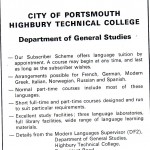
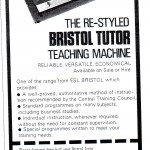
- Advertisements in trade journals indicated the benefits of machines which could support learning.
A popular at the time when the OU was being created was that machines could be used to support students learning at their own pace. It appeared possible to create systematically designed step-by-step courses with clear evaluation of the learning objectives. From before the war psychologists had showed that animals appeared to learn effectively when their learning was accompanied by rewards and Sidney Pressey had invented a keyboard-operated teaching machine which was supposed to allow students only to acquire new material once they had mastered the previous steps. Although there was not much interest in such machine in the 1930s, the ideas were adapted in the 1960s as interest in scientific management grew. This appeared to facilitate scientific control over the labour process. Programmed instruction was based on a behavioral model of learning that emphasized prompting for behaviors and responses that could then be reinforced (or not) and used to guide the learner through the course materials. Programmed instruction, later programmed learning, was popular in the 1960s. James Finn’s work at University of Southern California, connected programmed learning to audio-visual facilities and on behavioral psychology. There was also work by Arthur A Lumsdaine and Robert Glazer (eds.) Teaching machines and programmed learning, NEA Publications 1960 to which Burrhus Frederic Skinner contributed. The latter argued that the learning process should be divided into a very large number of very small steps and rewarded offered to the successful. He created a mechanical teaching machine. A learner could respond to a series of questions studied at their own rate. There was a reward for a correct response. The student had to compose an answer as there were not multiple choice answers. There were prompts and hints for students. The intention was to bring a single person into contact with a large number of students and a programmed instruction movement developed. Susan M Markle was an early exponent of Skinner’s programmed instruction in her work at the University of Illinois.
In the UK a Central Training Council was created in 1964. It promoted programmed instruction in industrial training and a survey in 1966 suggested that the idea of programmed learning was now accepted within industry. Universities also took it on and in 1966 Association of Programmed Learning formed. By 1968 it was being used in at least 29 universities in the UK. Electronic systems were developed such as the Edison Responsive Environment, known as the ‘talking typewriter’ and audiovisual material was also used. Programmed learning was used in a variety of trades and by the armed services. It was also used within teacher training.
During the1970s the idea fell out of favour, being deemed to be too mechanistic and rigid because programmed learning units and computer marked tests gave the student no chance to question the ‘teacher’ or to ask for elucidation. Cognitive approaches were becoming more popular within psychology and more flexible regulatory regimes were becoming more familiar within industry. Possibly, ‘there was a gendered effect in programmed learning, with conception and design being largely male areas, while delivery was more mixed’.’ (John Field, ‘Behaviourism and training: the programmed instruction movement in Britain, 1950-1975, Journal of Vocational Education and Training, 59, 3 September 2007, p.326). As the popularity of the socio-constructive paradigm for instruction grew, interest in supporting collaborative learning, social networking and virtual worlds developed.
Posted in History of the OU, Methods | No Comments »
Posted on June 15th, 2010 at 8:41 pm by Daniel Weinbren
Posted in Internal organisation, Research | No Comments »
Posted on June 14th, 2010 at 1:13 pm by Daniel Weinbren
As knowing where we are going, or might go, can help provide a new perspective on where we’ve come from, this conference, 22nd to 23rd June 2010 could help. It is 9am to 5pm and online
http://cloudworks.ac.uk/cloudscape/view/2012
There is a blog by organiser Matin Weller here and the programme is here
The OU has a conference every year to share practice and research around learning and technology. This year the event is completely online and open to all. The event will take place across 2 days (22nd and 23rd June), with the synchronous presentations being held in Elluminate and asynchronous discussion held in Cloudworks.
The theme of the conference is ‘Openness in education’ and in keeping with that theme it is open to everyone, not just OU staff. It is an opportunity to engage in dialogue around the four main themes of open content, teaching, learning and access.
If you are interested in ‘attending’ some or all of the conference, please go to the Cloudworks site http://cloudworks.ac.uk/cloudscape/view/2012 and also check there for up to date information about the programme, practice sessions and call for contributions. You will need to register on Cloudworks to add any content and to indicate you are attending.
Contributions will be in a web format, such as YouTube, Slideshare, Animoto, which might result in a broader audience, able to engage with the projects and ideas within the Open University, and a discussion which will aid the University in its exploration of the theme of open education.
Posted in Events, Internal organisation, Methods, Research | No Comments »
Posted on June 14th, 2010 at 1:01 pm by Daniel Weinbren

Will this help to contextualise how far, or indeed whether, media determines learning?
A five-part ‘media history’ series starts at 11pm tonight, 14th June on BBC Radio Three, and runs every night this week. It’s called “Rewiring the Mind”, runs in ‘The Essay’ slot, and it looks at ways in which media have shaped ways of thinking since about 1900:
The Essay: Rewiring the Mind, 11pm, Radio 3::
The historian of broadcasting, David Hendy, explores the ways in which the electronic media have shaped the modern mind.
Episode 1 (Monday 14th June): “The Ethereal Mind”:
How did wireless conquer the world in the early years of the twentieth century, and how did a fascination with radio among scientists and writers unleash new ideas about the transmission of thought and the utopian potential of invisible forces?
Episode 2 (Tuesday 15th June): “The Cultivated Mind”:
How effective were the efforts of the BBC to improve the ‘public mind’ between the wars? Did broadcasts such as W.B. Yeats’s poetry recitals or E.M. Forster’s talks foster ideas of a ‘spiritual democracy’ and an enlightened citizenry?
Episode 3 (Wednesday 16th June): “The Anxious Mind”:
Tonight the reporting of the Holocaust in 1945 and television coverage of the Challenger Space Shuttle explosion in 1986. If media have made us all witnesses to horror and tragedy do they also help us to come to terms with suffering, or just leave us depressed at the wrongs in the world?
Episode 4 (Thursday 17th June): “The Fallible Mind”:
Two seminal TV programmes: the American drama Marty, broadcast in 1953, and the BBC’s Face-to-Face, from 1960, used unflinching close-ups to reveal human beings as flawed individuals. Did they make us more compassionate – or just more obsessed with the private lives of others?
Episode 5 (Friday 18th June): “The Superficial Mind”:
Might the Internet, despite its wonderful power as a repository of information and creativity, be slowly degrading or enhancing our mental abilities? Are our brains ready for it?
(Presenter: David Hendy. Producer: Matt Thompson).
The series will also be available to listen to on BBC I-player for up to seven days after broadcast.
Posted in Methods | No Comments »
Posted on June 11th, 2010 at 4:57 pm by Daniel Weinbren
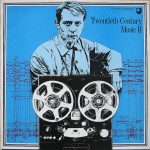
Educational technology has moved on from the reel-to-reel but has the OU struck a duff note for those left stranded by the digital divide?
Alan Tait, as well as being Pro-Vice-Chancellor (Curriculum and Awards) at the OU is also president of EDEN – the European Distance and E-Learning Network.
Here he notes that that ‘very few universities have a Pro-Vice Chancellor for Curriculum; in fact it is accurate to say that I have never come across another one! In fact the term curriculum in the sense of an overall view of what subjects a university teaches only came into common parlance in the UK perhaps 10 years ago (and was recognized in a book by David Watson and Jean Bocock ‘Managing the University Curriculum: Making Common Cause’). Up till then what universities taught was taken more as an unexamined issue: it was what academics wanted to teach and what the university agreed they could. The Open University however, as a mission-led university with a strong research identity has had a PVC Curriculum for some 20 years. This indicates the ways in which we have tried to deconstruct the curriculum from being a natural phenomenon to one that is constructed to meet audience needs, aligned of course with the University’s teaching priorities, external regulation from professional and other bodies, and the views of the academic community.’
Posted in Methods | No Comments »
Posted on June 11th, 2010 at 4:08 pm by Daniel Weinbren
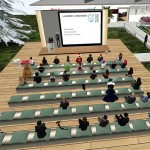
Vice Chancellor of The Open University Martin Bean visited Second Life in December 2009
David Hawkridge, Matthew Wheeler, ‘Tutoring at a distance, online tutoring and tutoring in Second Life’, European Journalof Open, Distance and e-learning, here
Abstract
Research into tutoring at a distance has a fairly long history and the functions of tutors in distance education institutions are well understood. Over the past 20 years research into online tutoring has advanced significantly as such institutions have ‘gone electronic’: in this paper we cite published research from the UK Open University. Recently, blogs, wikis and podcasts have arrived to supplement established systems like email, virtual learning environments (VLEs, such as Blackboard) and computer conferencing. Little research has been published so far, however, on tutoring distant students in three-dimensional multi-user virtual environments (3-D MUVEs). Distance educators may well ask whether the best practices from tutoring at a distance and online tutoring can be transferred to these environments, which do not resemble VLEs. To clarify what may or may not be feasible in a prime example of a 3-D MUVE, this paper elucidates tutoring by and through avatars on a Second Life Island created by the Beyond Distance Research Alliance at the University of Leicester (which has 7,000 students learning at a distance). It analyses what can be done in Second Life by way of meeting students’ needs for tutoring, and discusses some of the opportunities and challenges inherent in asking students and tutors to meet in such an environment.
Keywords
Tutoring, distance education, online education, e-learning, Second Life
Topics of the paper
Tutoring at a distance; Tutoring online; Tutoring in Second Life; Tutoring in the Sami tent and the Kalasha village; Virtual StoryCubes and tutoring; Conclusion; References; Acknowledgements
Posted in Methods, Online teachng and learning | No Comments »


