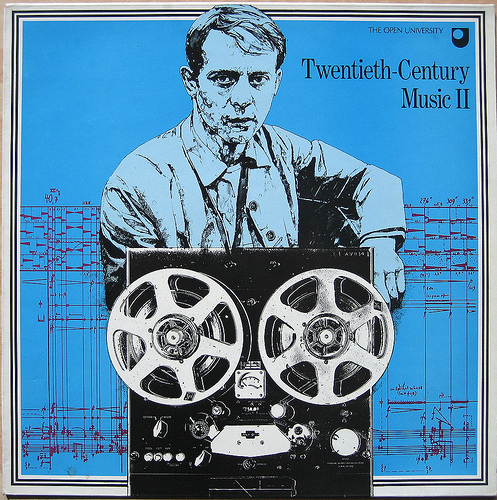
Has the OU got a history?

Posted on May 17th, 2010 at 2:02 pm by Daniel Weinbren

For David Sewart, at first the OU was:

like Athena springing fully grown and fully armed from the head of Zeus [it] appeared to have no mother and never to have had the opportunity to have been an adolescent, let alone a child … I began to realise that the UK OU was part of a world wide phenomenon – and a late entrant at that, to the world of distance education.

Review, Open Learning, June 1995, pp. 62-63, (p. 62). 


Reciprocity lay at the heart of Young’s understanding of socialism.

Posted on May 13th, 2010 at 4:45 pm by Daniel Weinbren

The tap-root of socialism was in working-class communities like the one in Bethnal Green… In the turnings of Bethnal Green the poor were helping the poor, looking after children of broken marriages and caring for the old, coming to the rescue of neighbours who fell on hard times having a whip round in the pubs, of which almost every street could boast one, in order to collect money for his widow whenever a man died.

Michael Young, ‘Education for the new work’ in Nigel Paine (ed.), Open Learning in transition. An agenda for action, National Extension College, Cambridge, 1988, p. 5.

Opening Up The Open University

Posted on May 12th, 2010 at 4:29 pm by Rachel Garnham

The History of The Open University Project is hosting a workshop that, through the prism of The Open University’s development, aims to reflect on debates about learning and teaching, the rationales for and values of higher education and the impact of expanding higher education on British society as whole.

Opening Up The Open University will be held on Wednesday 3 November, 11:00, Seminar rooms 1 and 2, Library and Learning Resources Centre, Walton Hall. For more information see here.

Proposals are invited for individual papers addressing themes related to the University’s development from a wide range of fields including the political, economic, social, cultural and technological.

Possible subjects for papers include:

 – What has been taught; how have content and disciplinary boundaries altered and what influence have such changes had in the outside world?

 – How have pedagogic techniques and tools evolved within the University and outside it?

 – To what extent has the University succeeded in widening participation; and what impact have its efforts to widen participation had on British society and further afield?

 – How successful have course teams been as a method of constructing high quality distance teaching?

 – What have been the implications of collaboration with the BBC?

 – How has the University’s different status affected its development?

 – What has been the effect on the University’s development of being a four-nation university?

 – What can we learn from representations of the University be they fictional or derived from personal experiences?

 – How has the University’s international strategy changed over 40 years?

 – What influence have Tutors, Tutor-Counsellors and Associate Lecturers had on development?

Abstracts of 150-250 words should be emailed to [email protected] by 9 July. Papers will be selected from those submitted.

We would like to create a network of people interested in these questions. If you would like to be part of that network please let us know. For more information email [email protected]
Dealing with a new government

Posted on May 12th, 2010 at 10:09 am by Rachel Garnham

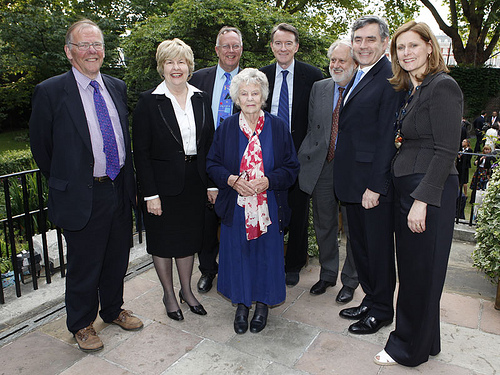
Was former OU Tutor, and former Prime Minister, Gordon Brown more sympathetic to the OU?

With a new government in place, promising cuts in public spending, there may be some sense of deja vu at the OU.

Forty years ago, with the University created by a Labour government but no students yet studying, the election of Ted Heath’s Tory government posed a real threat to the newly formed institution. William van Straubenzee, appointed as junior minister for higher education, reported ‘I would have slit its throat if I could.’ He blamed the outgoing Labour education minister Ted Short for some ‘nifty, last-moment work with the charter that made the OU unkillable’. Student numbers were cut but the University survived.

Nine years later, another Conservative government, this time led by Margaret Thatcher, caused more problems for the OU. In 1980 the University had to cut expenditure by £3.5 million, nine per cent of its 1979 expenditure and the government effectively imposed a 46 per cent increase in the undergraduate tuition fee. Again the University survived, as no doubt it will again, whatever the new government chooses to throw at it.

Mass-Observation Diary Day 12th May 2010

Posted on May 11th, 2010 at 1:38 pm by Daniel Weinbren

Mass-Observation holding a diary day, see here. Diaries should be no more than 750 words and MUST be in electronic form – emails or email attachments.

This is an opportunity to share your OU day and make a contribution to history.

Happy 41st birthday

Posted on April 29th, 2010 at 1:13 pm by Rachel Garnham

On 23 April 1969 the Royal Charter of The Open University was granted and the institution officially became a university. Indeed, this time a year ago the University was marking its official 40th birthday with futher celebrations throughout 2009. For more details see here.

The Charter stated that ‘the objects of the University shall be the advancement and dissemination of learning and knowledge by teaching and research by a diversity of means such as broadcasting and technological devices appropriate to higher education, by correspondence, tuition, residential courses and seminars and in other relevant ways’.

Uniquely, the University was also ‘to promote the educational well-being of the community generally.’

It was this obligation to the wider community that led to the development in the 1970s of the ‘Continuing Education’ programme with courses such as P911 ‘The first years of life’ and P912 ‘the pre-school child’.

It is this same obligation within the charter that informs continued University collaboration with the BBC on current popular programmes such as Bang Goes the Theory, Child of our time and Coast. For more information see here.

Allegations of Marxist bias in the 1970s and 1980s

Posted on April 28th, 2010 at 12:30 pm by Daniel Weinbren

Disputes about the content of a number of courses raged during the 1970s and 1980s. Read the rest of this entry »

Insubstantial, cosy and impractical

Posted on April 28th, 2010 at 9:16 am by Daniel Weinbren

The Times Educational Supplement, 1966:

“Mr Wilson’s pipe dream of the University of the Air, now adumbrated into a White Paper as vague as it is insubstantial is just the sort of cosy scheme that shows the Socialists at their most endearing but impractical worst.”

Quoted in Walter Perry, Lifelong learning in a non-traditional setting, in A Tuijnman and T Schuller, Lifelong learning policy and research, Portland Press, London, 1999, p213.

Citizen scientists

Posted on April 21st, 2010 at 11:58 am by Rachel Garnham

The Open University encourages a 1,000 flowers to bloom

With today’s technology, harnessing observations from a mass of volunteers to contribute to a body of knowledge has become more common.

The Open University has received plaudits for its recently ugraded ispot site which encourages users to post images to help name the flower, plant, insect or animal seen and share observations with others. When put together a broader picture of the wildlife of the country will be created. Changes over time will become apparent as data accumulates. This is linked to a new introductory course, Neighbourhood Nature, which includes iSpot as a field based activity.

Another OU based project is Creative Climate, which will present and archive a body of stories of people’s experiences and experiments with environmental change over a ten year period (from 2009).

But these projects have echoes from the University’s past. Forty years ago today an OU press release announced ‘Home-degree “army” to attack air pollution’. The University was in the process of recruiting its first students for a 1971 start and proclaimed that the 8,000 students taking its first year science course would be carrying out a ‘never-done-before “blanket” analysis – from air samples taken on their doorsteps.’ It claimed ‘the mass tests are expected to provide government and local authorities with vital data needed to overcome pollution hazards as they may exist district by district… A survey of this magnitude has not been possible before because of the heavy cost and organisational problems involved in setting up such a field task force.’

The press release announced that students would be supplied with ‘home experiment kits’ to carry out the pollution probe: ‘the country-wide data will be processed by automatic document reading and computer facilities at the University and passed on to official agencies dealing with air pollution who have welcomed the plan.’

Bright red herring spotted in Commons

Posted on April 21st, 2010 at 11:16 am by Daniel Weinbren

Did the Tories strike a duff note when they criticised the OU?

In 1965 Christopher Chataway a Conservative MP who had worked in news and current affairs for both ITN and the BBC, quoted Education which suggested that the topic about which most nonsense was talked was educational television. He went on to call the notion of a university of the air: Read the rest of this entry »