By Dr Alexandra Okada
The Seed – Brazil, 2004
I remember the moment clearly. A nine-year-old in my class looked at the screen, folded his arms, and said: “Can I use something else? MicroWorlds is too hard.”
I was a teacher then working across both private and public schools in São Paulo. And that single sentence became a research question that has never quite left me. I was not using Microworld to show off my own coding. I was using it because I believed, with every instinct I had developed from reading Seymour Papert and Paulo Freire and working alongside José Armando Valente, that the learner who struggles with the tool is the learner who truly learns. The difficulty is not the obstacle. It is the curriculum.
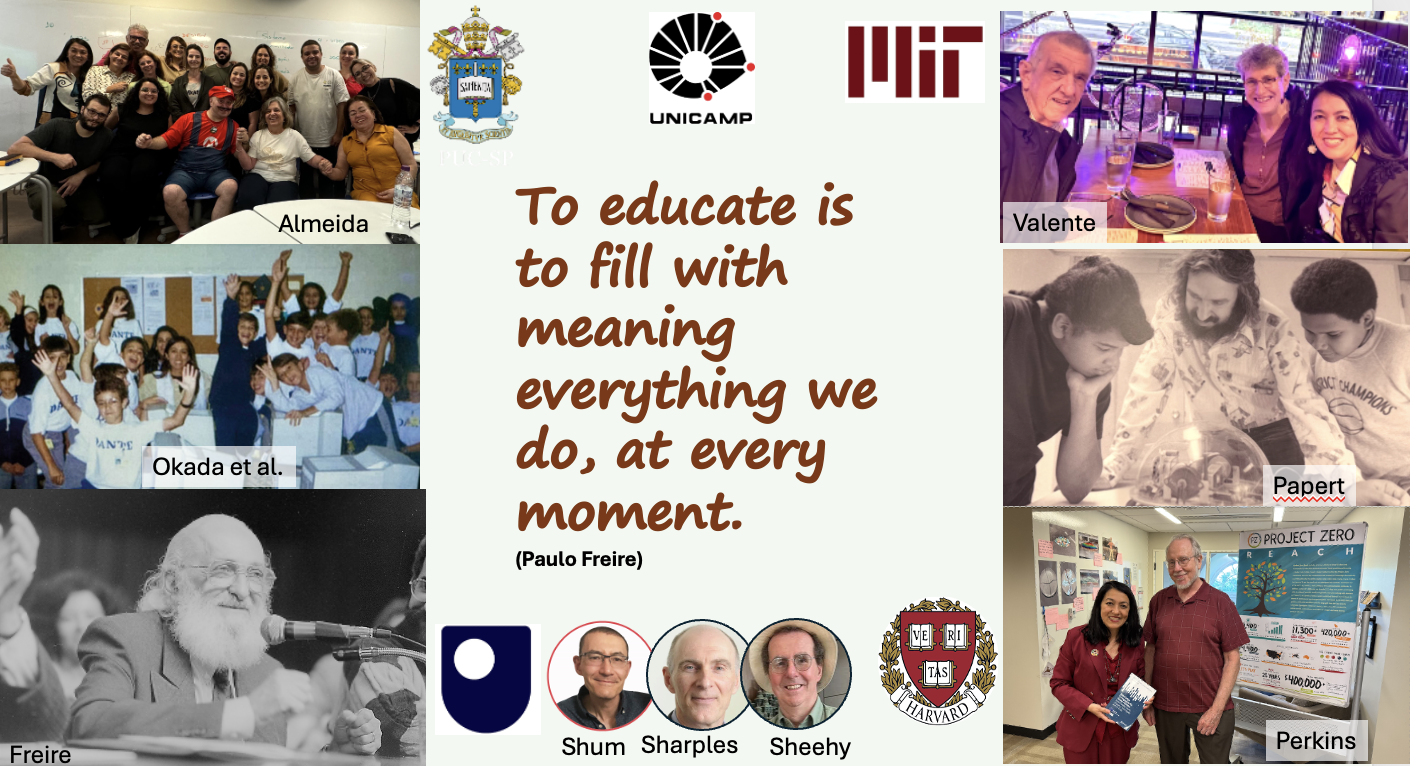
Seymour Papert’s constructionism taught me that children learn best when they are making something shareable, something meaningful — not completing exercises designed by adults. Paulo Freire reminded me that education is never neutral: it either domesticates or liberates. And José Valente, whose work on Logo from MIT to Brazil shaped a generation of teacher-researchers including me, gave us the practical language for what happens when a child cycles through description, execution, reflection, and debugging. These were not abstract theories to me. They were the air in my classrooms in Brazil.
So when that boy said Microworld was too difficult, I did not simplify the task. I made the reason to do it more compelling. We built a virtual museum of Mondrian’s paintings — together, collectively, in Logo — and by the end, those same children were saying: “I liked to build the museum with my colleagues, and when it was finished, it was nice to visit all the paintings.”
That is the moment this twenty-year journey began.
Remarkable People – The UK, 2014
After completing my PhD with Simon Buckingham Shum, I had the honour of meeting Mike Sharples, a renowned scholar in UK EdTech, whose early work on children writing poetry with Logo alongside three Edinburgh schoolboys I deeply respect. I see his work, and that of other scholars of computational thinking, as part of a long, continuous cycle: researchers and teachers across decades, continents, and technologies, all asking the same essential question — who holds the creative agency?
In Sharples’ 1978 project, he wrote the LOGO procedures himself and invited the boys to use them. That was already radical for its time, and what those boys learned about grammar and meaning through generating poetry was genuine and deep. But in my São Paulo classroom in 2004, my pupils wrote the code. The syntax was theirs. The bugs were theirs. The paintings — and the pride — were entirely theirs.
This is not a criticism of Sharples. It is a description of a cycle continuing. Beth Almeida, a renowned scholar on teachers education enhanced with technologies and e-curriculum who influenced so many of us working in Brazil, understood this rhythm: each generation of teachers-researchers must push the agency one step further toward the learner. That is the direction of travel. That is what Freire called conscientização — critical consciousness developed through one’s own action in the world, not received from above.
The Horizon Expands: Europe-Brazil, 2024
By the time I was leading the CONNECT project — an EU Horizon 2020 initiative across the UK, Greece, Romania, Spain, and Brazil — the technology had transformed beyond anything I could have imagined sitting with those children in São Paulo. We were now working with over 1,500 teachers and 50,000 students. I was no longer the classroom teacher. I was the Scientific Coordinator, the PI, designing frameworks and cross-national methodologies.
And yet — look at what the students were doing:
Greek teenagers in underserved communities were coding image-recognition algorithms in Scratch to detect wildfires in drone photographs. Brazilian students were building AI-powered inquiry maps about drought and indigenous land rights, presenting their findings to their own communities in Portuguese. UK students were designing AI-assisted renewable energy campaigns, pitching to engineers. All of them applying CARE-KNOW-DO in their projects and using CARE-KNOW-DO to reflect and explain what was transformed in their journeys and how they as transformers changed in their world.
In every case, CARE–KNOW–DO was not just the path — it was the map each learner drew of their own path. Students used it to reflect on and articulate their own transformation: I began to care about this place and these people. I learned what an algorithm actually does and why its biases matter. I did something real with that knowledge — and I changed in the doing of it.
This matters because education systems have historically spoken at underserved communities rather than with them — treating them as objects of policy, not subjects of their own learning. Their knowledge, their languages, their contexts were ignored. CARE–KNOW–DO flips that. A Brazilian student presenting AI-mapped findings to her own community in Portuguese is not being spoken at. She is speaking with — and for — her world. That is the transformation. And it echoes Freire’s most fundamental insight: that liberation begins the moment a learner recognises themselves as the author, not the object, of their own story.
The teacher was not coding. The researcher was not coding. The learner was coding.
Twenty-one years. Different continent, different language, different technology, different scale. Same philosophy.
CARE–KNOW–DO: What Twenty Years of Living This Taught Me
The CARE–KNOW–DO model did not arrive fully formed from a literature review. It grew from lived experience — from classrooms, from conversations with colleagues and mentors, from watching what happens when young people are trusted with genuine tools, genuine problems, and “hard fun” (Papert’s phrase, which Kieron Sheehy’s work on inclusive playful learning has helped me think with).
CARE is what I saw in 2004 when a nine-year-old dedicated a Mondrian painting to his mother and published it on the internet.
And in 2025, emotional investment including ethical connection to something beyond the self, with a teenager in Athens who begins to care about Mediterranean forests not as a lesson topic but as something fragile and worth protecting.
KNOW is what happens when you have to actually understand how Logo syntax works, how a machine learning algorithm classifies images, how AI can both help and harm — because you are building with it, not just reading about it.
DO is the moment a student in Manaus presents her AI-mapped analysis of Amazon drought to her community, or a student in Athens publishes code that detects deforestation. Likewise, UK students pitch for energy-saver funding using AI, and explain concepts and investment through AI. Not a simulation. Real action, in the real world, for real stakes.
These three dimensions align with UNESCO’s AI competencies — Understand, Apply, Create — but they are grounded in something deeper: the conviction that sustainable futures for people and planet require young people who are not merely literate about AI, but who are authors of it. Who CARE enough to use it ethically. Who KNOW enough to use it critically. Who DO enough to use it transformatively.
The Cycle Is Not Finished, May 6th 2026 00:30
Right now, as I write this, I am working on my next research bid, my next paper, supervising my next PhD students, designing my next course, and relearning with my son in hospital. The questions I am living with are the same ones that have always animated me, only sharper and more urgent: How do we ensure that generative AI in “lifeworthy” education — inspired by Perkins — empowers learners rather than replacing their agency? How do we build the kind of open schooling ecosystems that make AI literacy a matter of social justice, not just technical skill? How do we prepare this generation and the next to be citizens of an AI-mediated world, rather than its subjects?
I do not have all the answers. But I have learned where to look for them: in CARE-KNOW-DO, with the learners themselves.
A Note on This Blog Post — Authorship and Integrity
This post was drafted with Claude Sonnet 4.6 (Anthropic) as a writing assistant. However, its initial draft would not and could not exist in its form without: the lived experiences, research, and intellectual biography of Dr Alexandra Okada; her direct prompting and editorial direction throughout; her published articles including the 2004 EDMedia paper and the 2025 AIED/CONNECT journal article; and the vast body of her own content, reflections, and scholarly conversation that she brought to this process.
The ideas, the memories, the intellectual lineage I had the opportunity to encounter — Papert, Freire, Valente, Almeida, Buckingham Shum, Sharples, Sheehy, Perkins, and the thousands of students and teachers across Brazil, the UK, Greece, and beyond — belong to the author.
Claude Opus 4.7 (Anthropic) mediated the retelling. I, Dr Okada, authored this narrative (not generated, but lived), edited it, and published it in my own voice. AI-assisted writing is not AI-authored writing. Attribution matters.
References;
Okada, Alexandra (2004). Collaborative learning using Microworld and WebMapQuest. In: Proceedings of World Conference on Educational Multimedia, Hypermedia and Telecommunications 2004, Association for the Advancement of Computing in Education (AACE), pp. 2695–2698.
Okada, Alexandra (2025). Playing the Whole Game: How Open Schooling with STEM and AI Empowers Students to Transform Lives and the Planet. Revista e-Curriculum, 23, article no. e73918.
Okada, Alexandra; Sherborne, Tony; Panselinas, Giorgos and Kolionis, Georgios (2025). Fostering Transversal Skills Through Open Schooling Supported by the CARE-KNOW-DO Pedagogical Model and the UNESCO AI Competencies Framework. International Journal of Artificial Intelligence in Education, 35(4) pp. 1953–1998.
Sharples, M. (1978). Poetry from LOGO, Working Paper 30, Department of Artificial Intelligence, University of Edinburgh. DOI: 10.13140/RG.2.2.19158.87368.
Dr Alexandra Okada is an Assoc. Professor at The Open University, UK, Scientific Coordinator of the CONNECT-Science project (EU Horizon 2020), developer of the CARE–KNOW–DO pedagogical model, and lead of the Colearn Network, Brazil.