
Transformative Research Innovation Proposals in the METEOR Programme
By Alexandra Okada
1. What: Eco‑outwards research in METEOR
METEOR is a Horizon Europe programme that helps PhD students and early‑career researchers learn how to work in teams and design projects that make a difference in society.
Its key idea is eco‑outwards research. This means research does not stop at the university. It reaches outwards to people, organisations and environments, so that results can improve life for both people and planet.
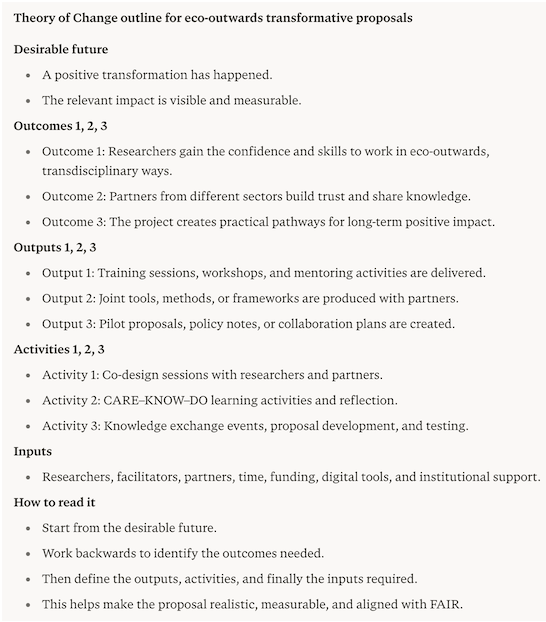
To plan this, we use a Theory of Change (ToC).
-
We start with the impact we want towards more fair, sustainable and resilient societies.
-
Then we work backwards:
What outcomes must happen first?
What outputs (tangible products) lead to these outcomes?
What activities produce these outputs?
What inputs (time, money, people, tools) do we need?
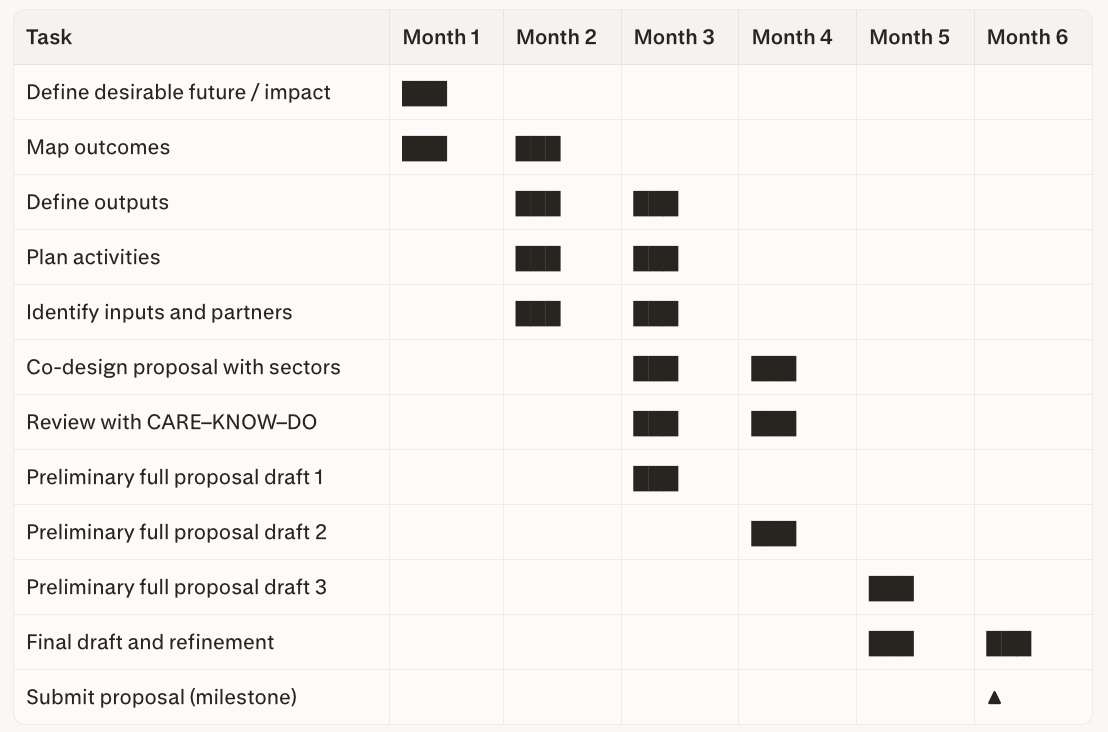
This backwards map then becomes a shared planning tool. Teams can agree who does what, when, and how this fits into a simple timeline (for example, a GANTT chart). Proposals should explain clearly how they will move along this chain from inputs to impact.
A GANTT chart is a simple timeline for your project.
-
-
Each task is shown as a horizontal bar, with its start date, end date and duration.
-
All bars are placed on one time line, so you can quickly see what happens when, where tasks overlap, and who is responsible for what
-
2. Why: Why we need eco‑outwards, engaging approaches
Today’s problems—like climate change and inequality—are complex. They need people who can work across disciplines and sectors, and who can co‑create solutions with others (not just study them).
Eco‑outwards projects answer this need. They show researchers as connectors: people who link knowledge from different fields, organisations and communities to create positive social and environmental impact.
Using a backwards‑mapped ToC makes it clear that impact is planned, not left to chance. Teams think from the start about how they will work together, learn from each other and turn ideas into action.
3. Who: The people involved
In METEOR, the main actors are doctoral candidates and early‑career researchers. They are supported to become:
“Eco‑outwards” in mindset and practice:
Connected researchers,
Project coordinators, and
Network leaders,
who can work confidently in transdisciplinary and intersectoral teams.
Around them is a wider eco‑system of partners:
academic supervisors and institutional leaders,
NGOs and community groups,
enterprises and social businesses,
government bodies and public services,
education providers and research centres, and
international partners
When using ToC, teams should bring these sectors into the conversation early. Together, they can discuss:
which impacts matter most to them,
how they will collaborate over time (for example, peer‑mentoring groups, cross‑institutional teams),
how partners will act as co‑researchers, co‑educators and co‑owners of the knowledge, instead of just “data sources.
In this way, the “who” becomes a living community of practice, not just a list of stakeholders.
4. When and How: CARE–KNOW–DO as a simple guide
METEOR uses CARE–KNOW–DO as a simple guide for when and how change happens.
-
CARE – what researchers care about
From the beginning, researchers think about their values, responsibilities and wellbeing. Short activities such as self‑assessment, ToC mapping and mentoring help them see how their personal story connects to fairness, sustainability and care for others. -
KNOW – What we understand and how we learn
Next, teams explore different types of knowledge. They compare views from different disciplines, listen to practitioners and communities, and learn about open science and responsible research. They practise asking good questions, dealing with uncertainty and building shared understanding. -
DO – What we actually do together
Then, during academies and follow‑up work, teams design and refine their TRIPS proposals. They use engaging methods—interactive workshops, challenges, scenarios and co‑creation sessions with partners—to turn CARE and KNOW into concrete plans, work packages and impact pathways linked to SDGs and Horizon Europe calls.
Because CARE–KNOW–DO is used throughout the project, the ToC is not a one‑off diagram. It is something teams keep revisiting as they learn more about their context and partners.
5. So what? What we learn for eco‑outwards proposals
Seen together, these ideas offer three simple lessons for anyone preparing a TRIPS proposal in METEOR:
-
Start from impact and work backwards.
Be clear about whose lives you want to improve and how. Use ToC to link your activities and outputs to real changes for people and planet, not just to interesting events or publications. -
Show how CARE–KNOW–DO supports impact.
Explain how your project will help researchers:– align their values and wellbeing (CARE)
– deepen and share understanding (KNOW)
– act together with partners (DO)This shows reviewers that researcher development is part of your impact pathway, not separate from it.
-
Tell a clear story about What, Why, Who, When/How and So what.
When your proposal clearly links:-
What you want to do
Why it matters
Who is involved
When and how CARE–KNOW–DO will guide the journey
So what for society and the environment
it supports METEOR’s wider aim: to make outward‑looking, ethical and transformative research the normal way of doing doctoral work, not the exception.
-
If you want, next I can compress this further into a one‑page handout or slide outline for apprentices to use during TRIPS workshops.
Example
This is a nice example: https://www.peoplepowered.org/news-content/introducing-a-global-theory-of-change-for-participatory-budgeting