50 objects for 50 years. No 28. Educating Rita.
Monday, October 29th, 2018In the 1980 play (and 1983 film) Educating Rita the OU was portrayed as a force not only for education, but for profound personal transformation of the eponymous student, who in turn changes the lives of those around her, including that of her tutor. Following a student from the time she overcomes the difficulty of entry to higher education – she is literally impeded, as she cannot open the door at the start of the play – to her final entrance and scene when she is calm and confident about her ability to succeed within the conventional academy, the emphasis was on personal liberation through learning. It positioned the OU as part of a long tradition of motivating forces within tales of women who through their own transformations transform others. Russell’s conventionally structured play echoes the tale (recounted by Ovid in the eighth century CE) of the sculptor Pygmalion, who fell in love with a statue he had carved. It also may have been inspired by the 1912 play by G. B. Shaw and a film, My Fair Lady, 1964. Russell did some of his research for the play at the OU and in the film course materials appear and are discussed. OU academic Gill Kirkup noted that while the play ‘purports to show the change in a mature women student who takes an Open University course’ it revealed (if it was ‘indicative of common beliefs’ about the OU) that the OU’s teaching system ‘seems to be widely misunderstood’. The OU’s pedagogy appeared to mimic that of the one-to-one Oxford college tutorial. Rita gains cultural capital through her trips to the theatre, does not mention watching the OU’s BBC broadcasts and is dismissive of the possibilities of learning through television. Nevertheless, the text was used to illuminate and support the OU’s mission. According to OU staff tutor Paula James, when students studied Pygmalion on the level one Arts Foundation course, A103 (which was presented 1998 to 2008), an Educating Liza sketch was presented for the arts event evening during the residential school week. ‘So Rita in one version or another has long been part of the OU fabric and culture!’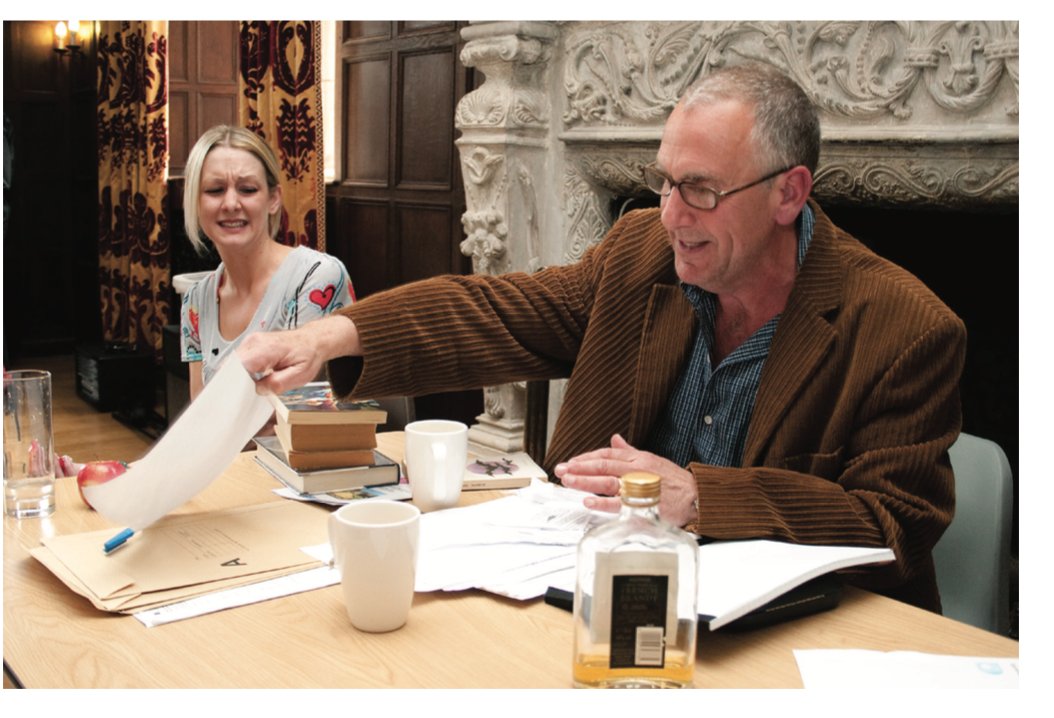
To celebrate forty years of the OU, in 2009, real-life Tutor David Heley and OU student Lisa Hubbard played Rita and Frank in a production of Educating Rita presented by the Open University in the South East with Pitchy Breath Theatre. This was part of the celebrations of The Open University’s fortieth birthday. The production toured the UK, playing in theatres, schools, community centres and prisons. In the written programme to accompany it there was information about the OU and links to the website. The Regional Director explained that although ‘Willy Russell’s play is not a very accurate presentation of Open University tutorials it does capture the excitement of learning with the Open University and the life changing experience which our courses can bring.’ Director and Actor David Heley said of a performance in HMP Swaleside that the audience there was ‘totally engaged’ and that ‘many of the prisoners said how they recognised themselves within the play’s action and meaning’.
In 1983 the play was deployed for marketing by the OU, which produced a flyer to accompany a professional performance.
| Part of an advertisement in the Educating Rita programme, Derby Playhouse, 7 September – 8 October 1983
EDUCATING RITA. YOU COULD BE A RITA TOO! As you watch Rita’s intellect developing throughout the play you might be tempted to ask ‘Could this really happen in everyday life?’ The answer is ‘Most definitely yes’ as thousands of adults have proved during the last thirteen years of The Open University. So far more than 57,000 have graduated with a BA degree and very many more have taken single one-year courses. There are no educational qualifications for The Open University, admission is on a rst-come, rst- served basis, and study mainly involves working at home. Of 5,945 students who graduated last year 17 per cent are housewives, 8 per cent are clerical and office staff and 8 per cent are technicians. 9 per cent had left school at 15. Nearly half of the graduates were women. |
In Educating Rita, as the play’s title implies, Rita is both being educated and educating others. Throughout the play there is a debate about the nature of learning and knowledge and the extent to which she is transformed by her own efforts compared to the influence of her tutor, Frank. Initially Rita feels that her mind is ‘full of junk’ and that a ‘good clearing out’ is required and that what she learns from Frank ‘feeds me inside’. She admits that she nearly wrote ‘Frank knows all the answers’ across her exam paper. In addition, she dismisses as ‘crap’ Howards End, a novel which involves co-operative learning between practical people and intellectuals. She expresses scepticism of the approach favoured by theorist Jean Piaget. She describes how at school the pupils would be having ‘a great time talkin’ about somethin’ and the next thing [the teachers] wanna do is to turn it into a lesson’.
As noted here perhaps one reason she changes is to fit into the academic world. She alters her accent from Scouse to that which the stage directions call a ‘peculiar voice’ but is then dismayed that she has become, in her words, a ‘freak’ and a ‘half-caste’. Echoing this, Frank refers to himself as Mary Shelley, author of a novel about the creation of a man-made person, Frankenstein. Having assessed the notion of learning as transmission, she then takes control of her own learning and makes only the changes that she requires. In addition, she is able to teach her tutor as well. Just as he asks questions, so does she. Asked why she did not attend a conventional university following her compulsory education she answers with a question: ‘What? After goin’ to the school I went to?’ Once Frank has suggested to her that ‘you’ll have a much better understanding of something if you discover it in your own terms’, she claims to have ‘begun to find me’ and she reverts to her previous name. She changes, but not into a typical student, at Frank’s ‘Victorian-built university’.
For her last appearance she does not, as she did before, unpack her notebook and pen. Instead she picks up some scissors and draws on her own skills, which she employs within the learning environment. She starts to cut hair. Neither Delilah nor Sweeney Todd, when Rita returns to hairdressing she wields the scissors in a more knowing fashion than at the beginning. This framing device indicates Rita’s circular route, her return to her roots, offering reassurance that, while learning changes people, the effects are likely to be positive. Rita, by taking flight from the humdrum, paradoxically took the university from where Geoffrey Crowther had placed it in his speech at its foundation, as ‘disembodied and airborne’, and brought it down to earth. In summarising its activities as ‘degrees for dishwashers’ Russell’s character domesticated the OU and placed it, reassuringly, if counter-intuitively, in front of the kitchen sink.