Archive for the ‘History of the OU’ Category

Visiting Canada

Sunday, November 14th, 2010

I’m visiting the Ontario Institute for Studies in Education which is part of the University of Toronto, Canada’s largest university. It is an international leader in the research, teaching and study of issues at the heart of education. Here one can study for degrees in Higher Education and also in the History and Philosophy of Education and it also runs a course in how to build a participative online learning community through online discussions and interactive learning sessions so it should be a good place to learn about the Canadian experience of distance education. A few years ago Jennifer Sumner sparked a debate within Open Learning with her ‘critical history of distance education’ , she now works at OISE and and I’m meeting her today.

Education using television

Monday, November 8th, 2010

The BBC produced adult education television and radio programmes prior to the creation of the OU and it also produced written materials to accompany many of these programmes.  One series, aimed at farmers, was broadcast in 1968. The Agricultural Producer at the BBC explained that each programme was clearly structured, sometimes the same film was shown twice in order to explain points but that every attempt was made not to patronize. (see Educational Television International, 2, ,2, June 1968, pp122-126. The booklet, pictured, was free on request and for those farmers who gathered to watch together there were also Tutor Notes which provided both additional background material and suggested topics for discussion.


The advertisement for a commercial television company (‘Look I’m five teachers’) dates from January 1969 and illustrates one of the cases made for the use of television for educational purposes.

This medium had long been conceptualised as of significance (in 1960 William Benton, one of those who played an important part in the OU’s foundation) said that it ‘could be the greatest force ever known to deepen our understanding and broaden our knowledge’ (W Benton, Television – a prescription: a national citizens’ advisory board, Vital speeches of the day, 26, 18, pp. 571-574, (p 572).

Certainly television helped secure the OU as part of the popular heritage of the UK. Much of the popular affection for the OU might well be due to the use of television for its broadcasts during a period when there were few channels available to UK residents. When Sheila Grant studied in the popular soap Brookside it was with the OU (and yes she was accused of having an affair with her tutor) and when in Life on Mars the central character receives comforting but complicated messages from across time and space, it was via late-night 1970s Open University programmes.

Antecedents on the wireless

Monday, November 8th, 2010

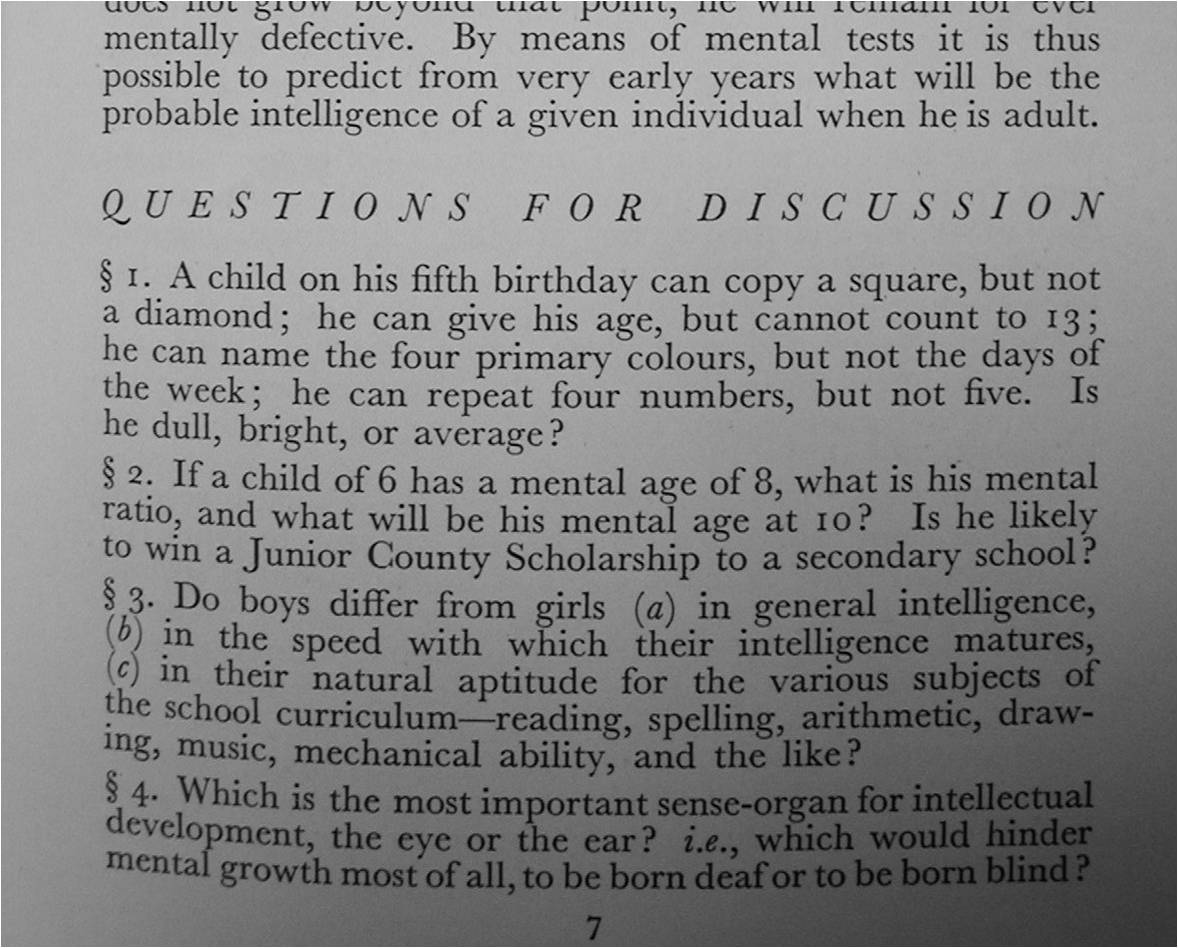
The BBC had a long history of producing discussion materials to accompany educational talks on the radio. This experience of combining material presented in one medium with that presented in another was of value when the university of the air was being designed. Thanks to Allan Jones and the BBC Archives for this image.

Experimentation by correspondence

Monday, November 8th, 2010


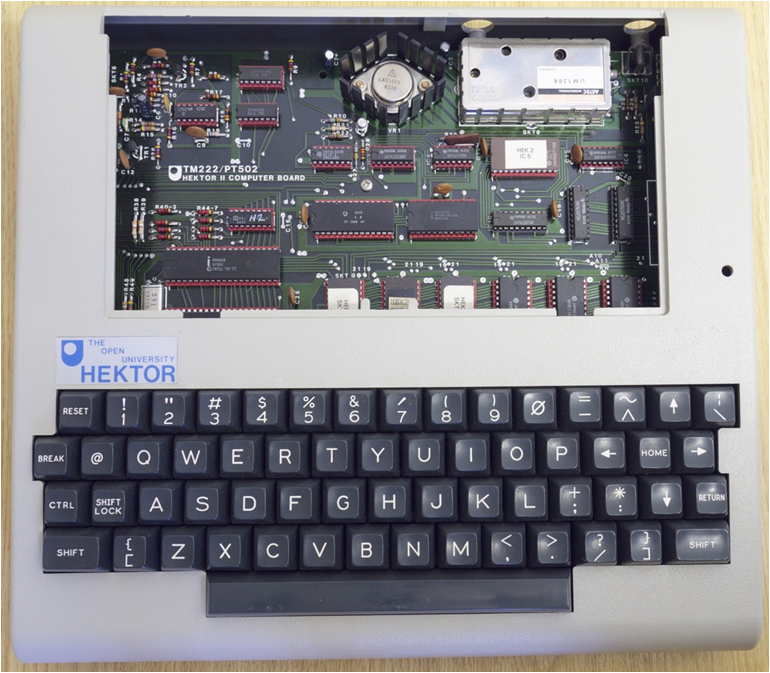
The notion of a correspondence course was transformed when the OU started to send out home experiment kits and computers by post. 

This is HEKTOR, a ‘home computer’ dating from 1982. It could be plugged into a TV which became its monitor and plugged into a cassette recorder for storage. Initially students were encouraged to write programs in BASIC but later it was used for other purposes, including on a control engineering course.

Instruction or construction?

Wednesday, November 3rd, 2010

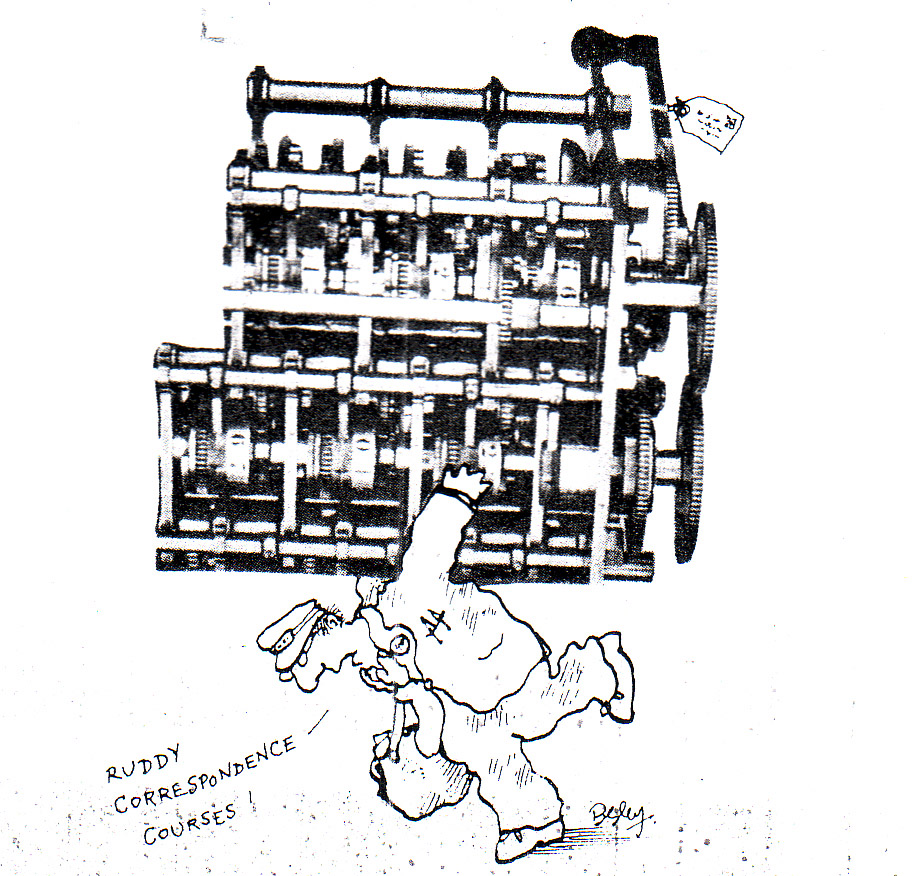
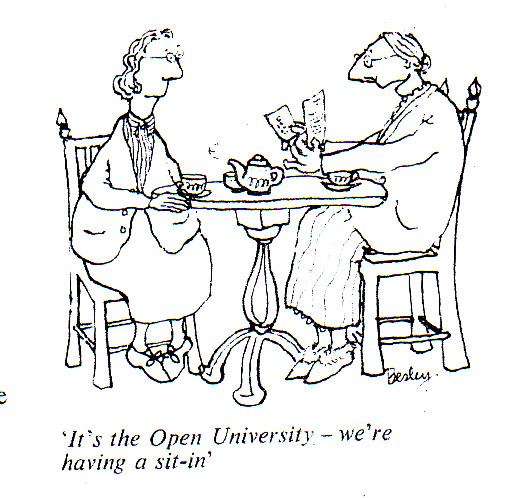
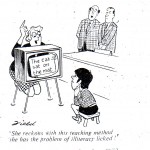
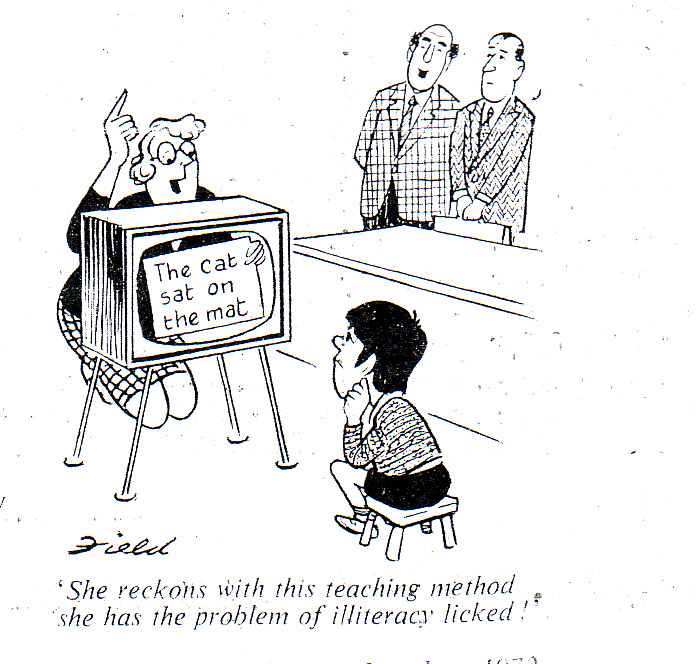
Perhaps in response to criticisms such as implied in these cartoons (ie that students were isolated and that the television was a badly-used fad) from early on many OU materials sought to minimalise the overt input of the lecturer and encourage learners to construct their own understandings. 

One cartoon features a couple eating breakfast and has the caption ‘it’s the Open University – we’re having a sit-in’ and the other one shows a woman with a fake television holding up a card stating, ‘The cat sat on the mat’. The caption refers to a conversation between the two men in the background: ‘She reckons with this teaching method she has the problem of illiteracy licked’.

In 1972 the intention of a psychology course film of children talking and teachers at work in schools was for the student to hear ‘not the analysis of a lecturer but the actual voices of teachers, children and parents… the filter of the lecturer’s personality has been effectively removed’. A sociology film made in the same year used a hidden camera in a hostel for ‘mental sub normals’. There was little editing as the aim was that students could form their own opinions and use it as a starting point for discussion. In 1976 Arthur Marwick (Professor of History at the OU) argued that his aim was ‘to leave each piece of film to speak for itself without being overlaid by an intrusive commentary’.
Happy Birthday Jennie Lee

Wednesday, November 3rd, 2010

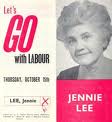
Today is Jennie Lee’s birthday.

Jennie was the Minister in Harold Wilson’s government responsible for setting up The Open University. It would be hard to argue that the OU would exist in its current form without her influence. For more information about her see here.

To celebrate we are hosting a workshop – Opening Up The Open University. For more information see here. There will be a full report of the workshop posted here over the next few weeks.

The verdict on Browne

Thursday, October 14th, 2010

Whilst others (for example here, here, and here) criticise aspects of the Browne report  published this week, particularly the huge additional burden to be placed on students and the increasing marketisation of higher education, the Open University appears to be the only progressive voice welcoming any of Browne’s recommendations.

This should come as no surprise. One of Browne’s recommendations is that ‘Part time students should be treated the same as full time students for the costs of learning.’ While the rest of Browne’s proposals can be debated, as those familar with the OU’s history will know, this particular recommendation has been a long time coming. If implemented this would effectively be the culmination of a campaign the OU has been waging since its foundation.

Official documents from the 70s, 80s, 90s right up to the present day consistently highlight the unfair treatment of part-time students, and the action being taken to lobby the government to redress this. Now the OU has launched a new campaign calling on the government to ensure part-time students in the UK get a fair deal. See www.fourinten.org.

Seasonal gloom

Friday, October 1st, 2010

In 1982 Open House reported that a fire in the Disabled Students Office, which caused £1,000 worth of damage, resulted from two Christmas puddings being placed on a Braille duplicating machine to heat up (Open House 196 February 1982).

The BBC move to Walton Hall

Friday, October 1st, 2010

In August 1976 Michael Drake asked why, in  view of the reluctance of many of the BBC staff to move to Milton Keynes, the OU could not work with ITV instead (Open House, 31 August 1976)? Despite this possibility being raised the BBC continued to be unhappy about moving the OU operations from Alexandra Palace to Milton Keynes. The argument was made that this was because this would adversely affect the relationship between the OU and the BBC. Deputy General Secretary ABS, P Leech, felt that the move

would lead to a dominance of BBC staff  by the OU, would lead to a greater involvement in the control over areas of legitimate BBC interest and that a move of this sort would lead to the BBC staff losing their identity with the Corporation (RGJ/JFW 24 April 1977 notes of a meeting of 24 March 1977)

There had been tensions betwen the BBC and the oU and this discussion occured shortly before a dispute between the BBC and the OU about The Balcony (probably Jean Genet’s play, Le Balcon which was set in a brothel). In 1977 the BBC banned this and was rebuked by the Chancellor at the Alexandra Palace degree ceremony (Open House, 24 May 1977,  OH 5 July 1977).

What should the regions do?

Friday, October 1st, 2010

Should the OU be more centralized? Zvi Friedman, who joined the OU in 1970 and was later the Senior Systems Analyst, thought it should: (more…)