
Author Archives: Helen Owton

About Helen Owton

Helen joined the Sport & Fitness team at the beginning of 2015 and weaved her expertise on gender in sport across the modules which focused on contemporary issues in sport. She is a psychologist and completed her PhD in Sport and Health Sciences at the University of Exeter. Helen enjoys boxing, cycling and running.

Blood, bruises and belief: how England’s women’s rugby team embody physical and mental endurance
Blood, bruises and belief: how England’s women’s rugby team embody physical and mental endurance

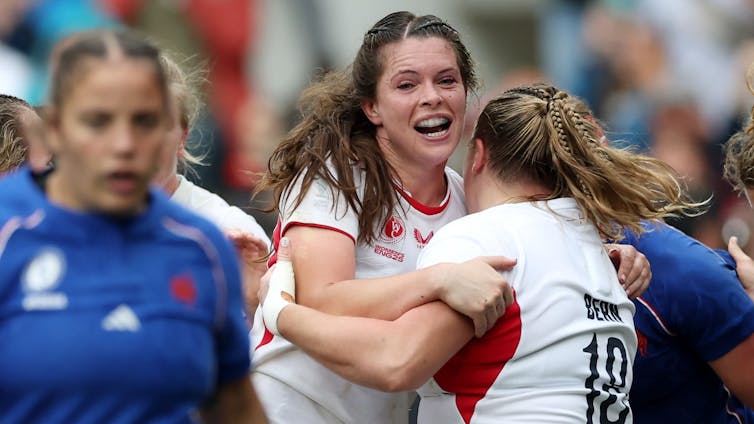
France v England Women’s Rugby World Cup Semi Final 2025.
Photo by Alex Davidson – World Rugby/World Rugby via Getty Images

Helen Owton, The Open University

As women’s sport surges on the global stage, hosts England have lit up the Women’s Rugby World Cup. But the tackles, speed and power fans see on the field are only part of the story. What we don’t see is what it takes – both physically and psychologically – to wear England’s emblem, the Red Rose.

The psychology of rugby shapes every performance. Behind the scenes lie early mornings, lonely and punishing rehab sessions, playing through pain, brutal setbacks, private doubts and personal sacrifices.

Before the whistle blows and the crowd roars, players stretch aching muscles, re-tape old injuries and mentally lock in. The changing room becomes a crucible – a place of intense pressure and transformation – where focus sharpens, rituals are repeated and the “game face” goes on.

That game face is more than a stare. It’s the product of years of physical and psychological battles. It’s the mindset that lets an athlete walk into the arena with purpose and conviction, no matter what pain or setbacks they’ve endured.

Consider Emily Scarratt, one of England’s most celebrated players. In 2023 a surgeon advised her to retire after a complex neck injury threatened her career. Opting for an artificial disc replacement near her windpipe was risky – any operation that close to the airway and spinal cord carries the danger of nerve damage or breathing complications – and career-defining because the operation’s success or failure would determine whether she could ever play again.

Her February 2024 return wasn’t just about regaining fitness. It was also about showing the mental steel that “game face” represents, blocking out fear and doubt to perform at the sport’s highest level. At 35, she became the first England player to feature in five Rugby World Cups.

Abi Burton’s comeback is equally astonishing. Just three years ago she was diagnosed with autoimmune encephalitis – a rare condition in which the immune system attacks the brain, causing inflammation and severe neurological symptoms – and placed in a medically induced coma. She woke four weeks later unable to walk, talk, read or write and more than 19 kg lighter. After years of rehabilitation, she made her World Cup debut against Samoa in 2025.

Rosie Galligan’s road back was just as brutal. She nearly lost her legs to meningitis in 2019, then fractured an ankle in early 2020, which sidelined her for over a year. Told by medical specialists and coaches more than once that she might never play again, she fought back to the delayed 2022 World Cup and is now a standout player for 2025.

These headline comebacks highlight something the public rarely sees: the daily grind of resilience. Managing concussions and torn ligaments, coping with the psychological toll of repeated setbacks; just staying in the game takes an immense toll and can lead to player burnout without strong support. Ellie Kildunne, ruled out of the quarter-final with head-injury symptoms, has spoken openly about the mental strength needed to survive the toughest moments, calling the internal battles “the hardest to win”.

So, while England may look clinical and composed on the pitch, every performance requires extraordinary emotional and mental strength. And the players are not doing it alone. Behind every recovery and every small gain is a network of coaches, physiotherapists, psychologists, doctors and support staff working to keep the foundations solid.

None of this happens by accident. It’s the result of years of sustained investment in the women’s game: not just in players, but in the infrastructure around them. Since 2009, nearly £50 million in National Lottery funding has gone into girls’ and women’s rugby.

The Impact 25 legacy programme – World Rugby’s initiative to grow the women’s game before, during and long after the 2025 tournament – is injecting a further £12 million to expand grassroots pathways: community-level coaching, clubs and player-development routes that help girls progress from school or local teams into elite rugby across England and the home nations.

Elsewhere the contrast is stark. Teams such as Samoa have had to fundraise just to get players on the pitch: a sharp reminder of the global inequalities that persist in women’s sport. While England can rotate two professional squads, other national teams are simply trying to cover basic costs.

England’s story shows what’s possible when talent is matched with belief and when belief is backed with resources and support. England’s success hasn’t come easy: it’s the product of years of grit, resilience and bold investment. If women’s rugby is to grow globally, England’s blueprint may be a powerful place to start.

Helen Owton, Senior Lecturer in Sport and Exercise Psychology, The Open University

This article is republished from The Conversation under a Creative Commons license. Read the original article.
Concussion, identity loss, depression: boxing’s toughest opponent isn’t in the ring – it’s mental health

Concussion, identity loss, depression: boxing’s toughest opponent isn’t in the ring – it’s mental health

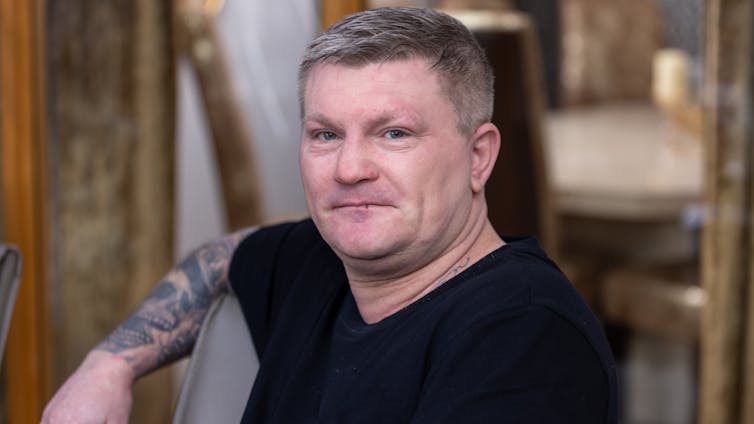
Hatton, who won 45 of his 48 professional bouts across an esteemed 15-year career, last fought professionally in 2012.
Go My Media/Shutterstock

Helen Owton, The Open University

Ricky Hatton’s death has reignited an all-too-familiar conversation about mental health in sport. Hatton had spoken openly about his long battle with depression, as well as the drug and alcohol addiction that began after his 2007 defeat to Floyd Mayweather.

Research shows that how a boxer thinks – their beliefs about success, identity and failure – can become harmful in the high-stakes context of the sport. The perfectionism and “must-win” mindset mean even a single loss can feel catastrophic.

The constant pressure of “winning at all costs” has negative consequences: for some, losing a fight is not just a professional setback but an identity crisis, laced with shame, guilt and a sense of personal failure.

This danger is especially acute for fighters who rise from humble beginnings to fame and glory. For a boxer, the fear of irrelevance or of being forgotten can trigger depression, anxiety and despair. When vulnerability is seen as weakness, many simply bottle up their emotions, compounding their internal struggle.

Hatton himself acknowledged in 2020 that mental-health problems are widespread in boxing. The sport is brutal by design, subjecting fighters to repeated blunt-force trauma to the head and body. Traumatic brain injury (TBI) is an accepted risk.

This trauma has been linked to a wide range of acute, subacute and chronic neurological and psychological complications, such as concussion, post-concussion syndrome (when the symptoms of a concussion don’t fade after the usual recovery period but linger for months or even longer), depression, anxiety, cognitive decline and movement disorders, and in some tragic cases even death in the ring.

Repetitive TBI is associated with chronic traumatic encephalopathy (CTE), a progressive disease once colloquially known as “being punch drunk”. CTE affects memory, mood and behaviour and is among boxing’s most severe long-term health risks.

While head trauma is a physical injury, its impact on mental health is profound. Damage to the brain can impair emotional regulation, increase impulsivity and heighten vulnerability to depression and suicidal thoughts. Yet for all this risk, boxing offers very few long-term support systems – something Hatton himself criticised.

Outside the ring, boxers face other pressures that rarely make headlines. The extreme weight cuts required for competition can alter brain chemistry and destabilise mood. The punishing solitude of training camps and the stress of maintaining a public persona feed into chronic stress.

Then there is the challenge of early retirement. Most athletes have a short competitive life, often retiring in their thirties – a transition many struggle with. Instead of relief, retirement can be a rupture: daily structure disappears, the roar of the crowd fades and with it the sense of purpose, identity and belonging.

With their athletic identities tied so closely to performance and public image, stepping away can feel like vanishing. Many athletes retire without financial security, career direction or a support network, leaving them exposed to loneliness and psychological decline.

Boxing has long offered a ladder out of working-class hardship to fame, fortune and respect. Hatton, like Tyson Fury and Frank Bruno, rose from humble beginnings to become a world champion and national hero.

But the climb from gritty local gyms to Las Vegas spotlights can be steep – and the fall steeper still. The gulf between where fighters start and where they end up can create a deep sense of dislocation. For working-class athletes, the pressure to stay strong, stoic and successful, even when struggling inside, can be overwhelming.

This is intensified by boxing’s enduring culture of hyper-masculinity. The “show no weakness” mentality may breed champions in the ring, but it can be deadly outside it. The sport’s traditional ethos – resilience, toughness, silence – often prevents fighters from seeking help. The stigma around mental health means many endure private battles in silence, where loneliness prevails.

The sport teaches resilience, emotional control, body awareness, the physical self-control that comes from disciplined training, mental focus and self-belief. For some, boxing gyms are sanctuaries that offer structure, mentorship and a reinvention of the self, especially for those overlooked or underestimated by society. But the sport also reveals the danger of fighting your battles alone.

The challenge now is to shift boxing’s culture so that vulnerability weighs as much as valour and to ensure support doesn’t end when the final bell sounds. Initiatives such as The Frank Bruno Foundation offer rare lifelines. Founded after heavyweight champion Bruno’s public battle with bipolar disorder, the foundation uses non-contact boxing and wellbeing programmes to show that true strength also means seeking help.

England’s Box In Mind, backed by Great Britain boxer Jordan Reynolds, who has spoken openly about his own mental-health struggles, urges others not to suffer in silence.

After news of Ricky Hatton’s death, Chris Eubank Snr urged the boxing industry to “look after their fighters”. With proper mental-health support, medical screening, career-transition programmes and open conversations about emotional wellbeing, boxing can continue to transform lives long after fighters hang up their gloves. Winning at all costs should never mean losing yourself outside the ring.

Helen Owton, Senior Lecturer in Sport and Exercise Psychology, The Open University

This article is republished from The Conversation under a Creative Commons license. Read the original article.

“Resilience isn’t enough”: why the growth of women’s football could lead to player burnout

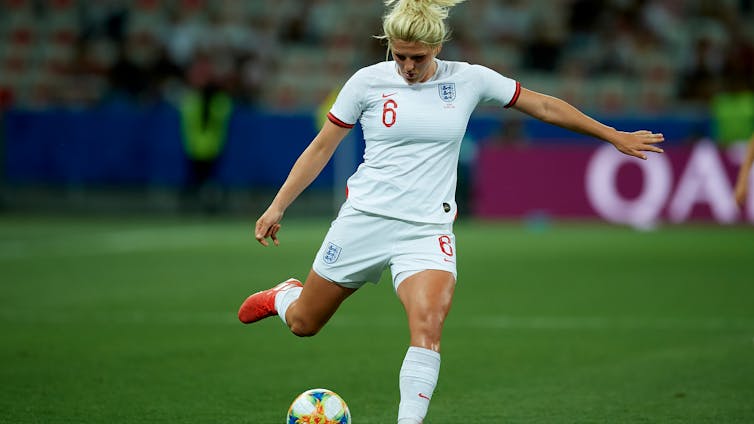
Millie Bright (Chelsea Fcw) of England shooting to goal during the 2019 Fifa Women’s World Cup in France.
Jose Breton- Pics Action/Shutterstock

Helen Owton, The Open University

Women’s football has exploded onto the global stage. Record-breaking crowds, major sponsorships, elite athletes and huge media deals have transformed the sport into a fast-growing spectacle. Its rise may be inspiring, but behind the success, many players are struggling with the growing physical and mental demands of the modern game.

As the game becomes faster and more physically intense, players are expected to deliver top performances across crowded domestic seasons, international tournaments and growing commercial commitments.

Recovery windows are shrinking, while the pressure to remain at peak performance only grows. Physiotherapists have already warned that many female players face burnout, overtraining and a rising risk of injuries due to inadequate rest and recovery time.

With growing visibility also comes increasing scrutiny. Female players now live under the spotlight of social media, where they are expected not only to perform, but to lead, inspire and remain endlessly positive – often while facing online abuse.

Chelsea and England star Fran Kirby has spoken openly about the criticism she has received about her body, especially after injuries or illness when she wasn’t at peak fitness.


Get your news from actual experts, straight to your inbox. Sign up to our daily newsletter to receive all The Conversation UK’s latest coverage of news and research, from politics and business to the arts and sciences.


“I get called fat all the time,” she has said, highlighting how online abuse adds another layer of psychological strain that isn’t always visible, but can be deeply harmful.

Mental health is increasingly part of the conversation around women’s football, but real support remains patchy. After the tragic suicide of Sheffield United’s 27-year-old midfielder Maddy Cusack in 2023, the FA commissioned a report into mental health support across the Women’s Super League (WSL).

More players are speaking publicly about the pressures of anxiety, burnout and emotional distress, but access to professional psychological care still depends largely on the resources of individual clubs.

For some players, the psychological toll deepens even further after injury. One study found that professional female footballers are nearly twice as likely to experience psychological distress after undergoing surgery. Yet mental health support during injury recovery remains inconsistent across the WSL.

Millie Bright’s story offers a recent example. The Chelsea and England defender missed much of the 2023-24 season due to injury and, in 2025, withdrew from the England squad citing burnout. She eventually underwent knee surgery and chose to prioritise her rehabilitation over international duty, highlighting the difficult choices players face when balancing physical and emotional wellbeing.

Governing bodies and clubs have a crucial role to play in safeguarding players’ wellbeing. Yet Uefa has come under fire for putting commercial growth ahead of player welfare with its expansion of the women’s Champions League into the new “Swiss model” format.

Instead of facing three opponents twice, teams will now play six different teams during the league phase, splitting those matches home and away. While the extra fixtures may boost visibility and revenue, they also add to an already punishing schedule, heightening the risk of fatigue, injury and burnout for players who are already stretched to the limit.

Financial security remains another major challenge. Some WSL players reportedly earn as little as £20,000 a year, forcing many to juggle full-time jobs or academic studies alongside football.

For mothers in the game, the demands are even higher, as they manage childcare, training, travel and recovery with little institutional support. Maternity policies remain inconsistent, and many players face intense pressure to return quickly to peak form after pregnancy.

Extraordinary resilience

Despite these enormous challenges, female players continue to demonstrate extraordinary resilience, paving the way for the next generation. But as a 2024 Health in Education Association report notes, resilience alone isn’t enough. Without proper investment in both physical and mental health services, the long-term wellbeing and careers of these athletes remain at risk.

While mental toughness is often celebrated, research shows that resilience depends heavily on the support structures available. In the WSL, access to mental health care and sports psychology varies dramatically between clubs.

The FA has announced plans to make wellbeing and psychology roles mandatory in WSL licensing, which is a positive step. But for many players, consistent, high-quality support remains far from guaranteed.

There is no doubt that women’s football has finally gained the attention it deserves. But progress must not come at the cost of player welfare. A sustainable future for the sport means investing not just in performance, but in protection: standardised access to physiotherapy, sport psychology and wellbeing professionals for all players, across all clubs.

If the game truly wants to thrive long-term, it must create a culture where players aren’t just expected to perform, but are supported to rest, recover and speak openly about their mental health – without fear, stigma or consequence.The Conversation

Helen Owton, Lecturer in Sport and Fitness, The Open University

This article is republished from The Conversation under a Creative Commons license. Read the original article.

The quiet contender of Switzerland hosts Euro 2025

By Dr Helen Owton

With the 2025 Euro Championships coming up, this article explores this year’s tournament and who to watch out for.

Find out more about The Open University’s Sport and Fitness courses and qualifications.

As women’s football continues its rapid global rise, in 2025 all eyes turn to an unexpected yet compelling stage: Switzerland (UEFA, 2025 ). Long considered a quiet contender in the sport due to its slow comparative progress, the Alpine nation now finds itself in a leading role as it prepares to host the UEFA Women’s Euro 2025 where global TV audiences could exceed 500 million (Gardner, 2024 ).

While there were earlier attempts to recognise the women’s game in Switzerland, formal engagement with women’s football began late, with official recognition by the Swiss Football Association only in the 1970s (UEFA, 2022 ). For decades, the Swiss Women’s Super League (formally named Nationalliga A) remained semi-professional, limiting domestic opportunities for female athletes (Le Low, 2025 ). While, the country is steadily investing in its football infrastructure, player development, and opportunities for women on and off the pitch, progress is slow. 

Beyond the pitch

Crucially, the game plays a powerful role off the field. In a country where over 25 per cent of the population is made up of foreign nationals, football has become a vital tool for social integration; helping foster community, develop language skills, and build connections, especially among immigrant women (Zwahlen et al., 2018 Bartosik, 2018 ).

Euro 2025, then, is more than just a tournament. It’s planning to be a platform for promoting inclusion, belonging and civic engagement (UEFA, 2025 ).

To reflect this inclusive vision, matches will be held across eight cities including Zurich, Basel, Bern, Geneva and Sion (UEFA, 2025 ).

Stade de Tourbillion, Sion

Organisers have intentionally structured the matches into regional clusters to ease travel for fans and players; encouraging national engagement and local pride while minimising regional disparities (UEFA, 2025 ). The tournament will not only increase the sport’s visibility domestically but is already driving investments in infrastructure, grassroots programs and media attention – setting the stage for a lasting legacy (UEFA, 2025 ).

Hosting Euro 2025: a national milestone

The Swiss national team qualified for their first FIFA Women’s World Cup in 2015, reaching the Round of 16, and repeated this success in 2023 (FIFA, 2023 ). They have also participated in consecutive UEFA Women’s Euros (2017 and 2022), albeit exiting in the group stages (UEFA, 2024 ). With the home crowd behind them, cultural momentum on their side, and football’s broader social impact in focus, how far can Switzerland go?

Switzerland’s chances at Euro 2025

Under the leadership of experienced coach, Pia Sundhage, Switzerland has shown glimpses of potential with a hard-fought 1-1 draw against Australia  in a friendly. Switzerland enters Euro 2025 as the host and automatic qualifier, placed in Group A alongside Norway, Iceland and Finland (UEFA, 2024 ). It’s a group filled with balanced yet formidable competition, but Switzerland have their work cut out after they were relegated in the UEFA Women’s National League finishing with just 2 points (Shelat, 2025 ). Euro 2025 power rankings  rank Switzerland as thirteenth.

Teenager Sydney Schertenleib  (18 years old) remains one to watch on the Swiss team – she plays as a midfielder for Primera Federación club FC Barcelona. Too many of their experienced core of players, such as Luana Bühler  (defender for Women’s Super League club Tottenham Hotspur), are injured  might not recover in time. Norway (ranked eighth) poses the greatest threat, while Iceland (ranked twelfth) and Finland (ranked fifteenth) are the weaker teams which make for an unpredictable group stage.

‘Home advantage’

Switzerland is placed as an ‘outsider’, but several factors could tip the balance in their favour – chief among them: home advantageHome advantage  is a phenomenon which has been a hotly debated contentious issue but appears to be very real. Research  suggests that home teams in sport competitions win over 50 per cent of games played under a balanced home and away schedule.

Playing on familiar soil  in front of home crowds across cities like Basel, Geneva and Bern could prove crucial. The emotional lift from local supporters, coupled with minimal travel demands and familiarity with the venues, offers a tangible boost . Historically, host nations  in major tournaments often outperform expectations, and Switzerland will hope to draw on that energy to fuel a deep tournament run. With the country rallying around the team and national pride at stake, Euro 2025 may well be Switzerland’s moment to exceed expectations if momentum builds and inspire the next generation of players and fans.

England and Wales

Meanwhile, England are ranked third and are in a tough group  with France, the Netherlands and Wales. Despite losing three high profile England players – Millie Bright (defender), Fran Kirby (midfielder) and Mary Earps (goalkeeper) – Sarina Wiegman is feeling ‘good’ about their chances at the Euros. For Wales, 2025 marks their first ever appearance  in a major international football tournament. This reflects years of growth and investment in the sport and is expected to inspire future generations and elevate the profile of women’s football in Wales . England and Wales will compete against each other on 13 July 2025 and all games in the UK will be aired on either BBC or ITV .

Take a look at who plays where and when .

London marathon: why you need a plan to prevent the post-race blues

IR Stone/Shutterstock

Helen Owton, The Open University

As the sun rises over the river Thames on marathon day this year, tens of thousands of cheering spectators will fill the streets and a record-breaking 56,000 adrenaline-fuelled runners will gather at the starting line of the TCS London marathon.

At the start of the gun, the stampede of runners will surge forward bringing the streets of London alive with the rhythmic thud of trainers, the sweat of determination, and the roaring of the crowd shouting: “Come on, you can do it!”

The race isn’t just about competition; it’s a celebration of perseverance, passion and overcoming adversity. “Every marathon is up and down, very emotional” says “Britain’s bladerunner” double Paralympic gold medallist Richard Whitehead, who holds the Guinness World Record for fastest double amputee marathon in 2024.

At the finish line, exhaustion is mixed with triumph and runners share in a sense of collective achievement. But, once the race is over, it’s back home to daily tasks; the gruelling demands of the training schedule vanish, and the highs of the marathon can fade quickly.

The low after the high

While marathon runners usually experience a great sense of accomplishment and euphoria after completing a race, it can often be followed by a lingering sense of emptiness.

A 2024 study found that endurance athletes often face a mixture of emotions after a race, both physically and mentally. Their feelings seem to depend on factors like how much time they spent training and their ability to set new goals for the next phase of training.

A comedown after a major event is a common experience for many athletes. After the months of intense training, physical exertion and the emotional high of participating in such a momentous event, the mind and body can experience a crash and “post-marathon blues” can set in as the excitement, adrenaline and sense of purpose and meaning fades.

The post-marathon blues describes mild depression and feelings of emptiness. It’s characterised by increased anxiety levels, depression, burnout and challenges in adjusting back to everyday life.

Set goals, rest and recover

Marathon runners report that it can take between one to eight weeks before they feel their wellbeing return to pre-race levels. While setting goals ahead of time could help alleviate negative emotions after the marathon, attempting to achieve another goal too soon also has its risks, including injury and training plateau.

Eddie Izzard, who ran 43 marathons in 51 days in 2009 and 31 in 31 days in 2020 has been open about the physical toll of running multiple marathons. For some, though, marathon running is a way of life, as “ ultramarathon man” Dean Karnazes explains:

I run because if I didn’t, I’d be sluggish and glum and spend too much time on the couch. I run to breathe in fresh air. I run to explore. I run to escape the ordinary. I run … to savour the trip along the way. Life becomes a little more vibrant, a little more intense. I like that.

Setting a new goal, however, doesn’t have to be another marathon or even another sports-related goal. Reflect on and enjoy the sense of achievement from running a marathon and channel this into other aspects of your life and explore other interests like a DIY project or a hobby.

A post-marathon plan is just as crucial as the pre-marathon training schedule. Proper recovery and continued maintenance of your physical and mental wellbeing are essential for long-term performance, injury prevention and overall health. While there is no one-size-fits-all recovery plan, some suggest a phased recovery, building up to a return to training after adequate recovery time.

In the end, post-marathon blues is a real challenge. Despite the euphoria of such an incredible achievement, experiencing negative emotions is inevitable and something you might not be able to avoid. But post-marathon blues doesn’t have to define the journey. It’s all part of the process. And athletes, if physically and psychologically prepared, can turn the finishing line into a new starting point.The Conversation

Helen Owton, Lecturer in Sport and Fitness, The Open University

This article is republished from The Conversation under a Creative Commons license. Read the original article.
Tackling abuse: the triumphs of women rugby players

By Helen Owton

Sportswomen continue to break barriers despite facing a disturbing level of online abuse that goes beyond their athletic abilities.

From body-shaming  to sexist comments, the digital world has become a toxic space where female athletes are frequently targeted for their appearance, strength, or refusal to conform to traditional gender norms and expectations. These challenges, however, highlight the resilience and triumphs of women in sports, as they push back against gender inequality and break down barriers redefining what it is to be an athlete.

How can we better support women rugby players as they rise as a force of nature, tackling both the physical and mental demands on the pitch and the discrimination and harassment they face off it?

Dealing with trolls

Ellie Kildunne  a Full Back in International rugby, playing for England and Harlequins, and World Player of the Year , spoke out about her experiences of dealing with trolls. She has had to deal with sexist trolls who criticise her body and tell her to ‘get back in the kitchen ’. Also, she highlights that being in a male-dominated sport means that she probably experiences trolling a lot more.

Ellie Kildunne runs with the ball during the England Red Roses training session at SGS College

Ellie Kildunne runs with the ball during the England Red Roses training session at SGS College

Sadly, these comments are not new, particularly for women who play rugby. In the 2012 Olympics, Rugby athlete Heather Fisher , was criticised for her appearance. Fisher experiences alopecia – or hair loss – and works as an advocate for others with the same condition. Comments on twitter questioned her womanhood, saying they were ‘not convinced’ that she is ‘female’ and that she’s ‘the manliest woman I have ever seen’. 

Heather Fisher of Great Britain makes a break past Stacey Flood of Ireland

Heather Fisher of Great Britain makes a break past Stacey Flood of Ireland

Studies  reveal that female elite athletes are exposed to different forms  of body-shaming and are a form of emotional abuse .

Widening narrow beauty standards

Rugby is a dynamic game combining elements of skill, strength, speed and team strategy. Yet when women run too fast, kick too hard, or look too muscular, they are subjected to abuse. Rugby is known for its emphasis on respect and sportsmanship, both on and off the field. At the same time as being world-class athletes, sportswomen are expected to be physically appealing (e.g., wear make-up, paint fingernails), while photographs of sportswomen in the media are generally more likely to be sexually suggestive . However, there has been a trending movement in football which has been viewed as widening narrow beauty standards . Those who defend this state of affairs often say it’s a way to attract fans and endorsements to women’s sports – yet women athletes are still paid less than men . Additionally, whilst media coverage in women’s sports has nearly tripled, their games are given less air time .

Men are not immune from discrimination and abuse in sport either. In some ways, men face more limitations on what physical traits are deemed acceptable, thanks to society’s particularly narrow ideas about masculinity. A study by World Athletics  revealed that racism constituted 26% of the abuse directed at male athletes, while female athletes faced a combination of sexual and sexist abuse. (Neal Maupay on social media abuse: ‘To ignore it is not the solution’ | Brentford FC )

Neal Maupay of Brentford celebrates scoring his team's first goal during the Premier League match

Neal Maupay of Brentford celebrates scoring his team’s first goal during the Premier League match

Women and men who do not conform to expectations about their respective genders are often targets for abuse. This is because they threaten traditional attitudes about the appropriate roles, rights and responsibilities of women and men in society. Indeed, human beings can feel uncomfortable when other people do not fit neatly into categories, because it challenges preconceived ideas about what it is to be ‘normal’.

But as more people embrace identities that exist outside the conventional male/female binary classification system, society is forced to confront the complexity of gender.

Has this change resulted in even stricter or more rigid classification, for example in sport, where physical traits are often used to determine eligibility? Rather than broadening the understanding of gender to allow for a more inclusive spectrum, certain systems may have inadvertently reinforced narrow, essentialist ideas of what it means to be ‘truly’ male or female. It seems that the boundaries of what is acceptable in sport to be a man or a woman has become even narrower. So perhaps it is a cultural reluctance that needs addressing.

‘Lad culture’

While ‘lad culture ’ can sometimes foster an environment where unhealthy behaviours, such as bullying, harassment, and discrimination are normalised, it can also create a strong sense of camaraderie and support among friends, fostering loyalty and teamwork. However, when these behaviours cross the line into exclusion or reinforce narrow ideals of masculinity, they can contribute to a toxic atmosphere. In some cases, this culture may trivialise harmful actions, such as dismissing online abuse as ‘banter ’.

Watching women play rugby, however, offers a positive shift. It’s a chance to appreciate the sport itself, the incredible athleticism, and the dedication of the players, regardless of gender. When anyone plays sport, they are judged but Heather Fisher, ex-rugby international player and advocate of resilience says, ‘Knowing who you are and having emotional intelligence are the most important things !’

As the Women’s Rugby Six Nations 2025  kicks off on Saturday 22 March 2025, it’s important to remember these incredible athletes are not only competing for victory on the field but are also breaking down barriers and challenging outdated norms off the field.

By watching women’s rugby  and supporting these athletes, we play a crucial part in supporting our local teams, our communities, our country and fostering a more inclusive and respectful environment for all sportswomen. Every match is an opportunity to celebrate strength, skill, resilience and determination, and to show that women in sport deserve the same recognition, respect, and admiration as their male counterparts.

Originally published on OpenLearn

Women’s Sport: Insights from a Researcher’s Journey

By Dr Helen Owton and Lorna Stevens

Have you ever witnessed the electrifying rush of motorcycle racing and then realised you’re watching women? The roar of the engines, the speed, the exceptional skill, the intense focus: it’s more than just a race for many women, it can be a fierce battle for empowerment and mastery.

Find out more about The Open University’s Sport and Fitness courses and qualifications.

But what drives these women to race motorcycles at the highest levels where the stakes are so high? And what inspires others to take it even further, diving into research with a PhD to uncover the untold stories of women in motorcycling? Lorna Stevens talks about her own experiences of competitive motorcycling and her motivations to pursue a PhD in this field.

Getting into competitive motorcycle racing

Women can get into motorcycling through the influence of fathers, brothers or partners who introduce them to the thrill of the sport. Others can be drawn to the freedom and independence it provides, especially in areas with limited public transportation. Media representations and the influence of supportive communities, such as women’s motorcycle clubs, also play key roles in inspiring women to pursue motorcycling. These connections can spark a passion, igniting a desire to push boundaries. Listen to Lorna’s background and how she got into competitive motorcycling.

Transcript

Why ride?

Women riding motorcycles often experience a powerful mix of empowerment, exhilaration, and intense focus. The sense of mastery and independence that comes from controlling a powerful machine in a traditionally male-dominated sport provides a strong feeling of personal achievement. The adrenaline rush of high-speed racing can be both thrilling and addictive, fuelling their passion for the sport. Additionally, women describe entering a state of deep concentration, where they are fully immersed in the experience, responding instinctively to every turn and vibration. Listen to Lorna describe how she enters ‘a bubble’, commonly referred to as ‘the zone’.

Transcript

Sudden moments

Women riding motorcycles describe sudden, memorable moments that are intense, life-changing, and emotionally significant (Owton, 2022a). These moments can range from unexpected challenges, like a dramatic crash or near-miss, to profound experiences of personal growth or realisation, such as a shift in focus or mindset during a race (Owton, 20212022a2022b). Some women reflect on feeling moments of clarity or vulnerability, such as when they realise the risks involved or when their priorities shifted due to life events. Listen to Lorna describe some of her sudden moments which include a major crash and getting back on the bike after having had a baby.

Transcript

Why do a PhD on women’s motorcycling?

Women can be driven to pursue a PhD in fields like competitive motorcycling by a deep personal passion for the subject and a desire to contribute to underexplored areas of research. Many are motivated by a strong interest in addressing gender disparities within the sport or by the desire to further understand and document the unique experiences of women in motorcycling. Personal experiences, such as overcoming challenges in the sport, may also inspire women to delve into academic research to better understand the barriers and opportunities that women face. For some, as is the case with Lorna, the pursuit of a PhD represents the culmination of long-held academic aspirations, while for others, it becomes a way to blend personal passion with scholarly inquiry to make a lasting impact on the field. There are many positives of sportspeople completing a PhD in sport. Listen to Lorna’s motives of pursuing a PhD and what she hopes to find out.

Transcript

For many women who engage in motorcycling and competitive motorcycling, the appeal appears to lie in the adventure, thrill, and personal challenge, as well as the opportunity to develop new skills. The thrilling sight of women racing motorcycles isn’t just about speed – for those who dive into the world of competitive motorcycling or pursue a PhD in this field, it’s about more than just a personal challenge; it’s about carving out space, overcoming barriers, and rewriting the rules. Women are not only changing the landscape of women’s sports, they’re creating a legacy that will inspire generations to come.

Transcript

If you’re interested in completing a PhD in women’s sporting experiences, then explore the opportunities online at the OU or get in touch with Dr Helen Owton.

Originally published on OpenLearn

Pushing through the speed barrier: trailblazing women in motorsport

By Dr Helen Owton

Explore how women are increasingly breaking into the traditionally male-dominated field of motorsport in this article.

Find out more about The Open University’s Sport and Fitness courses and qualifications.

The beginnings …

For decades, motorsport has been a male-dominated arena, with women constantly having to challenge not just their competitors, but entrenched barriers. Yet, as the world evolves, so too does the world of sport. Women are now pushing through these limitations, proving their grit and skill at the highest levels of racing. Their path has been anything but smooth, as motorcycling faced fierce opposition to female participation. When Beryl Swain became the first woman to race in the Isle of Man TT in 1962 , finishing in a remarkable 22nd place, the Fédération Internationale de Motocyclisme (FIM) banned women from competing, declaring it an unsuitable activity for women. One reporter summed up the misogynistic sentiment of the time: ‘Women, the weaker sex, are muscling in on man’s domain, practically no sport is sacred’. See also: Isle of Man TT: Meet the thrill seeking women who dare  and A concise history of the Isle of Man TT: stories of legends and leathers .

But the story didn’t end there. In 1978, Hillary Musson became the 2nd woman to race a solo motorbike round the TT  finishing in an even more respectable 15th place. Fast forward to 2005, when Maria Costello made history as the first woman to claim a podium finish in a solo race at the Isle of Man TT – one of the most dangerous and prestigious events in motorsport. These women’s success paved the way for other women to make their mark, including Carolynn Sells, who in 2009 became the first and, as of 2024, the only woman to win a solo race on the iconic TT mountain course. As a rider who has ridden round the mountain course, I can only imagine the speed at which these women flew!

In the world of the British Superbike Championships (BSB), Jenny Tinmouth  firmly established herself as the most accomplished female racer to date. In 2011, she became the first woman to compete in the BSB. She also holds the record as the fastest female rider at the Isle of Man TT, reaching an average lap speed of 119.945mph in 2010 – surpassing Maria Costello’s Guinness World Record of 114.73mph set in 2004. Beyond racing, Tinmouth has made her mark as a stuntwoman in blockbuster films, most notably Mission Impossible: Rogue Nation alongside Tom Cruise.

Jenny Tinmouth

Trailblazing women

These women have not only shattered records but are now guiding the next generation of female riders. Maria Costello, in partnership with FHO Racing , is mentoring young women with the goal of helping them reach the top levels of racing. The FHO Racing initiative, founded by Macanese businesswoman Faye Ho, is dedicated to nurturing emerging female talent, breaking down the gender barriers that have long existed in the motorsport world.

With their support, riders like Costello are helping pave the way for the stars of tomorrow. The FIM also launched the inaugural Women’s Circuit Racing World Championship in 2024 , providing a global platform exclusively for female racers, showcasing the ever-growing opportunities for women in the sport.

Watch the following video: Maria Costello’s role in raising the next generation of female motorcycle racers . And you can hear from Maria Costello in The BBC Bikes Podcast, Maria Costello: The Racing Drug .

Women in Formula 1

But motorsports aren’t just about racing – they’re about creating lasting change. Susie Wolff has played a pivotal role in advancing the achievements of women in motorsports  by paving the way in her achievements and creating the conditions through her role as Managing Director in the F1 Academy. The F1 Academy, which saw Abbi Pulling dominate the 2024 season , clinching the title with nine wins and 14 podiums, is a testament to the success of her leadership. Wolff’s efforts have been instrumental in shaping the future of women in motorsport and the impact is undeniable.

Susie Wolff

Just recently, Bianca Bustamante made history as the first female in McLaren’s Driver Development Programme. Meanwhile, Jessica Hawkins, Head of F1 Academy at Aston Martin Aramco , will represent Arm in 2025 as an Official Ambassador, championing opportunities for women in motorsport. Jamie Chadwick has been selected as the Grand Marshall for 63rd Annual Rolex 24 at Daytona  meaning a woman will give the command to start engines for the twice-around-the-clock race at Daytona.

The most recent and exciting announcement in motorsport is the news that Laura Mueller has been promoted to the role of Race Engineer by Haas . While there is an increasing number of female engineers working in senior jobs in F1, Mueller is set to be the first to work in the role of race engineer. As a race engineer, she will work most closely with Esteban Ocon on the set-up and running of his car and will be the main link between the driver and the team on the track through radio communications. Additionally, Carine Cridelich will join Haas as new Head of Strategy after moving from their rivals Racing Bulls. These are just a few of the landmark achievements that underscore the growing impact of women in motorsport, and justify the increasing prize funds for 2025 .

Breaking barriers

This momentum of women in motorsports is accelerating faster than ever, with barriers being smashed and records being broken at every turn. Women are proving they belong at the top. In motorcycling, Ana Carrasco “beat the boys” by winning the World SuperSport 300 Championship race . Additionally, Sells beat the men on the mountain with a time of 1:25.24.51 on a 400cc Yamaha. The latest outright fastest time for Isle Man TT is held by Peter Hickman (16:42:778) in 2024 which is approx. 2.10 minutes faster than Tinmouth’s record set in 2010. However, SuperBikes have seen a significant advancement over the past 14years; in the mid-2010s superbikes began exceeding 200 horsepower with ShiftCam technology in 2019. Depending on the type of racing, track and series, with improved support, training, and equality in opportunities, this gap can certainly close over time and the likes of Sells and Carrasco have already proved they can set the pace. Now is the time to jump on board as this unstoppable wave of talent and opportunity continues to build, promising a future where women could lead the charge in motorsport.

Women to watch in 2025!

There are several talented females in motorsports and motorcycling making significant strides. Here are some of the most exciting up-and-coming female talents to watch for 2025.

Motorcycling

Maria Costello (UK): at the age of 51, FHO will also be sponsoring Maria Costello to race in the Isle of Man TT in 2025.

Anna Carrasco  (Spain) has to be mentioned as she is the one to beat on the circuit in 2025! She was the 2018 SuperSport 300 World Champion and 2024 Women’s Circuit Racing World Champion. She continues to break barriers as she advances to the World SSP category joining a revamped Honda France Team with teammate Corentin Perolari.

Lissy Whitmore  (UK) is an upcoming talent, starting at the age of 12. She competed in the 2024 FIM Women’s Circuit Racing World Championship (WorldWCR) with Sekhmet Racing, but she had a tough season with injuries cutting her campaign short. She is set to compete in the 2025 season of the WorldWCR. She has also expressed her interest in competing at the renowned Isle of Man TT.

Chloe Jones  (UK) stunned everyone with her performance in the 2024 WorldWCR finale at Jerez in Spain on her wildcard debut. GR Motosport have announced that they will return to the World Superbike Championship Paddock entering Chloe Jones in the 2025 Women’s Circuit Racing World Championship (WorldWCR).

Motorsports

Ella Lloyd  (UK): joined the MacLaren Driver Development Programme and will represent the team in the 2025 F1 Academy season with Rodin Motorsport.

Abbi Pulling  (UK): became the first female race winner in the British F4 Championship and now she has further endorsed her potential by winning the coveted F1 Academy. As F1 champion, she receives a fully-funded drive in next year’s GB3 series as a member of the 2024 title-winning Rodin Motorsport team – the same outfit with which she has raced this season in both British F4 and the F1 Academy. To support her campaign, the prize drive also comes with a 20-day testing programme in the same car.

Laura Mueller (Germany): watch the first F1 engineer perform on the track with Esteban Ocon, on the set-up and running of his car.

2025 is indeed shaping up to be another landmark year for women in motorsport, as more females continue to break barriers and make their mark at every level of competition. With growing support, increasing opportunities, growing sponsorship and increasing prize funds, the future is looking brighter than ever for women in motorsports, featuring a year of defying expectations, achieving remarkable feats with breathtaking races, and groundbreaking milestones as they inspire a new generation of racing stars.

Originally published on OpenLearn

Victory through resilience: how England Vitality Roses adapted to setbacks

By Dr Helen Owton

Failure is rarely something people seek out because it’s uncomfortable and reminds us of our shortcomings, whether of personal goals or external expectations. However, avoiding failure would mean avoiding sports.

Find out more about The Open University’s Sport and Fitness courses and qualifications.

As the saying goes, ‘Without failure there is no success’. For the England Vitality Roses Netball team, setbacks became the catalyst for growth, ultimately leading to their triumph in the 2025 Nations Cup!

Women’s sport is ever increasing in popularity evident in the choice we, as spectators, have at weekends both live and on TV. The 2025 Vitality Netball Nations Cup hosts, England Vitality Roses, continued to be a force to be reckoned with over the two weekends of the tournament. England, however, faced a closely contested match on 2 February 2025, at the Motorpoint Arena in Nottingham and had everyone sitting on the edge of their seats at home and at the stadium, with both teams level at the end of each of the first three quarters. On this occasion, South Africa managed to pull ahead in the final quarter, clinching a 61-59 victory over England.

This did not stop England from persevering and secured a spot in the final with a 59-48 victory over Uganda at the Copper Box Arena in London the following weekend. This win gave them the chance to apply the lessons from their earlier encounter with South Africa, and they rose to the challenge. In the final, they proved their growth and determination, turning past setbacks into a championship-winning performance.

England’s Berri Neil, Razia Quashie, Paige Reed, Olivia Tchine and Alicia Scholes celebrate the 2025 Vitality Netball Nations Cup win.England’s Berri Neil, Razia Quashie, Paige Reed, Olivia Tchine and Alicia Scholes celebrate the 2025 Vitality Netball Nations Cup win.

The defeat 61-55 highlighted their improved cohesion and execution on the court. Indeed, their performance underscored England’s commitment to learn from each game, refine their strategies, adapting and strengthening their team dynamics to achieve success against formidable opponents like South Africa.

What is adaptability?

In sport, adaptability is everything, particularly as a coach. The American Psychological Association (APA) defines adaptability as

the capacity to make appropriate responses to changed or changing situations; the ability to modify or adjust one’s behaviour in meeting difference circumstances or different people. Furthermore, according to the ‘Tripartite model’, adaptability also refers to an individual’s cognitive, behavioural, and emotional regulation (or adjustment) in situations of change, novelty, and uncertainty (Martin, 2017Martin et al., 2013). Essentially, this involves the management, adjustment, and modification of one’s thoughts, actions, and affect, respectively (Holliman et al., 2021).

Adaptability and resilience are closely connected in sports because both help athletes and teams overcome challenges and perform under pressure. In such a fast-paced game every match presents a choice – either dwell on mistakes or learn from them. In psychological terms, resilience is the ability to cope with challenges and experiences of significant adversity in different contextsThe American Psychological Association defines resilience as:

The process of adapting well in the face of adversity, trauma, tragedy, threats, or even significant sources of stress – such as family and relationship problems, serious health problems, or workplace and financial stressors. It means ‘bouncing back’ from difficult experiences.

Resilience is not necessarily a trait we’re born with – it can be developed through experiences, mindset shifts, culture, and support systems (Chemaly, 2024). A key factor in resilience can be having caring and supportive relationships within and outside the family that offer encouragement and reassurance – this can be found in a sporting team environment. Whilst a resilient player may use mistakes as an opportunity to learn, it is equally particularly important to receive this support when mistakes are made to avoid letting this affect their performance.

Teaching athletes to acknowledge, review and strategise after a defeat allows them to manage the emotional response which comes with making mistakes. England’s netball team have always demonstrated resilience and adaptability in their encounters with teams, such as South Africa, turning past setbacks into valuable learning experience that have led to significant victories. This year was no exception. England knew they could match South Africa, but execution in high-pressure moments were key. Their loss forced a young and relatively inexperienced team to evolve, refine tactics, strengthen their mindset, and embrace change. Rather than fearing failure, they used it as fuel, adjusting their approach and building resilience needed to succeed and thrive on the international stage. Their ability to adapt turned past struggles into the foundation of the new team’s greatest victory so far – becoming the Nations Cup Champions!

Find out where to watch the Netball Super League.

ORIGINALLY PUBLISHED ON OPENLEARN

Netball Super League 2025: the Nottingham Forest rise to success!

By Dr Helen Owton

Learn about Nottingham Forest Netball and their rise to success in this article.

Find out more about The Open University’s Sport and Fitness courses and qualifications.

The ‘coolification’ of women’s sport has transformed it from a niche pastime to a mainstream attraction, with fans flocking to support women’s teams across the globe (Maurice, 2024 ). In Australia, netball is one of the most popular women’s sports, boasting over 1 million players nationwide and a robust grassroots network . The Suncorp Super Netball (SSN) stands as the epitome of professionalism, with players earning full-time salaries, attracting crowds exceeding 10,000 for major games, and benefiting from a multi-million-dollar TV deal with Fox Sports and Kayo Sports . This fully professional model has made SSN the most competitive and lucrative netball league in the world . Currently, there are four key England players (Fran Williams, Helen Housby, Imogen Allison and Eleanor Cardwell) playing in the SSN. This raises the issue that if the sport in England was at the same level as it is in Australia, players might be more inclined to play their club sport in England. Former Loughborough Lightning shooting superstar Mary Cholhok  is another example of a player who has been lured to the SSN despite having spent six years in England.

In the UK, netball is evolving towards greater professionalism, with leagues like the Netball Super League (NSL) becoming stronger and more competitive. The debut of Nottingham Forest Netball  (alongside Birmingham Panthers) signals the sport’s increasing traction and, as investment continues, there’s potential for it to reach the same level of professionalism as Australia’s SSN. For example, Natasha Pavelin  has chosen to stay in England and play for Nottingham Forest for this very reason.

Nottingham Forest Netball

Over the past year, Nottingham Forest Netball has made significant strides in preparation for their debut in the NSL in 2025. In July 2024, former England international Chelsea Pitman, who earned 52 caps for England and was part of the 2018 Commonwealth gold-winning team, was appointed as head coach. She expressed her excitement for the role, stating ‘I am extremely excited at what this opportunity presents’ .

Chelsea Pitman playing for the Vitality Roses in 2023

Some SSN teams are backed by Australian Football League (AFL) clubs or private investors, bringing in more funding. Similarly, Nottingham Forest Netball are owned and managed by their related Premier League football club, who say they have ‘major plans to develop a multi-sport model’ . This financial backing allows them to invest in top players, coaching staff and facilities. Being linked to a Premier League brand makes Nottingham Forest Netball an attractive sponsorship opportunity for major brands, especially when we see such sensational performances from Nottingham Forest men’s team (Sky Sports, 2025 ). This could lead to more investment in marketing, merchandise, and match-day experiences, boosting the club’s profile even more. Consequently, this could snowball netball into growing new audiences, helping the sport to grow and women’s sport to become even more popular.

To encourage the team’s performance, Karen Atkinson MBE joined as Forest’s Technical Advisor in July 2024 (Nottingham Forest, 2024 ). Atkinson, a former England Captain with 122 caps, brings extensive experience as both player and coach. She remarked: ‘Taking on a role with Nottingham Forest in an advisory capacity was too good an opportunity to turn down’ .

This hiring of experienced figures like Pitman and Atkinson shows a move towards high-performance coaching. In assembling the inaugural squad, Pitman secured a mix of international talent and experienced players. The ability to attract international talent highlights the growing reputation of the NSL. The line-up includes:

  • England International Jayda Pechova
  • Scotland’s Hannah Leighton and Iona Christian
  • Uganda’s Faridah Kadondi
  • South Africa’s Rolene Streutker

Additionally, Rhea Dixon, Jamaican international and two-time NSL champion with Loughborough Lightning, has joined the team. Pitman acknowledged the commitment of these players, stating ‘I’m really thankful that they took a leap of faith in me as a new head coach with a new franchise’ . These strategic appointments and signings reflect Nottingham Forest Netball’s dedication to establishing a competitive presence in the NSL and fostering the growth of netball in the East Midlands and across the UK.

Nottingham Forest Netball’s transformation is part of a broader shift in netball towards increased professionalisation, investment and visibility. The introduction of Nottingham Forest  into the Netball Super League in 2025 is a key moment in this evolution, as it expands the league and brings new opportunities for players, coaches and fans.

Motorpoint Arena and National Ice Centre in Nottingham

With strong financial support, access to elite resources, and a built-in fanbase, Nottingham Forest Netball is well positioned to be one of the most competitive new teams in the NSL. Let’s face it, with the men’s football club’s rising profile during the 2024–25 season, Nottingham Forest’s success can only benefit netball. The football club’s rising profile will generate more media attention and fan interest, which could translate into increased exposure for the netball team. With success on the football field boosting overall brand recognition, the netball team is in a prime position to capitalise on the momentum and attract support for their first season!

England Netball has a broadcasting partnership with Sky Sports for the NSL, which will also see games broadcast on the BBC, increasing exposure and professionalising the sport further (Islam, 2024 ). The new era of netball will see 50 per cent of games played in major arenas across the country to draw bigger crowds and enhance the match-day experience for fans (Sky Sports, 2024 ). The average salary will increase by at least 60 per cent, with the minimum salary payment more than doubling (Sky Sports, 2024 ).

The relaunch of the NSL this year will mark a significant step for the sport towards professionalisation in the UK. The 2025 NSL season is set to begin in March 2025 with the Super League Cup. Matches will be played at national arenas across the country and broadcast on Sky Sports and YouTube, giving fans plenty of opportunities to follow the action. The Grand Final will be played at the O2 Arena . Indeed, fans can expect high-intensity matches, fierce rivalries, and a growing spotlight on the sport, making this one of the most exciting NSL seasons yet.

Check out the Netball Super League fixtures and results .

ORIGINALLY PUBLISHED ON OPENLEARN




