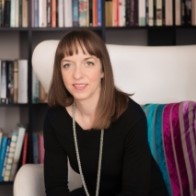
Sketching in Shadow and Sunlight: Writing Multivocal Historical Fiction by Sarah Law

Today, we hear from one of the Associate Lecturers who teaches on our Creative Writing MA programme. Sarah Law draws back the curtain to reveal some of the choices and happy accidents that lie behind the final form and title of her recently published novel Sketches from a Sunlit Heaven.

Sometimes writing allows us to meet characters who we don’t correspond with in terms of time or culture, but who speak to us anyway. My novel, Sketches from a Sunlit Heaven, arguably falls into this category: historical fiction where my characters, based on real people, tell their stories.
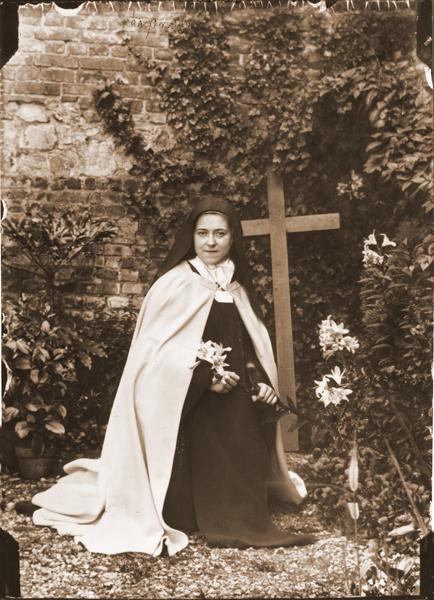
July 1896, in the sacristy courtyard. Licensed for non-commercial use by Copyright Office Central de Lisieux

By way of an introduction to my subject matter: I have an endless fascination with the ‘Little’ Saint Therese. She lived in a Carmelite Monastery in Lisieux, France, for nine short years before dying of tuberculosis in 1897 at the age of twenty-four. Her own memoir is full of sweetness but granite-tough underneath. Rare archive photos reveal lively eyes and a subtle smile full of some secret I still want to hear. Most unusually, three of her blood sisters and a cousin joined her in the same monastery. One sister was an artist and photographer. Another became prioress for much of her long life, and together they supported the cause of Therese being canonised, which she duly was in 1925 when, had she lived, she would have been fifty-two years old.

I started writing a fictionalised biography, hoping to deepen my knowledge of this young nineteenth-century nun. Then, as I read about her family, particularly her blood sisters, I heard their voices in my head (I mean this figuratively, of course). Pauline, the prim, practical community leader. Marie, the warm-hearted dreamer. Celine, the fiery-tempered artist. And Leonie, the difficult loner. Add in cousin Lucie with a beautiful singing voice, and Maurice, a missionary who fails and fails again, but with whom Therese, toward the end of her life, corresponds with the tenderness of an ethereal lover. Six different perspectives emerged: six distinct, but related, takes on Therese. But how were they going to work together? As each character’s narrative grew, so did my concerns about a clunky jumping from one chapter to another, from one account to the next, especially as they would substantially be going over the same events as each other.

I paused to reflect. I decided that my options were:

  1. Change the novel’s narrative perspective back to the third person, potentially becoming an authorial presence in my own right;
  2. Revise my narrative strategy to just one sustained first-person voice;
  3. Somehow intercalate my various first-person speakers (or at least some of them) into one chronological narrative.

While I considered each option seriously, I decided I wanted to retain the polyphony of multiple voices, even if they weren’t the longest-lived or most substantial in terms of narrative length. I wanted the book to offer a multidimensional account. A series of fragments mapped over Therese’s life and beyond. A mosaic.

Something clicked into place: this was how the novel itself wanted to emerge. A mosaic or a series of sketches, as each speaker passed the narrative between themselves. Sketches from a Sunlit Heaven had found its form and, incidentally, soon afterward, its title.

I embarked on an intense period of copying and pasting as I took what felt like brief but complete episodes from all six of my first-person narratives. I wanted to proceed in chronological order, but alert to the poetic magnetism produced by selective juxtapositions of my speakers’ accounts. Of course, I’m not the first novelist to choose multiple speaking characters (‘intradiegetic narrators’, if you will). From Wilkie Collins’s The Woman in White to George SaundersLincoln in the Bardo, the polyphonic approach to narrating a novel has been successful across recent centuries. Virginia Woolf’s The Waves remains one of my favourite modernist novels. A very tall order to write anything on par with these great works! But, to paraphrase the words of poet Robert Browning in ‘Andrea del Sarto’ a writer’s reach should exceed their grasp, or what’s a heaven for?

As I continued to cut, paste, shape, and write, I imagined jigsaw pieces fitting together to make a whole picture. Neither mosaics or jigsaws are perfect analogies, but both echo images in the novel: pieces of mosaic from the Roman Forum that teenage Celine cherished, and later, Lucie’s imaginative consideration of the ‘jigsaw’ view of Normandy seen from above – looking down from a sunlit heaven.
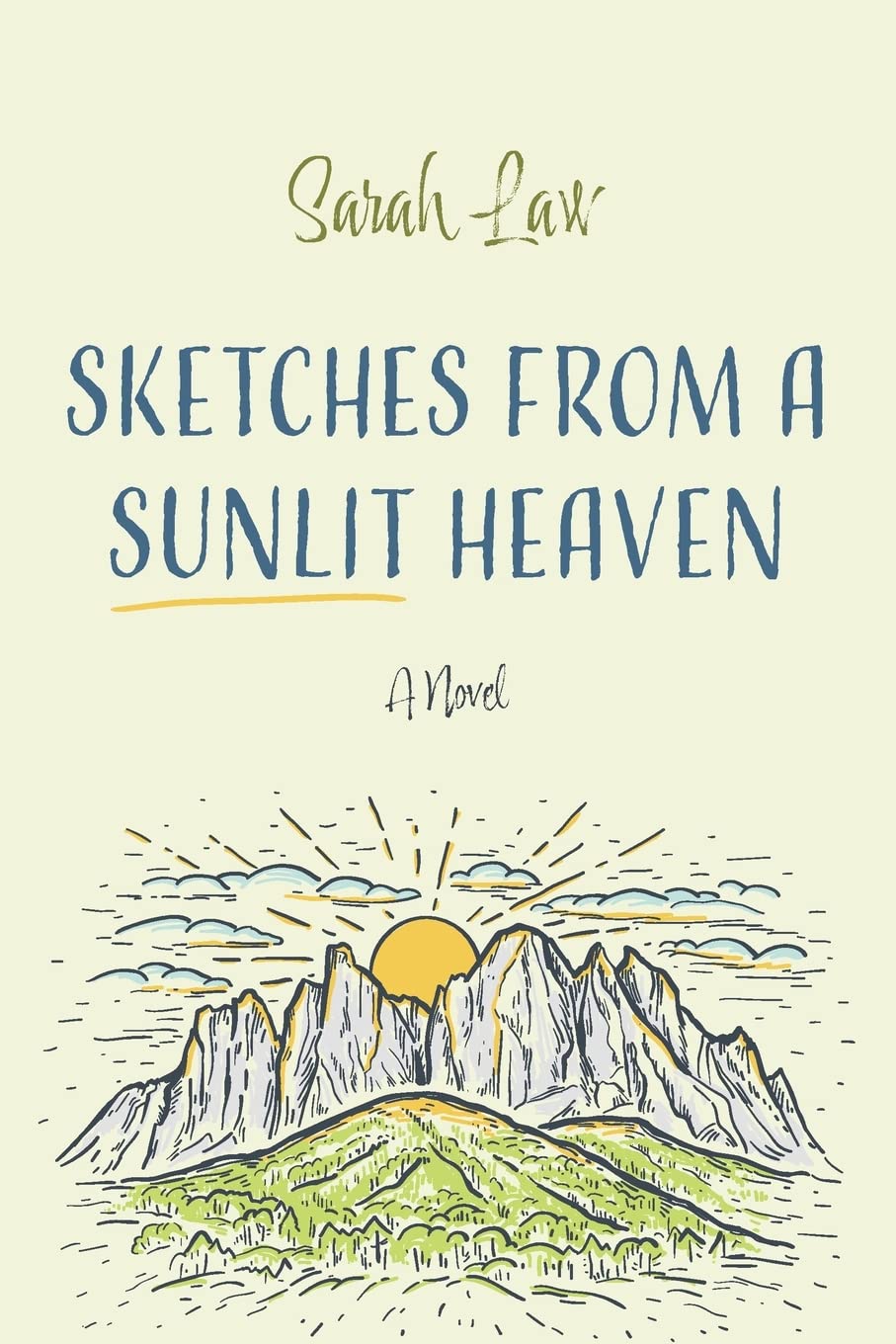
Sketches from a Sunlit Heaven is published by Wipf and Stock.

Two more motifs appeared as the novel grew into its ultimate structure. Firstly, that of letters. Therese, her sisters, and others close to them or the family wrote to each other a lot. I haven’t framed any narrative fragments as letters per se, but their usual length—from a few hundred words to a thousand or so—is reminiscent of a letter. The epistolary novel is the earliest form of the novel genre in English, so there is perhaps an echo in my work of its literary ancestor. My characters write to each other, request letters, read, receive, and even dream letters. And then there’s the sketch. A sketch is brief, descriptive, often urgent, suggesting with few lines, and judicious shade and hatching, larger issues than itself. Something Celine literally does, as do the others, figuratively. Sketches from a Sunlit Heaven secured its place as my novel’s name.

Combing through my draft, I found it fell into fourteen sections, each bound by dates, and housing narrative fragments that developed the section’s essential kernel—Vocation, Discipline, Legacy, and so on. An introductory section, Glimmerings, also appeared.

It’s strange how, in the end, a novel largely emerges of its own volition. Despite the planning and researching, even historical fiction does too. Holding the published book in my hand, I can say the process of writing it is still part mystery.
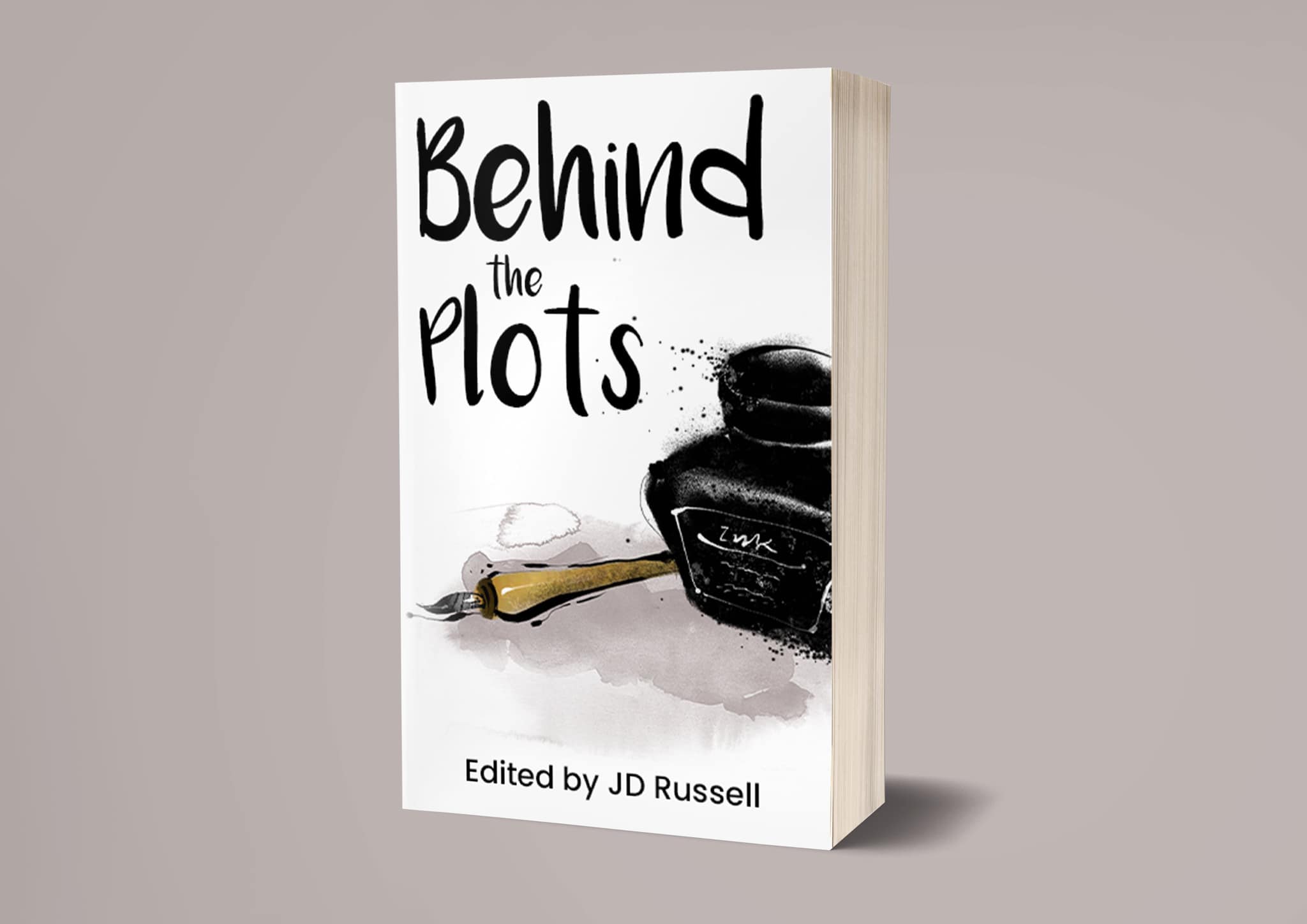
With thanks to Writing Bad for permission to publish this blog, which is an abridged version of an essay Sarah Law originally published in Behind the Plots.

Dr Sarah Law is an Associate Lecturer for the Open University. As well as a novel, she has published six poetry collections and writes academic and creative nonfiction. She also edits the online journal Amethyst Review, for new writing engaging with the sacred. She lives in Norwich. 


‘I shall shift my trumpet and take up my knitting’: Disability, Sex, and Self-Assertion in the Autobiography of Harriet Martineau

Today on the blog, we welcome our colleague Clare Walker Gore, who has recently joined us as a Lecturer in Victorian Literature. Clare offers us a glimpse into her research interests by sharing insights into the multiple ways nineteenth-century writer Harriet Martineau represented her experience of disability.   

I first came across Harriet Martineau’s ‘Letter to the Deaf’ (1834) when I was writing my book on representations of disability in nineteenth-century fiction. I had been drawn to Martineau as an example of a writer who was herself disabled, having lost most of her hearing in childhood, but whose life signally failed to conform to the expectations established by fiction of the period for disabled characters.

By 1834, when she published this article on her experience of deafness, Martineau was well known as a writer unafraid to tackle controversial and even ostentatiously ‘unfeminine’ subjects. In 1832 she had made her name, and indeed her fortune, by publishing a spectacularly successful series of pamphlets, Illustrations of Political Economy, and become a notable – in some circles infamous – champion of free market capitalism.

She went on to tackle a wide range of inflammatory subjects, apparently undeterred by attacks on her character in the press and even by ostracism from her own family.

Martineau was clearly a woman who thrived on conflict. As she admitted in her Autobiography (1877), she found hostile reviews more inspiring than positive ones, declaring that ‘the more brutal, the more animating’ they were (Martineau, Autobiography II, 158)

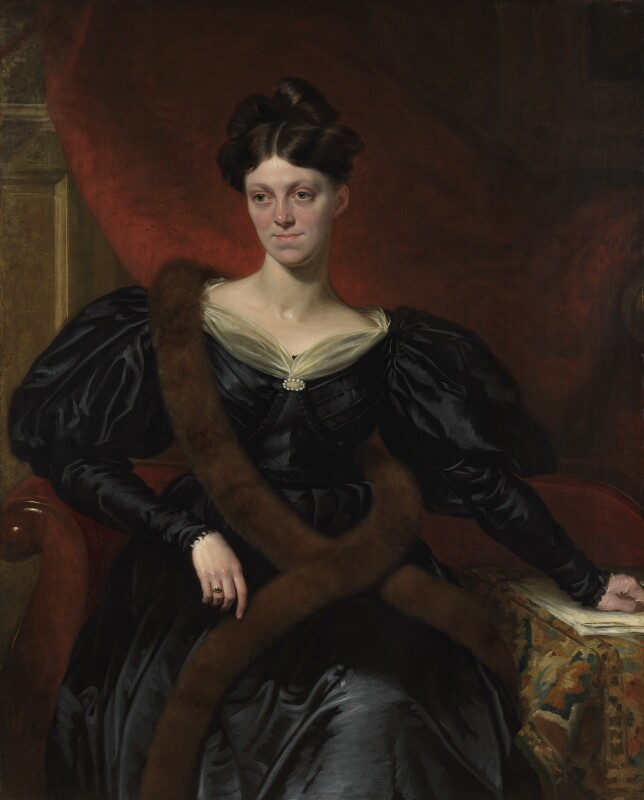
Harriet Martineau
by Richard Evans
oil on canvas, exhibited 1834
NPG 1085
© National Portrait Gallery, London

So it came as something of a surprise to me to find that in her ‘Letter to the Deaf’, Martineau advises her Deaf readers that they must ‘submit to be usually insignificant’, and accommodate themselves to hearing society in every possible way, recommending positively masochistic strategies of self-suppression (Martineau, ‘Letter’, 176). She promises that Deaf readers who mask their true feelings and adopt the rule of turning ‘every sigh into a smile’ will experience the ‘thrill of delight which arises during the ready agreement to profit by pain’ (Martineau, ‘Letter’, 177).

How could so self-assertive and combative a writer have integrated such a view of her own disability with the narrative of her own life?

An answer is offered, I think, by the way Martineau develops her apparently depressing advice as the ‘Letter’ goes on. She exploits one of the commonest tropes of disability in contemporary fiction to offer her Deaf readers a potentially powerful self-image.

Most nineteenth-century novels depict disabled characters as either exceptionally flawed or exceptionally virtuous. Martineau taps into this tradition, suggesting that her Deaf readers will emerge from their ‘trial’ as either ‘selfish in principle, sour in temper, and disagreeable in manners’ or ‘with principles strengthened, affections expanded … and manners graced by the permanent cheerfulness of a settled mind and a heart at ease’ (Martineau, ‘Letter’, 179).

The exceptionally virtuous deaf subject will achieve such perfect self-control, in Martineau’s account, that they will be able to withstand anything in the future: ‘If you have brought vigour out of this conflict … your cheerfulness will probably be beyond the reach of circumstance’ (Martineau, ‘Letter’, 179). In other words, Deafness necessarily entails conflict and possibly produces heroism; it also puts the Deaf subject beyond the comprehension or judgement of their hearing counterparts. ‘No one can judge for you’, she assures her Deaf readers (Martineau, ‘Letter’, 177).

It is this understanding of her disability which shapes Martineau’s self-representation in her Autobiography. She depicts the onset of her deafness as ‘about the best thing that ever happened to me’ (Martineau, Autobiography I, 78). In her account, the struggle it entailed formed her character and freed her from dependence upon her family, in both an intellectual and an emotional sense. In Martineau’s telling, deafness essentially made her the heroine of her own story, the self-reliant and resourceful woman who could reject the belief systems she had inherited, and the limitations imposed by her society.

Indeed, Martineau suggests that disability put her beyond the scope of conventional femininity and allowed her to draw on masculine forms of heroism – acting, as she told her mother in one letter of 1833, the part of ‘a professional son’ rather than a daughter (Martineau, Autobiography III, 91).

Martineau’s choice to live by herself, when she could have lived with members of her family, shocked some reviewers. The novelist Margaret Oliphant, for example, clearly found Martineau’s preference for ‘bachelor life’ deeply unfeminine, suggesting that the Autobiography proved her to be ‘a very clever writer’ who was ‘not much of a woman at all’ (Oliphant, 52; 59).

Martineau anticipates and attempts to disarm such a reaction by insisting that her deafness effectively excepted her from ordinary rules, just as it excluded her from conventional femininity.

Interestingly, however, Martineau occasionally uses her disability not to circumvent but to re-affirm her femininity, in the face of accusations that her writing has in some sense unsexed her. She was criticised, for instance, for championing Thomas Robert Malthus’ highly controversial Essay on the Principle of Population (1798), in which he argued that over-population would lead to disaster unless drastic action were taken – often interpreted as an argument for the use of birth control. In an essay for the conservative Quarterly Review, John Lockhart accused her of having ‘no modest misgivings’ as she promoted ‘unfeminine and mischievous doctrines’ (‘Miss Martineau’s Monthly Novels’, 136).

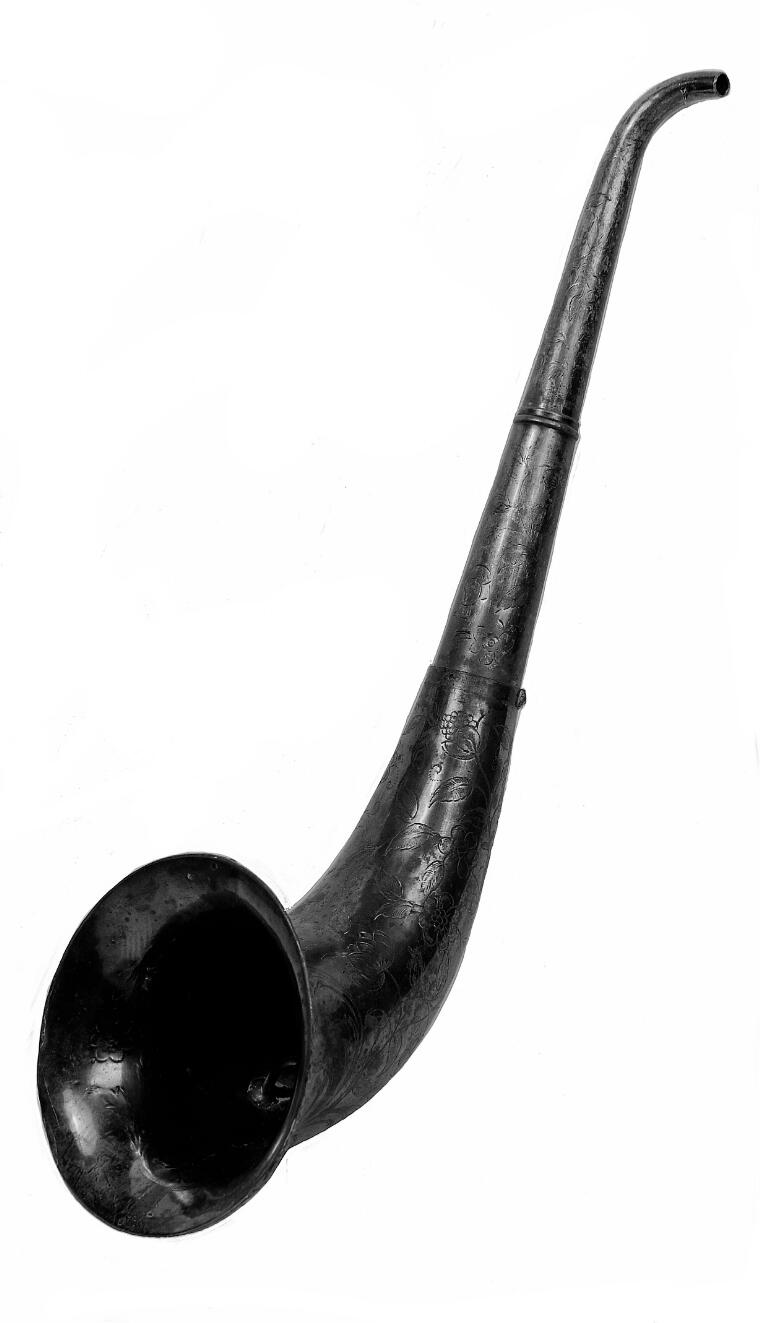
Recalling how she dealt with such criticism, Martineau uses her ear trumpet – a nineteenth-century version of a hearing aid – to defend her impugned modesty:

Credit: Ear trumpet, 19th century. Wellcome Collection. Attribution 4.0 International (CC BY 4.0)

‘I consider it, as treated by Malthus, a strictly philosophical question. So treating it, I find no difficulty in it; and there can be no difficulty in it for those who approach it with a single mind. To such I address myself. If any others should come whispering to me what I need not listen to, I shall shift my trumpet, and take up my knitting.’ (Martineau, Autobiography I, 202)

In this scene, Martineau’s ear trumpet becomes an instrument of self-assertion, just as her deafness, while cast as ‘affliction’, became a means of writing herself out of one, undesirable role and into an alternative, more heroic one. It’s an intriguing example of the multiple uses to which disability could be put in nineteenth-century texts, and into both the difficulties but also the possibilities opened up by an autobiographer’s dual identity as both ‘woman’ and ‘writer’.


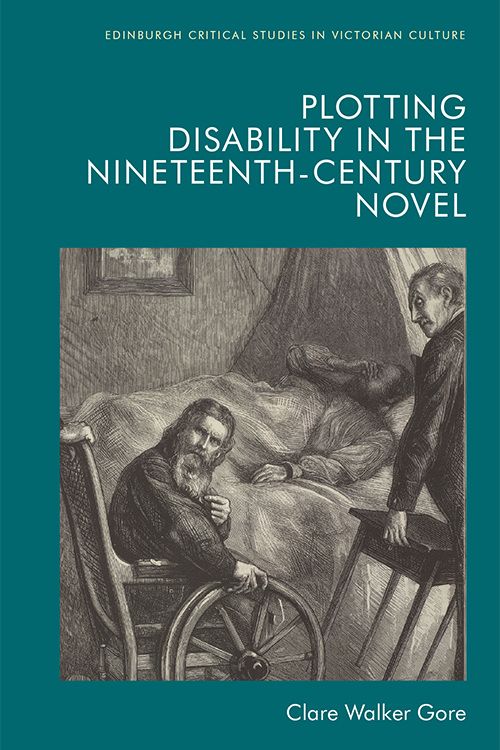
 Clare Walker Gore has recently joined the Department of English and Creative Writing as a Lecturer in Victorian Literature. She is the author of Plotting Disability in the Nineteenth Century Novel (Edinburgh University Press, 2019), and is now pursuing a project on women novelists’ life writing in the nineteenth century.

Works Cited

John Lockhart, ‘Miss Martineau’s Monthly Novels’, Quarterly Review, 49.97 (April 1833), 136 – 152

Harriet Martineau, Autobiography (1877), 3 vols, repr. Cambridge University Press, 2010

Harriet Martineau, ‘Letter to the Deaf’, Tait’s Edinburgh Magazine, 1834, 174–79

Margaret Oliphant, ‘Harriet Martineau’, Blackwood’s Edinburgh Magazine, 121 (April 1877), 472-96

Suggested Further Reading

Harriet Martineau, Deerbrook (1838), repr. Virago, 1983

Margaret Oliphant, The Autobiography and Letters of Mrs Margaret Oliphant (1899), repr. Broadview, 2002


From software tester to novelist, publisher and PhD candidate

Insurgent Press’s recent take over of the Barbican Library featured readings from Brian Kelly’s debut Murph – a novel about a virus that reveals everyone’s internet search histories, and a joke shop owner who finds himself swarmed with customers seeking disguises.  

Here, Brian lets us into his own journey from dissatisfied company employee to founder of his own press, host of longstanding literary night, novelist and PhD student. And he tells us about the crucial role played by the OU along the way.

At twenty-three I left Dublin to become a rock star in London. The big smoke kicked my ass for a couple of years and when the band eventually broke up on a rainy night in Liverpool (pathetic fallacy right on cue), I was left working as a software tester with no real creative output. It was around the time of the financial crisis, and I remember the CFO calling us in for our quarterly report. He advised us that money rarely disappears from the market but rather changes hands. As people in the know, he claimed, we stand to make large gains. At home, Ireland was going through a terrible time, unemployment and immigration back with a vengeance. I left the office and walked along the Thames to Vauxhall where I was renting a room over a pub. I sat down on my sofa-bed and decided I needed to do something else with my life.

My girlfriend at the time (now my partner of sixteen years) had given me a wrecked old computer from her parents’ attic and I had a vague impulse to write. Maybe it was the position above the pub, listening to voices below in the beer garden, the weird atmosphere of that bit of Vauxhall where gas towers stand cheek-by-jowl with cricket grounds and twenty-four hour gay clubs. I wanted to put down some words and make sense of it all, but I had no idea how to go about it.

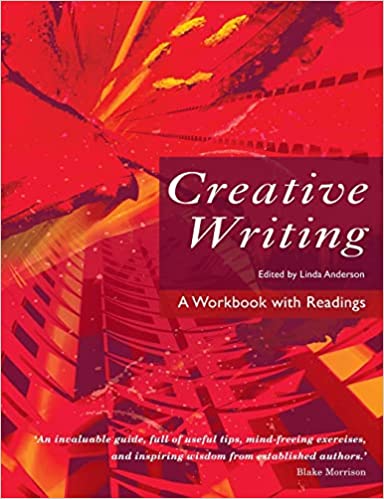
Creative Writing: A Workbook with Readings, Ed. Linda Anderson

I remember the day I finally signed up for A215: Creative Writing and the little shot of adrenaline I felt. Would I have the discipline required to finish the course? How would it feel to have a proper writer reading my work?

Doing the daily writing exercises in my room every night, I came to a Colin Powell-esque realisation about all the things I didn’t even know I didn’t know. Step by step, the material demystified the various elements of the writer’s craft, and I was writing in unexpected and exciting ways. About halfway through the course, there was an exercise about eavesdropping on people’s discussions and using that to create characters. I was on a plane back to Dublin and a few rows ahead of me was a man from Roscommon giving out yards about something or other. The best material went in my notebook.

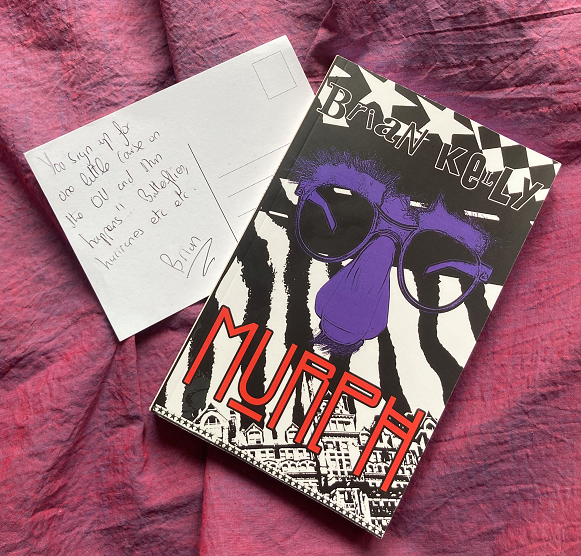
Murph by Brian Kelly

Back in London, I quit my job and was plotting a move to Korea to do a stint as an EFL teacher. While waiting for my visa to come through, I was spending my days in Stoke Newington Library reading and writing. My next OU assignment came up and the decrepit atmosphere of Stokey’s library merged with our man from Roscommon to create a short story about a psychedelic steam-of-consciousness librarian on the West Coast of Ireland. I remember feeling like I’d opened a door to a room I didn’t know existed. Could writing really be like this?

The guidance and encouragement from my tutor Emma Claire Sweeney egged me on. Moving to Seoul, I continued my writing and Emma started receiving pieces of work all the way from the Korean peninsula. I finished that first module and instantly signed up for the next, A363: Advanced Creative Writing. Life in Asia was fun, and I enjoyed teaching. The kids, the colleagues, the sense of purpose. I decided to pursue a BA in English at the OU.

I changed Seoul for Beijing but kept studying. Six years after starting my odyssey, I remember sitting my final exams in the British Embassy. The plan was to return to the UK to do a PGCE and start teaching in London, but the funding for third level had changed and unless I got a good degree from the OU my bursary was not going to cover my living costs. I studied like my life depended on it.  In the end I got the grades and returned to London where I started my career as an inner-city teacher in Camden Town.

But the OU was not done with me yet.  I had stayed in touch with my first tutor and when I mentioned being back in London, she encouraged me to apply for a novel writing course at City University. The people I met on that course were some of the most talented people I had ever met and became lifelong friends. The novel I wrote was a finalist in Penguin’s WriteNow competition and I continued on to do a Masters in Creative Writing, with the novel I finished winning an Irish Writers Centre award in 2022.

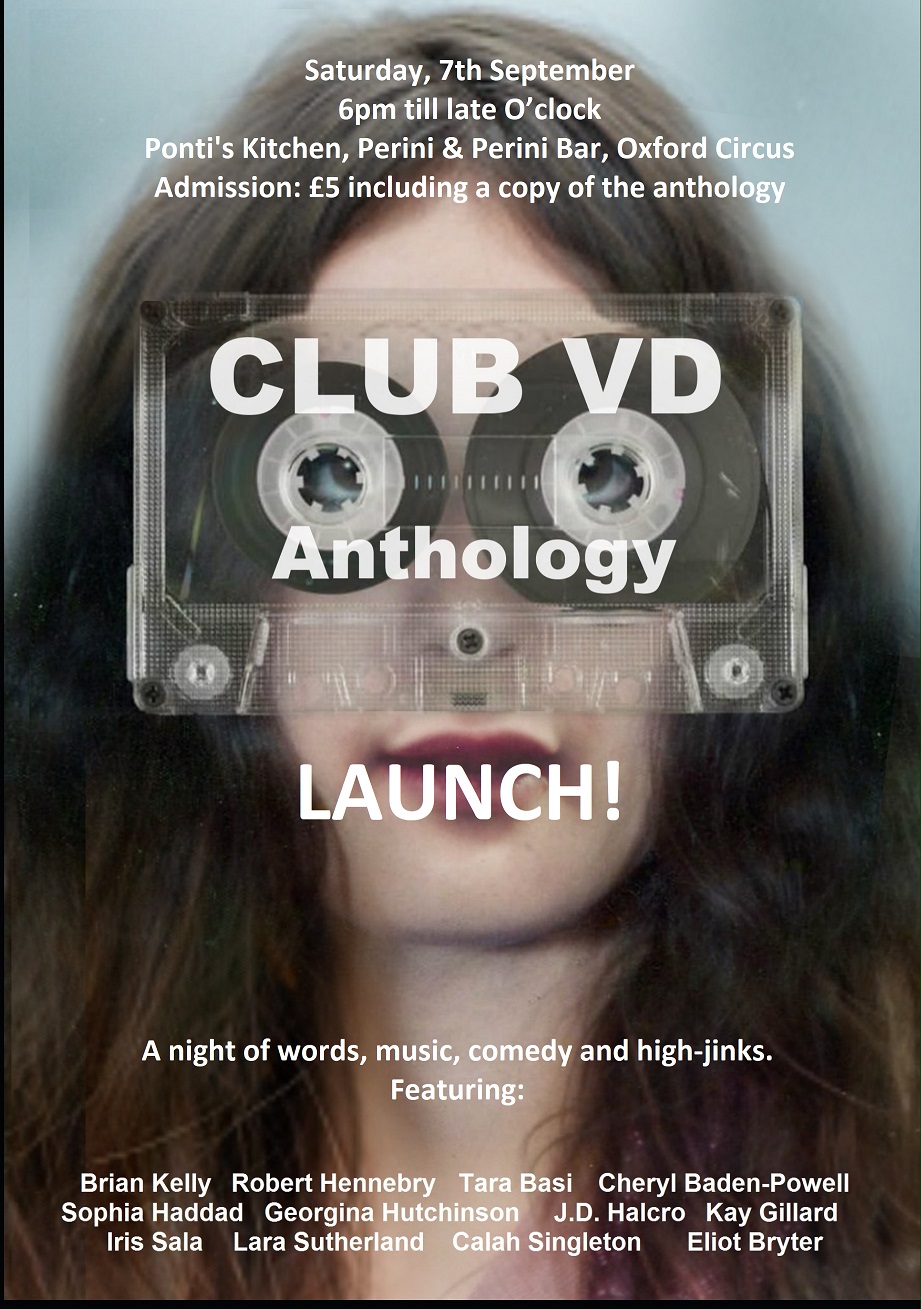
Verbal Discharge anthology launch

Along the way, I had met so many brilliant writers and wanted to create a space where we could all share work in progress and chew the cud. Club Verbal Discharge was born and has been running in the Perini & Perini bar, Oxford Circus on the first Friday every month for four years in a row. We publish an anthology each year and this in course led to the creation of The Insurgent Press. Our mighty little press has now published three anthologies, one collection of short stories by Tara Basi and my novel Murph. I sent a copy to my first OU mentor to say thanks, and on the card I wrote:

You sign up for one little OU course and looks what happens!! Butterflies, hurricanes etc. etc.

Next month I start a PhD in English Literature at Kings and so the wheel continues to turn…

Brian Kelly

Born in Dublin, Brian Kelly now lives in London with his partner and daughter where he works as an English teacher. After graduating from the OU with a BA in English, Brian continued to write fiction. In 2019, he was a finalist in Penguin’s WriteNow competition. In 2021, he received a Masters in Creative Writing from City University. In 2022, he won the Irish Writer’s Centre Novel Fair prize. He runs the monthly spoken word night Verbal Discharge, which publishes its third anthology this spring. He also runs the Insurgent Press, which does tiny runs of strange books and generally tries to cause trouble.


On writing The art of The Faerie Queene

On their virtual stand at the Renaissance Society of America’s annual meeting, Manchester University Press recently featured Richard Danson Brown’s latest book, The art of The Faerie Queene. Richard is Professor of English Literature at the Open University, and Head of the School of Arts and Humanities. Here, he shares with us the longstanding obsessions, academic collaborations, and scholarly disagreements that informed his writing of The art of The Faerie Queene.

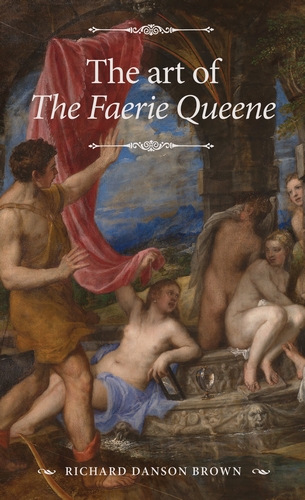
Published by Manchester University Press, 2018

If I believed in fate, I would say that I was destined to write this book, since it reflects obsessions I’ve had for most of my adult life and probably earlier: poetic forms, what those forms tell us, how skilful writers work with those forms to create new texts, what claims such formal work might have on us as readers. From first reading it aged 19, The Faerie Queene had seemed to me a formal structure—or rather a series of formal structures—of the utmost intricacy, where the liaisons between poetic line and poetic conceit were always shifting, always provocative.

As it is, I am not a fatalist, so there are other, more persuasive accounts for its genesis: firstly, my collaboration with Julian Lethbridge on the Concordance to the Rhymes of The Faerie Queene (2013) left me with an unfinished sense that there was more to say, even after the two comparatively long studies we contributed to that vast volume. Academic collaborations are productive as much for the swerves they induce in thinking as the moments of agreement around shared ambitions. While Julian and I very much agreed that form was a neglected category in post 1980s Spenser criticism, we were to take that thought in different directions. While for Julian, the evidence of the Concordance pointed towards Spenserian automation—what he calls the “non-expressive” aspects of The Faerie Queene—for me, those same data sets sent me back towards poetic particularity, and a sense that even if Spenser is often formulaic (and he is), readers can never take automatism on trust. Each instance of poetic usage at some level demands the reader recodes familiar lexis and stanza form in terms of “darke conceit”.

I was strengthened in this perspective by a different collaboration, with David Lee Miller, on Spenser Review. In between the pleasurable stresses of editing the journal for its three appearances a year, David and I would exchange emails and conversations about latest projects, with him gently insisting that he genuinely did want to see draft chapters from what was at that stage a much delayed and longed-for project. (As well as book reviews editor on SpR, I was at that period dean of a faculty in a university undertaking a momentous “change process”; “O pittious worke of MUTABILITIE!” indeed.) David’s readings strengthened the book at every page, demanding more craft, and broader sympathies, as I worked through a structure which one reader called an “inverted Christmas tree,” moving from individual words, via lines, meters, rhymes, and stanzas up to the larger forms of cantos and books and the poem as a whole. My book as it turned out was inconceivable without the input of Julian and David, which is why I dedicated it to them jointly.

Writing about your own work is always mildly queasy. (Maybe this is a scholarly version of the modesty topos, but I am not faking for effect.) For many years, I found it difficult to reread my first book (on the Complaints). With The art of The Faerie Queene, I have related but different feelings. In an ideal world, it would be more comprehensive—less tendentious and show-offy. But we don’t live in such a world, and I look at this book, with the beautiful painting of Titian’s Actaeon fatally raising his arm towards the naked Diana on the cover, with a kind of equanimity. Some of the things unsaid from the Concordance are contained within these covers.

Thanks to Manchester University Press for allowing us to repost this piece, which was originally published on their blog.

Richard Danson Brown

Richard Danson Brown is Professor of English Literature at the Open University, and Head of the School of Arts and Humanities. Throughout his career, his main research interest has been the poetry of Edmund Spenser, but he has also worked extensively on the poetry and drama of Louis MacNeice. Richard has had his own poems published in several magazines, and was an editor of The English Review, a peer reviewed magazine aimed at sixth form students.


Researching truth in documentary theatre

Dónall Mac Cathmhaoill, Open University Lecturer in Creative Writing, has been collaborating with University of València colleagues who share his interest in contemporary Irish theatre. Together, they have been exploring the relationship between performativity, truth, and documentary sources.

Here, Dónall offers us a glimpse into this relationship, and tells us how these shared research interests have informed his recently published article in Platform: Journal of Theatre and Performing Arts.  

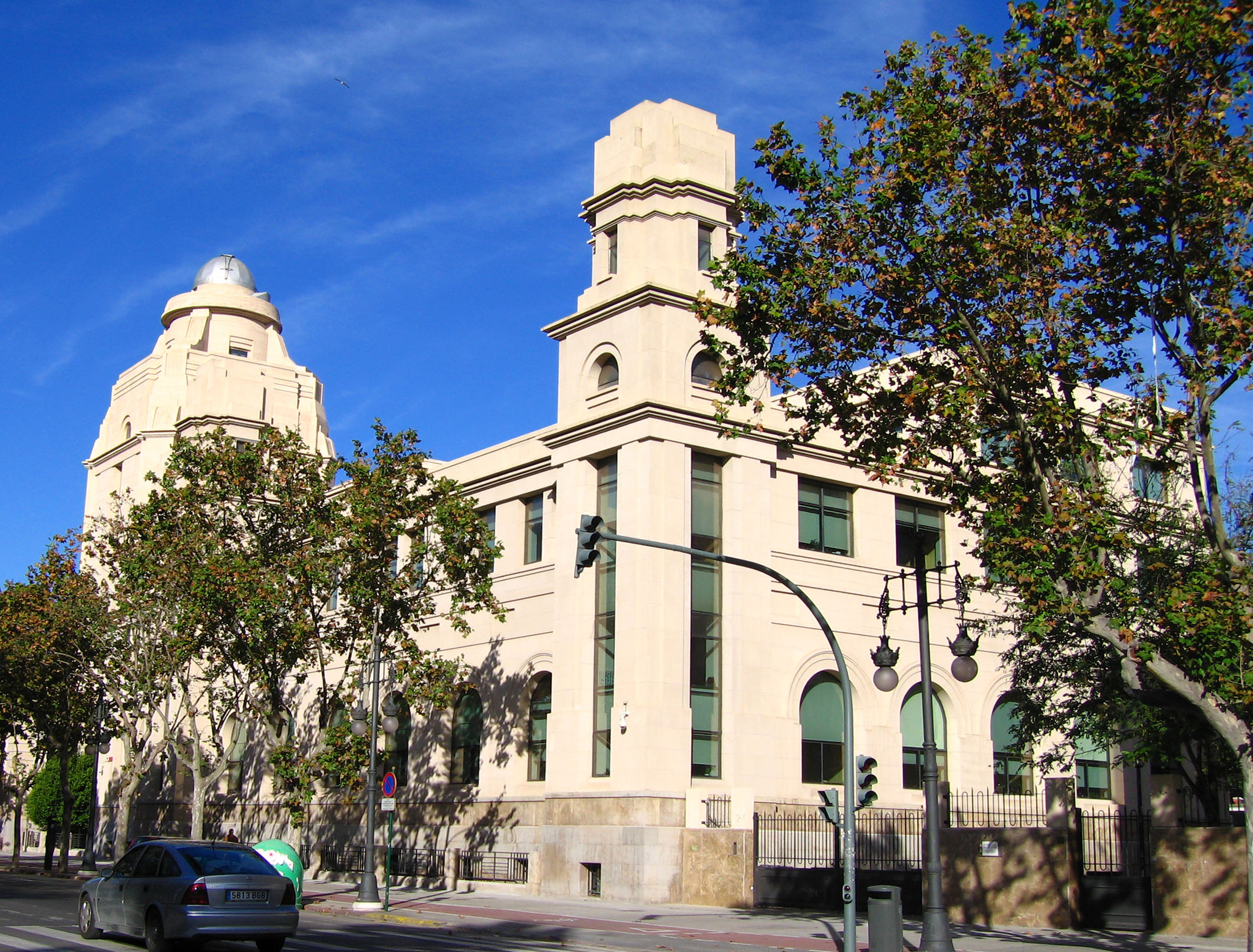
The University of València’s Rectorate (This image is in the public domain)

València in spring is generally a relaxing, pleasantly warm place to be. So I was very much looking forward to conducting a couple of seminars with the Departament de Filologia Anglesa during the month of Las Fallas – the Valencian festival to bid adiós to wintry days.

I came out expecting warm Levante breezes and two-hour terrace lunches with academic colleagues.  Unfortunately, València has been experiencing some of the coldest, wettest weather ever for this time of year: high winds and incessant rain. (Being Irish, I felt right at home.)

The research trip evolved through my connection with Dra Maria Gaviña Costero, an English literature academic who specialises in the literature of the Irish conflict, particularly drama.

Given my own research into theatres of conflict, we found we had many interests in common. Having contributed some suggestions of writers the department might consider for their new drama module, I was invited last year to speak at their annual conference.

The idea then developed to deliver a research seminar and workshop with the university undergraduates in English, looking at performativity, truth, and documentary sources in Irish theatre.

The plan was to develop this collaboration to create a research paper on the work of Northern Irish playwright Stacey Gregg, who I had recommended for inclusion on the undergraduate drama module. Gregg agreed to take part in the session I would deliver.

Scorch by Stacey Gregg

The design of the research process was simple enough: the students would take part in a drama workshop where the contingent and subjective nature of dramatic truth would be explored. This involved creating dramatic narratives from ostensibly ‘true’ and ‘real’ material: documentary drama by another name.

The credibility of the narratives was predicated on their affective and aesthetic qualities: on the extent of identification between audience and performer, and on the presence of aesthetic signifiers of truthfulness, such as simplicity and directness of presentation, what Elizabeth Burns calls ‘authenticating conventions’ (1972, p.108).

Importantly, though, the narratives would be considered truthful through the rhetorical convention of having them presented by ‘real people’. This is a technique which has been used in northern Irish post-conflict drama, and which has been subject to academic scrutiny (Upton, 2010; Weigelhofer, 2015; De Ornellas & Mac Cathmhaoill, 2021).

Some, notably Carole-Anne Upton (2011), have called into question the assumptions upon which this work is built. The workshop and seminar explored how truth, and indeed identity, in documentary drama are contingent and subjective, performative and in flux.

The follow-up seminar, just completed, saw Gregg joining us online from Belfast for a discussion and Q&A. The undergraduates had by this stage read Gregg’s play Scorch, which is written from documentary sources. Gregg outlined the strategies she used as a creative writer to ensure truthfulness and fidelity to source in a work that is both documentary and fictional.

These methods – including in-depth case research, interviews, consultations with subject specialists, and presentation of work-in-progress – allow her to write plays that do not claim to be ‘the truth’ but that are unquestionably truthful.

The themes of these seminars will provide the material for upcoming research papers. They are also explored in my journal article in Platform: Journal of Theatre and Performing Arts, 15 (2): ‘Boundaries: respecting authenticating limits in the production of a play on trans marginality’.

Dónall Mac Cathmhaoill

Dónall Mac Cathmhaoill is a lecturer in Creative Writing at the OU. His PhD examines modes of authorship in theatre for social and political advocacy. His research interests range from authorship in theatre for social change to advocacy theatre in post-conflict societies. As a writer-director he has wide experience working with communities in Ireland, the UK and beyond. He was director of Irish theatre company Tinderbox, a producer and Head of Education at Soho Theatre, and has worked with major theatre companies including Bruised Sky, London; 7:84 Theatre Company, Scotland; Jagriti Theatre in Bengaluru, India; and Irish language company Aisling Ghéar.  

Works cited

Burns, E. (1972) Theatricality: a study of convention in the theatre and in social life. London: Longman.

De Ornellas, K. and Mac Cathmhaoill, D. (2021) Addressing the legacy of inter-communal violence through drama: mainstream theatre and community action. In: Glencree Journal, 2021, 163-174.

Gregg, S. (2016) Scorch. London: Nick Hern.

Mac Cathmhaoill, D. (2021) Boundaries: respecting authenticating limits in the production of a play on trans marginality. Platform: Journal of Theatre and Performing Arts, 15 (2), 111-117.

Upton, C.A. (2010) Theatre of Witness: Teya Sepinuck in conversation with Carole-Anne Upton. Performing Ethos, 1 (1), 97-108.

Upton, C.A. (2011) Real people as actors – actors as real people. Studies in Theatre and Performance, 31 (2), 209-222.

Weigelhofer, M. (2015) The function of narrative in public space: witnessing performed storytelling in Northern Ireland. Journal of Arts and Communities, 6 (1), 29-44.

A Writing Chance: Margins to Mainstream

Stephen Tuffin, Associate Lecturer on OU Creative Writing courses A215 and A363, has recently won A Writing Chance bursary – an award that celebrates fresh perspectives and great stories from people whose voices have not historically been heard in publishing and the media. This UK-wide project is co-funded by actor Michael Sheen and the Joseph Rowntree Foundation, and supported by the New Statesman and Daily Mirror, with research into barriers to publication being conducted by Northumbria University

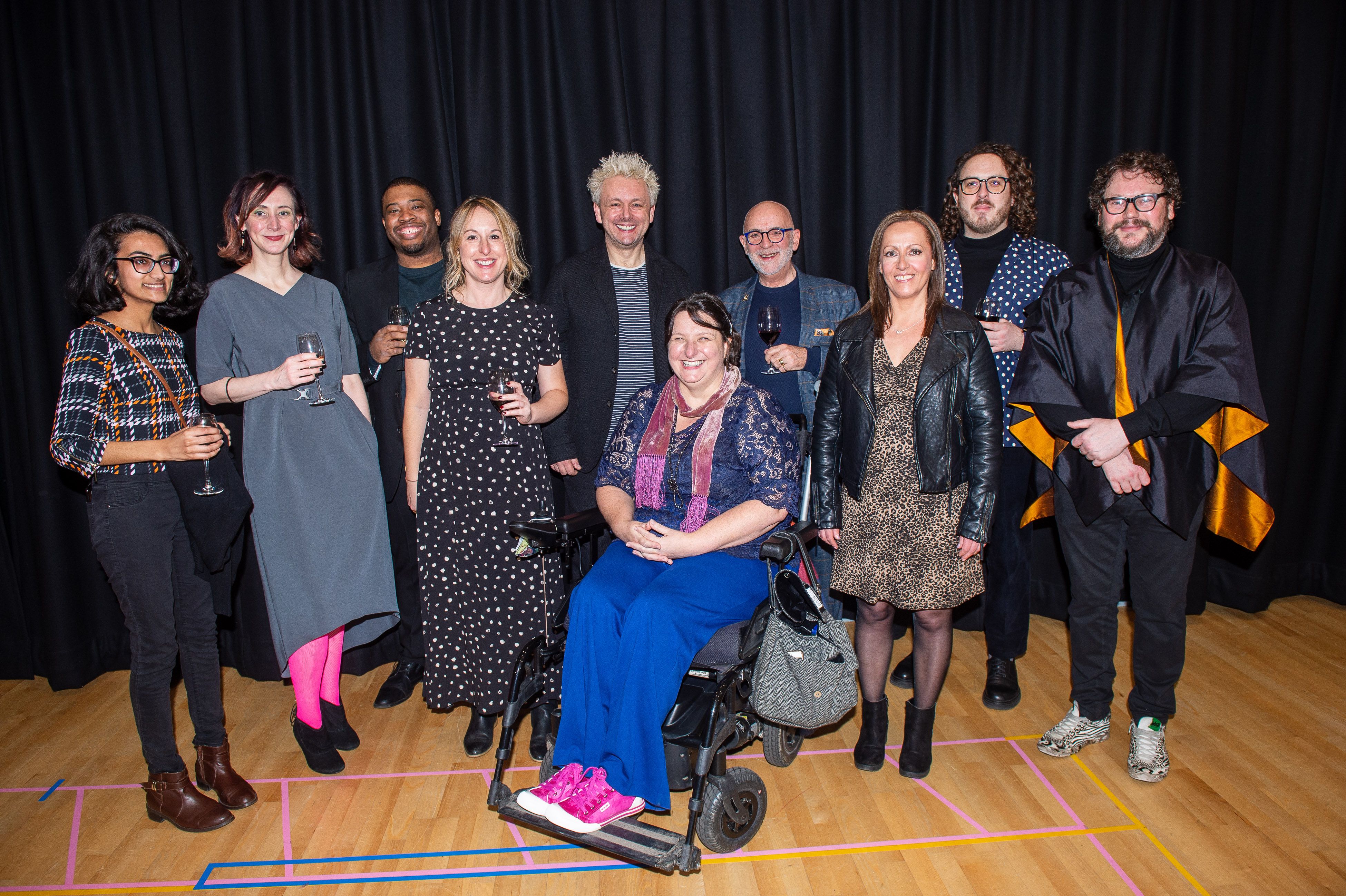
Recipients of Writing Chance bursaries

We asked Steve to tell us about how his own class background and experience of disability have both helped and hindered his journey into publishing and academia.

I first started writing when I was a road worker. I wrote on bits of paper in the days before PCs. I didn’t write much or very often because much of the time I was too exhausted. The days were very long and very tough.

But, knackered or not, I had this urge to write. I wrote fiction. Short fiction. I didn’t write poetry because I didn’t like it. I didn’t understand it, and, in any case, only posh people read or wrote poems.

Despite not having enough the money, I signed up for the Writers Bureau, and set about learning to write. I paid in instalments, completed several assignments, and was thrilled to receive feedback. But I defaulted on the payments and so was unable to continue.  I believe I still owe the Bureau so I’m hoping they don’t read this.

My life took me to Swindon in search of employment. I did a City and Guilds apprenticeship and became a carpenter. I worked on sites all over the place and eventually found myself working at The Institute of Directors in The Mall. I worked there as the lone maintenance man and so found plenty of time to read. I read thrillers and novels about barrel-chested men, with firm chiselled jaws, and women with hour-glass figures and names like Storm. In my spare time, I continued to write. I only ever shared my writing with my wife. No one else. I had trouble with my spelling – and still do.

One day I acquired an electric typewriter – it was being replaced with a new model. I set it up at home and imagined myself to be Hemingway even though I’d never read a word he’d written. I smoked while I wrote. One roll-up after another. I hung doors in the daytime and typed words out at night. Hanging doors is hard physical work but isn’t anywhere near as knackering as digging trenches.

Time passed and the PC came along. Now I could see my words on a screen, as if they were in print, and I could correct my spelling as I went along. I wrote short stories about working-class people – café workers, shop workers, road workers. I wrote what I know.

I fell ill. I was diagnosed with Ankylosing Spondylitis and so my life on site was over. I lost my job, my income and my dignity. I had no idea what I would do next. I considered work in B&Q or as a storeman at the building firm where I’d worked as a carpenter. But my wife had started a course at our local college, and I decided to follow suit.

I wrote my first full length play in the 2002. It was called Roger and Gerald and I didn’t have a clue what I was doing, but I did it. I sat up late into the night and I wrote. I heard their voices in my head, these two men, talking, laughing, arguing, loving. I finished the play and I sat back, and I rolled a cigarette and I felt good.

My college studies took me to Bath Spa University where I gained a BA and an MA in Creative Writing. Later on, I taught there on their undergraduate programme, and it was then that I saw an advert for Associate Lecturers with the Open University. And here I am.

It’s been an interesting journey.

If I am being honest, I’ve always felt a little apart from my colleagues. They are all lovely, but they seem very posh to me. And so much smarter than me, and well educated. In a nutshell, middle-class. And I, well, I was a road worker masquerading as a clever person.

I still am.

I lived too long in that world to suddenly become something else. And I am proud of that world too. I don’t see why, as a working-class man, I can’t enjoy these things that I’ve been led to believe can only be appreciated by the middle-classes. But don’t get me started on that.

You can listen to Martin Sheen read Steve’s work on the BBC’s Margins to Mainstream (about 14 minutes into the programme). This episode also features the work of another awardee, Maya Jordan, who studied creative writing at the OU.

Now I am on this wonderful programme fronted by Michael Sheen for underrepresented writers, and I am seeing my writing take off in a way it never has before.

And the thing is, I have my arthritis to thank for it. So, good things can come in painful packages. Had the AS not got a hold of me I would still be out on site. I wouldn’t be writing this and would never have met all the fine and good people I have taught and worked with over the 16 years I’ve been employed by the OU.

Stephen Tuffin

Stephen Tuffin was born in 1958 on a council estate on the south-east coast of England. A former butcher’s boy, cook, cab driver, door-to-door salesman, care home assistant, road worker and builder, he now lives in Swindon and teaches creative writing at the Open University. He is a working-class writer writing working-class stories inspired by the remarkable and raw world he has lived and worked in for most of his life.

Launch of new Language, Literature and Politics research group

Group of feminist women with raised fists and shouting slogans in Mexico

The Language, Literature and Politics research group is a cross-faculty initiative, bringing together researchers from the School of Arts and Humanities in the Faculty of Arts and Social Sciences and the School of Languages and Applied Linguistics in the Faculty of Wellbeing, Education and Language Studies. The aim of the group is to investigate the relationship between language, literature (literary criticism and creative writing) and politics in the widest variety of contexts.

Co-directors Professor David Johnson and Dr Philip Seargeant founded the new research group to give oxygen to interdisciplinary research conversations and initiatives, and they see it as an exciting opportunity for new and interesting synergies to emerge.

The group launched with an online literary event featuring author Jim Crace, who read from his Booker-shortlisted novel, Harvest, and spoke to OU Lecturer in Creative Writing and fellow novelist, Dr Emma Claire Sweeney, about the interrelationship between politics and language in his own work.

A conversation between Jim Crace and Emma Claire Sweeney

This year, LLP will kick off with a series of public talks that take inspiration from Raymond Williams’s hugely influential ‘Keywords’ book to examine the terms and concepts that act as touchstones for today’s society.

Williams describes a keyword as one for which ‘the problems of its meanings seem inextricably bound up with the problems it’s being used to discuss.’ So the act of defining the word is part of the process of exploring and arguing for the values that the concept represents.

An animated video essay about Raymond Williams’s ‘Keywords’, and the relevance of the idea for today’s society.

With speakers spanning disciplines from philosophy to political science and lexicography to literature, the series will look at how Williams’s project is still highly valid today, and at what words – and the arguments around them – define society and culture in 2022.

All events are 4-5pm

27 Jan:    Professor Teresa Bejan on EqualityMore details and register via Eventbrite.

10 Feb:   Professor Tony Crowley on PrivilegeMore details and register via Eventbrite.

17 Feb:   Fiona McPherson on the Oxford English Dictionary and Words of the YearMore details and register via Eventbrite.

24 Feb:   Professor Tim Blackman on EducationMore details and register via Eventbrite.

24 March: Dr Sarah Marie Hall on Rupture/RevolutionMore details and register via Eventbrite.

7 April: Professor Kate Pullinger on LiteratureMore details and register via Eventbrite.

21 April: Professor Quentin Skinner on Three Concepts of LibertyMore details and register via Eventbrite.

5 May: Dr Lara Choksey on PeasantMore details and register via Eventbrite.


Narrative Imperialism and Writing Home: A conversation between Rebekah Lattin-Rawstrone, a new PhD student, and Sarah Butler, a recent graduate

Rebekah Lattin-Rawstrone has just embarked on a PhD in creative writing funded by the Open-Oxford-Cambridge Arts and Humanities Research Council Doctoral Training Partnership. We put her in touch with Sarah Butler, who was recently awarded her own PhD in creative writing, which was also funded by the AHRC – in her case via the Consortium for the Humanities and the Arts South-east England. Here, Rebekah and Sarah let us eavesdrop on their conversation about their writing and research.   

Sarah Butler
Rebekah Lattin-Rawstrone


Rebekah: It’s a privilege to be given this chance to focus for three whole years on something that really fascinates me – narrative imperialism in the contemporary British novel. But that privilege brings responsibility with it.

Sarah: I’d love to hear more about the concept of narrative imperialism.

Rebekah: This gets right to heart of what I’m hoping to explore in both my critical writing and in the novel. I intend to unravel this concept from several angles: firstly, looking at the development of the novel during a time of imperialism and asking if that affected the narrative structures widely adopted in the form, particularly the three act teleological structure based around conflict and resolution; secondly, building on feminist criticism of narrative structures, thinking specifically of Ursula K. Le Guin’s wonderful essay ‘The Carrier Bag Theory of Fiction’ in which she outlines the possibility of new story forms that don’t follow the spear, or the arrow model – the hero’s journey model – but the gathering, containing, holding model, arguing that the bag rather than the stick was the first human tool; thirdly, looking at the wide adoption in the creative writing industry, both academic and commercial, of the three act structure and the hero’s journey, especially under the influence of film theory, and asking whether, as the industry attempts to publish different stories it could also look for writing that tells these stories differently (put in another way, are we only interested in different stories when they fit into a certain story telling structure? Are we continuing to enforce a kind of narrative imperialism?).

Sarah: This is so interesting! I teach creative writing at Manchester Metropolitan University and have been reading critiques of the workshop model by writers coming from different literary/cultural traditions. I’ve been thinking about the assumptions I make about structure and form, and about how I support writers and writing from backgrounds different to my own.

I set off on my PhD thinking I was going to write about narrative and ageing and particularly about endings and death, but very early on in the process my supervisors asked me to ‘just write something’ reflective about my work. I ended up writing an essay about home across all of my published work, and realised that it is a huge and pressing theme for me.

So, I changed the direction of my research, exploring the relationship between the novel form and home. I thought about the impact of the loss of home (particularly through urban gentrification) and nostalgia, and how nostalgia can be a driver of narrative. I thought about the verbs to leave, to stay, to return and to settle in relation to home in my own work and in two novels by Anne Tyler, who is a big influence on my writing.

Rebekah: I read your response with real delight because the concept of home has been a driver for my work too. I was born overseas and my father then became a diplomat so I spent a lot of time abroad as a child and it has had a huge impact on how I think about where and what I call home and how that might relate to a sense of belonging. You can see how all of these things then fed into an interest in world literature and a wider storytelling practice.

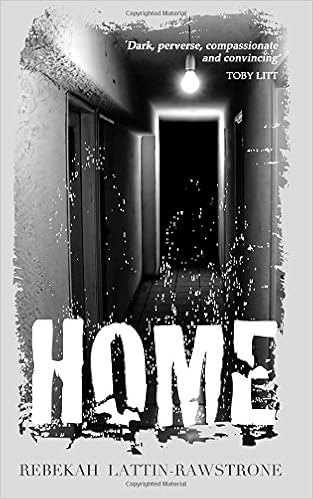
My first novel is actually called Home. It is about a corrupt care home, and I was trying to explore the fractures in the English extended family unit. Age, death and home – more common themes with you. My second novel is about a white English woman trying to forge a relationship with her Malawian half-sister. The desire to create a sense of family and home across national boundaries is central to this book.

I’ve begun by investigating possible alternative narrative structures and am having a lot fun looking at Islamic architecture and the mathematics of tessellation as a possible model for my novel’s structure. As the novel is partly set in Iraq, there is a real wealth of early literature to draw on. It makes for an interesting contrast with my protagonist, real-life adventurer Gertrude Bell who, as someone very keen to contribute to world events, did her best to fulfil the hero’s journey – albeit the heroine’s journey. I’m interested in her life outside of the public eye and how what often really fulfils us in life isn’t always our achievements. In that way, both the subject of the story and the telling should cohere as they attempt to express something different to the traditional three act structure. There will be other threads to the novel too, adding to that sense of pattern and structure through tessellation.

SarahI am a bit obsessed about applying structures from different disciplines/places onto writing, so I love the idea of taking ideas from architecture and maths and using those to find a structure for your novel. The way the form and the content are working together also sounds fascinating (and very satisfying!). It’s also really interesting to me because I have an idea for a new novel that I’m struggling to impose a traditional structure onto – I feel as though this conversation has given me permission to think that might not be such a bad thing!

When I started out on my PhD, I worried that ‘over’ analysing my own work would somehow damage my creative process. In fact, it’s been just the opposite. Spending time really thinking about my themes and process has given me a certain clarity of purpose. It’s allowed me to be clearer about what I’m interested in and what I want to explore in my writing.

I’ve been doing some research work for some academics at the OU about the climate crisis and creativity and that’s got me thinking about how I might combine my interest in home with my concern about the climate crisis. I guess I think of myself as both a writer and a researcher now, and that feels exciting and full of possibility.

I wish you all the very best with your PhD. It sounds fabulous, and important, and I am sure it will be an adventure worth having!

Rebekah Lattin-Rawstrone is the author of short story collection Glitches (Acorn Publishing, 2014) and novel Home (Red Button, 2015, now Kindle Direct Publishing). The working title of her PhD is Longing to Belong: an investigation into the potential for alternative storytelling techniques, in particular from the Middle East, to challenge narrative imperialism in the contemporary British novel.

Twitter: @RebekahLattinR; Website: www.lattin-rawstrone.com

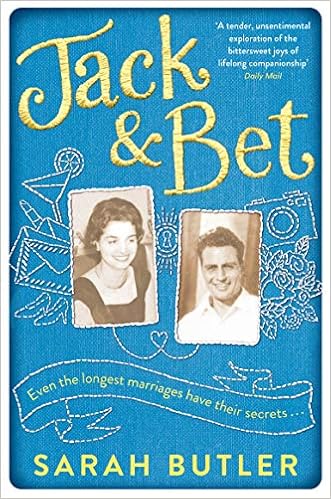
Sarah Butler is the author of novels Ten Things I’ve Learnt About Love (Picador, 2013), Before The Fire (Picador, 2015) and Jack and Bet (Picador, 2020). The title of her PhD is Writing Home: an exploration of the writing of Jack and Bet (a novel) and a consideration of what the novel – as a space and a practice – offers to our understanding of the concept of home, and what a consideration of home offers to our understanding of the novel.

Twitter @SarahButler100; Insta: sarahbutlerwriter; Website: http://www.sarahbutler.org.uk/

Climate Change and Creativity: Interview with Sally O’Reilly

Sally O’Reilly is a novelist and Senior Lecturer here at the Open University’s Department of English and Creative Writing, where her role as Media Lead has included editing this blog. Before Sally’s appointment as a Central Academic in 2014, she’d already worked here for many years as an Associate Lecturer. But Sally’s long relationship with the OU is about to evolve as she is now making the leap to fulltime writing. Ahead of her departure, Sally’s successor as Media Lead, Emma Claire Sweeney, has seized the opportunity to ask Sally about her recent research into climate change and creativity – an area where Sally hopes to continue collaborating with OU colleagues.

Emma: How do you think creative writing might play a role in addressing the societal challenges posed by climate change?

Sally: Like so many people, I am increasingly alarmed by the climate crisis and I also feel unsure what I can do to help. It’s hard to see a way in which any one person can make a difference, and there are two default settings – thinking about something else, or assuming a position of nihilistic fatalism. But what I’ve realised is that it’s not about any one person, it’s about the power of collective action and social change, and while one person is powerless alone, if you can start communicating with like-minded people, astonishing changes can be made.

And while, at first, I thought that trying to address these issues was something I must do outside my work and writing time, I saw eventually that writing creatively is directly related to the climate crisis, because writers can (perhaps) encapsulate what this means in human terms, and be part of a movement to reimagine the world.

I’ve talked about this in three videos recorded for the Faculty of Arts and Social Sciences:

Imaginative writing can seem like an adjunct, a ‘nice to have’, rather than being essential to society like (say) physics. But if you look at the way people turned to books, film and TV during the lockdown, you see how vital narrative is to everyone. So writing can both help people process what is going on, and help communicate the situation – but without pushing an overt ‘message’ because there we have another pitfall,  becoming polemical or seeming to preach.

Emma: Can you name a few contemporary writers who you feel have navigated this territory particularly well?

I really like the way that a fiction writers like Jenny Offill can play on our sense of unease by weaving alarming statistics about climate, preppers and the coming apocalypse into a contemporary realist narrative. It is the very ordinariness of the story that makes it terrifying.

Right now, I’m in the middle of a fascinating book called Being a Human by Charles Foster, which isn’t overtly about climate change, but about the way in which humans lived for many thousands of years, as Palaeolithic hunter gatherers. They lived long, healthy lives, their carbon footprint was zero and they produced visual art of stunning sophistication. Our view of modernity as being part of a post-Enlightenment process of constant improvement does not stand much scrutiny if you take the long view, and the despoliation of the planet is part of that. What’s particularly interesting about Foster, who is an extraordinary writer, a sort of modern William Blake, is that he bends genre in this book. Ostensibly, it’s creative nonfiction, but he brings in the ghost figures of a character named X and his son, spirits from the Palaeolithic age. His writing reminds me of both Ted Hughes and Alan Garner, the sense of the numinous in nature, the mystery in being. And Foster also embodies the meeting of scientific, empirical knowledge and creativity – he has studied veterinary medicine, he is barrister, and he has a wild imagination.

Emma: You curated this autumn’s Climate Change and Creativity series for the OU’s Contemporary Cultures of Writing research group. Tell us a bit more about this series.

Sally: I invited poets, fiction writers, scientists and activists to talk about how distilling observations about the natural world and telling stories relates to the present moment and our choices about the climate. I’m aware of my own ignorance here. My writing has not focussed on climate previously, and so it is as steep a learning curve for me as it is for anyone. But in the research I have done so far, I can see how this issue connects with so many other issues – racism, social justice, education, equality.

Emma: So your own research interests are changing in the light of these connections?

After I leave the OU, I will be working on a series of essays about the contemporary world and climate, working tranche title Eco Worrier. And my current novel explores Victorian attitudes to nature and the way in which the ancient, shamanic understanding of the natural world had its last gasp at that time. It’s a book that has led me down a lot of surprising, twisty pathways, like walking through an ancient forest. Or so I tell myself when my energies are flagging.

Emma: Another area of your research relates to diverse voices in historical fiction. Could you tell us a bit more about that? Are there links between this and your interest in creativity and climate change?

Sally: I’m in the process of putting together a collection of essays about difference in historical fiction, and the way that previously marginalised voices are now being heard in this genre. Two years ago, I would have said this was separate from my interest in climate, but now I see a close connection. If you read about the British Empire and the ruthless way in which the British colonised and exploited people and resources, you can see how the foundations of climate injustice were laid. The Industrial Revolution paved the way for global expansion, which traditional British histories have said made the UK the ‘workshop of the world’, but we did this at the expense of disenfranchised groups in Britain – women, children, the working class – as well as in the global South. And the roots of Empire go back to Tudor England, to those glamorous swashbucklers Drake and Raleigh, that period of history that now seems so brightly coloured and picturesque.

Emma: Now that you are leaving your current post at the OU to write full time, how do you hope your new relationship with the OU might develop?

I’d like to find a new way of working, writing books that have academic rigour in collaboration with academics, perhaps in other disciplines, and also writing novels that reflect the new way that I see the modern world. One of the poets at the first seminar, Kristian Evans, talked about the way in which writing makes us more present to reality, and helps us experience life with more intensity, more directness. I’d like to channel that, into reading, thinking and writing. And collaborating. Because as I was saying earlier, this has to be about collective action. Novelists are good at sitting on their own tapping out sole-authored books, and writing novels is still my priority, but I’ll be looking for creative collaborations with OU colleagues whose interests relate to mine. I’d like to follow Foster’s example and work at the interface between fiction and nonfiction, a way of writing that seems particularly resonant at this time, when the facts are so extraordinary that processing them is an imaginative challenge.

Elspeth Huxley and Time & Tide

Anne Wetherilt, PhD student, English

In November 2020, a one-day online conference brought together scholars, journalists and readers to celebrate the centenary of the feminist magazine Time and Tide.  Speakers highlighted the magazine’s progressive interwar agenda, and the contributions of well-known writers such as Rebecca West, Winifred Holtby, E. M. Delafield and Cicely Hamilton.  Although the magazine had no overt party-political affiliation, it engaged with topical issues, including women’s political rights, their role in the workplace and their cultural interests.  In the late 1920s, it also embraced an internationalist agenda, committed to peace and disarmament.

However by the late 1930s Time and Tide had evolved from a feminist magazine, aimed primarily at educated middle-class women and their political and cultural interests, to a general interest periodical with an increasingly male and conservative readership.  After World War Two, the magazine moved further to the right and women no longer played a key role. Its post-war coverage has attracted limited scholarly interest.

I first became interested in Time and Tide’s post-war history as I was researching the late colonial fiction of Elspeth Huxley.  Best known for her fictional autobiographies The Flame Trees of Thika (1959) and The Mottled Lizard (1962), which depict an idyllic Kenyan childhood in the early decades of the twentieth century, Huxley was a frequent contributor to Time and Tide in the 1950s and 1960s, commenting on political developments in Britain’s overseas colonies. Although she came to accept African independence, Huxley was the voice of a conservative readership, consistently arguing against an accelerated timetable for decolonisation and expressing concerns about the future of African nations, governed by, in her view, ill-prepared indigenous politicians.

Widely recognised as an expert on African matters and praised for her lyrical descriptions of the African landscape, Huxley’s contributions provide a fascinating insight into the politics and lived experience of decolonisation.  But they also tell us something about Time and Tide’s post-war readership: interested in the Empire, willing to adopt a critical stance towards the British government, but not immune to sensationalist accounts of nationalist violence and African ‘savagery.’  Huxley’s journalistic output was substantial and varied, but two examples may illustrate these points.

In late 1953, Huxley reported on a recent trip to Kenya, providing first-hand experience of the Mau Mau insurgency.  Her articles contain a fascinating mix of location and character sketches: the reader walks with Huxley on the streets of Njoro, her former hometown, climbs on a jeep to visit a detention camp and witnesses the ‘brutish, sullen look of hatred and inhumanity’ on the faces of Mau Mau detainees.  These pieces combine factual reporting and an earnest attempt to understand the causes of the uprising, ranging from rural land poverty and urban unemployment to the loss of tribal customs and a desire to end colonial occupation.  But this is combined with more subjective, and at times racist judgement.  Thus, Huxley compares the Mau Mau uprising to European medieval witchcraft, a spiritual cancer, and its adherents to Nazi stormtroopers.  Equally controversial are her descriptions of the infamous Mau Mau oaths, which echo sensationalist media accounts, yet were based more on hearsay and less on fact:

There are seven grades of Mau Mau oath and now an eight has been added in the forest.  The ritual of the first three is disgusting and barbaric, but not unprintable, and a good many have taken at least the first two under duress.  Those who have taken the fourth oath and upwards have done so, it is believed, because they wished to and have performed such acts of bestiality (in its true sense) and perversion that many doubt whether these men and women can ever again take their places as decent members of a civilized society

Writing at the height of the Emergency, Huxley’s vision for a peaceful, independent Kenya is rather vague.  She recommends development in agriculture, irrigation and industry, alongside the eradication of racial barriers: ‘All Kenya’s races must work together towards coalescence as a nation.’

In August 1959, mere months before the British government lifts the Emergency and invites the various parties to the negotiating table, she offers a more focused commentary on Kenya’s political future.  Here, she reveals a deep unease with African leaders’ inclination towards one-party rule and dismisses what she views as the naïve British belief that newly independent nations will follow the Westminster model of democracy.  She further urges the Tory government to provide safeguards to Asian and European minorities ‘against being swamped by an enfranchised flood of Africans quite without experience.’

Huxley also criticises Labour for turning colonial politics into a major election issue, accusing them of undermining efforts to install democracy, by backing ‘self-rule plus autocracy.’  What is fascinating about this later piece is that it draws a clear line from colonial to metropolitan politics: Africa is to be a ‘stink-bomb’ in the forthcoming general election.  But, yet again, Time and Tide readers are given a topical political commentary, which is balanced precariously between factual reporting and lingering colonial discourse.

To conclude, by the 1950s, Time and Tide had travelled a long way from its suffragist and internationalist origins.   For me, this brief case study is relevant for two main reasons.  First, in light of the ongoing re-assessment of Empire, it is crucial to listen to a wide spectrum of voices, even when they express views that are ambivalent.  And second, not to abandon a historical source when its original commitment is a distant memory.

Sources:

‘The Kenya Scene – I: A Raid against Mau Mau’, Time and Tide, 28 November 1953, pp. 1539-40

‘The Kenya Scene – II’, Time and Tide, 5 December 1953, pp. 1569-70

‘Kenya Screening’, Time and Tide, 26 December 1953, pp. 1695-6

‘The Issue in Africa’, Time and Tide, 1 August 1959, p. 820

Further reading:

David Anderson, Histories of the Hanged: Britain’s Dirty War in Kenya and the End of Empire (London: Weidenfeld and Nicolson, 2006),

Catherine Clay, Time and Tide: The Feminist and Cultural Politics of a Modern Magazine (Edinburgh: Edinburgh University Press, 2018)

Angela V. John, Turning the Tide: The Life of Lady Rhondda (Cardigan: Parthian, 2013)