Kidnapped by Agatha Christie and OpenLearn

In readiness for the BBC’s adaptation of Agatha Christie’s 1939 novel Murder is Easy, which will air this festive season, senior lecturer Anthony Howell lets us in on how the Queen of Crime has added a touch of mystery to new Open University courses.

The sheer star power of Agatha Christie took me by surprise, I must admit. I was aware of the statistics (her novels have sold over 2 billions copies) and that her best-known protagonist, Hercule Poirot, was enjoying new prominence as a result of the recent Kenneth Branagh adaptations. But given that I primarily investigate the dusty corners of the late 18th- and early 19th century (and am used to being read mostly by two old university friends and the dog) I was struck by the degree to which she justified the label ‘popular’. We had decided to make ‘Literature and the Popular’ the organising theme for the first block of teaching material on the new MA in English Literature (A893). But, quite honestly, there is popular fiction and then there is Agatha Christie, in a class all of her own.

Kenneth Branagh as Hercule Poirot in Death on the Nile (2022). This image is publicly available.

With some trepidation, I volunteered early in module production to contribute a unit on Christie for the new MA. I had enjoyed her novels since my teenage years but writing about them in a teaching context would involve venturing some distance from my specialism. Nevertheless, I was confident that with some preparation I could get a handle on it. Christie is normally considered ‘middlebrow’ as an author and, clearly, her work is intended as a form of escapism. Among other things, I was able to touch on how this made it, in the words of Alison Light, an invaluable ‘literature of convalescence’ for the British public after the the First World War. However, Christie also possessed a seemingly supernatural skill for crafting a satisfying clue-puzzle story and it became clear to me that this was the key to the cultural impact of her fiction.

The unit was later adapted into an OpenLearn course, Agatha Christie and the Golden Age of Detective Fiction, with the help of the module Chair, Alex Tickell. Launched in 2006, OpenLearn is the Open University’s home of free learning. It hosts over 10,000 free courses, articles, activities and videos. There were around 15 million visits to the platform last year from all over the globe so pairing Agatha Christie with OpenLearn always had the potential to be a powerful combination. You can view the course here.

OpenLearn: the home of free learning at the OU

Right away, it seemed to have a ready-made audience and the ability to travel all by itself with minimal effort (certainly from me). A range of people interested from all walks of life began to click though the minute it landed on Google. I was invited to take part in different kinds of media to promote it. Local radio, for example, with a lighter tone and a mainstream audience. It was hugely enjoyable. The Faculty’s social media team created a buzz with some activities on Facebook, Twitter and Instagram. People responded immediately, sharing pictures of their own rare collections of Christie’s novels, participating in quizzes and games and generally responding very warmly to this opportunity to share their enthusiasm for one of their favourite authors.

Although we did take the course out into the world, the world also came looking for us. For the first time, I received emails out of the blue from learners not yet enrolled on an Open University course. One wanted help to download and print a copy of the course for her elderly mother, who struggled to read on a screen. Another had recently visited Torquay museum and thought the course might be a good fit for the Agatha Christie display there.
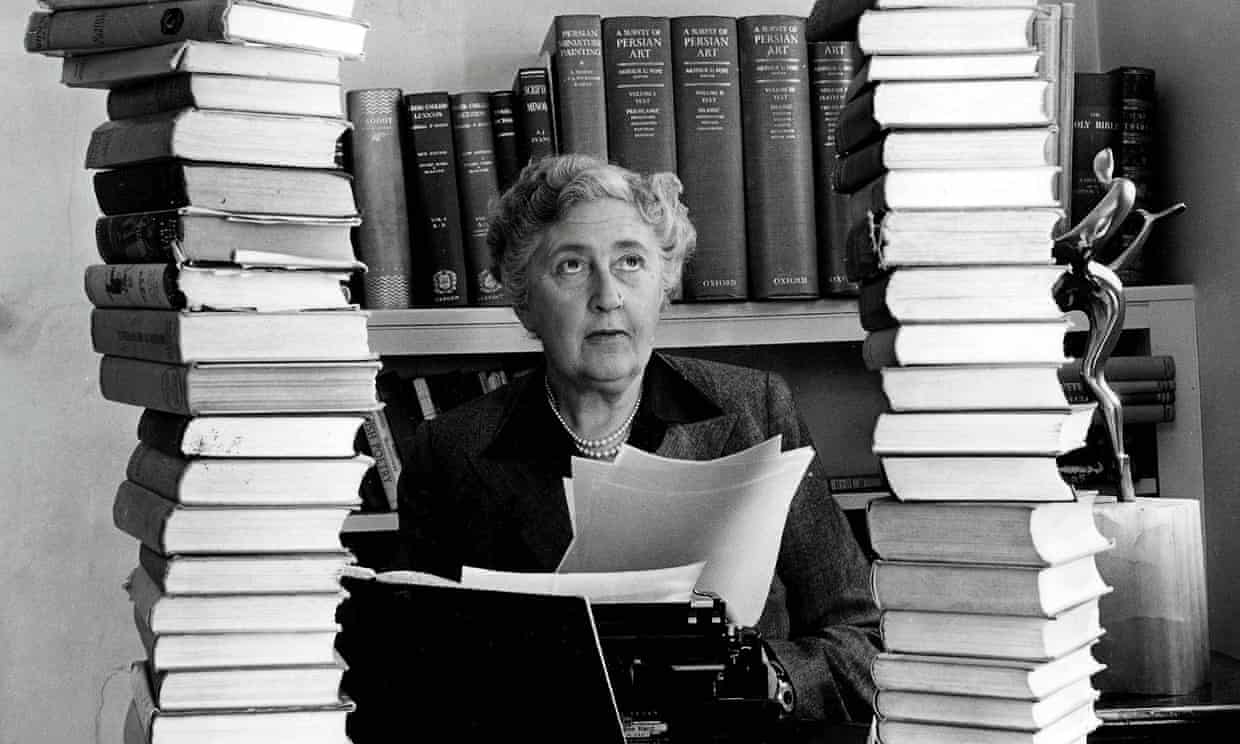
Agatha Christie at her home: Winterbrook House, Berkshire, 1950. This image is publicly available.

Professionally too, unsolicited requests arrived. An offer came to act as a reviewer for a new course on European Crime fiction, currently under production in the school of Social Sciences at the OU. I was encouraged to attend ‘Captivating Criminality’, the annual conference of the International Crime Fiction Association, which took place at the imposing setting of Corsham Court in Wiltshire. Experts in the field were keen to hear more about the OpenLearn course and the feedback from students. I’ll be moonlighting at the next one in Budapest too.

This is a very roundabout way of explaining that, since writing the course, I have found myself periodically snatched away from my usual teaching and research interests and taken in quite different directions. It sometimes feels as if I have been kidnapped by Christie herself and taken by her to new places without very much agency of my own; plotted helplessly into a new narrative.

Agatha Christie and the Golden Age of Detective Fiction now feels established on OpenLearn. In the first few weeks, the course page had received over 15,000 visits. As of this month, that has now risen to 57,000 visits and 2,460 enrolled learners (with 806 gaining statements of participation). I was delighted to learn that the course will soon feature in a new landing page featuring Women in the Arts, curated by Hannah Parish. I would say that it’s comfortably the biggest pedagogical impact I’ve managed to have in my career so far. But, although it’s been enormous fun for me, it doesn’t feel much like my impact. I’m left, in the end, along with the detective fiction enthusiasts, to ponder a familiar question: whodunit?
Anthony Howell is a Senior Lecturer, Staff Tutor and Associate lecturer in the Department of English Literature and Creative Writing at the Open University. He is currently Chair of the MA in English Part 2 and a module team member on A893 and A894. Anthony has contributed teaching units to a variety of OU modules and developed new teaching strategies to support students in secure environments. His research interests are in the field of Romanticism, in particular the work of Sir Walter Scott, William Wordsworth and John Clare.
A Fine Balance: writing, teaching, public engagement

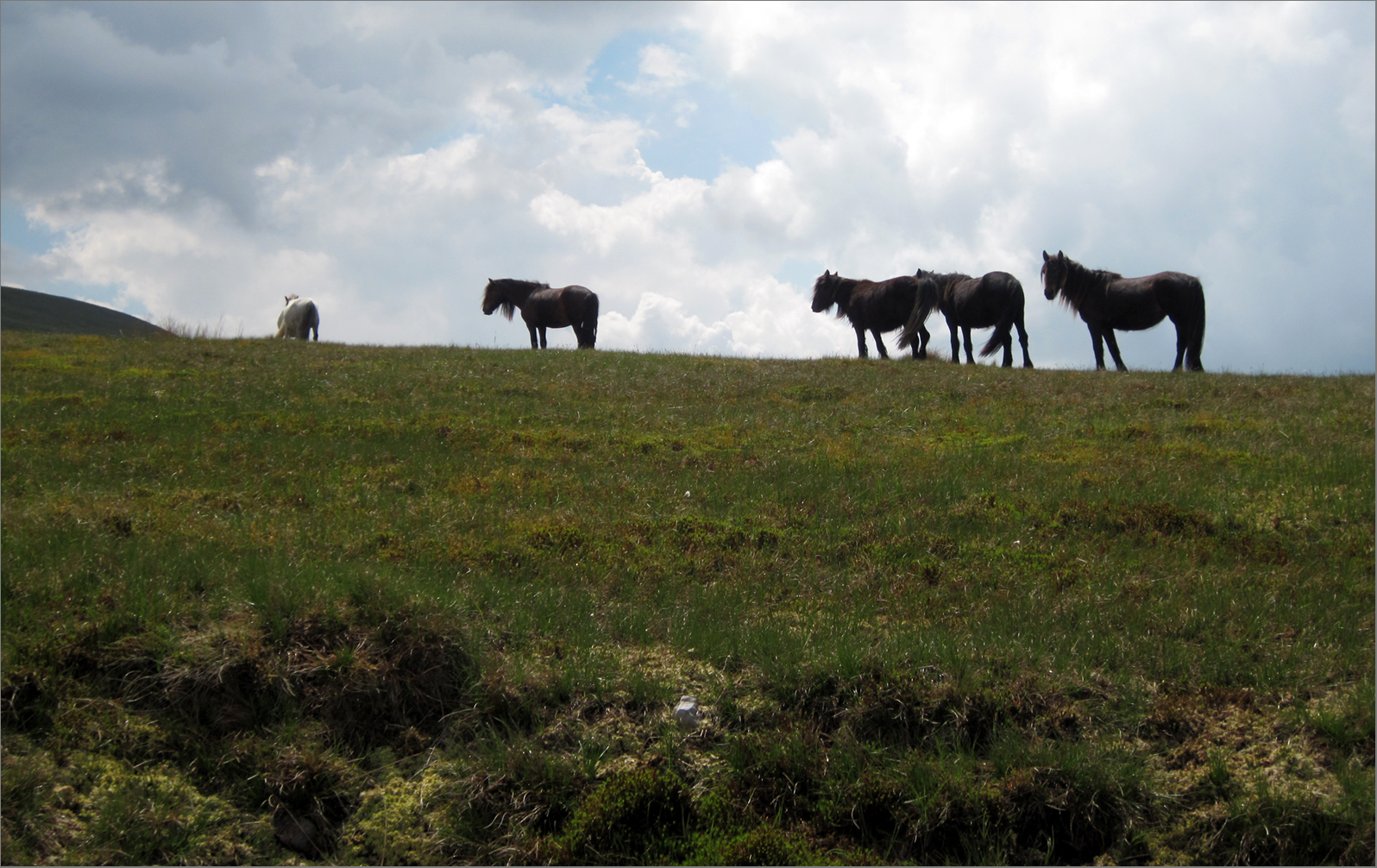
When the world opened again after lockdown, my steadfast companion was the view out my home office window of a fell in Cumbria. Fell ponies often arranged themselves along the ridge of the commons above grazing sheep, backlit by low winter sun. I would gaze at their silhouettes when I needed a break from my computer screen. Former colleagues at brick-and-mortar universities in the US and UK began heading back to campus as COVID restrictions were lifted. I’d taken a job at the OU working from home during the pandemic, and I’d moved five hours north in search of an affordable house with a garden. My ‘new’ office was in a converted bedroom. I couldn’t go to campus or meet colleagues face-to-face for several months after lockdown eased, so I dug in and reconciled myself to living and working in what I came to think of as my ‘fast-moving cloud,’ the western slope of the Howgills.

Fell ponies

Working at the OU has transformed my life as an academic. Moving into a home-based role that is part operational, part distance learning, and part research has provided time for reflection. Most days after lunch, I walk a different lane or track or public footpath in my tiny village where sheep outnumber humans, and I think about things. I live on the edge of the Lake District, countryside that writers Dorothy and William Wordsworth and their friend Samuel Taylor Coleridge would have found familiar. At first, the reality of experiencing the romantic notion of the ‘sublime’ was quite a shock, and it took months to connect with the land in a way other than fear (of high winds, low clouds, and gusting rain) or dread (of same). With time, though, I settled in and got on with work and with writing and connecting with local writers and artists, which has made everything better, especially the low-lying clouds.

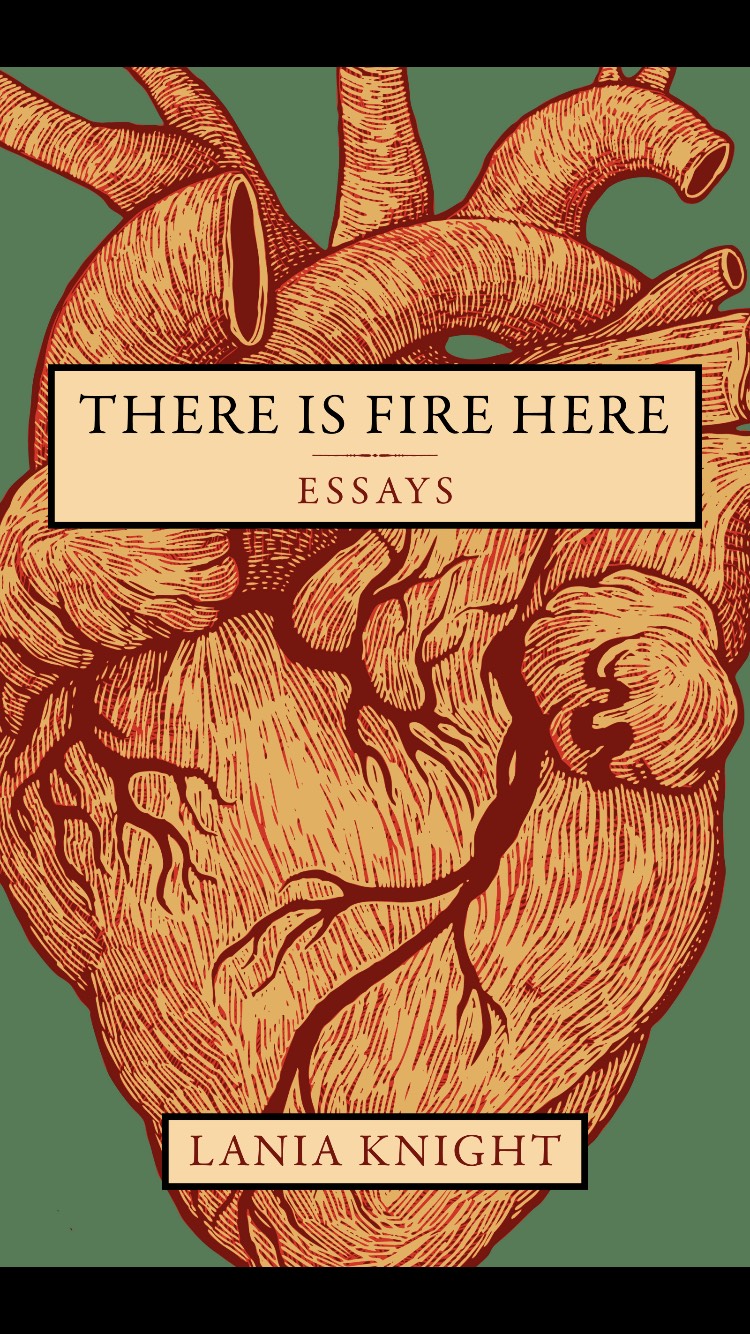
Like other writers who have lived in isolated landscapes, I’ve found this time fruitful. A collection of personal essays There is Fire Here was published in September by a small UK publisher, Signal 8 Press. I have long been a fan of the ‘fourth genre,’ and There Is Fire Here has been a satisfying opportunity to bring together fifteen essays spanning the day I dropped out of high school in Texas and left home on the back of a motorbike at sixteen, to my move across the Atlantic to the UK, where I learned how to write poetry.

Some of the joys of being a writer and an academic are the connections between your research, your teaching, your colleagues, and public outreach. My work in creative nonfiction includes my own writing, my teaching, and public engagement—a circle which is finely balanced within my role at the OU.

While I was working on finalising the manuscript for There Is Fire Here, I was asked to serve on the panel that would be revising the third-year Arts & Humanities module, A363 Advanced Creative Writing. I proposed that we expand the teaching on life writing.

Emma Claire Sweeney, the discipline’s Media Lead and a fellow course author, asked if I might like to interview Kit de Waal for the Milton Keynes Literary Festival. De Waal’s debut memoir Without Warning and Only Sometimes had recently been released and the festival needed someone to interview her. It was a dream role. I was sent all her previous books to read, which included several novels and an anthology she edited, Common People. I set those on my bedside table and devoured them.

Kit de Waal

During my conversation with de Waal at Milton Keynes Lit Fest, I confessed in front of the festival audience that I had cried on the train finishing one of de Waal’s novels, My Name Is Leon. In the same way that she had wowed me with her stories, Kit wowed the crowd, made them laugh and cry, held them enthralled for the entire hour. An OU camera team were there to record it all.

Soon, clips from that conversation with Kit de Waal will be part of the next iteration of A363 Advanced Creative Writing, a culmination of research, teaching and public engagement woven through bespoke teaching materials for the OU. I’ve sent Kit a copy of my book, and fingers crossed, she’ll be attending my online book launch on Wednesday 8th November, when I’ll be in conversation with brilliant UK writer, Zoe Lambert.

Tickets are free and it will be a relaxed evening. I’ll be joining from Cumbria, in a comfy spot by the woodstove. Grab your favourite drink, settle in somewhere cozy and join us.

Lania Knight

Lania Knight holds a BSc in Plant Science and Environmental Conservation from the University of New Hampshire, and an MA and PhD in English Literature and Creative Writing from the University of Missouri. She is the author of four books, including two novels, Three Cubic Feet, shortlisted for the Lambda Literary Award in Debut Fiction, and Remnant, a dystopian novel set in the American Midwest, as well as a poetry pamphlet Single-Track B-Road, and a collection of personal essays There Is Fire Here.

From creative practice PhD to academic book publication: a eureka moment!

The previous post in our series on the PhD journey and beyond explored the nature of research in Creative Writing. Following up on this, recent PhD graduate, Shanta Everington, shares her experience of adapting her practice-based PhD research for publication.

Much has been written about turning the traditional academic thesis into a monograph. As a researcher undertaking a practice-based PhD, my journey to book publication was a little different. A PhD in Creative Writing typically comprises two connected components – a book length piece of creative writing (in my case, experimental life writing) and an accompanying critical commentary exploring the process of producing the creative writing.

Many Creative Writing PhD students write novels or poetry collections which are then published by mainstream or independent publishers on completion. As a previously published novelist, I initially planned for my life writing to be published as a stand-alone creative non-fiction book, and the content of the critical commentary to find its way to an audience via peer-reviewed journal articles and conference papers.

Contemporary explorations of motherhood have primarily focused on the biological mother raising the child she gave birth to. My research project, ‘Other Mothers’, aimed to give voice to women who become mothers through the alternative routes of adoption, surrogacy and egg donation, and their silent partners – the birth mothers, surrogate mothers and egg donors – who make motherhood possible for them.

I interviewed six women, drawing on a range of interdisciplinary approaches, and created a body of experimental life writing, which aims to expand our understanding of what it means to be a mother.

The research presents the stories of a mother via egg donation and adoption; an egg donor; someone who became a mother through surrogacy in India; a surrogate mother; an adoptive mother of two who was herself adopted as a baby; a birth mother in her seventies who gave her baby up for adoption fifty years ago. My own personal experience of pregnancy loss and adoption offers a seventh voice.

At the end of the PhD, I approached a few literary agents who handled creative non-fiction. Although I received a few encouraging rejections, I wasn’t hitting the mark for the mass-market route. Then I had my eureka moment!

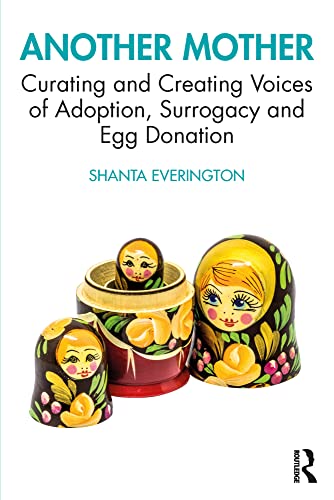
Another Mother: Curating and Creating Voices of Adoption, Surrogacy and Egg Donation

Through creative practice as research, I developed an experimental approach to writing lives – a hybrid form of curated material (edited interview and quotation collage) and created material (poetry, reimagined scenes and lyric essay), a literary tapestry building on Jo Parnell’s idea of the literary docu-memoir. There is a duality to the research’s original contribution to knowledge which lies in both its expansion and analysis of life writing techniques. Both components – the experimental life writing AND the critical meta-narrative analysing the artistic, ethical, personal and political considerations involved in transforming life into literature – are of equal significance and belong together. After a rethink, I decided to pitch a book consisting of both parts. In some ways, this might limit my readership – for example, women considering adoption, surrogacy and egg donation might be interested in a book of women’s stories but perhaps not so interested in critical analysis of form. Yet in other ways, it expanded the book’s potential readership, to anyone interested in motherhood, gender and women’s studies, life writing studies, the sociology of reproduction, creative non-fiction writing approaches, oral history and ethnography studies.

It seemed that an academic publisher would be my best bet for these audiences. Pitching to an academic publisher was quite unlike my previous experience submitting to literary agents, the gatekeepers of commercial publishing. Although I didn’t need an agent, there was a new set of gatekeepers to get past – the peer reviewers.

My external viva examiners helped me frame my writing as a form of autoethnography, connecting my own personal experience of motherhood and the experience of other mothers to wider cultural, political and social understandings. After looking at a range of academic publisher lists, I found a commissioning editor of an ethnographical series who I thought might be interested in work spanning both literature and social sciences.

Emily Briggs at Routledge expressed interest and helped me rework my proposal. At this stage, I still planned for the book to be published in its original structure: creative writing first and critical commentary second. Emily sent me a similar creative-critical title that she’d commissioned, Situated Writing as Theory and Method: The Untimely Academic Novella by Mona Livholts, which presented the theoretical framework before the novella; Emily and I agreed a similar structure for my book, switching the original order.

Peer review flagged up problems with connotations of ‘other’ in research title ‘Other Mothers’, and so, ‘Another Mother’ was chosen to represent the triangular nature of motherhood via adoption, surrogacy and egg donation. I took on board suggestions for beefing up existing content and adding additional material, mainly in the areas of politics and power, as well as gender identity issues dissecting with motherhood.

As a creative writer responding to feedback from sociologists, I had to remain clear on my research aims and parameters. Brochner and Ellis (2016) set out two forms of autoethnography: analytic and evocative – the former developing theoretical explanations of phenomena and the latter offering a narrative presentation that opens up conversations and evokes emotion. My work was firmly the latter, raising questions to which there are no easy answers, offering a discursive site on motherhood. The book presents a collage of voices and forms, offering stories which are open to multiple readings and interpretations.


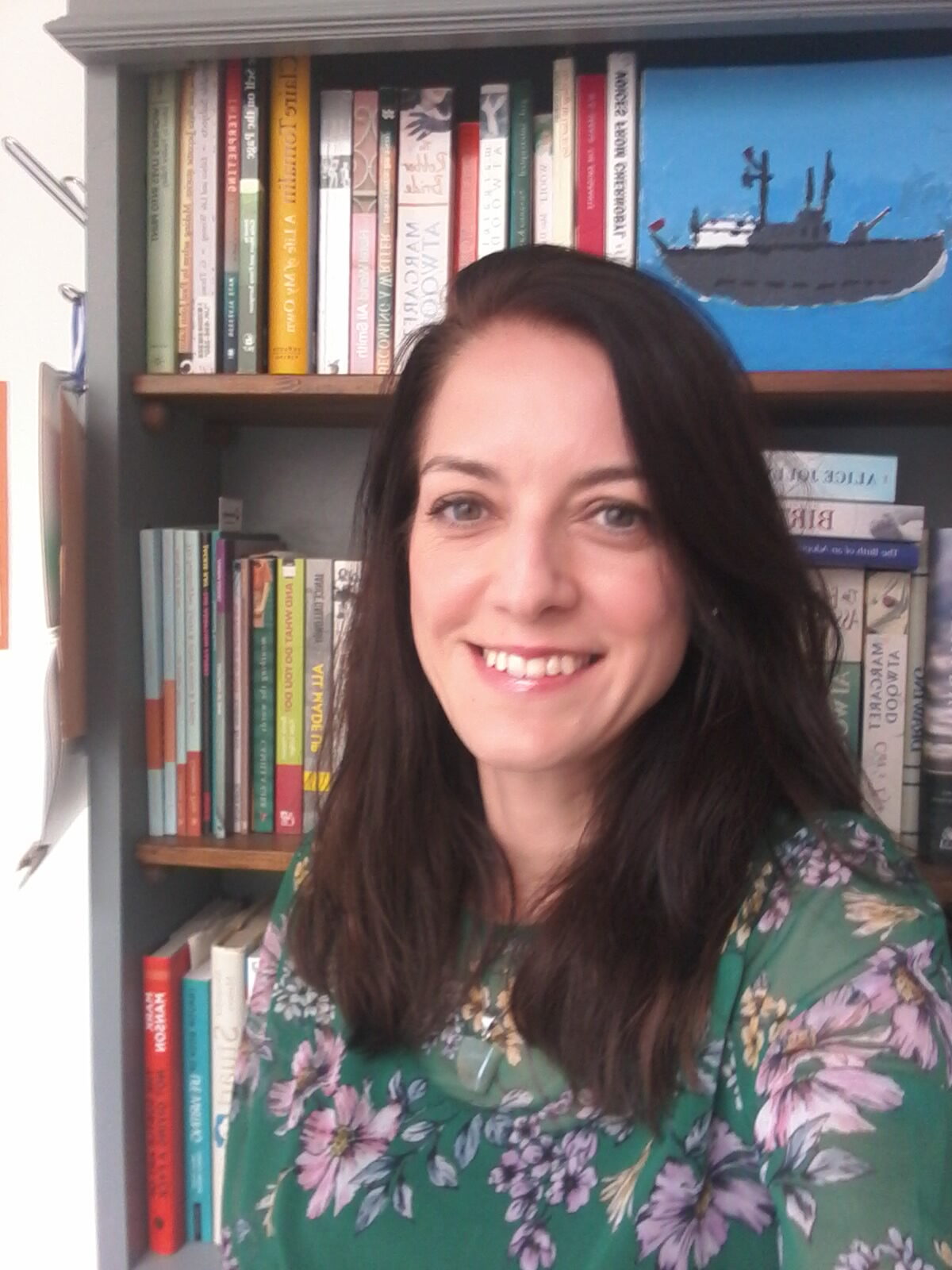
Shanta Everington

Dr Shanta Everington is Associate Lecturer at The Open University, where she gained her PhD in Creative Writing. A creative and critical writer working across a range of forms, much of Shanta’s writing explores recurring themes of difference, identity and belonging. Previous books include novel Marilyn and Me (2007), narrated by a young woman with a learning disability, and young adult dystopian novel XY (2014), exploring gender identity. A consultant for the Royal Literary Fund, working as a Writing Fellow and a Reading Round Lector, Shanta is also a member of the National Association of Writers in Education (NAWE).

Another Mother: Curating and creating voices of adoption, surrogacy and egg Donation was published by Routledge on 8th June 2023.

From PhD Thesis to Monograph: Tips for Editing Your First Book

Heather Hind is a Lecturer in English Literature with research interests in Victorian literature and material culture. She is currently turning her PhD thesis into a monograph. In this post, the second in our series on the PhD and beyond, she shares her hints and tips for getting started with this process.

Motivation

Steppingstones across the River Aire, Gargrave” by Tim Green aka atoach is licensed under CC BY 2.0.

Why do you want to publish a book? And how, in broad terms, do you want to go about it? These questions are worth asking yourself early on. Perhaps you see a monograph as a steppingstone in an academic career. Or maybe you want to disseminate your research to a wider audience. Or publication might be a personal goal. Quite likely, your reasoning is a combination of all of these and more.

There are alternatives to the book route, such as publishing your research via academic journals or public-facing media outlets. In any case, practical life matters need to be factored in too. The post-PhD period can be tricky in terms of employment, access to resources and mentoring, and time.Even if you plan to lightly edit your thesis, the timeline from writing your proposal through to seeing your book being published can be surprisingly lengthy – not to mention busy and uncertain.

My best advice is to keep in mind a clear sense of your motivation for publishing your book, and to create a realistic editing schedule. For me, that has meant being more ambitious than I initially intended with my revisions (because my motivation is academic impact) and assigning plenty of time to do them (acknowledging that I have other demands on my time).

Proposal

The next step, after deciding to publish your book, is to get a proposal and sample chapters in order. I’d highly recommend checking out Laura Portwood-Stacer’s Manuscript Works Archive. Laura is the author of The Book Proposal Book and her website contains guidelines, templates, prompts and all kinds of proposal-writing information.

The broad questions I found useful to think about while writing my proposal, and working out the new shape and emphasis of my monograph, were:

  1. What new perspective/s will my book offer?
  2. What ideas does it connect, or what story does it tell?
  3. How might it inform and influence my field and discipline?

Initial edit

First, remove any thesis-y phrasing and heavy-handed signposting, such as ‘In this thesis…’. Next, revise or cull your footnotes and any extraneous references. One of my PhD supervisors advised me to ‘wear my learning heavily’ in the thesis or, in other words, include plenty of references to show the full breadth and depth of my reading and research. While your monograph should be detailed and well-researched, it doesn’t want quite the same ‘heaviness’ as a thesis. During this initial edit, pay extra attention to the clarity of your writing and flow of your argument. As with your footnotes and references, consider cutting any tangential sentences or paragraphs. It’s a good idea to make space for new material before it’s written, rather than adding and adding to an increasingly baggy monster of a manuscript.

Content and structure

Hot Air Balloon Inflating” by ajagendorf25 is licensed under CC BY-NC 2.0.

Next, you might rethink your monograph’s overall content and structure. Your examiners’ reports can be very useful here! You may well plan to cut as well as add material, though identifying areas to expand—whether to include unused thesis research or new post-PhD developments—can make for a major selling point in a book proposal. I have heard that some publishers want to see an entirely new chapter for the monograph, though another approach (which I’ve adopted) is to add sections of new material to your existing chapters.

You might also consider restructuring your chapters so that they make more sense (or are more marketable) as a book. For example: would splitting your chapters up into shorter ones help to guide your reader through the material with more ease? Is there a current or emerging topic that you might engage with in a new chapter or sub-section? Can you retitle your chapters (or overall book) to appeal to a wider audience?

With these points in mind, I found it helpful to reread some monographs that I admire to reflect on what works well, especially in terms of structuring the introduction and conclusion.

Academic writing guides

These can also be sources of inspiration. Helen Sword’s books on academic writing are excellent and she also has some free writing tools and videos. Here are two more resources I’ve found helpful for writing and editing:

The Thesis Whisperer – This site is useful for thesis writing pointers as well as general academic writing tips.

Publish Not Perish / Jenn McClearen – A newsletter with a back catalogue of posts that includes tips on all aspects of academic writing.

Valuable tips

Picking up on my earlier point about recognising the pressures of the post-PhD period, here’s the advice I’ve found most helpful.

  • Carve out writing and editing time
Mechanical Clock 9 – by Eric Freitas” by Kotomi_ is licensed under CC BY-NC 2.0.

I have found online writing retreats vital to gaining momentum with my editing because they force me to sit down, focus, and work in regular blocks. I even volunteered to run a series of them to squeeze more into my calendar. Even if you don’t join a writing group, you could try marking out blocks of writing and editing time in your calendar as well as planned deadlines for chapters or sub-chapters (which work even better if you tell someone about them for accountability!).

  • Look into post-PhD funding and other kinds of support

While there are major postdoctoral funders that provide longer-term fellowships (e.g. Leverhulme, British Academy), these almost exclusively require you to start work on a new project. However, your period or discipline may have societies or associations that provide small pots of research funding to early career academics for developing existing projects or publications (e.g. the Royal Historical Society). Some will cover expenses for research trips (ideal if needed for expanding your monograph), while others may fund proposal writing or even monograph editing. Some have early career memberships and fellowships that provide other benefits to recent PhD graduates, such as academic affiliation, library access, or networking and mentoring opportunities.

  • Keep connected to others

I’ve found academic and peer networks in the form of writing groups, societies, conferences, and PhD/Early Career Researcher friends even more important in the post PhD-period. Whether it’s through presenting and getting feedback on your research, swapping proposals or chapter drafts with someone, or just venting about how it’s all going, don’t underestimate the value of sharing your work-in-progress with others.

Heather Hind

Heather Hind’s monograph will be the first book-length study of Victorian hairwork – the crafting of decorative objects from human hair – and its presence in British literature of the period, with chapters that focus on works by Charlotte and Emily Brontë, Wilkie Collins, and Margaret Oliphant. Her broader interests are in nineteenth-century literature, material culture, textiles and handicrafts, and object-led and embodied methodologies.


The Ins and Outs of Archival Research

Part-time postgraduate researcher, Antonia Saunders, kicks off our series on the PhD journey and beyond with her reflections on a recent trip to Oxford’s Bodleian Libraries. As Antonia reveals, her visit not only furthered her research into how 19th-century historians and novelists constructed an idea of Jewishness, it also offered broader and more unexpected rewards.

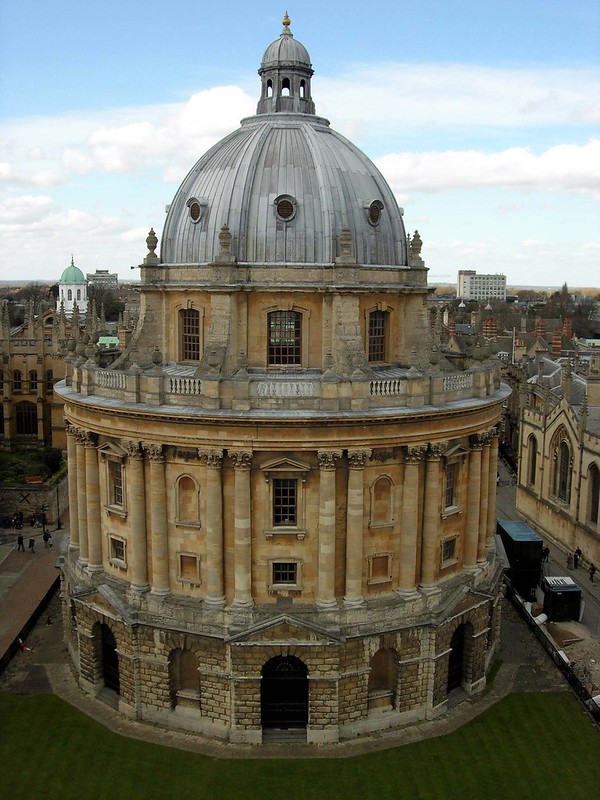
The Bodleian Library” by malias is licensed under CC BY 2.0.

As a part-time PhD student with a full-time job in corporate banking, I sometimes feel as if I am snatching snippets of time to follow my aspirations of becoming a full-time academic.

So, when my supervisors suggested that I use some of my Support Grant to facilitate a three-day research trip to the Bodleian Libraries, I got onto it straight away. The prospect was overwhelmingly appealing: access to materials relating to my research on Maria Edgeworth, Benjamin Disraeli, and George Eliot; accommodation in college rooms; an uninterrupted period to focus on my research.

I needed to apply for a Bodleian Reader card ahead of my visit, and my supervisor very kindly supplied me with a letter of introduction. I could order materials for my visit up to five days before. My list of archival materials has over forty items, and you can only order up to ten items at a time. So, I selected what I thought might be the most relevant ones to look at on my first visit.

These included handwritten manuscripts and typed proofs of Disraeli’s novels, and one of George Eliot’s notebooks from 1861, and two for 1868 when she first conceived the idea of her long poem The Spanish Gypsy. I also wanted to consult Gordon S. Haight’s seven volumes of George Eliot’s letters in the Old Bodleian Library as these have not, as yet, been digitized.

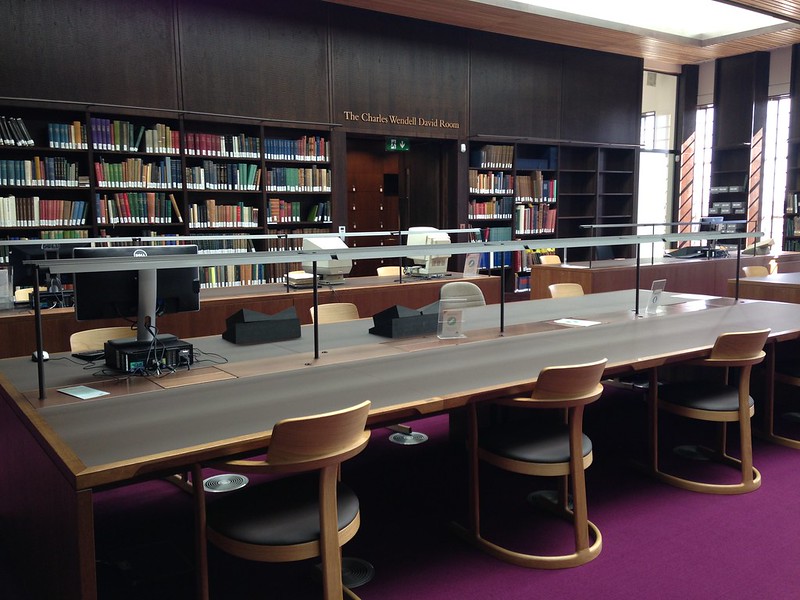
The Weston Library, Oxford University. Opening Weekend tour (March, 2015)” by alisonjpope is licensed under CC BY 2.0.

I spent most of my visit in the Weston Library with the resources I had ordered. The ability to search through Disraeli’s papers and George Eliot’s notebook was thrilling. At first, I found Disraeli’s handwriting illegible – horizontal lines in brown ink with occasional bumps and tails. I had a sinking feeling that I wouldn’t be able to make out anything. But I tried comparing his handwriting to his novels on Project Gutenberg, and – slowly, very slowly – I began to be able to decipher his handwriting, and to note some changes between the manuscript and the finished novels.

George Eliot’s handwriting in her notebooks was meticulously neat, but she had written some pages in Latin, German, and Italian, so I copied down some passages with names and words I recognised to translate later on. I also spent some time in the Old Bodleian Library reading through Haight’s volumes of George Eliot’s letters.

I didn’t get through all of the material I ordered for my visit. Now that I know what is held there, I am planning my next trips with a more focused approach to specific materials – perhaps visiting for one day at a time,

I do, however, highly recommend staying overnight in college rooms. I booked into St. Stephen’s House, a theological college, about a twenty-minute walk from the centre of Oxford. The students were welcoming, and I had some very interesting conversations over breakfast. One of the students had a diamond pin on his lapel with the figures 1897. I asked him of the significance of the year, and he told me it was from the diamond jubilee of Queen Victoria and that he collects Victorian merchandise from the golden and diamond jubilees. I also spoke to a visitor who is an Egyptologist translating a ceremonial text held at the Ashmolean Museum.

I completed both my BA and my MA at the Open University, and I am passionate about the egalitarian principles the university is founded on, especially because of the opportunities it has afforded me. However, the chance to sit down and meet other students in a relaxed atmosphere, and to talk about interests beyond my own research, gave me a feel of what it might have been like had I attended university in my youth.

The benefits reaped during my visit went beyond the academic. I also experienced a boost to my mental health. I found it invaluable to clear space in my schedule to focus on my research, to be able to think a thought through without being interrupted by pressures of work or home life, and to be surrounded by such a wealth of learning and knowledge.

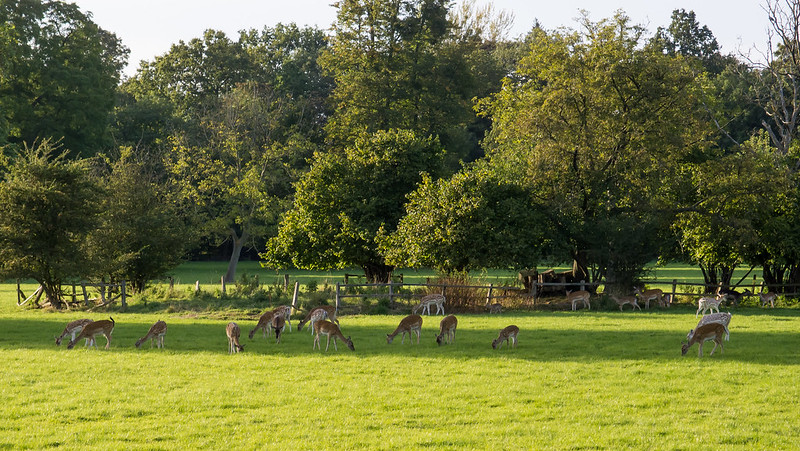
Magdalen College, Oxford” by interbeat is licensed under CC BY 2.0.

One of my supervisors, who lives in Oxford, met me for a walk on two of the days. She gave me a tour of Magdalen College, including a walk around the deer park and through a field of snake’s head fritillaries. She also took me to her own alma mater, New College, where we heard the choristers practising.

I started my research in 2020 during lockdown, and I think I have inadvertently adopted sedentary habits – always a potential risk for bibliophiles. But it felt so good to be out and about, walking in the fresh air. It made me reflect on my use of time and to commit to getting outside each day, rain or shine, to clear my mind.

Antonia Saunders

Antonia Saunders studied for both her BA and MA at The Open University. Her primary interest is in the novel in all its forms with a particular concentration on the nineteenth and early twentieth century. She began her part-time PhD at the OU in October 2020. Her thesis, The construction of a Jewish Identity in histories and novels of the nineteenth century, considers the literary and historiographical contexts of representations of Jewish people and Jewish Identity.

Cursed art, ekphrastic poetry and Prague

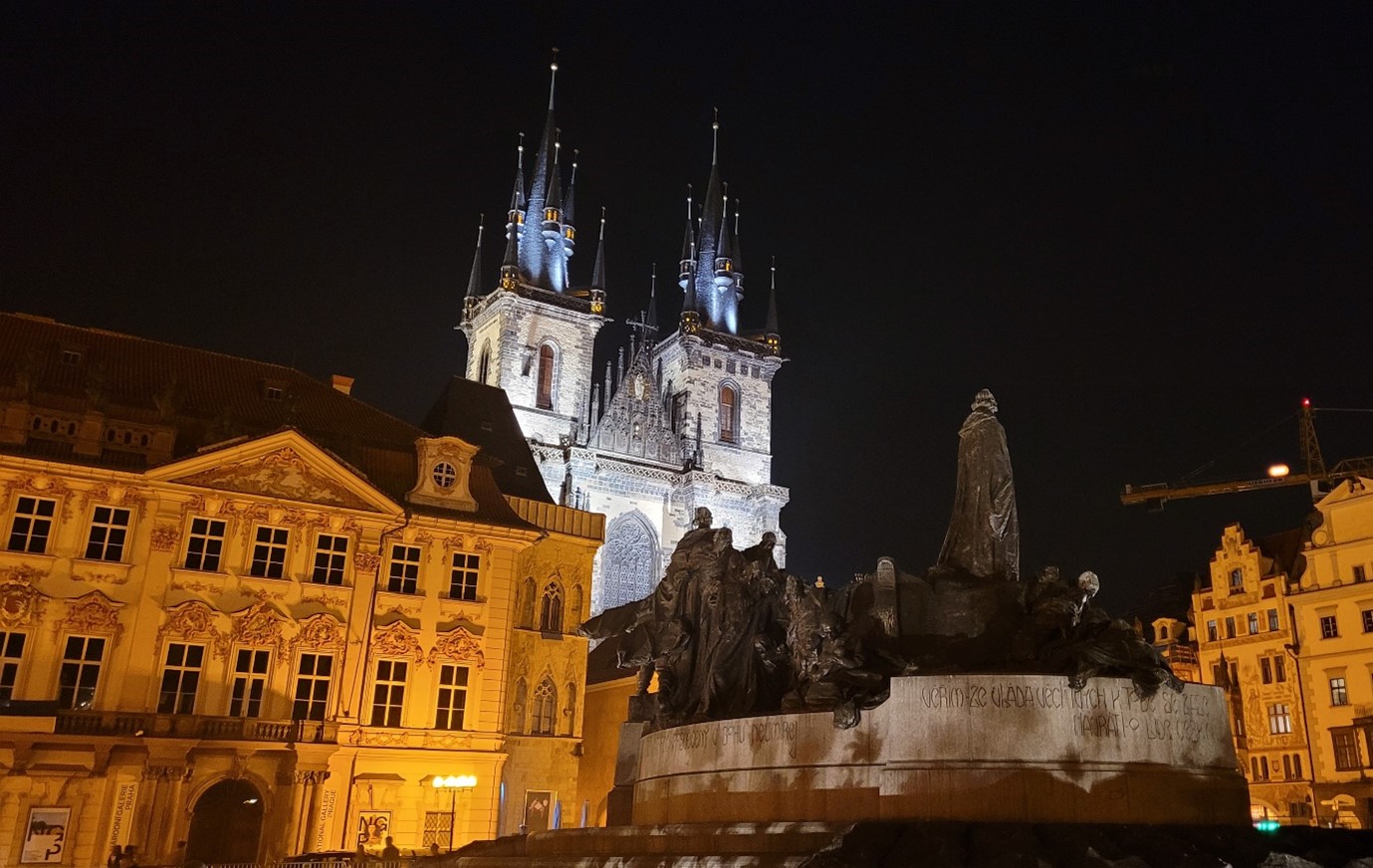
Staff Tutor and Associate Lecturer, Jennie Owen, travelled to Prague to present at a conference on the theme of Global Horror. The conference was run by Progressive Connexions, an organisation that supports sustainable global interdisciplinary research, and promotes collegiate exchange of ideas, experiences, and points of view.

Prague

This emphasis on curiosity, open-mindedness, and collaboration is also at the heart of our Contemporary Cultures of Writing conference on 20th April, which Jennie is organising. You can book here for tickets to this London-based one-day conference: Writing place: what haunts the landscape of modern Britain?

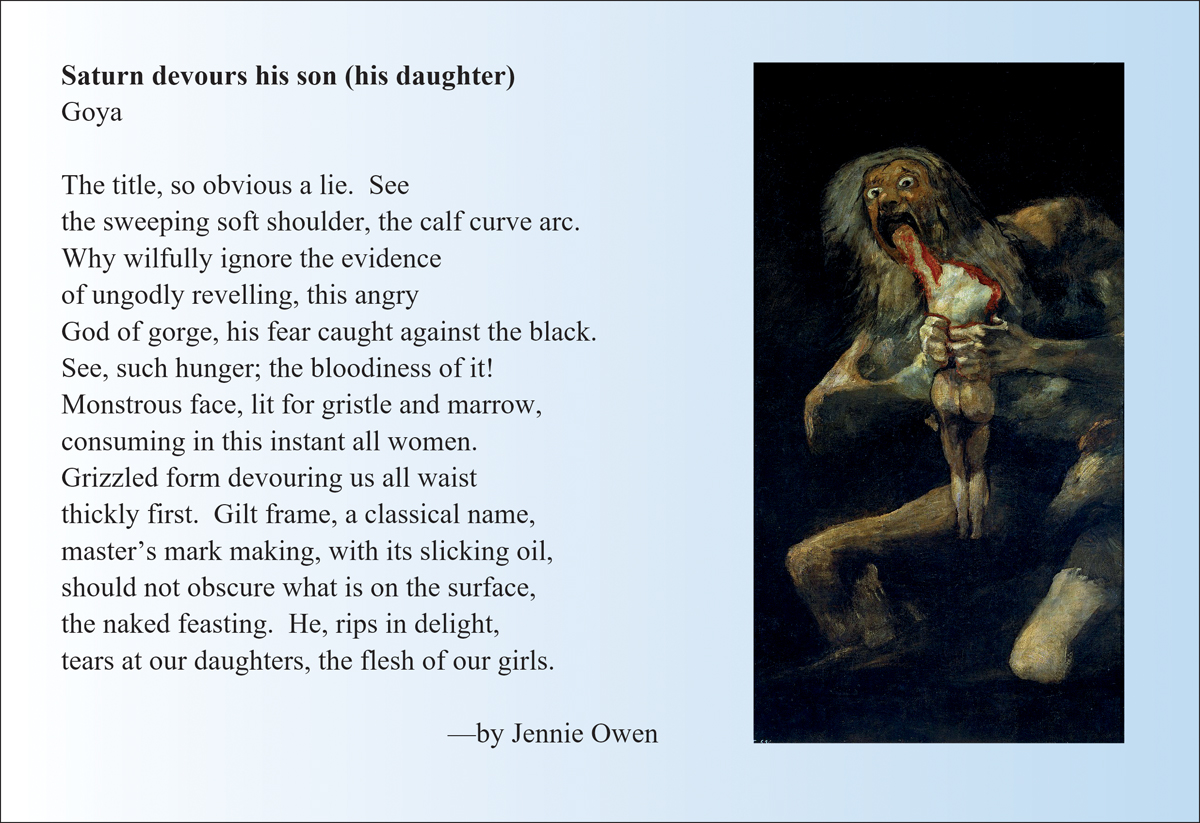
Today, Jennie offers us a glimpse into the kinds of urban legends that inspired her paper, ‘Cursed Poetry: An Exploration of Ekphrastic Poetry Inspired by Cursed Art’.

At the Darkness at the Edges conference, delegates spoke on varied topics, from the gothic and dystopic in Indigenous fictions to fairy tale motives in German post-war literature.

I’ve long had an interest in horror, as well as the gothic and dystopian. My particular fascination with cursed paintings began as a distraction from the more challenging sociological aspects of my PhD research into traumascapes in the northwest of England.

The notion of the modern-day curse is often propagated through social media, and I was fascinated by how these urban legends become fragmented as they are retold online on websites and community forums.

But the idea of the curse is not a new one. We can trace its path through ancient history: it’s discussed in the Bible, linked inextricably to our perceptions of ancient Egypt, and a common inciting incident in the fairy-tale narrative. In common folklore, a portrait that falls to the ground may foretell the death of a loved one; whilst anyone who was a fan of the cartoon Scooby Doo will be aware of the risk of the eyes in a portrait following you around the room.

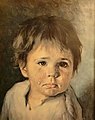
The Crying Boy by Giovanni Bragolin. This image is in the public domain.

One of the most famous cursed paintings in the UK is The Crying Boy by Giovanni Bragolin (1911-1981) – an image of a smudge-faced toddler looking sadly out at the viewer, tears running down his face.

In 1985, the Sun issued a warning that around 50 houses in Yorkshire had burned to the ground, leaving only this painting intact. This created a mild panic, reflected in a series of subsequent articles with headlines such as ‘Crying Flame’ and ‘Crying boy curse strikes again’. Such was the panic that on Halloween the Sun burned dozens of these paintings, which had been sent to their offices, and quoted a fire officer who stated: ‘I think there will be many people who can breathe a little easier now’.

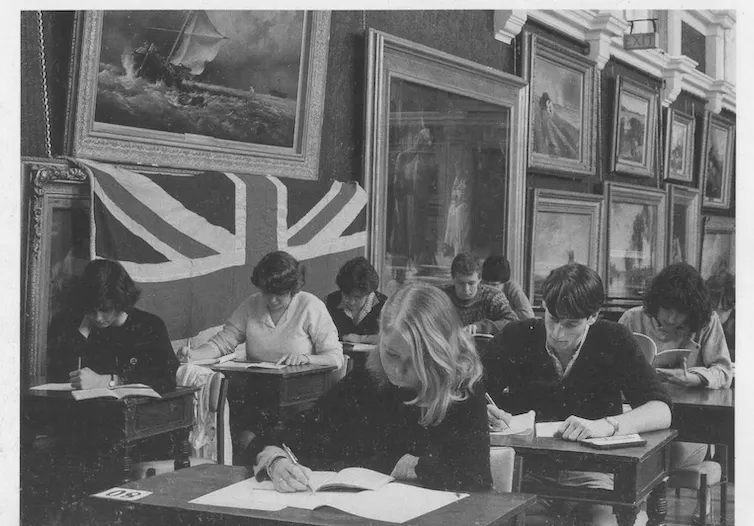
The covered painting during an exam in 1984. ©Royal Holloway, University of London

There is a rich vein of allegedly cursed artworks. Man Proposes, God Disposes by Sir Edwin Landseer (1802-1873), which hangs in Royal Holloway University, has to be covered with a Union Jack during exam season to allay students’ fears that they might fail or lose their minds if they spend too long staring at the painting. Indeed, its subject matter is rather gruesome: two polar bears fighting over the remains of the 1845 Franklin expedition. This infamous expedition was designed to locate the northwest passage in the Artic, and resulted in the loss of two ships and all men aboard (and rumours of cannibalism).

There are dozens of mysterious contemporary pieces too: having once seen it, for instance, who can forget the Momo Whatsapp curse, which featured a distorted wide-eyed sculpture by Japanese artist Keisuke Aiso?

Using close examination of supposedly cursed art in the public domain, I used an ekphrastic methodology to create a series of poems.

The Poetry Foundation defines an ekphrastic poem as ‘a vivid description of a scene or, more commonly, a work of art. Through the imaginative act of narrating and reflecting on the “action” of a painting or sculpture, the poet may amplify and expand its meaning.’ It is hardly a new form of poetry – just think of Percy Bysshe Shelley’s ‘On the Medusa of Leonardo Da Vinci in the Florentine Gallery’ or ‘Ode on a Grecian Urn’, by John Keats. But ekphrastic poetry does appear currently to be celebrating a kind of renaissance in popularity.

With international colleagues from a wide variety of disciplines, I shared my practice-based research by discussing my own creative process of using art as a means of inspiration for poetry. I explored how this approach has had an impact on both the form and content of my writing, as well as how the writing of these pieces both celebrates and challenges the concept of cursed art.

My presentation was received, I hope, without any undue residue of curses.


Jennie Owen

Jennie E. Owen’s cursed poems will be featuring in an anthology pamphlet published by Nine Pens Press later in 2023. Jennie has worked as an Associate Lecturer here at the OU for nearly 20 years. She is now also a Staff Tutor in Creative Writing, and lead Cluster Manager for A363, our level three undergraduate creative writing module. Jennie is working towards her PhD with Manchester Metropolitan University. She is a Forward– and Pushcart-prize nominated poet and writer of short stories, whose work has been widely published in anthologies, journals and magazines. 

Judging Milton Keynes LitFest’s Writing Competition

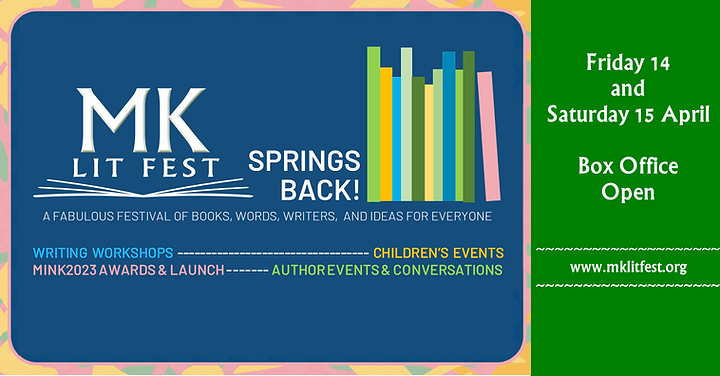
Open University PhD graduand, Patrick Wright, and current PhD student, Gwyneth Jones, acted as judges for Milton Keynes LitFest’s  MinK2023 Writing Competition. All the shortlisted entries will be published in an anthology, and the winners will be announced at the Anthology Launch at Milton Keynes Library on 15th April 2023.

To mark the announcement of the shortlisted entries, we caught up with Gwyneth Jones, who judged the flash-fiction categories and is a prize-winning author of flash herself.

MK LitFest Springs back launch banner

What is flash fiction and how did you first discover it?

Flash fiction, in a nutshell, is a very short story. Exactly how short is debateable but certainly less than 1000 words, perhaps as few as 200, and it should feel absolutely complete in itself. Flash can be any genre it chooses. It can dress up, dress down, dress to impress, or go commando. It’s a delinquent midget-gem that resists pigeonholing.

Very short fiction has been around for ever – just think of Aesop’s Fables. But flash fiction really began to gain traction as a genre in the late 1980s. Today it has a wide international fanbase and is published in literary magazines, anthologies, single-author collections, and also, of course, online. The immediacy and connectivity of the internet has proved an excellent forum for these punchy bite-sized fictions.

It was on the internet that I stumbled across flash fiction competitions. Entering gave me a way of finding out if my writing was any good – which it wasn’t at first – but I learned by reading the entries that were better than mine, the ones scooping prizes. After a while, I got hooked, got listed, got published.

As a writer, what attracts you to the form?

The chance to experiment in a way that might not be sustainable in long-form fiction. Flash can be very disruptive, disregarding ‘rules’ about writing, such as having a beginning, middle, and end. Scrap that! Flash hardly gets past the beginning. Flash is always close to the end. You might start in the middle, in media res, or you could squeeze that out altogether and trust the reader to fill in the gaps. Another rule: ‘create original characters’. Or you could use archetypes to save thousands of words. Take Goldilocks: your reader already knows she’s an adventurous, entitled, blonde who’s very, very picky. With only a few hundred words so much is possible; you could write about a nanosecond, a lifetime, or an eon. You could write from an unusual point of view, or in the negative, or in a Fibonacci sequence. Flash can handle some serious subjects, but the form is very playful.

You have won the Wild Words competition and been long/shortlisted for the Bridport, Bath Flash Fiction, Reflex Flash, and the Quiet Man Dave prizes, and now you have judged MK Litfest’s flash fiction competitions. From your experience on both sides of the process, what would you say makes for a prize-winning flash?

A title that works hard – something that interacts with the text; pin-sharp specificity, nothing anodyne, clichéd, or generalised; careful attention to the sound of the words because flash is great for reading aloud; and, of course, absolute economy – not one single wasted word, no lazy word choice. As with all great fiction regardless of size, voice is important. Voice is the thing that snags the reader from the start. It’s in the vocabulary, the syntax, the imagery, and the things left unsaid.

After that, the elusive prize-winning quality is something that’s hard to describe – but you know it when you read it – and you want to go back and read it again, and again. Roland Barthes called it the punctum. He was talking about photographs, but I think it translates. It’s some unexpected detail or moment, some splinter beyond the ordinary subject that pierces you and isn’t easily forgotten. Julio Cortázar talks about this power as a story ‘rupturing its own limits’, spilling out and illuminating something beyond the page. The best flash fictions do this; they remain with you like an earworm or a bruise.

Tell us a bit about some of the flashes shortlisted for MK Litfest.

The theme was ‘Green Spaces in the City’ and there was a lot of inventiveness in the shortlist with some writers speculating on the future and about how our relationship with the natural world might develop. One that made me laugh out loud, was written as an email to mankind, warning of an imminent plant-life revolution. There were also some finely penned observations of present-day concerns including one about a woman with a young child searching for a new home and measuring spaces both urban and green with the span of her hands. My personal favourite came from the younger age category (14-19 years) and it was the shortest by far, just 188 words. A quirkily voiced stream of consciousness that exactly captured the crowding and leaping of thoughts, and how one thing leads to another. It had slant, and resonance, and compression; I just adored it from the very first read.

How has your study at the OU shaped you as a writer of flash fiction?

I’ve learned a lot about the craft of writing and applied that to flash fiction, but the most surprising thing is discovering that a ‘being a writer’ isn’t the solitary endeavour I first imagined. I did an MA in Creative Writing here at the OU and was lucky enough to be part of group of incredible, talented writers; we’re still in touch on a regular basis, swapping work and cheering each other on. Now, I’m doing a PhD, and the circle is smaller, but the support and the camaraderie is every bit as good. My time at the OU has spurred me to get involved and make connections out in the wider world where the flash fiction community is vibrant and welcoming with a multitude of workshops, discussion groups, and festivals. I’ve benefitted enormously from the advice and generosity of other writers, and hope to pay that forward. But still, all this sociability and joining in is learned behaviour; if I wasn’t a writer, my dream job would be lighthouse keeper.

Headshot of Jupiter Jones
Jupiter Jones

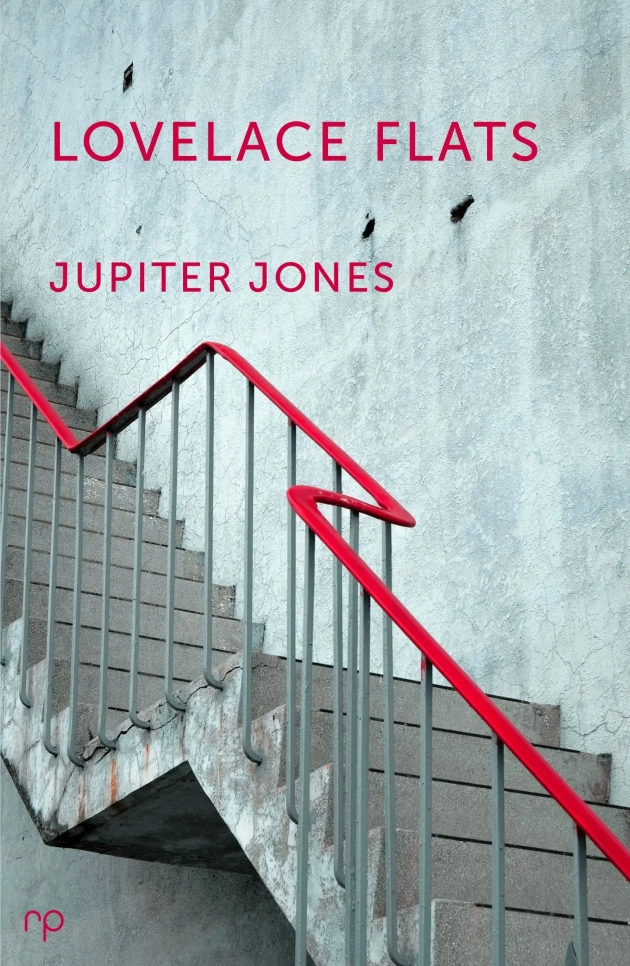
Gwyneth Jones lives in Wales and writes short and flash fictions. Under the pen name Jupiter Jones, she is the two-time winner of the Colm Tóibín International Prize, and her stories have been published by Aesthetica, Brittle Star, Fish, Scottish Arts, and Parthian. Her first novella-in-flash, The Death and Life of Mrs Parker was published by Ad Hoc Fiction, the second, Lovelace Flats by Reflex Press and the third, Gull Shit Alley and Other Roads to Hell by Ad Hoc. She is currently a PhD candidate at the OU researching form and narrative purpose in the novella-in-flash.


Adam Baldwin on helping George Griffith wing his way into modern critical consciousness

We are proud to announce that this year’ s Peter Nicholls Prize has been awarded by the Science Fiction Foundation to Adam Baldwin. Adam is a fourth-year PhD student here with us at the Open University. He completed his BA and MA at the OU too, so has been with us now for almost 20 years – testament, he says, to the addictive nature of studying here.

Adam’s PhD focuses on the once popular but now little-known novelist George Griffith, and his role in the development of early science fiction. Adam’s prize-winning essay ‘Secularizing the Destruction of Gomorrah in George Griffith’s Hellville, USA’ will appear in the Science Fiction Foundation’s summer 2023 issue (no. 145).

Today, he shares with us how this fascination began, and where it has taken him.

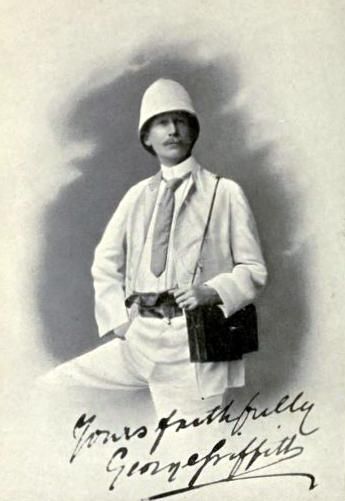
I have been working on a PhD thesis on George Griffith, a little-known science fiction and adventure writer, as well as journalist and globe-trotter, from the late-nineteenth century and into the first few years of the twentieth. Born the son of a country vicar in 1858, George Chetwynd Griffith-Jones (he changed his name by deed poll to George Chetwynd Griffith in 1894), was an immensely prolific author, writing around 44 novels across multiple genres between 1893 and his early death in 1906 at just 48, as well as a stream of innumerable short stories, poems and articles.

This image of George Griffith is in the public domain.

I came across his work around eight years ago when I picked up a modern reprint of his first novel The Angel of the Revolution (1893). I was fascinated by this story of an underground revolutionary group, led by the mysterious and mesmeric Natas, who, having exclusively obtained the knowledge of heavier-than-air flight (the novel is written some ten years before the Wright brothers finally succeeded at Kittyhawk), end a catastrophic world war and go on to impose a world-wide socialist utopia. The edition I read was edited by H. G. Wells specialist Steven McLean, and he ended his introduction with the words: ‘The Angel of the Revolution deserves to wing its way into modern critical consciousness’ (2012).

This comment was made only a couple of years before I read it, and I was interested enough in the novel to see if any work had been done on George Griffith’s work since then. The short answer appeared to be No. There is a handful of modern pieces on Griffith’s writing, but nothing substantial, and he certainly hadn’t winged his way into critical consciousness. I sought out reprints of his novels from small publishing houses and read what I could. McLean’s phrase stayed in my mind, and I decided I would take up his challenge. Luckily, the Open University agreed.

I have been drawn to Griffith’s work not because he is a great writer of extraordinary prose and delicately drawn characters, quite the opposite: Griffith writes thrilling novels, exciting page-turners, full of action, romances in the vein of H. Rider Haggard of King Solomon’s Mines (1885), She, (1886) and Allan Quatermain (1887) fame.

His great innovation was to build on the adventure romance, bringing in various other popular genres: the future-war dramas that followed in the wake of George Chesney’s The Battle of Dorking (1871); utopian writing such as Edward Bellamy’s Looking Backward (1888), William Morris’s News from Nowhere (1890) and Edward Bulwer-Lytton’s The Coming Race (1871); the apocalyptic dramas of Richard Jeffries’s After London (1885) or Mary Shelley’s The Last Man (1826); and the voyages extraordinaire novels of Jules Verne, such as Twenty-Thousand Leagues under the Sea (1869, trans. to English 1873). This combination helped to form the emerging genre of scientific romance, an early form of what is now called science fiction.

All this is set against a backdrop of what Sally Ledger and Roger Luckhurst called ‘an epoch of endings and beginnings…a time when British cultural politics were caught between two ages, the Victorian and the Modern; a time fraught with anxiety and with an exhilarating sense of possibility’ (2013).

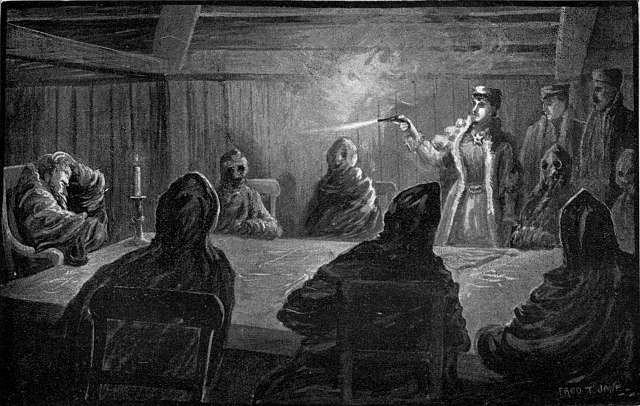
Within this new genre framework Griffith examines contemporary anxieties: the fear of invasion, the rise of socialism, the extension of suffrage, both male and female, evolution and degeneration, and the rise of the New Woman, a proto-feminist figure. Griffith’s portrayal of women is fascinating, if complex. Many of his women characters possess an unusual degree of personal agency over their lives and marriage choices for the time. In one extraordinary scene Natasha, the titular Angel of the Revolution, dispatches an unwanted suitor with a well-aimed gunshot to the head.

Natasha despatching her unwanted suitor, illustration by Fred T. Jane, 1893.                                       (This image is in the public domain).

This is no spur of the moment action by a hysterical figure, but calm, controlled, if not quite cold-blooded. The remarkable part of this is that Natasha is permitted to do this, and she does not suffer punishment within the novel for her actions.

Reading further across Griffith’s novels, I frequently found similarly strong, independent female characters. An exploration of these, and how much freedom they actually have, is central to my thesis. Closer reading of the novels shows that women were still subject to patriarchal authority, they were just lucky enough to have father’s and/or erstwhile suitors who allowed these women unusual personal agency.

This may not seem like a great victory for women’s rights, but glance through the works of H. G. Wells, H. Rider Haggard, Arthur Conan Doyle or other adventure writers of the period, and you would be hard-pressed to find a female character who was not merely decorative, or a victim in need of rescuing – often both.

My mission is to rise to Steve McLean’s challenge, slightly modified, and help George Griffith wing his way into modern critical consciousness.

Adam Baldwin is a PhD Candidate at the Open University, studying the role of Victorian writer George Griffith in the development of science fiction. Adam has studied with the OU through his BA and MA since 2004. He is a recipient of the 2023 Peter Nicholls prize for early career researchers, awarded by the Science Fiction Foundation.